
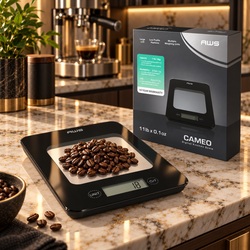
A pocket scale can be an excellent tool for sample roasting, small home-roasting batches, green-coffee evaluation, blend development, and measuring retained coffee samples. Its compact size and fine resolution make it especially useful when the amounts being weighed are too small for a typical whole-gram kitchen scale.
For most coffee-roasting applications suited to a pocket scale, a model with 500 to 1,000 grams of capacity and 0.1-gram resolution is a practical starting point. A 500 g × 0.01 g scale may be useful for small green-coffee samples and detailed blending work, while a 2,000 g × 0.1 g scale offers more flexibility for larger containers and home-roasting batches.
The right capacity and resolution depend on:
-
Your green-coffee batch size
-
The weight of the empty container
-
Whether you will weigh roasted coffee
-
The smallest difference you want to track
-
The platform size
-
The scale’s minimum useful load
-
Your roast-loss calculations
-
The stability of the weighing environment
This guide explains how to select a pocket scale for roasting coffee without buying too little capacity or more resolution than your process can realistically use.
Why Use a Pocket Scale for Coffee Roasting?
A pocket scale is not designed to support a large production cooling tray or a multi-kilogram roast batch. Its strength is measuring smaller quantities with more detail.
It can be useful for:
-
Weighing sample-roaster batches
-
Comparing green and roasted weights
-
Calculating roast weight loss
-
Measuring green-coffee blend components
-
Dividing coffee into evaluation samples
-
Measuring retained roasted samples
-
Preparing small cupping portions
-
Tracking coffee lost during sorting
-
Weighing defects or separated beans
-
Creating travel or demonstration kits
The National Institute of Standards and Technology explains grams and milligrams through its overview of SI units for mass. Keeping roast records in grams simplifies comparisons and percentage calculations.
What Does Pocket-Scale Capacity Mean?
Capacity is the maximum physical load the scale is designed to support.
A pocket scale might have a capacity of:
-
100 g
-
200 g
-
500 g
-
1,000 g
-
2,000 g
Capacity includes everything placed on the platform:
-
Green coffee
-
Roasted coffee
-
Weighing cup
-
Bowl
-
Sample tray
-
Bag
-
Scoop
-
Platform cover used as a tray
Use this formula:
Total physical load = container weight + coffee weight + other items on the platform
The coffee alone may fit within the scale’s stated capacity while the coffee and container together do not.
Tare Does Not Restore Capacity
The tare function resets the display to zero after a container is placed on the platform. It does not remove the container’s physical weight.
For example:
-
Maximum capacity: 500 g
-
Empty container: 150 g
-
Display after tare: 0.0 g
-
Remaining physical capacity: approximately 350 g
If you add 500 grams of coffee after taring, the scale will physically support approximately 650 grams and become overloaded.
This distinction matters when:
-
Using a heavy glass bowl
-
Weighing coffee in a metal container
-
Filling bags inside a holding tray
-
Combining several blend components
-
Using the scale’s cover as a weighing tray
Always calculate the complete load before selecting capacity.
How Much Capacity Do You Need?
100–200 g Capacity
A scale in this range may be suitable for:
-
Very small green-coffee samples
-
Defect sorting
-
Retained roasted samples
-
Cupping portions
-
Small blend ingredients
-
Lightweight containers
Its limitations become apparent quickly. A ceramic cup or glass container may use most of the capacity before coffee is added.
Choose this range only when:
-
The coffee portions are small
-
The weighing container is lightweight
-
You do not expect larger sample-roaster batches
-
Portability is more important than flexibility
500 g Capacity
A 500-gram pocket scale is a useful option for:
-
50-to-300-gram sample roasts
-
Small home-roasting batches
-
Green-coffee evaluation
-
Retained samples
-
Blend components
-
Small package filling
A configuration of 500 g × 0.1 g offers practical resolution for sample roasting. A 500 g × 0.01 g scale provides finer detail for small samples and blend development.
The AWS pocket scales collection includes compact options with different combinations of capacity and readability.
1,000 g Capacity
A 1,000-gram model offers more flexibility for:
-
Larger sample roasts
-
Small home-roasting batches
-
Heavier weighing containers
-
Green and roasted batch comparisons
-
Multiple blend components
This capacity can be a good middle ground when the scale still provides 0.1-gram resolution.
2,000 g Capacity
A 2,000-gram scale can accommodate:
-
Larger home-roasting batches
-
Heavier bowls
-
Small cooling containers
-
Bulk green-coffee portions
-
Finished coffee packaging
At this capacity, the model may be physically larger than a traditional pocket scale. A scale from the AWS kitchen scales category may provide a better platform for larger bowls and roasting containers.
More Than 2,000 g
If the combined container and coffee regularly exceed 2 kilograms, prioritize:
-
A larger platform
-
Higher capacity
-
A visible display
-
Durable construction
-
A stable base
A compact pocket scale is unlikely to be the best tool for this job, even if a high-capacity version is available.
What Does Resolution Mean?
Resolution is the smallest change in weight displayed by the scale.
A scale with 1-gram resolution might display:
-
199 g
-
200 g
-
201 g
A scale with 0.1-gram resolution might display:
-
199.9 g
-
200.0 g
-
200.1 g
A scale with 0.01-gram resolution might display:
-
199.99 g
-
200.00 g
-
200.01 g
Resolution determines the level of detail shown. It does not automatically establish accuracy.
Is One-Gram Resolution Enough?
One-gram resolution can be sufficient for medium and large home-roasting batches.
For a 1,000-gram green batch:
-
1 g represents 0.1%
-
5 g represents 0.5%
-
10 g represents 1%
This may provide adequate detail for routine roast-loss calculations.
However, one-gram resolution is coarse for a 100-gram sample roast. A one-gram increment represents 1% of the starting batch, which can obscure smaller differences.
Use one-gram resolution for:
-
Larger home batches
-
Bulk green coffee
-
Multi-kilogram roasting
-
Finished package quantities
-
General inventory work
Choose finer resolution for sample roasting.
When Is 0.1-Gram Resolution Best?
For many pocket-scale coffee applications, 0.1 gram is the ideal resolution.
It provides meaningful detail for:
-
50-to-500-gram roast batches
-
Sample-roast weight loss
-
Green-coffee evaluation
-
Small blend components
-
Retained samples
-
Detailed roast records
Consider a 100-gram sample roast:
-
Green weight: 100.0 g
-
Roasted weight: 84.7 g
-
Weight loss: 15.3 g
-
Percentage loss: 15.3%
A whole-gram scale might display the roasted coffee as 85 grams, producing a calculated loss of 15%. A 0.1-gram scale preserves more detail for comparing sample roasts.
When Should You Choose 0.01-Gram Resolution?
A 0.01-gram pocket scale is useful when working with very small samples or components.
Potential uses include:
-
Small green-coffee samples
-
Detailed blend development
-
Defect analysis
-
Retained samples
-
Research
-
Comparing small sorting losses
-
Measuring low-percentage blend components
For example, if a small experimental blend contains 2.75 grams of one component, a 0.1-gram scale cannot display the target exactly. A 0.01-gram scale can.
However, 0.01 gram is generally unnecessary for a 500-gram roast batch. Environmental conditions and process variation may exceed the added display detail.
Do You Need 0.001-Gram Resolution?
Milligram resolution is rarely useful for weighing whole coffee beans or roast batches.
It may be appropriate for specialized laboratory procedures, but it is excessive for:
-
Normal sample roasting
-
Home roasting
-
Roast-loss calculations
-
Coffee blending
-
Package filling
The AWS milligram scales collection is intended for applications that genuinely require one-milligram readability.
A 0.001-gram display also requires greater control of:
-
Drafts
-
Vibration
-
Static electricity
-
Temperature
-
Platform movement
-
Nearby activity
For roasting coffee, a stable 0.1-gram scale is usually more useful than an unnecessarily sensitive milligram scale.
Capacity and Resolution Combinations
| Coffee-roasting application | Suggested capacity | Suggested resolution |
|---|---|---|
| Defect sorting | 100–500 g | 0.01–0.1 g |
| Small retained samples | 100–500 g | 0.01–0.1 g |
| 50–100 g sample roasts | 500 g | 0.1 g |
| 100–300 g sample roasts | 500–1,000 g | 0.1 g |
| 300–750 g home roasts | 1,000–2,000 g | 0.1–1 g |
| Small coffee blends | 500–2,000 g | 0.01–0.1 g |
| Larger home batches | 2,000 g or more | 0.1–1 g |
These are general starting points. The actual choice depends on the container, batch, platform, and required tolerance.
How to Calculate the Required Capacity
Example 1: 100-Gram Sample Roast
-
Empty container: 45 g
-
Green coffee: 100 g
-
Total load: 145 g
A 200-gram scale could support the load, but it would leave only 55 grams of margin. A 500-gram model provides more flexibility.
Example 2: 300-Gram Sample Roast
-
Empty bowl: 120 g
-
Green coffee: 300 g
-
Total load: 420 g
A 500-gram scale could work, but it would operate close to maximum capacity. A 1,000-gram scale would offer a more comfortable margin.
Example 3: 750-Gram Home Roast
-
Empty bowl: 350 g
-
Green coffee: 750 g
-
Total load: 1,100 g
A 1,000-gram scale would be insufficient. A 2,000-gram model would be more suitable.
Example 4: Small Blend
-
Empty container: 200 g
-
Complete blend: 500 g
-
Total load: 700 g
A 1,000-gram scale could accommodate the complete load while allowing 0.1-gram measurement if supported by the model.
How to Determine the Required Resolution
Ask what the smallest meaningful difference is.
Sample Roast Comparison
If you want to distinguish between 84.4 and 84.8 grams after a 100-gram roast, choose 0.1-gram resolution.
Blend Development
If the smallest blend component is 2.35 grams, choose 0.01-gram resolution.
Larger Home Roasting
If a one-gram difference has no meaningful effect on decisions made from a 2-kilogram batch, one-gram resolution may be sufficient.
Packaging
Select resolution based on the target package quantity, process tolerance, and any applicable commercial requirements.
The finest resolution is not automatically the most useful. Choose the increment that supports an actual decision in your workflow.
Resolution Is Not Accuracy
Resolution describes display increments. Accuracy describes closeness to a recognized reference value.
Also consider:
Repeatability
Does the scale show a similar result when the same load is measured repeatedly?
Linearity
Does it perform consistently across the full weighing range?
Minimum Load
What is the smallest amount the scale is intended to weigh reliably?
Stabilization Time
How quickly does the display settle after coffee is added?
For more controlled measurement work, an AWS balance scale may provide a larger or more stable format than a traditional pocket model.
Why Minimum Load Matters
Buyers often focus on maximum capacity while ignoring the smallest practical measurement.
A scale may display 0.01 gram without providing its best performance at a load of exactly 0.01 gram.
Near-zero readings can be affected by:
-
Zero tracking
-
Internal filtering
-
Load-cell sensitivity
-
Drafts
-
Static electricity
-
Vibration
-
The manufacturer’s minimum-load specification
Whenever possible, choose a process in which the smallest important target covers multiple displayed increments.
Calculating Roast Weight Loss
Use:
Roast weight loss percentage = (green weight − roasted weight) ÷ green weight × 100
Example: 100-Gram Sample
-
Green weight: 100.0 g
-
Roasted weight: 84.2 g
-
Difference: 15.8 g
-
Weight loss: 15.8%
Example: 250-Gram Sample
-
Green weight: 250.0 g
-
Roasted weight: 212.5 g
-
Difference: 37.5 g
37.5 ÷ 250 × 100 = 15%
Example: 500-Gram Batch
-
Green weight: 500.0 g
-
Roasted weight: 422.5 g
-
Difference: 77.5 g
77.5 ÷ 500 × 100 = 15.5%
Use the same weighing method before and after roasting. Consistent timing, containers, cooling procedures, and sample handling make the comparison more useful.
The Specialty Coffee Association publishes technical information through its coffee standards resources. Weight-loss data should be interpreted alongside the complete roast profile and sensory results.
Platform Size Can Be More Important Than Capacity
A pocket scale may support 500 grams but have a platform too small for the selected bowl.
An unsuitable container may:
-
Touch the table
-
Cover the display
-
Press a button
-
Rest on the scale housing
-
Shift during filling
-
Create an off-center load
If the container touches another surface, the scale may not support the complete load and can display an incorrect result.
Choose a container with a base that fits securely on the platform. Large cooling trays and production bins generally require a larger scale.
Display Visibility
A large container can block a pocket scale’s display.
Look for:
-
A forward-facing screen
-
Bright backlighting
-
High-contrast digits
-
A stable-reading indicator
-
An overload warning
-
A low-battery indicator
-
Accessible buttons
Test the scale with the container you plan to use. Capacity specifications alone do not show whether the display and controls remain usable.
Calibration Capability
Calibration compares the scale’s indication with a suitable reference. Some scales also allow internal adjustment through the calibration procedure.
Before purchasing, confirm:
-
Whether the model can be calibrated
-
Which reference weight it requires
-
Whether the calibration weight is included
-
Whether instructions are available
-
How performance can be verified
-
Whether settings remain after battery replacement
Compatible AWS calibration weights can support calibration and performance checks when matched to the scale’s requirements.
Do not use coins, coffee bags, or household objects for calibration. Their actual masses may vary from assumptions.
When to Calibrate or Check a Pocket Scale
Consider checking the scale:
-
When it is new
-
Before important sample-roast work
-
After traveling
-
After moving it
-
After battery replacement
-
After an impact
-
After an overload
-
After a significant temperature change
-
When readings become unstable
-
According to the manufacturer’s instructions
A reference check does not correct environmental problems such as vibration, airflow, platform contact, or heat exposure.
Environmental Factors Affecting Pocket Scales
Roaster Vibration
Drum roasters, motors, cooling trays, grinders, and fans can make readings fluctuate.
Airflow
Cooling fans and ventilation systems can affect fine-resolution measurements.
Static Electricity
Plastic containers, chaff, and dry conditions can generate static. Particles may cling to containers, and fine readings may drift.
Temperature
A scale moved between environments may need time to stabilize. Avoid weighing hot beans or hot metal containers unless the scale is designed for that temperature.
Uneven Surfaces
Pocket scales should be used on firm, level surfaces—not soft mats, bags, or unstable roasting carts.
Dust and Chaff
Coffee dust and chaff can collect around the weighing platform and buttons.
The AWS information on digital scale maintenance provides general guidance for scale care and storage.
Coffee-Roasting Safety
Position the scale away from hot surfaces, moving equipment, and direct exhaust.
Coffee roasting can create heat, smoke, chaff, and fine particulate matter. OSHA provides information concerning combustible dust hazards, which may be relevant to facilities where combustible organic dust can accumulate.
Good practices include:
-
Keeping the weighing area clean
-
Removing chaff regularly
-
Following the roaster manufacturer’s instructions
-
Keeping batteries and cords away from heat
-
Avoiding unstable transfer containers
-
Maintaining ventilation
-
Following applicable workplace procedures
A scale measures mass. It does not monitor heat, smoke, ventilation, fire risk, carbon monoxide, or roaster condition.
Using a Pocket Scale for Sample Roasting
Step 1: Prepare the Workspace
Place the scale on a level surface away from the operating roaster, cooling fan, and grinder.
Step 2: Inspect the Platform
Remove dust, chaff, and bean fragments.
Step 3: Select Grams
Use the same unit throughout the roast record.
Step 4: Place the Container
Center a lightweight cup or bowl on the platform.
Step 5: Press Tare
Wait for a stable zero.
Step 6: Add Green Coffee
Add beans until the intended batch weight is reached. Record the actual amount.
Step 7: Roast and Cool the Coffee
Follow the established roasting and cooling procedure.
Step 8: Weigh the Roasted Coffee
Use the same scale and container when practical.
Step 9: Calculate Weight Loss
Apply the percentage formula and record the result.
Step 10: Clean and Protect the Scale
Remove coffee particles and replace the protective cover.
Standardizing the Weighing Procedure
Repeatable data requires a repeatable method.
Define:
-
Which scale is used
-
Which container is used
-
When green coffee is weighed
-
When post-roast cooling is considered complete
-
When roasted coffee is weighed
-
Whether chaff is excluded
-
How removed samples are handled
-
How spilled beans are documented
-
How frequently the scale is checked
If one batch is weighed immediately after discharge and another after a different cooling interval, the results may be less comparable.
Using a Pocket Scale for Coffee Blends
A pocket scale can be useful for experimental green or roasted blends.
For a 200-gram blend:
-
50% component = 100 g
-
30% component = 60 g
-
20% component = 40 g
For a 50-gram sample blend:
-
50% component = 25 g
-
30% component = 15 g
-
20% component = 10 g
A 0.1-gram scale is sufficient for many small blends. A 0.01-gram model may be helpful when components are only a few grams or when detailed development records are required.
Using a Pocket Scale for Packaging
A pocket scale can portion small sample bags or small retail quantities when the complete physical load remains within capacity.
A basic process is:
-
Place the empty bag or container on the scale.
-
Press tare.
-
Add roasted coffee to the target.
-
Confirm the reading.
-
Remove the package.
-
Check that the scale returns to zero.
-
Repeat.
Commercial transactions may require approved equipment. NIST provides information about legal metrology and weights and measures. A household pocket scale should not automatically be assumed legal for trade.
Food Handling and Labeling
Keep the platform, weighing containers, and packaging area clean.
The FDA publishes the Food Code as a model for food-safety practices in retail and food-service environments.
The FDA also provides information regarding food labeling and nutrition. Requirements may depend on the product, package, claims, sales channel, and jurisdiction.
For coffee weighing:
-
Use clean containers
-
Keep chaff and dust under control
-
Avoid cross-contamination
-
Protect coffee from moisture
-
Clean spills promptly
-
Follow applicable business procedures
What a Pocket Scale Cannot Measure
A pocket scale measures mass. It does not directly determine:
-
Green-coffee moisture
-
Water activity
-
Bean density
-
Roast color
-
Caffeine content
-
Chemical composition
-
Roast development
-
Sensory quality
-
Contamination
The USDA’s FoodData Central provides available food-composition information for coffee and other foods, but individual products and preparation methods vary.
Use the appropriate instrument or analytical method for properties beyond weight.
Common Buying Mistakes
Choosing Capacity Based Only on the Coffee
The weighing container counts toward the maximum.
Assuming Tare Creates More Capacity
Tare changes the display, not the physical load.
Buying Too Little Capacity
A 500-gram scale may not accommodate a 400-gram batch in a 150-gram bowl.
Choosing Excessive Capacity
A high-capacity scale may provide less detail than sample roasting requires.
Selecting Too Much Resolution
Milligram readability usually adds unnecessary sensitivity.
Confusing Resolution With Accuracy
The last displayed digit is not a guarantee of exact measurement.
Ignoring Minimum Load
A scale may display 0.01 gram without being ideal for measurements at that exact weight.
Using an Oversized Container
A bowl touching the table can produce an incorrect reading.
Weighing Near Cooling Fans
Air movement and vibration can destabilize fine-resolution scales.
Placing Hot Beans on the Platform
Heat may damage the scale or affect its reading.
Calibrating With Coins
Use the reference weight specified for the scale.
Pocket Coffee Scale Buying Checklist
Capacity
-
What is the largest sample batch?
-
What does the empty container weigh?
-
What is the total physical load?
-
Is there a reasonable margin?
-
Will future batches be larger?
Resolution
-
Is one gram enough?
-
Do I need 0.1 gram for sample roasting?
-
Do blend components require 0.01 gram?
-
Does the smallest target span several increments?
Performance
-
Are tolerance specifications provided?
-
Is minimum load stated?
-
Are readings repeatable?
-
Does the display stabilize quickly?
-
Can the scale be calibrated?
Physical Design
-
Does the container fit?
-
Is the display visible?
-
Are buttons accessible?
-
Is a protective cover included?
-
Is the platform easy to clean?
Environment
-
Can the scale be isolated from vibration?
-
Is it protected from cooling airflow?
-
Will static be a problem?
-
Can hot containers be kept away?
-
Is there a firm, level surface?
Frequently Asked Questions
What capacity pocket scale is best for sample roasting?
A 500- to 1,000-gram scale is suitable for many sample-roasting batches, provided the coffee and container remain below capacity.
Is 0.1-gram resolution enough for roasting coffee?
Yes. It is a strong choice for sample roasts and small home batches. Larger batches may require only one-gram resolution.
Do I need a 0.01-gram coffee scale?
Choose 0.01 gram for very small samples, detailed blending, or specialized analysis. It is not necessary for most roast batches.
Is a milligram scale useful for coffee roasting?
Usually not. Milligram resolution is excessive for weighing whole beans and is more sensitive to environmental conditions.
Does tare remove the container from capacity?
No. The container continues to count toward the physical load after the display is reset.
Can I weigh a 500-gram batch on a 500-gram scale?
Not if a container is required. The combined coffee and container weight must remain below 500 grams.
Can a pocket scale calculate roast loss?
The scale provides the green and roasted weights. You calculate loss by subtracting the roasted weight from the green weight and dividing by the green weight.
Why does my pocket scale drift near the roaster?
Possible causes include vibration, cooling airflow, heat, static electricity, low batteries, or an unstable work surface.
Can I weigh hot roasted coffee?
Only if the manufacturer confirms that the scale can tolerate the temperature. Otherwise, cool the beans and container before weighing.
How often should I calibrate a coffee scale?
Follow the manufacturer’s instructions and check the scale after travel, impact, overload, battery replacement, or unexpected readings.
Can I use a pocket scale for retail coffee bags?
Possibly for internal checks, but quantities sold by weight may require legal-for-trade equipment. Confirm applicable requirements.
Final Thoughts
For most sample-roasting and small coffee-development work, a pocket scale with 500 to 1,000 grams of capacity and 0.1-gram resolution offers the best balance.
Consider these configurations:
-
200 g × 0.01 g: very small samples and defect sorting
-
500 g × 0.01 g: detailed sample and blend development
-
500 g × 0.1 g: small sample-roast batches
-
1,000 g × 0.1 g: versatile sample and small home roasting
-
2,000 g × 0.1 g: larger home batches and heavier containers
Choose capacity by adding the coffee, container, and any accessories. Leave a reasonable margin and remember that tare does not restore physical capacity.
Choose resolution according to the smallest meaningful measurement. For most sample roasters, 0.1 gram provides useful detail without the environmental sensitivity of milligram equipment.
The best pocket scale is not simply the model with the most decimal places. It is the model that fits your container, supports the complete load, produces stable readings, and captures the level of detail your roasting decisions actually require.