
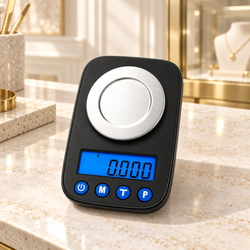
A pocket scale can be an excellent tool for weighing miniature screws, washers, clips, springs, electrical terminals, model-making fasteners, and other lightweight hardware. Its compact platform and fine resolution make it especially useful when a standard kitchen or shipping scale cannot reliably detect individual parts.
For many small-hardware applications, a pocket scale with 500 grams of capacity and 0.01-gram resolution provides a useful balance. A 1,000 g × 0.1 g model may be more appropriate for larger batches and heavier containers, while a 100–300 g × 0.01 g scale can work well for miniature components and portable inspection kits.
The correct configuration depends on:
-
Individual piece weight
-
Maximum batch weight
-
Container weight
-
Required counting sensitivity
-
Platform dimensions
-
Minimum useful load
-
Manufacturing variation
-
Calibration requirements
-
Environmental conditions
This guide explains how to select pocket-scale capacity and resolution for small hardware without buying too little capacity or more precision than the process can support.
Why Use a Pocket Scale for Small Hardware?
Pocket scales are designed for compact, precise weighing. They can be used for:
-
Miniature screws
-
Thin washers
-
Small springs
-
Retaining clips
-
Electrical contacts
-
Rivets
-
Pins
-
Hooks
-
Model-building hardware
-
Repair-kit components
-
Watch or electronics hardware
-
Lightweight plastic fasteners
-
Small replacement parts
Common applications include:
-
Sorting parts by weight
-
Creating sample quantities
-
Checking incoming lots
-
Dividing hardware into packages
-
Estimating piece counts
-
Verifying kit weight
-
Recording component usage
-
Preparing repair or installation sets
-
Checking supplier consistency
-
Portable field inventory
The National Institute of Standards and Technology explains grams and milligrams through its overview of SI units for mass. Using consistent units makes it easier to document component weights and compare lots.
What Does Pocket-Scale Capacity Mean?
Capacity is the maximum physical load the scale can support.
A pocket scale may have a capacity of:
-
50 g
-
100 g
-
200 g
-
300 g
-
500 g
-
1,000 g
-
2,000 g
The stated capacity includes everything on the platform:
-
Hardware
-
Weighing tray
-
Cup
-
Bag
-
Container
-
Platform cover used as a tray
-
Any accessory resting on the scale
Use:
Total physical load = container weight + hardware weight + accessories
The parts alone may fall within capacity while the complete setup exceeds it.
Tare Does Not Restore Capacity
Tare resets the display to zero after a container is placed on the platform. It does not remove the container’s physical weight.
For example:
-
Maximum capacity: 500 g
-
Empty tray: 100 g
-
Display after tare: 0.00 g
-
Remaining physical capacity: approximately 400 g
Adding 500 grams of hardware would create an actual load of approximately 600 grams and overload the scale.
Calculate capacity using the gross load, even if the display shows only net hardware weight.
How Much Capacity Do You Need?
50–100 g Capacity
This range may be suitable for:
-
Extremely small screws
-
Electrical contacts
-
Tiny springs
-
Watch hardware
-
Small inspection samples
-
Lightweight plastic components
Its limitation is container weight. Even a small metal or glass cup can consume much of the available capacity.
Choose this range only if:
-
Parts are extremely light
-
Samples are small
-
Containers are lightweight
-
Maximum portability is important
200–300 g Capacity
This range works for:
-
Miniature hardware batches
-
Small repair kits
-
Electronic components
-
Lightweight sample trays
-
Model-making fasteners
-
Portable inspection kits
A 200–300 g scale provides more flexibility than a 100-gram model while remaining highly portable.
500 g Capacity
A 500-gram pocket scale is a versatile choice for:
-
Small screws
-
Washers
-
Clips
-
Springs
-
Rivets
-
Pins
-
Electronic hardware
-
Sample packaging
A configuration of 500 g × 0.01 g provides fine readability while supporting a practical tray or cup.
The AWS pocket scales collection includes compact models with several combinations of capacity and resolution.
1,000 g Capacity
A 1,000-gram model may be appropriate for:
-
Larger screw batches
-
Mixed repair sets
-
Heavier weighing cups
-
Small boxes of hardware
-
General portable inventory work
A 1,000 g × 0.1 g scale offers more capacity but less detail than a 500 g × 0.01 g model.
2,000 g Capacity
This range can accommodate:
-
Larger hardware batches
-
Small nuts and bolts
-
Heavier containers
-
Packaged repair kits
-
Bulk sample quantities
At this capacity, the scale may be larger than a conventional pocket model. A dedicated parts-counting scale may be more practical for frequent inventory work.
Understanding Resolution
Resolution is the smallest change shown on the display.
Common pocket-scale resolutions include:
-
1 g
-
0.1 g
-
0.01 g
-
0.001 g
A 0.1-gram scale displays:
-
50.0 g
-
50.1 g
-
50.2 g
A 0.01-gram scale displays:
-
50.00 g
-
50.01 g
-
50.02 g
Resolution should be selected according to the lightest part and the smallest meaningful difference.
Is One-Gram Resolution Enough?
One-gram resolution is usually too coarse for miniature hardware.
It may be suitable for:
-
Large bolts
-
Heavy nuts
-
Anchors
-
Metal brackets
-
Bulk packages
If one screw weighs 0.8 gram, a whole-gram scale may not reliably display the addition or removal of one piece.
For small hardware, 0.1- or 0.01-gram resolution is generally more useful.
When to Choose 0.1-Gram Resolution
A 0.1-gram scale can work well for:
-
Standard screws
-
Medium washers
-
Nuts
-
Small bolts
-
Rivets
-
Anchors
-
Repair-kit parts
It is often the best choice when:
-
Individual parts weigh several grams
-
Batches approach 500–2,000 grams
-
Container capacity matters more than hundredth-gram detail
-
The scale will support manual counting calculations
When to Choose 0.01-Gram Resolution
Choose 0.01 gram for:
-
Miniature screws
-
Thin washers
-
Small clips
-
Lightweight springs
-
Electrical contacts
-
Tiny plastic parts
-
Model-building hardware
-
Precision replacement components
Suppose one miniature screw weighs approximately 0.18 gram. On a 0.1-gram scale, it represents fewer than two displayed increments. On a 0.01-gram scale, it represents approximately 18 increments.
The finer scale provides more useful information for sampling and count estimation.
Do You Need 0.001-Gram Resolution?
A 0.001-gram scale displays one-milligram increments.
This level of resolution may be appropriate for:
-
Extremely light specialty hardware
-
Laboratory analysis
-
Controlled research
-
Miniature precision components
The AWS milligram scales category is intended for applications requiring this finer readability.
Milligram resolution is generally unnecessary for ordinary screws, nuts, clips, and washers. It also requires greater control of:
-
Drafts
-
Vibration
-
Static electricity
-
Temperature
-
Platform movement
-
Workbench stability
A stable 0.01-gram scale is often more practical than an unnecessarily sensitive milligram model.
Capacity and Resolution Recommendations
| Hardware application | Suggested capacity | Suggested resolution |
|---|---|---|
| Watch and miniature hardware | 50–200 g | 0.001–0.01 g |
| Tiny screws and clips | 100–500 g | 0.01 g |
| Electronic hardware | 300–1,000 g | 0.01–0.1 g |
| Standard screws and washers | 500–2,000 g | 0.1 g |
| Small nuts and bolts | 1,000–2,000 g | 0.1–1 g |
| Repair-kit verification | 500–2,000 g | 0.01–0.1 g |
| Bulk parts counting | Above 2,000 g | Use a larger counting scale |
These are general starting points. The lightest part, container, batch size, and required tolerance should determine the final choice.
How to Calculate the Capacity You Need
Example 1: Miniature Screws
-
Empty tray: 20 g
-
Screws: 75 g
-
Total load: 95 g
A 100-gram scale would leave almost no margin. A 200- or 300-gram model would be more practical.
Example 2: Small Clips
-
Empty cup: 35 g
-
Clips: 180 g
-
Total load: 215 g
A 300-gram scale could support the load. A 500-gram model offers room for larger quantities.
Example 3: Standard Screws
-
Empty bowl: 150 g
-
Screws: 600 g
-
Total load: 750 g
A 500-gram scale would be insufficient. A 1,000-gram scale would provide a more suitable range.
Example 4: Repair Kit
-
Packaging and tray: 300 g
-
Hardware components: 450 g
-
Total load: 750 g
A 1,000-gram scale could accommodate the complete kit.
How to Determine the Resolution You Need
Start with the individual piece weight.
Component Weighs 5 g
A 0.1-gram scale provides 50 displayed increments per piece and is likely sufficient for many workflows.
Component Weighs 0.5 g
A 0.1-gram scale provides five increments per piece. A 0.01-gram scale provides 50.
Component Weighs 0.08 g
A 0.1-gram scale cannot display the individual component reliably as a complete increment. A 0.01-gram scale is more appropriate.
Component Weighs 0.008 g
A 0.01-gram scale may be too coarse for an individual piece. A specialized milligram scale and controlled procedure may be required.
Do not rely on the displayed resolution alone. Review minimum-load and accuracy specifications.
Resolution Is Not Accuracy
Resolution is the smallest displayed increment. Accuracy describes how closely the result agrees with a recognized reference.
Also evaluate:
Repeatability
Does the scale produce similar readings when the same load is weighed repeatedly?
Linearity
Does it perform consistently across its range?
Minimum Load
What is the smallest practical measurement?
Stabilization Time
How quickly does the reading settle?
An AWS balance scale may be more appropriate for controlled component inspection when stability is more important than extreme portability.
Using a Pocket Scale to Estimate Piece Count
A pocket scale can support manual parts counting through average piece weight.
Use:
Estimated quantity = total net weight ÷ average piece weight
Example
-
Sample: 25 screws
-
Sample weight: 12.50 g
-
Average piece weight: 0.50 g
-
Bulk net weight: 150 g
150 ÷ 0.50 = approximately 300 screws
For frequent inventory counting, a dedicated AWS counting scale can calculate the estimated count automatically.
Why Sample Size Matters
A larger sample typically produces a more representative average.
Individual parts can vary because of:
-
Manufacturing tolerance
-
Material
-
Plating
-
Coating
-
Length
-
Thread design
-
Wear
-
Corrosion
-
Residue
-
Supplier or lot
A one-piece sample can magnify the effect of an unusually heavy or light component. Samples of 10, 25, 50, or more pieces may produce more useful results.
ASTM International’s Committee F16 develops standards relating to fasteners, while the International Organization for Standardization maintains classifications for fasteners.
Parts should be sorted by specification and manufacturing lot when those differences affect weight.
Can a Pocket Scale Replace a Counting Scale?
A pocket scale can be useful for occasional manual counting, sample weighing, and small quantities.
A dedicated counting scale is usually better when:
-
Large batches are counted repeatedly
-
Average piece weights must be stored
-
Several operators use the equipment
-
Check-weighing is required
-
Accumulated totals are needed
-
Speed is important
-
Large bins are used
Some businesses use both:
-
A 0.01-gram pocket scale to establish precise sample weights
-
A larger counting scale for bulk inventory and package filling
Platform Size and Container Fit
Pocket scales have limited platform space.
The container should:
-
Fit securely on the platform
-
Avoid touching the workbench
-
Avoid resting on the scale housing
-
Avoid pressing buttons
-
Leave the display visible
-
Remain stable during loading
If the container touches another surface, part of its weight may be supported outside the scale, creating an incorrectly low reading.
Use lightweight containers with a base designed for the platform.
Display Visibility
A container that covers the display makes the scale difficult to use.
Look for:
-
A forward-facing display
-
Bright backlighting
-
High-contrast digits
-
Stable-weight indicator
-
Low-battery warning
-
Overload indicator
-
Buttons positioned away from the platform
Test the scale with the actual container you plan to use.
Calibration Capability
Calibration compares the scale’s indication with an appropriate reference and may allow adjustment when supported by the model.
Before purchasing, determine:
-
Whether the scale can be calibrated
-
Which reference weight is required
-
Whether the calibration weight is included
-
Whether instructions are available
-
How verification is performed
-
Whether calibration settings remain after battery replacement
Compatible AWS calibration weights can support calibration and performance checks.
Do not use screws, coins, tools, or household objects as calibration references. Their actual masses may differ from assumptions.
When to Calibrate or Check a Pocket Scale
Consider a check:
-
When the scale is new
-
Before important inspection work
-
After moving or traveling with it
-
After battery replacement
-
After an impact
-
After accidental overload
-
After major temperature changes
-
When readings become unstable
-
When count estimates change unexpectedly
-
According to the manufacturer’s instructions
Calibration cannot correct vibration, container contact, low batteries, or physical damage.
Environmental Factors
Vibration
Drills, presses, machinery, carts, and unstable benches can affect readings.
Static Electricity
Plastic trays and lightweight hardware may develop static, causing parts to cling or readings to drift.
Air Movement
Drafts matter most when working with high-resolution scales and extremely light parts.
Temperature
Allow the scale and hardware to stabilize after moving between different environments.
Uneven Surfaces
Use a firm, level workbench rather than a padded mat, shelf, or soft field surface.
Debris
Metal filings, dust, oil, and stray components can collect around the platform.
The AWS guide to scale maintenance and care provides general guidance for keeping digital scales clean and protected.
Pocket-Scale Safety and Handling
Pocket scales are compact, but small hardware can be sharp.
OSHA provides requirements concerning materials handling and storage and information about personal protective equipment.
Depending on the task, consider:
-
Suitable gloves
-
Eye protection
-
Stable containers
-
Immediate spill cleanup
-
Controlled handling of sharp fasteners
-
Clear work surfaces
-
Proper disposal of damaged pieces
A scale cannot determine a fastener’s grade, strength, dimensions, or suitability for an installation.
Travel and Field Use
A pocket scale is useful for:
-
Field inventory
-
Repair kits
-
Mobile technicians
-
Vendor inspections
-
Trade shows
-
Model-building events
-
Portable quality checks
Protect the scale by:
-
Using its cover
-
Keeping heavy tools off the platform
-
Carrying spare batteries
-
Packing a lightweight tray
-
Rechecking performance after travel
-
Allowing temperature stabilization before use
Do not place a pocket scale directly on a vehicle seat, soft case, or uneven floor when performing precision measurements.
Kit Verification by Weight
A pocket scale can help check small hardware kits.
The method involves:
-
Weighing several verified complete kits.
-
Establishing an acceptable range.
-
Weighing each completed kit.
-
Investigating results outside the range.
This method works only when:
-
Packaging weight is consistent
-
Components are sufficiently heavy
-
Scale resolution is appropriate
-
The process is validated
-
Repeatability is adequate
A correct total weight does not prove that all correct components are present. A missing part may be offset by an incorrect extra part of similar weight.
Use weight verification with visual, barcode, camera, or manual inspection.
Commercial Sales by Weight
A pocket scale used for internal inventory may not be approved for commercial sales.
NIST provides information concerning legal metrology and weights and measures. Requirements may include:
-
Legal-for-trade approval
-
Inspection
-
Sealing
-
Defined scale divisions
-
Net-quantity rules
-
Recordkeeping
Confirm applicable requirements before using a pocket scale to determine the quantity or value of a commercial transaction.
Common Buying Mistakes
Choosing Capacity Based Only on the Parts
The container and packaging count toward maximum capacity.
Assuming Tare Restores Capacity
Tare changes the display, not the physical load.
Choosing Too Little Capacity
A 500-gram scale cannot hold 450 grams of hardware in a 100-gram bowl.
Choosing Too Much Capacity
A high-capacity scale may use increments too large for individual parts.
Selecting Milligram Resolution Automatically
Extra sensitivity may not improve ordinary hardware measurements.
Confusing Resolution With Accuracy
Additional decimal places do not guarantee a correct reading.
Ignoring Minimum Load
The smallest display increment may not be the most reliable working amount.
Using Too Small a Counting Sample
A one-piece sample may not represent normal component variation.
Using an Oversized Container
A tray touching the table can produce an incorrect reading.
Calibrating With Coins or Hardware
Use the reference weight specified for the scale.
Pocket Hardware Scale Buying Checklist
Capacity
-
What is the largest hardware batch?
-
What does the container weigh?
-
What is the gross load?
-
Is there enough margin?
-
Will larger quantities be needed later?
Resolution
-
What does one piece weigh?
-
Does the component cover several display increments?
-
Is 0.1 gram sufficient?
-
Is 0.01 gram required?
-
Is milligram resolution genuinely necessary?
Performance
-
Are accuracy specifications available?
-
Is minimum load stated?
-
Are readings repeatable?
-
Does the display stabilize promptly?
-
Can the scale be calibrated?
Physical Design
-
Does the container fit?
-
Is the display visible?
-
Are buttons accessible?
-
Is a protective cover included?
-
Is the platform easy to clean?
Workflow
-
Is occasional manual counting sufficient?
-
Is a dedicated counting scale also required?
-
Will the scale travel?
-
Are batteries easy to replace?
-
Is auto-off adjustable?
Frequently Asked Questions
What capacity pocket scale is best for small hardware?
A 500-gram model is a versatile choice for many small components. Choose 1,000 grams or more for larger batches and heavier containers.
Is 0.01-gram resolution necessary?
It is useful for miniature screws, thin washers, lightweight clips, and electronic parts. Standard hardware may require only 0.1 gram.
Is 0.1 gram enough for screws?
It is sufficient for many standard screws. Weigh a representative piece and compare it with the scale’s resolution and minimum-load specifications.
Does tare increase maximum capacity?
No. The container still counts toward the physical load after the display is reset.
Can a pocket scale count hardware?
It can support manual counting through average piece weight. A dedicated counting scale is more efficient for repeated bulk work.
How large should the sample be?
Use a sufficiently large representative sample to account for normal piece-weight variation. Lightweight parts generally benefit from larger samples.
Why does the estimated count change?
Possible causes include manufacturing variation, mixed hardware, a small sample, vibration, static, incorrect tare, or scale drift.
Can one pocket scale handle every type of hardware?
Not always. Miniature components and heavy batches may require different combinations of capacity and resolution.
How often should the scale be calibrated?
Follow the manufacturer’s instructions and check it after travel, impact, overload, battery replacement, or unexpected readings.
Can a pocket scale verify repair kits?
It can help detect some missing or extra parts, but it cannot identify components. Combine weight checks with another inspection method.
Final Thoughts
For many small-hardware applications, a 500 g × 0.01 g pocket scale provides a useful balance of fine resolution and practical capacity. Larger batches may be better suited to a 1,000 g × 0.1 g or 2,000 g × 0.1 g scale.
Consider these configurations:
-
100–200 g × 0.001–0.01 g: extremely small specialty hardware
-
300–500 g × 0.01 g: miniature screws, clips, springs, and electronic components
-
1,000 g × 0.1 g: standard screws, washers, and small repair kits
-
2,000 g × 0.1–1 g: larger batches and heavier containers
-
Above 2,000 g: dedicated counting or bench scale for bulk inventory
Choose capacity by adding the hardware, container, and accessories. Choose resolution by weighing the lightest individual piece and confirming that it spans several displayed increments.
The best pocket scale is the one that fits the complete load, detects the components that matter, works with the chosen tray, and produces stable, repeatable results in the actual work environment.