
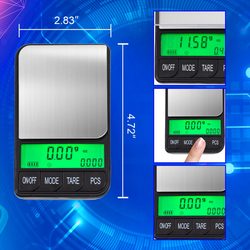
A pocket scale for soap fragrance oils should provide enough capacity for your weighing container and ingredients while offering resolution fine enough for the smallest quantity in your formula.
For most small test batches and fragrance blends, a pocket scale with 500- to 1,000-gram capacity and 0.01-gram readability is a strong choice. If you routinely measure larger fragrance quantities, a model with 1,000 to 3,000 grams of capacity and 0.1-gram readability may provide a better balance of range, stability, and usability.
The correct combination depends on four numbers:
-
The smallest fragrance quantity you need to measure
-
The largest fragrance quantity you need to measure
-
The weight of your heaviest container
-
The total combined load placed on the platform
Capacity and resolution must be considered together. A scale that reads to 0.01 gram may not have enough capacity for a heavy beaker, while a high-capacity kitchen scale may not show the small changes required for a fragrance test.
This guide explains how to select the right pocket-scale capacity and resolution for soap fragrance oils.
Quick Recommendation
Use the following table as a starting point:
| Soap-Making Application | Suggested Capacity | Suggested Resolution |
|---|---|---|
| Tiny fragrance experiments | 100–300 g | 0.01 g |
| Small fragrance blends | 300–500 g | 0.01 g |
| Sample and test batches | 500–1,000 g | 0.01–0.1 g |
| Regular home batches | 1,000–3,000 g | 0.1 g |
| Larger fragrance quantities | 3,000–5,000 g | 0.1–1 g |
| Base oils and soap batter | Based on vessel and total batch | 1 g may be sufficient |
For dedicated fragrance measurement, begin by exploring digital pocket scales with 0.01- or 0.1-gram readability. For bulk ingredients, heavy pitchers, and full soap batches, a separate model from the kitchen scale collection may be more appropriate.
What Is a Pocket Scale for Fragrance Oils?
A pocket scale is a compact digital scale designed for small objects and ingredients. It usually includes:
-
A small weighing platform
-
A digital display
-
A tare button
-
Multiple measurement units
-
Battery power
-
Automatic shutoff
-
A protective cover or tray
-
Calibration capability on some models
For soap makers, a pocket scale can be used to measure:
-
Fragrance oils
-
Essential oils
-
Small fragrance blends
-
Colorants
-
Antioxidants
-
Botanical extracts
-
Powders
-
Other low-weight additives
A pocket scale is not generally intended to support a full soap pot, large pitcher, or complete production batch. Its main advantage is fine readability in a portable format.
Capacity and Resolution: What Is the Difference?
Capacity and resolution describe two different scale characteristics.
Capacity
Capacity is the greatest total load the scale is designed to support. A 500-gram scale should not be loaded beyond 500 grams.
The total includes:
-
The container
-
The fragrance oil
-
A weighing tray or cover
-
Any additional ingredients on the platform
Resolution
Resolution, also called readability or graduation, is the smallest increment displayed by the scale.
Examples include:
-
1 g
-
0.1 g
-
0.01 g
-
0.001 g
A scale with 0.01-gram resolution may display 4.98, 4.99, and 5.00 grams. A scale with 0.1-gram resolution may display 4.8, 4.9, and 5.0 grams.
Why You Need to Consider Both
A scale can have excellent resolution but insufficient capacity. It can also have substantial capacity but inadequate resolution.
Consider these two models:
-
Scale A: 100 g × 0.01 g
-
Scale B: 5,000 g × 1 g
Scale A is more suitable for a tiny fragrance blend, but its limited capacity may not accommodate a heavy container. Scale B can support a large vessel, but its whole-gram resolution may be too coarse for a small test formula.
The best scale is the one whose capacity and resolution match the actual task.
How Much Capacity Do You Need?
To calculate the required capacity, add the weight of your container to the maximum amount of fragrance or other ingredients you plan to measure.
Use this formula:
Required capacity = container weight + maximum ingredient weight + safety margin
Example 1: Small Plastic Fragrance Cup
-
Empty cup: 15 g
-
Maximum fragrance: 30 g
-
Combined load: 45 g
A 100-gram scale would accommodate the load. A model with 200 or 500 grams of capacity would provide more flexibility.
Example 2: Small Glass Beaker
-
Empty beaker: 140 g
-
Maximum fragrance: 100 g
-
Combined load: 240 g
A 200-gram scale would be insufficient. Choose at least 300 grams, preferably with additional capacity for a reasonable margin.
Example 3: Heavy Glass Container
-
Empty container: 350 g
-
Maximum fragrance: 250 g
-
Combined load: 600 g
A 500-gram pocket scale cannot support this combination. Select a 1,000-gram model or use a lighter container.
Example 4: Production Pitcher
-
Empty pitcher: 750 g
-
Fragrance quantity: 500 g
-
Combined load: 1,250 g
A compact 500-gram scale is unsuitable. A model with at least 2,000 grams of capacity would be more appropriate, assuming its platform is also large enough.
Why Container Weight Matters
The tare function makes the display return to zero after the empty container is placed on the scale. However, tare does not physically remove the container’s weight from the load sensor.
Suppose you have a pocket scale with a capacity of 500 grams:
-
Container weight: 175 g
-
Fragrance added: 325 g
-
Actual load on scale: 500 g
The scale has reached its maximum capacity even though the tared display shows only 325 grams.
Adding more fragrance could trigger an overload warning or damage the sensor.
Before selecting a scale:
-
Weigh or determine the weight of your most frequently used container.
-
Add the largest fragrance amount you expect to measure.
-
Choose a scale with capacity above the combined total.
-
Leave extra room to reduce the risk of accidental overloading.
Is 100-Gram Capacity Enough?
A 100-gram pocket scale may be appropriate for:
-
Very small fragrance tests
-
Sample formulas
-
Lightweight cups
-
Individual fragrance components
-
Tiny essential-oil blends
Its limitation is container compatibility. A glass beaker may use most or all of the available capacity before any fragrance is added.
A 100-gram model is best when the entire measurement system has been designed around lightweight containers and small quantities.
Is 500-Gram Capacity Enough?
A 500-gram capacity is versatile for many fragrance-related tasks. It can support:
-
Small plastic or silicone cups
-
Lightweight glass containers
-
Moderate fragrance quantities
-
Test-batch formulation
-
Fragrance blending
-
Low-weight additives
For soap makers focused on small batches and scent development, 500 grams paired with 0.01-gram readability is often a useful combination.
Check the container weight before assuming that 500 grams will be sufficient.
Is 1,000-Gram Capacity Better?
A 1,000-gram pocket scale provides more flexibility for heavier containers and larger fragrance quantities.
It can be suitable for:
-
Small commercial soap batches
-
Larger fragrance blends
-
Glass beakers
-
Moderate pitchers
-
Multiple ingredients measured in one vessel
The tradeoff is that some 1,000-gram models may provide 0.1-gram rather than 0.01-gram readability. That may still be appropriate for routine soap production.
When Do You Need 2,000 Grams or More?
Consider 2,000- to 5,000-gram capacity when:
-
Your fragrance container is heavy.
-
You measure several hundred grams of fragrance.
-
You want the scale to handle other soap ingredients.
-
You make larger production batches.
-
You need a broader platform.
-
You occasionally weigh filled containers.
At this range, the scale may function more like a compact kitchen or bench scale than a traditional pocket scale. Verify both platform dimensions and readability.
If your work requires more capacity while maintaining controlled measurement performance, digital balance scales may provide an alternative to a compact pocket model.
What Resolution Do You Need?
The smallest ingredient quantity in your formula should determine the required resolution.
One-Gram Resolution
A scale with 1-gram resolution displays whole grams.
It may be appropriate for:
-
Large fragrance quantities
-
Base oils
-
Water
-
Bulk ingredients
-
Finished soap batter
-
Large production batches
It is usually too coarse for small fragrance tests or detailed blending.
0.1-Gram Resolution
A 0.1-gram scale displays tenths of a gram.
This resolution is suitable for many:
-
Home soap batches
-
Small-business batches
-
Regular fragrance measurements
-
Essential-oil additions
-
Moderate test batches
-
Colorants and additives
For many soap makers, 0.1 gram offers the best balance between useful precision, capacity, speed, stability, and price.
0.01-Gram Resolution
A 0.01-gram scale displays hundredths of a gram.
Choose this resolution for:
-
Tiny fragrance batches
-
Sample soaps
-
Multi-component scent blends
-
Fragrance-ratio testing
-
Additives used below one gram
-
Detailed formulation records
-
Product-development work
A 0.01-gram scale is generally more sensitive to air movement, vibration, static, and temperature than a 0.1-gram model.
0.001-Gram Resolution
A 0.001-gram scale displays thousandths of a gram, or milligrams.
This level may be useful for specialized formulation or laboratory-style development. It is usually unnecessary for ordinary fragrance-oil measurement.
If your formulation genuinely requires milligram-level readability, compare suitable digital milligram scales and prepare a controlled workspace.
How Small Is Too Small for Your Scale?
An ingredient quantity should be large enough relative to the scale’s displayed increment to allow meaningful control.
Suppose a formula calls for 0.15 gram:
-
A 1-gram scale cannot measure it.
-
A 0.1-gram scale can only approximate it coarsely.
-
A 0.01-gram scale is much more appropriate.
Now suppose a formula calls for 100 grams:
-
A 1-gram scale may be sufficient.
-
A 0.1-gram scale provides more control.
-
A 0.01-gram scale may offer unnecessary resolution unless the formula requires it.
The correct resolution depends on the scale of the formula rather than a universal rule.
Readability Is Not the Same as Accuracy
A scale that displays 0.01 gram does not necessarily provide an accurate result within exactly 0.01 gram.
Readability tells you the smallest change shown on the display. Overall measurement performance can also depend on:
-
Calibration
-
Sensor quality
-
Repeatability
-
Linearity
-
Temperature
-
Air movement
-
Static
-
Vibration
-
Battery condition
-
Surface stability
-
User technique
More decimal places can create the appearance of precision without guaranteeing that every displayed digit is meaningful.
The National Institute of Standards and Technology provides broader information about reliable weighing through its Office of Weights and Measures.
Resolution Versus Repeatability
Repeatability refers to how consistently a scale measures the same stable object under the same conditions.
You can perform a basic repeatability check:
-
Place the scale on a stable, level surface.
-
Turn it on and allow it to initialize.
-
Place a stable object on the platform.
-
Record the reading.
-
Remove the object completely.
-
Wait for the scale to return to zero.
-
Repeat several times.
A 0.01-gram scale that fluctuates widely may be less useful than a stable 0.1-gram model.
This test does not replace calibration, but it can help identify poor setup, weak batteries, environmental interference, or equipment problems.
Choosing Capacity and Resolution Together
Use these combinations as a general guide:
100–300 g × 0.01 g
Best for:
-
Tiny tests
-
Lightweight containers
-
Individual scent components
-
Sample formulation
Limitations:
-
Low capacity
-
Small platform
-
Limited container choice
500 g × 0.01 g
Best for:
-
Fragrance-blend development
-
Test batches
-
Small soap businesses
-
Precision additives
This is one of the most practical combinations for a dedicated fragrance scale.
1,000 g × 0.01 g
Best for:
-
Heavier containers
-
Larger test batches
-
Detailed commercial formulation
-
Makers wanting capacity without giving up fine readability
Confirm the platform size and environmental requirements.
1,000–3,000 g × 0.1 g
Best for:
-
Routine home batches
-
Small production batches
-
Larger fragrance quantities
-
Versatile soap-making use
This range offers a practical combination of stability and capacity.
5,000 g × 1 g
Best for:
-
Bulk oils
-
Water
-
Large vessels
-
Soap batter
-
Production weighing
Use a separate precision scale when measuring small fragrance quantities.
Does Platform Size Affect Your Choice?
Yes. Capacity and resolution are useless if the container cannot sit safely on the platform.
A container that is too large may:
-
Block the display
-
Tilt or wobble
-
Touch the countertop
-
Make pouring awkward
-
Increase spill risk
-
Cause part of the load to be externally supported
Measure the base of your fragrance containers and compare it with the listed platform dimensions.
If your preferred container is too large:
-
Use a smaller weighing vessel.
-
Transfer the measured fragrance to the main vessel.
-
Choose a scale with a larger platform.
-
Use a balance or kitchen scale with suitable resolution.
Do not place unstable extensions over the platform unless the manufacturer specifically supports that method.
Why Tare Is Essential
Tare subtracts the displayed weight of the container so you can see the fragrance weight directly.
A reliable tare procedure is:
-
Turn on the unloaded scale.
-
Confirm that it displays zero.
-
Select grams.
-
Place the empty container on the platform.
-
Wait for stability.
-
Press tare.
-
Confirm zero again.
-
Add fragrance slowly.
Tare reduces manual subtraction and speeds up formulation. It does not increase capacity.
If the displayed zero begins to drift, check the environment, battery, container placement, and scale condition before continuing.
Why Grams Are Usually the Best Unit
Grams make it easier to measure and document both small and large quantities.
Examples include:
-
0.45 g
-
8.7 g
-
42.35 g
-
250 g
Grams also simplify many percentage calculations and reduce the long decimals that can occur when small amounts are expressed in ounces.
If your formula uses ounces, convert the complete formula carefully before production instead of switching units repeatedly during weighing.
Always confirm the unit symbol on the screen before adding fragrance.
Calibration Requirements
Some pocket scales allow user calibration with a specified reference weight. Others are factory configured and may not provide an adjustment procedure.
Before buying, determine:
-
Whether calibration is supported
-
Which reference mass is required
-
Whether the mass is included
-
How calibration mode is entered
-
Whether a draft shield is needed
-
How successful calibration is confirmed
Use only the reference weight and process specified for the model. AWS offers calibration weights for digital scales that can be matched to compatible procedures.
Check the scale:
-
When it is new
-
After relocation
-
After replacing batteries
-
After a drop or impact
-
After accidental overloading
-
When readings become inconsistent
-
According to your production schedule
Calibration cannot repair physical damage or compensate for an unstable work surface.
Environmental Requirements for a Pocket Scale
Fine-resolution scales are more sensitive to their surroundings.
Use a Stable Surface
Place the scale on a hard, level counter. Avoid flexible tables, cushioned mats, moving carts, and active appliances.
Control Drafts
Fans, vents, open windows, and rapid movement can influence high-resolution readings.
Reduce Vibration
Keep the scale away from mixers, washing machines, refrigerators, heavy foot traffic, and equipment that shakes the countertop.
Allow Temperature Stabilization
If the scale or fragrance has been stored in a hot or cold environment, allow it to reach normal workspace conditions.
Watch for Static
Plastic containers, dry air, powders, and clothing can generate static effects. Follow the manufacturer’s recommendations when readings behave unexpectedly.
Measuring Fragrance Oil With a Pocket Scale
Step 1: Verify the Formula
Confirm the intended fragrance weight and applicable supplier guidance before opening the container.
Step 2: Prepare the Work Area
Use a stable surface away from drafts and vibration. Gather the scale, fragrance, container, transfer tools, written formula, and safety equipment.
Step 3: Check Capacity
Confirm that the container and fragrance will remain below the scale’s maximum load.
Step 4: Turn On the Scale
Allow it to initialize and display zero.
Step 5: Select Grams
Check the unit symbol rather than relying on memory.
Step 6: Add the Container and Tare
Place the container centrally, wait for stability, and press tare.
Step 7: Add Fragrance Slowly
Pour carefully. Switch to a pipette or controlled dropper as you approach the target.
Step 8: Wait for a Stable Result
Do not record a number while it is fluctuating.
Step 9: Document the Actual Measurement
Record the actual weight, unit, ingredient identity, date, formula version, and lot information when applicable.
Step 10: Clean the Scale
Remove drips promptly using the manufacturer-approved cleaning method. Review AWS guidance for scale maintenance and the instructions supplied with the model.
Fragrance-Oil Safety Considerations
A pocket scale helps measure fragrance accurately, but it does not determine the safe amount for a soap formula.
Before using a fragrance:
-
Review current supplier documentation.
-
Confirm that it is intended for the application.
-
Identify the relevant product category.
-
Check the recommended or maximum usage level.
-
Read the Safety Data Sheet.
-
Wear appropriate protective equipment.
-
Work with suitable ventilation.
-
Label temporary containers.
-
Prevent cross-contamination.
-
Keep fragrance materials away from children and pets.
The International Fragrance Association provides access to information about its safe-use standards and documentation. Limits can differ by fragrance, ingredient, and product category.
The Occupational Safety and Health Administration explains the information included in Safety Data Sheets, including hazards, handling, storage, exposure controls, and accidental-release measures.
Soap and Cosmetic Regulatory Context
Product classification can depend on composition, intended use, labeling, and marketing claims.
A product marketed solely for cleansing may be treated differently from one promoted with moisturizing, deodorizing, antimicrobial, or therapeutic claims. The U.S. Food and Drug Administration discusses these distinctions in its frequently asked questions about soap.
Fragrance labeling is another consideration for scented products. The FDA provides additional information about fragrances in cosmetics.
The scale supports formulation control, but it does not establish that a product’s formula, claims, labeling, or fragrance level complies with applicable requirements.
Common Pocket-Scale Mistakes
Buying Too Little Capacity
A small scale may be unable to support a glass beaker even when the fragrance quantity is low.
Choosing Resolution Without Considering Stability
A 0.001-gram scale may fluctuate in an ordinary soap-making workspace and provide more resolution than necessary.
Forgetting Container Weight
Taring changes the display, not the load on the sensor.
Using an Oversized Container
A container that touches the counter or blocks the display can create inaccurate measurements and an awkward workflow.
Pouring Too Quickly
A delayed display response can cause you to overshoot the target.
Measuring Near Maximum Capacity
Leave room for accidental additions and variations in container weight.
Assuming Readability Equals Accuracy
Decimal places do not independently demonstrate accuracy.
Ignoring Automatic Shutoff
The scale may turn off during a pause and lose the tare setting.
Exposing the Scale to Fragrance Spills
A metal platform does not necessarily protect the display, buttons, seams, or internal electronics.
Calibrating With an Unverified Object
Use the calibration mass and procedure specified by the manufacturer.
Pocket Scale Buying Checklist
Before purchasing, verify:
| Question | Why It Matters |
|---|---|
| What is my smallest fragrance amount? | Determines resolution |
| What is my largest fragrance amount? | Affects capacity |
| What does my heaviest container weigh? | Counts toward total load |
| Do I need 0.1 or 0.01 g? | Determines usable precision |
| Is the platform large enough? | Supports safe container placement |
| Does it measure in grams? | Simplifies formulation |
| Is tare included? | Removes container weight from the display |
| Can it be calibrated? | Supports performance checks |
| Which calibration mass is required? | Determines accessory needs |
| Is the display visible? | Helps prevent overshooting |
| Does it stabilize quickly? | Improves pouring control |
| Is auto-off adjustable? | Prevents workflow interruption |
| Is it easy to clean? | Reduces residue and cross-contamination |
| Does it warn about overload? | Helps protect the sensor |
| Is support available? | Assists with operation and troubleshooting |
For product-specific questions about capacity, readability, calibration, or maintenance, contact AWS customer support.
Frequently Asked Questions
What capacity pocket scale is best for fragrance oils?
A 500- to 1,000-gram capacity is a practical choice for many soap makers. Select more capacity if you use heavy glass containers or measure large fragrance quantities.
What resolution should a fragrance-oil scale have?
Choose 0.1 gram for routine soap batches and 0.01 gram for small tests, samples, and fragrance blending.
Is a 500 g × 0.01 g scale good for soap making?
It is an excellent dedicated fragrance scale when the combined weight of the container and ingredients remains below 500 grams.
Is a 1,000 g × 0.1 g scale precise enough?
Yes, for many regular soap batches. It may not be sufficient for tiny blend components below one gram.
Do I need 0.001-gram resolution?
Usually not. Milligram resolution is best reserved for specialized formulations that genuinely require it and can be performed in a controlled environment.
Can I put a soap pot on a pocket scale?
Only if the combined weight and platform size fall within the scale’s specifications. Most soap pots are better suited to a larger kitchen or bench scale.
Does tare give me more capacity?
No. Tare resets the display, but the container still counts toward the maximum physical load.
Why does my 0.01-gram scale fluctuate?
Drafts, vibration, static, temperature, surface instability, weak batteries, or nearby movement can affect the reading.
Can I measure fragrance oil in ounces?
Yes, but grams are usually easier for small quantities and percentage-based formulation. Use one unit consistently throughout the recipe.
How much extra capacity should I leave?
Choose a scale with capacity comfortably above the combined container and ingredient weight. Avoid operating routinely at the absolute maximum.
Can I use the same scale for fragrance and base oils?
Yes, if it provides enough capacity and appropriate readability for both. Many makers obtain better results using separate precision and bulk scales.
Is a pocket scale waterproof?
Most are not. A stainless steel platform or protective cover does not necessarily make the buttons, display, seams, or internal electronics waterproof.
How often should I calibrate my pocket scale?
Follow the manufacturer’s instructions and your quality procedures. Check it after relocation, battery replacement, impact, overload, or unexpected changes in performance.
Does precise weighing guarantee that a fragrance level is safe?
No. Precise weighing helps follow a formula, but the appropriate fragrance level must come from current supplier documentation and relevant standards.
Final Thoughts
For most soap makers, the best pocket scale for soap fragrance oils has either:
-
500–1,000 g capacity with 0.01 g resolution for small batches and fragrance blends, or
-
1,000–3,000 g capacity with 0.1 g resolution for routine fragrance measurement.
Choose capacity by adding the heaviest container to the largest ingredient quantity. Choose resolution according to the smallest amount in the formula.
Do not forget the practical details:
-
Tare does not restore capacity.
-
Platform size must fit the container.
-
More decimal places do not guarantee accuracy.
-
High-resolution scales need stable working conditions.
-
Calibration requires the correct reference mass.
-
Large vessels may require a separate kitchen or bench scale.
-
Fragrance usage must follow current supplier and safety guidance.
A pocket scale matched to your formulation range makes fragrance measurement faster, more repeatable, and easier to document. The right balance of capacity and resolution is more valuable than selecting the highest number in either specification.