
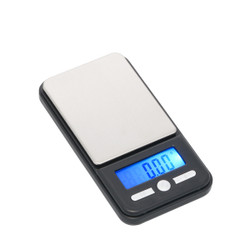
A pocket scale is a convenient way to measure loose-leaf tea at home, while traveling, during tastings, or when dividing larger packages into smaller portions. The best configuration depends on two primary specifications: capacity and resolution.
For most dry tea-leaf portions, a pocket scale with 200 to 500 grams of capacity and 0.01-gram resolution offers an effective balance. It can measure common 2-to-10-gram servings with more detail than a whole-gram kitchen scale while leaving enough capacity for a small cup or weighing tray.
If you plan to place a teapot on the scale or weigh brewing water, a pocket scale may not offer enough capacity or platform space. In that situation, a larger model with approximately 1,000 to 2,000 grams of capacity and 0.1-gram resolution may be more practical.
The right choice depends on:
-
Your normal tea portion
-
The smallest quantity you need to measure
-
The weight of your weighing container
-
Whether you will weigh water
-
The size of the platform
-
The scale’s minimum useful range
-
The required level of repeatability
-
Your brewing and packaging workflow
This guide explains how to match pocket-scale capacity and resolution to loose-leaf tea without paying for unnecessary specifications.
Why Weigh Loose-Leaf Tea?
Loose-leaf teas have different shapes, sizes, and densities. Tea may consist of:
-
Large whole leaves
-
Fine broken leaves
-
Rolled pellets
-
Long twisted leaves
-
Compressed fragments
-
Powder
-
Flowers
-
Herbs
-
Fruit pieces
-
Spices
A teaspoon measures volume rather than mass. The same spoon can hold very different weights depending on the tea.
For example, a spoonful of tightly rolled oolong may contain more tea by weight than an equally full spoon of large white-tea leaves. A scale measures both directly in grams, making the comparison more meaningful.
Weighing tea supports:
-
Consistent tea-to-water ratios
-
Repeatable brewing
-
More useful tasting notes
-
Controlled recipe comparisons
-
Small-sample preparation
-
Tea blending
-
Inventory tracking
-
Portion packaging
-
Cost calculations
-
Reduced waste of expensive tea
The National Institute of Standards and Technology explains grams and related units through its overview of SI units for mass. Using grams provides a consistent basis for recording and repeating tea recipes.
What Does Scale Capacity Mean?
Capacity is the maximum physical load the scale is designed to support.
A pocket scale may have a maximum capacity of:
-
50 g
-
100 g
-
200 g
-
300 g
-
500 g
-
1,000 g
The scale must support everything placed on its platform—not only the tea.
The complete load may include:
-
A weighing cup
-
A tray
-
A tea scoop
-
A filter
-
A small brewing vessel
-
Tea leaves
-
Any water added while the vessel remains on the scale
Use this formula:
Total physical load = container weight + tea weight + all other contents
Capacity Example: Dry Tea Portion
-
Empty cup: 35 g
-
Tea leaves: 5 g
-
Total physical load: 40 g
A 100-gram scale could technically accommodate this setup. A 200- or 300-gram model would offer more flexibility for other containers.
Capacity Example: Tea Sample
-
Empty sample bag: 3 g
-
Tea: 25 g
-
Total physical load: 28 g
A 100-gram scale could provide enough capacity, assuming its platform works with the packaging method.
Capacity Example: Small Gaiwan
-
Gaiwan and lid: 180 g
-
Tea: 6 g
-
Water: 100 g
-
Total physical load: 286 g
A 300-gram scale would leave very little margin. A 500-gram scale would be the more practical choice.
Capacity Example: Ceramic Teapot
-
Teapot and lid: 650 g
-
Tea: 8 g
-
Water: 400 g
-
Total physical load: 1,058 g
A typical pocket scale would not be appropriate. A larger scale with at least 1,500 to 2,000 grams of capacity would provide a safer margin.
Tare Does Not Increase Capacity
Tare resets the displayed reading to zero after a container is placed on the scale.
Suppose a pocket scale has:
-
Maximum capacity: 500 g
-
Empty container: 150 g
-
Reading after tare: 0.00 g
The scale has approximately 350 grams of physical capacity remaining. It does not regain all 500 grams simply because the display says zero.
If you add 450 grams of contents, the load cell carries approximately 600 grams in total, exceeding the scale’s rated capacity.
This distinction is important when:
-
Using a heavy cup
-
Weighing a brewing vessel
-
Adding water after taring
-
Filling multiple ingredients sequentially
-
Portioning tea in a glass jar
Always calculate the complete physical load before selecting capacity.
How Much Capacity Do You Need?
50–100 g Capacity
This range may be suitable for:
-
Individual tea portions
-
Very light weighing trays
-
Small tea samples
-
Lightweight travel kits
It provides limited flexibility. A glass or ceramic container can use most of the capacity before tea is added.
Choose this range only when:
-
The container is very light
-
The tea quantities are small
-
The scale will not be used for water
-
The platform suits your weighing method
200–300 g Capacity
This is a useful range for:
-
Everyday dry tea portions
-
Small sample bags
-
Lightweight cups
-
Tea-blending ingredients
-
Portable tea sessions
A 200- or 300-gram pocket scale offers more container flexibility while remaining compact.
500 g Capacity
A 500-gram scale is one of the most versatile pocket-scale choices for tea leaves.
It can accommodate:
-
Normal loose-leaf portions
-
Small bowls or cups
-
Multiple tea ingredients
-
Sample packaging
-
Some lightweight gaiwans
-
Small amounts of water, depending on the vessel
The AWS pocket scales collection includes compact options with different combinations of capacity, resolution, platform size, and features.
1,000 g Capacity
A 1,000-gram model may be suitable when:
-
Containers are heavier
-
Tea is portioned in larger quantities
-
A small brewing vessel is placed on the scale
-
Greater flexibility matters more than extreme portability
However, confirm the resolution. Some higher-capacity scales use larger display increments.
2,000 g or Greater
This capacity is useful for:
-
Teapots
-
Brewing water
-
Larger tea containers
-
Bulk portioning
-
General kitchen use
At this point, a conventional kitchen or beverage scale may be more practical than a pocket scale. The AWS kitchen scales collection provides larger-capacity options for vessels and ingredients beyond typical pocket-scale limits.
What Does Resolution Mean?
Resolution is the smallest weight change shown on the display.
Common resolutions include:
-
1 g
-
0.1 g
-
0.01 g
-
0.001 g
A scale with 0.1-gram resolution displays values such as:
-
4.0 g
-
4.1 g
-
4.2 g
A scale with 0.01-gram resolution displays:
-
4.00 g
-
4.01 g
-
4.02 g
Resolution determines the level of detail visible to the user. It does not, by itself, prove accuracy.
Is 1-Gram Resolution Enough for Tea?
A scale that displays only whole grams is often too coarse for individual cups of tea.
Suppose you want to measure 3.5 grams. A whole-gram scale cannot display that value. It may alternate between 3 and 4 grams or round according to its internal programming.
For a target near 3 grams, a one-gram difference represents a substantial percentage of the total. This may affect the strength and balance of the finished tea.
Whole-gram resolution can still be appropriate for:
-
Large cold-brew batches
-
Bulk tea quantities
-
Large commercial recipes
-
Noncritical inventory estimates
It is generally not the best option for individual loose-leaf servings.
Is 0.1-Gram Resolution Enough?
For most tea brewing, 0.1-gram resolution is sufficient.
It works well for portions such as:
-
2.5 g
-
3.0 g
-
5.0 g
-
7.5 g
-
10.0 g
A 5-gram portion spans 50 displayed increments on a 0.1-gram scale. That gives the user much more control than a whole-gram display.
Choose 0.1-gram resolution for:
-
Everyday loose-leaf tea
-
Gongfu-style brewing
-
Western-style brewing
-
Teapot recipes
-
Cold-brew tea
-
Herbal infusions
-
General food measurement
A 0.1-gram scale may also offer greater capacity and a larger platform than a finer pocket model.
When Should You Choose 0.01-Gram Resolution?
A 0.01-gram pocket scale is useful when you want more detailed control over small amounts.
Choose 0.01 gram for:
-
Tea portions below approximately 2 grams
-
Small tea samples
-
Detailed tasting comparisons
-
Expensive or limited teas
-
Tea-blending ingredients
-
Small botanical additions
-
Sample packaging
-
Recipe-development work
For example, a user comparing 1.50, 1.65, and 1.80 grams of the same tea needs 0.01-gram resolution to display those targets directly.
A 0.01-gram scale may also be useful when dividing a limited quantity into equal samples.
However, extra digits do not always improve the cup. If your preferred recipe uses 6 grams of tea and small differences are unimportant, 0.1-gram resolution may be easier and more practical.
Do You Need 0.001-Gram Resolution?
A scale with 0.001-gram resolution displays one-milligram increments.
This degree of readability is normally unnecessary for tea brewing. It may be appropriate for:
-
Laboratory work
-
Research
-
Very small blending components
-
Specialized product development
-
Controlled formulation procedures
The AWS milligram scales category is designed for applications that genuinely require milligram readability.
Milligram-level measurements are more sensitive to:
-
Air movement
-
Table vibration
-
Static electricity
-
Temperature changes
-
Movement near the scale
-
Uneven surfaces
-
Heat from hands
-
Moisture and evaporation
A 0.001-gram display should not be confused with guaranteed accuracy to exactly one milligram.
Resolution Versus Accuracy
Resolution is the smallest displayed increment. Accuracy describes how closely the measurement agrees with a recognized reference.
A scale may display 5.00 grams while its actual measurement uncertainty or stated tolerance is greater than 0.01 gram.
Also consider:
Repeatability
Will the scale provide similar readings when the same tea sample or reference weight is measured repeatedly?
Linearity
Does the scale perform consistently across different areas of its weighing range?
Minimum Load
What is the smallest amount the scale is intended to measure reliably?
Stability
Does the reading settle under normal operating conditions?
For applications requiring more controlled measurements, a larger AWS balance scale may provide a more suitable platform and operating format.
Recommended Capacity and Resolution Combinations
| Tea application | Suggested capacity | Suggested resolution |
|---|---|---|
| Small dry portions | 100–300 g | 0.01 g |
| Everyday loose-leaf tea | 200–500 g | 0.01–0.1 g |
| Travel tea kit | 100–300 g | 0.01–0.1 g |
| Tea samples | 100–500 g | 0.01 g |
| Tea blending | 500–1,000 g | 0.01–0.1 g |
| Gaiwan plus water | 500–1,000 g | 0.1 g |
| Teapot plus water | 1,500–2,000 g or more | 0.1 g |
| Bulk portioning | 1,000 g or more | 0.1–1 g |
These are general starting points. Always calculate the complete load and compare it with the specifications of the exact model.
How to Calculate Your Required Resolution
Begin with the smallest tea quantity you want to distinguish.
Example 1: Everyday Portion
Your normal range is 4 to 6 grams, and differences of 0.1 gram are meaningful.
Choose a scale with 0.1-gram resolution or finer.
Example 2: Small Tea Sample
You want to prepare 1.25-gram samples.
A 0.1-gram scale cannot display 1.25 grams directly. Choose 0.01-gram resolution.
Example 3: Tea Blend
A 100-gram blend contains an ingredient at 0.5%.
Calculate the ingredient weight:
100 g × 0.5 ÷ 100 = 0.5 g
A 0.01-gram scale gives more control over that addition than a whole-gram scale.
Example 4: Larger Blend
A 1,000-gram blend contains an ingredient at 5%.
1,000 g × 5 ÷ 100 = 50 g
For a 50-gram addition, 0.1-gram resolution may be sufficient, depending on the allowable process tolerance.
The smallest important ingredient—not the total batch alone—should determine resolution.
Why Platform Size Matters
Pocket scales are compact, but loose tea leaves can be bulky relative to their weight. A small quantity of large white-tea leaves may require a wider cup than the same weight of rolled oolong.
Check whether the platform can support:
-
Your tea scoop
-
A lightweight bowl
-
A sample bag
-
A tea filter
-
A small cup
-
A travel gaiwan
The container should not:
-
Touch the table
-
Rest on the display housing
-
Press a button
-
Shift during loading
-
Cover the screen completely
-
Create an unstable, top-heavy setup
If a container touches another surface, the scale may not support the complete load, leading to an incorrect reading.
Essential Features in a Pocket Tea Scale
Tare Function
Tare removes the displayed weight of the container and allows the tea weight to be read directly.
Gram Mode
Grams are convenient for tea recipes and ratio calculations. Use one unit consistently to reduce conversion mistakes.
Calibration Capability
Confirm whether the scale can be calibrated and which reference weight it requires.
Compatible AWS calibration weights can support calibration and routine checks.
Protective Cover
A cover protects the platform during transport and storage. On some pocket scales, it may also serve as a weighing tray.
Backlit Display
A clear display helps when weighing tea in low light or during travel.
Overload Warning
An overload indicator alerts the user when too much weight is placed on the platform. Remove the load promptly.
Adjustable Auto-Off
A short auto-off interval can interrupt a tasting session. An adjustable timer is helpful during extended use.
Stable Reading
The display should settle under suitable conditions without constant drifting.
Portable Design
A pocket tea scale should be easy to pack without allowing other items to press directly on its platform.
Pocket Scale Versus Kitchen Scale for Tea
A pocket scale and kitchen scale serve different priorities.
| Feature | Pocket scale | Kitchen scale |
|---|---|---|
| Portability | Excellent | Moderate |
| Typical capacity | Lower | Higher |
| Typical resolution | Often finer | Often coarser |
| Platform size | Smaller | Larger |
| Dry tea portions | Excellent | Good if resolution is suitable |
| Teapot and water | Often limited | Usually better |
| Travel use | Excellent | Less convenient |
| Bulk ingredients | Limited | Better |
Choose a pocket scale if you primarily measure dry tea leaves and samples. Choose a larger kitchen scale if you want to weigh the brewing vessel, water, or bulk quantities.
Some tea enthusiasts use both: a 0.01-gram pocket scale for leaves and a higher-capacity 0.1-gram scale for water and brewing vessels.
Calibration and Routine Checks
Calibration helps compare or adjust the scale using an appropriate reference weight.
A general process may include:
-
Place the scale on a level, stable surface.
-
Keep it away from fans and vibration.
-
Allow the scale to reach room temperature.
-
Confirm that the platform is clean.
-
Turn on the scale.
-
Allow the reading to stabilize.
-
Enter calibration mode according to the manual.
-
Place the specified calibration weight in the center.
-
Wait for confirmation.
-
Remove the weight as instructed.
-
Perform a separate verification check.
Do not use coins or household objects as calibration substitutes. Their actual mass may differ because of manufacturing tolerances, dirt, wear, or damage.
Consider checking the scale:
-
After travel
-
After battery replacement
-
After an impact
-
After an overload
-
After a significant temperature change
-
When readings appear unusual
-
According to the manufacturer’s schedule
Calibration cannot correct an unstable table, an oversized container touching the counter, or air blowing across the platform.
Environmental Factors Affecting Pocket Scales
Air Movement
Fans, vents, windows, and breathing can influence fine readings or move lightweight tea leaves.
Vibration
Footsteps, appliances, grinders, kettles, and flexible tables can cause fluctuations.
Static Electricity
Dry tea and plastic containers may generate static. Leaves can cling to a scoop or tray, making complete transfer difficult.
Temperature
A scale moved from a cold bag into a warm room may need time to acclimate. Keep it away from direct sunlight and hot appliances.
Moisture and Steam
A compact metal platform does not necessarily make the entire scale waterproof. Protect the display, buttons, battery compartment, and internal components.
Uneven Surfaces
A pocket scale may be used during travel, but a bed, fabric tablecloth, vehicle seat, or uneven outdoor surface will not provide the stability needed for precise measurements.
Use a firm, level surface whenever possible.
The AWS guide to scale maintenance and care provides additional information about protecting digital scales.
Using a Pocket Scale for Tea Leaves
Step 1: Prepare the Scale
Place it on a firm surface away from drafts, heat, moisture, and vibration.
Step 2: Select Gram Mode
Use the same unit throughout your tea records.
Step 3: Add a Container
Place a lightweight cup, tray, or scoop in the center of the platform.
Step 4: Press Tare
Wait for the display to return to a stable zero.
Step 5: Add the Tea
Transfer the leaves gradually until the target is reached.
Step 6: Record the Actual Weight
If the target is 5.00 grams but the final reading is 5.08 grams, record the actual amount when detailed tasting notes matter.
Step 7: Transfer the Tea Carefully
Confirm that the complete portion moves from the weighing container to the brewing vessel. Static or large leaves can cause some material to remain behind.
Step 8: Protect the Scale
Remove leaf fragments, replace the cover, and store the scale where other objects will not press on the platform.
Tea-to-Water Ratios and Pocket Scales
A pocket scale measures the tea portion. Water can be measured separately with a larger scale or suitable volume measure.
Example ratios include:
| Tea weight | Water weight | Ratio |
|---|---|---|
| 2 g | 200 g | 1:100 |
| 3 g | 250 g | 1:83 |
| 5 g | 250 g | 1:50 |
| 5 g | 100 g | 1:20 |
| 8 g | 120 g | 1:15 |
These are mathematical examples, not universal brewing instructions. The preferred ratio depends on the tea, brewing style, temperature, steep time, and personal preference.
A pocket scale helps repeat the leaf quantity so you can adjust other variables systematically.
Travel Use
Pocket scales are well suited to travel, tea events, tastings, and outdoor brewing.
Pack the scale with:
-
Its protective cover
-
Fresh batteries or charging cable
-
A lightweight weighing cup
-
Tea samples
-
A small brush or cloth
-
The manual or calibration instructions, if needed
Avoid storing heavy objects on top of the scale. Pressure on the platform during transportation can damage the load cell.
After traveling, allow the scale to acclimate to the new environment and check its operation before measuring valuable tea.
Tea Sample Packaging
Pocket scales are useful for dividing tea into small portions.
A simple workflow is:
-
Place the empty sample bag or cup on the platform.
-
Press tare.
-
Add tea until the target is reached.
-
Record the result if required.
-
Remove the package.
-
Confirm that the scale returns to zero.
-
Repeat.
For commercial packaging, legal and labeling requirements may apply. NIST provides information about legal metrology and weights and measures. A general pocket scale should not automatically be assumed suitable for legal-for-trade use.
The FDA also provides resources concerning food labeling and nutrition. Businesses should confirm the requirements applicable to their products, packaging, claims, and sales locations.
Tea, Nutrition and Brewing Variables
A scale precisely measures how much dry tea is used, but it does not determine the composition of the finished beverage.
The USDA’s FoodData Central provides available food-composition information for foods and beverages. The characteristics of a particular cup can vary based on:
-
Tea variety
-
Processing
-
Leaf quantity
-
Water quantity
-
Water temperature
-
Steep time
-
Number of infusions
A scale is a tool for controlling quantity. It does not directly measure caffeine, nutrients, freshness, contaminants, or flavor quality.
Food-Handling Considerations
Use clean weighing containers and protect tea from moisture, odors, pests, and cross-contamination.
The FDA publishes the Food Code as a model for food-safety practices in retail and food-service environments.
For tea weighing:
-
Keep the platform clean and dry
-
Use food-appropriate containers
-
Avoid placing tea directly on an unclean surface
-
Prevent contact with unrelated ingredients
-
Clean spills promptly
-
Store tea in suitable containers
-
Follow applicable commercial requirements
Common Pocket-Scale Buying Mistakes
Choosing Too Little Capacity
A 100-gram scale may measure tea perfectly but become unusable with a ceramic cup.
Choosing Excessive Capacity
A higher-capacity model may sacrifice the fine resolution desired for small samples.
Ignoring Container Weight
The cup or tray counts toward maximum capacity even after taring.
Assuming Tare Creates Capacity
Tare changes the display, not the physical load.
Buying Based Only on Decimal Places
Resolution does not establish accuracy, repeatability, or minimum-load performance.
Ignoring Platform Dimensions
A bulky tea container may be too wide even when its weight is below capacity.
Choosing 0.001 Gram Without a Need
Milligram resolution can create environmental sensitivity without improving normal brewing.
Weighing on an Unstable Surface
A precise pocket scale cannot perform properly on a bed, soft mat, or uneven travel surface.
Allowing Water Into the Scale
A compact scale should not be assumed waterproof unless its specifications say so.
Calibrating With Coins
Use the reference weight specified for the model.
Pocket Tea Scale Buying Checklist
Before buying, answer these questions:
Capacity
-
How much does my empty container weigh?
-
What is my largest tea portion?
-
Will I weigh water?
-
What is the heaviest total load?
-
Have I included a capacity margin?
Resolution
-
Is 0.1 gram sufficient?
-
Do I need to measure hundredths of a gram?
-
Is milligram readability truly necessary?
-
Does the smallest target span several displayed increments?
Physical Design
-
Will my container fit?
-
Can I read the display?
-
Is the tare button accessible?
-
Does the scale include a protective cover?
-
Is the platform easy to clean?
Performance
-
Are accuracy or tolerance specifications available?
-
Is a minimum load stated?
-
Are readings repeatable?
-
Can the scale be calibrated?
-
Which calibration weight is required?
Practical Use
-
Does it support grams?
-
Is auto-off adjustable?
-
Is there an overload indicator?
-
Are batteries easy to replace?
-
Is it protected during travel?
Frequently Asked Questions
What is the best pocket-scale capacity for tea leaves?
For most dry tea portions, 200 to 500 grams is a practical range. It accommodates tea leaves and a lightweight cup or tray.
Is 0.1 gram accurate enough for loose-leaf tea?
A scale with 0.1-gram resolution is sufficient for most tea portions. Confirm the model’s accuracy and repeatability specifications rather than relying on resolution alone.
Do I need 0.01-gram resolution for tea?
Choose 0.01 gram for small portions, tea samples, detailed tasting comparisons, or blending work. It is optional for normal 3-to-10-gram servings.
Is a 0.001-gram scale better for tea?
Usually not. Milligram resolution is generally unnecessary for ordinary brewing and requires a more controlled environment.
Can I weigh a teapot on a pocket scale?
Only if the teapot, lid, tea, and water remain below the scale’s capacity and fit securely on the platform. A larger kitchen scale is often more appropriate.
Does tare remove the container from the capacity?
No. Tare removes the container from the displayed result, but its physical weight still counts toward maximum capacity.
Can I use the scale’s cover as a tea tray?
Some pocket-scale covers are designed to function as trays. Check the manufacturer’s instructions and tare the cover before adding tea.
Why does my pocket scale drift?
Common causes include drafts, vibration, static electricity, temperature changes, low batteries, an uneven surface, or an object touching the platform.
Can I bring a pocket scale in a travel tea kit?
Yes. Protect the platform with its cover, avoid placing heavy objects on it, and check the scale after travel.
How often should I calibrate a tea scale?
Follow the manufacturer’s instructions. Consider checking it after travel, battery replacement, overload, impact, or major temperature changes.
Final Thoughts
For most loose-leaf tea portions, a pocket scale with 200 to 500 grams of capacity and 0.01-gram resolution provides a useful combination of portability and measurement detail. If you prefer simpler everyday brewing and do not need hundredth-gram adjustments, 0.1-gram resolution is usually sufficient.
Choose capacity by adding the weight of the container and the largest expected tea portion. If you intend to weigh a brewing vessel or water, calculate the full physical load before deciding whether a pocket scale is appropriate.
The best configuration depends on the task:
-
Choose 100–300 g × 0.01 g for small portions and travel.
-
Choose approximately 500 g × 0.01 g for versatile dry-leaf measurement.
-
Choose 500–1,000 g × 0.1 g for lightweight vessels and some water measurement.
-
Choose 1,500–2,000 g or more × 0.1 g for heavier teapots and brewing water.
A good pocket tea scale should provide more than extra decimal places. It should fit your container, remain stable, offer dependable tare, support calibration, and measure your normal working range without approaching its limits.