
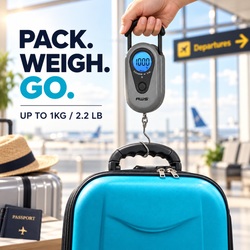
A pocket scale for travel luggage can help you check the weight of your suitcase before leaving home, repacking at a hotel, or approaching an airline check-in counter. However, “pocket scale” can be a confusing term. Traditional pocket scales are compact platform scales designed for small objects and relatively light loads. They generally cannot support a full suitcase.
For luggage, you need a pocket-size hanging scale: a compact handheld instrument with a strap or hook that attaches to a bag handle. You lift the scale and luggage together, allowing the scale to measure the suspended load.
The two most important specifications are capacity and resolution. Capacity tells you the heaviest load the scale is designed to measure. Resolution—also called readability or graduation—tells you the smallest weight increment shown on its display.
For most travelers, a compact luggage scale with a capacity of at least 110 pounds or 50 kilograms and readability between 0.1 and 0.2 pound is a practical choice. That combination covers common checked-baggage weights while remaining small enough to carry in a backpack, purse, or suitcase pocket.
This guide explains how to choose the right capacity and resolution, which additional features matter, and how to obtain repeatable luggage measurements.
Quick Recommendation
The following specifications work well for most leisure and business travelers:
| Specification | Practical Recommendation |
|---|---|
| Scale type | Compact digital hanging scale |
| Capacity | At least 110 lb or 50 kg |
| Resolution | 0.1–0.2 lb or approximately 0.05–0.1 kg |
| Attachment | Strong strap with a secure clasp |
| Units | Pounds and kilograms |
| Display | Large, backlit digital display |
| Helpful functions | Hold, peak hold, low-battery warning and auto-off |
| Portability | Small enough to pack with travel accessories |
Travelers looking for a suitable example can review the AWS-LS0907 compact luggage scale. It offers a 110-pound capacity, 0.1-pound readability, a polypropylene strap, a metal clasp, a backlit display, and a peak-hold function. It also includes a tape measure, which can help when checking a bag’s exterior dimensions.
Always compare your measurement with the rules for your specific airline, fare, destination, and baggage type. Allowances and fees can vary significantly, and the airline’s check-in scale determines the official weight.
What Is a Pocket Scale for Travel Luggage?
In this context, a pocket scale is a small, portable hanging scale designed to fit easily into travel gear. It does not mean a miniature platform scale intended for jewelry, ingredients, coins, or other small items.
A luggage scale typically has four main parts:
-
A handheld body containing the display and weighing mechanism
-
A strap, loop, clasp, or hook that connects to the luggage
-
A digital display that shows the measured weight
-
Controls for power, unit selection, tare, or hold functions
To use the scale, you attach it to the luggage handle and lift until the bag is completely clear of the floor. The scale measures the tension created by the suspended bag and converts that force into a weight reading.
This design is more appropriate for travel than placing a suitcase on a small platform. It also eliminates the difficulty of trying to read a bathroom scale display hidden underneath a large bag.
You can compare luggage models with other portable options in the AWS collection of digital hanging scales.
Why Capacity and Resolution Matter
Capacity and resolution describe different aspects of a scale’s performance. A high-capacity model is not automatically more precise, and a scale with fine resolution is not necessarily suitable for heavy luggage.
Capacity
Capacity is the greatest load the scale is designed to measure. A scale labeled for 110 pounds should not be used for luggage exceeding that limit.
Exceeding capacity can produce an overload warning, an unreliable reading, or damage to the weighing mechanism. The strap or attachment point may also be placed under excessive stress.
Resolution
Resolution is the smallest increment the scale can display. A scale with 0.1-pound resolution may display 42.0, 42.1, and 42.2 pounds. A scale with 0.2-pound resolution may move from 42.0 to 42.2 and then 42.4 pounds.
Resolution affects how precisely you can see changes in luggage weight. It does not, by itself, guarantee overall accuracy. Accuracy also depends on the scale’s design, condition, calibration, environment, battery level, and weighing technique.
Why You Need Both
Suppose you have two scales:
-
Scale A has a capacity of 11 pounds and readability of 0.01 pound.
-
Scale B has a capacity of 110 pounds and readability of 0.1 pound.
Scale A displays smaller increments, but it cannot weigh a loaded suitcase. Scale B has slightly coarser resolution, but its capacity is appropriate for normal luggage.
For travel, usable capacity comes first. After confirming that the scale can safely handle your bags, select enough resolution to identify whether you are comfortably below or uncomfortably close to the airline’s limit.
What Capacity Do You Need for Travel Luggage?
A 110-pound or 50-kilogram capacity is the most versatile choice for ordinary air travel. It covers common checked-bag limits and gives the scale enough range for heavy suitcases, duffel bags, and equipment cases.
The capacity you need depends on what you plan to weigh.
Carry-On Bags
Carry-on bags are usually lighter than checked luggage. A lower-capacity scale might technically handle them, but a 110-pound model remains useful because it can measure both cabin and checked bags.
Airline carry-on policies can address dimensions, weight, or both. Some carriers focus mainly on bag size, while others enforce specific weight limits. The Federal Aviation Administration provides general carry-on baggage guidance, but travelers must still consult their airline for exact requirements.
Standard Checked Luggage
A 110-pound capacity gives travelers room to measure conventional checked bags without approaching the scale’s maximum range. This is especially useful when you are moving items among suitcases to stay under a carrier’s allowance.
The appropriate airline limit cannot be determined from the scale alone. The U.S. Department of Transportation advises travelers to review airline-specific baggage fee information, because fees and restrictions may vary among carriers and itineraries.
Heavy and Oversize Bags
Sports equipment, tools, samples, trade-show materials, and long-trip luggage can be much heavier than an ordinary vacation suitcase. A 110-pound scale may still be suitable if the expected load remains below its rated capacity.
If bags may exceed that range, use equipment specifically designed for heavier loads. Do not assume a compact luggage scale can safely measure freight, machinery, or commercial cargo.
Businesses weighing boxes or outgoing parcels may be better served by purpose-built digital shipping scales with stable platforms and capacities suited to their packages.
Multiple Bags
Do not add several bags to one strap unless the scale and attachment are expressly designed for that configuration. Weigh each bag individually. Separate measurements are easier to control and correspond more closely to how airlines assess checked items.
Why 110 Pounds or 50 Kilograms Is a Useful Target
A capacity of 110 pounds is approximately equivalent to 50 kilograms. This range is common among portable luggage scales because it offers a balance of versatility, compact size, and manageable cost.
It gives you enough capacity to:
-
Check ordinary carry-on and checked luggage
-
Weigh heavily packed suitcases
-
Measure duffel bags and equipment cases
-
Recheck luggage after buying items during a trip
-
Use one device for both domestic and international travel
The capacity rating should not be treated as a recommended lifting weight. Even if a scale can measure 110 pounds, the user may not be able to lift that amount safely.
If a bag is uncomfortably heavy, ask another person for assistance or use an appropriate platform scale. Avoid twisting, jerking, or lifting with an awkward posture merely to obtain a reading.
How Much Resolution Does a Luggage Scale Need?
Most travelers do not need laboratory-style resolution. A luggage scale is intended to tell you whether a bag is comfortably within an airline’s allowance—not to measure tiny changes in mass.
0.1-Pound Resolution
Readability of 0.1 pound gives a detailed display for travel use. It lets you see relatively small changes when removing toiletries, books, shoes, or souvenirs from a bag.
For example, a displayed weight might change from 48.7 to 48.4 pounds after you remove an item.
This is useful when you are balancing contents between two suitcases or trying to create a reasonable buffer below a baggage limit.
0.2-Pound Resolution
Readability of 0.2 pound is also suitable for most travelers. The difference between 0.1- and 0.2-pound increments is unlikely to matter if you maintain a sensible safety margin.
A reading of 49.8 pounds should not be interpreted as a guarantee that a check-in scale will show less than 50 pounds. Minor differences can result from scale condition, technique, rounding, bag movement, or the airport equipment.
Kilogram Resolution
For travelers using metric units, readability around 0.05 or 0.1 kilogram is usually sufficient. The goal is to determine whether your luggage is clearly under the applicable limit.
Changing the display from pounds to kilograms does not change the underlying load. It simply changes how the measurement is presented.
Finer Resolution Is Not Always Better
A display with more decimal places may look more precise, but extra digits are not necessarily helpful for luggage. Movement, lifting angle, and unstable handling can affect the reading more than a very small display increment.
Excessively fine resolution can create false confidence. What matters is whether the entire measuring system—including the load cell, electronics, attachment, calibration, and weighing procedure—produces dependable results.
The National Institute of Standards and Technology’s Office of Weights and Measures offers broader information about measurement standards and reliable weighing practices. A consumer luggage scale is not a substitute for regulated commercial equipment, but the same general principle applies: a measurement is useful only when the instrument and procedure are suitable for the task.
Capacity Versus Resolution: Choosing the Right Balance
Travelers sometimes focus on finding the finest possible resolution and overlook capacity. For luggage, that priority should be reversed.
Use this order when comparing scales:
-
Confirm the scale type is appropriate for suspended luggage.
-
Choose a capacity higher than the heaviest bag you reasonably expect to weigh.
-
Select practical readability, usually 0.1 or 0.2 pound.
-
Compare the attachment, display, hold function, size, and power source.
-
Review the manufacturer’s operating and care instructions.
The following table summarizes common needs:
| Travel Situation | Suggested Capacity | Suggested Resolution |
|---|---|---|
| Light carry-on travel | 50 lb or more | 0.1–0.2 lb |
| Carry-on plus checked luggage | 110 lb/50 kg | 0.1–0.2 lb |
| International travel | 110 lb/50 kg | 0.1 lb or 0.05–0.1 kg |
| Heavy equipment bag | 110 lb or more, based on expected load | 0.1–0.2 lb |
| Commercial freight | Use an appropriate commercial scale | Based on operational requirements |
A 110-pound capacity does not mean the scale is more accurate than a 50-pound model. It only means that the instrument is designed to accept a heavier maximum load.
Features That Matter in a Compact Luggage Scale
Capacity and resolution establish the basic measuring range, but usability depends on several other features.
Secure Strap or Hook
The attachment must fit around the luggage handle and close securely. A durable strap with a metal clasp can reduce the chance that the suitcase will slip while being lifted.
Check the strap before every use. Do not use it if you see tearing, severe fraying, deformation, or damage to the clasp.
Hold or Peak-Hold Function
A hold function keeps the stabilized reading on the screen after you lower the bag. This is valuable because the display may be difficult to read while you are lifting a large suitcase.
Peak hold records the highest detected load during the lift. When used correctly, it can make suspended weighing more convenient.
Backlit Display
A backlit display improves readability in dim hotel rooms, garages, early-morning departure areas, and other low-light environments.
The digits should be large enough to read quickly without changing your grip or turning the scale at an unsafe angle.
Pounds and Kilograms
A unit-selection feature makes the scale more convenient for international trips. Airlines and destinations may present baggage allowances in different units.
Remember to confirm the selected unit before interpreting the result. Confusing pounds with kilograms can lead to a serious packing error.
Low-Battery Indicator
Weak batteries may cause a scale to switch off unexpectedly or behave inconsistently. A low-battery warning gives you time to replace the battery before weighing important luggage.
For frequent travelers, carrying an appropriate spare battery may be worthwhile. Batteries must also be packed in accordance with applicable aviation rules. The FAA’s PackSafe guidance explains restrictions for batteries and other potentially hazardous items.
Automatic Shutoff
Automatic shutoff conserves battery power if the scale is accidentally left on. This is useful for a device that may remain in a travel organizer for months between trips.
Compact Construction
A travel scale should be small enough to remain in your luggage throughout the trip. Leaving it at home defeats one of its biggest advantages: checking the additional weight of purchases before the return flight.
Built-In Tape Measure
Weight is only one part of baggage compliance. Airlines may also apply dimensional limits. A built-in tape can help you estimate the exterior length, width, and height of a bag.
Measure the widest exterior points, including wheels, feet, handles, pockets, and rigid projections when applicable. Then compare those dimensions with the airline’s current policy.
Do Airline Luggage Limits Differ?
Yes. Baggage rules can vary according to:
-
Airline
-
Route
-
Cabin or fare class
-
Loyalty status
-
Ticket type
-
Destination
-
Operating carrier
-
Baggage type
-
Codeshare arrangements
-
Applicable local regulations
Do not rely on a general statement that every checked bag is allowed the same weight. Consult the airline responsible for the flight and review the terms attached to your reservation.
The International Air Transport Association’s overview of baggage operations provides industry context, but it does not replace your carrier’s specific passenger policy.
Also distinguish between weight and contents. A bag can be under the weight allowance and still contain an item that is prohibited or restricted. Before packing, consult the Transportation Security Administration’s What Can I Bring? resource and any applicable airline or destination rules.
How to Weigh Luggage Correctly
A consistent method improves repeatability.
Step 1: Inspect the Scale
Check the body, strap, clasp, and display. Make sure the battery has adequate power and the attachment components are not damaged.
Step 2: Select the Correct Unit
Choose pounds or kilograms to match the airline’s published allowance. Confirm the unit symbol on the display before lifting the bag.
Step 3: Turn On and Zero the Scale
Turn on the scale while it is unloaded. Wait for a stable zero reading. Do not attach or pull on the strap while the scale is initializing unless the manufacturer’s directions specify otherwise.
Step 4: Attach the Strap Securely
Loop the strap through the suitcase handle and fasten the clasp. Confirm that the handle, strap, and clasp are seated correctly.
Do not attach the scale to a decorative loop, zipper pull, or damaged handle that may not support the bag.
Step 5: Use a Safe Lifting Position
Stand with stable footing. Keep the bag close to your body and avoid twisting. Lift smoothly with controlled movement.
If the luggage is too heavy to lift safely, stop. Use assistance or an appropriate platform scale.
Step 6: Lift the Bag Clear of the Floor
The suitcase must be fully suspended. If part of it rests on the floor, bed, wall, or your leg, the displayed weight will be too low.
Avoid bouncing or swinging the bag. Hold it as steadily as possible until the reading stabilizes or the hold function activates.
Step 7: Lower the Bag Carefully
Once the measurement is captured, lower the suitcase in a controlled manner. Read the held value after the bag is safely supported.
Step 8: Repeat the Measurement
Take at least two or three readings. If they are close, you have a reasonable indication of the bag’s weight. If they differ substantially, check your technique, battery, attachment, and scale condition.
Additional care recommendations are available in the AWS guide to scale maintenance.
Leave a Safety Margin Below the Airline Limit
Avoid packing to the exact displayed limit. If the airline allows 50 pounds, a home reading of precisely 50.0 pounds provides no cushion for differences between instruments or weighing conditions.
A practical safety margin may be one or two pounds, depending on the trip, airline policy, and consequences of exceeding the allowance. The correct margin is ultimately a personal decision, but “comfortably below” is safer than “exactly equal.”
Several factors can produce a small difference between your luggage scale and the airport scale:
-
The bag moved during the home measurement.
-
The home scale rounded the displayed value.
-
The battery was weak.
-
The luggage was not lifted vertically.
-
An item was added after weighing.
-
A jacket, tag, strap, or accessory was attached later.
-
The two instruments have different tolerances or calibration conditions.
The check-in scale controls the airline’s decision. Your pocket-size luggage scale is a planning tool that helps reduce surprises; it cannot guarantee the airport result.
Common Luggage-Weighing Mistakes
Using a Gram Pocket Scale
A conventional gram scale may be excellent for small objects, but it does not have the platform size or capacity required for luggage. Do not balance a suitcase on a tiny weighing surface.
Choosing Insufficient Capacity
Never assume that a scale can tolerate a small overload. Select a model with capacity above the greatest load you expect to measure.
Confusing Resolution With Accuracy
A display reading to 0.1 pound does not prove that every measurement is correct within 0.1 pound. Resolution is only the display increment.
Pulling at an Angle
Sideways force can make the suitcase swing and may produce less consistent readings. Lift smoothly and keep the load aligned beneath the scale.
Reading Before the Load Stabilizes
A changing display is not a final measurement. Wait for the reading to settle or for the hold function to capture it.
Ignoring Bag Dimensions
A suitcase can meet the weight limit and still exceed the airline’s permitted dimensions. Check both requirements.
Weighing Only Before Departure
Souvenirs, gifts, documents, product samples, and other purchases can make the return bag heavier. Pack the scale so you can check again before coming home.
Neglecting the Battery
A scale stored for months may have a weak or depleted battery when you need it. Test the device several days before travel.
Testing Your Scale Before a Trip
You can perform a basic repeatability check without attempting a formal calibration.
-
Place a stable object in a strong bag.
-
Weigh it using the same technique three times.
-
Lower the load completely and allow the scale to return to zero between readings.
-
Compare the results.
-
Replace the battery and repeat if the measurements vary unexpectedly.
A repeatability check tells you whether the scale provides similar readings under similar conditions. It does not certify absolute accuracy.
Some hanging scales may support a manufacturer-defined adjustment or calibration procedure, while others may not require user calibration. Follow the manual for the exact model. Never assume that calibration instructions for a platform or pocket scale apply to a luggage scale.
If you need product-specific instructions, replacement information, or troubleshooting assistance, consult AWS customer support.
Caring for a Pocket-Size Luggage Scale
A few simple habits can help protect the instrument:
-
Keep it dry and store it away from extreme temperatures.
-
Do not drop or crush it inside a packed suitcase.
-
Avoid pulling beyond its rated capacity.
-
Inspect the strap and clasp regularly.
-
Remove leaking or damaged batteries promptly.
-
Store it so buttons are not continuously pressed.
-
Test it before an important trip.
-
Follow the manufacturer’s cleaning and battery instructions.
Do not lift luggage by the scale’s display housing unless that is the intended gripping area. Use the grip points described by the manufacturer.
If the scale has been dropped, overloaded, exposed to moisture, or stored with a leaking battery, test it carefully before relying on it.
Is a Pocket Luggage Scale Better Than a Bathroom Scale?
For travel, a compact hanging luggage scale is generally more convenient. It fits in your bag, can be used at a hotel, and is designed to attach directly to a suitcase handle.
A bathroom scale can provide a rough estimate through one of two methods:
-
Place the luggage directly on the scale if it fits without obstructing the display.
-
Weigh yourself, then weigh yourself while holding the luggage and subtract the two readings.
Both methods have limitations. A large bag may sit unevenly on the platform, obscure the display, or shift your posture. Subtracting two body-weight measurements also combines variation from both readings.
A luggage scale produces a direct bag measurement and is easier to take on a trip.
Pocket Luggage Scale Versus Shipping Scale
A luggage scale is best for portability and occasional suspended weighing. A shipping scale is better for packages that can rest on a stable platform.
| Feature | Pocket-Size Luggage Scale | Shipping Scale |
|---|---|---|
| Weighing method | Suspended from strap or hook | Placed on platform |
| Portability | Very high | Low to moderate |
| Best use | Suitcases and travel bags | Parcels and outgoing shipments |
| Storage space | Minimal | More space required |
| Measurement stability | Depends on lifting technique | Generally stable on a level surface |
| Travel convenience | Excellent | Usually impractical |
For a traveler who wants to check bags at home and at a destination, a compact hanging scale is usually the practical choice.
Frequently Asked Questions
What capacity should a travel luggage scale have?
For most travelers, choose a capacity of at least 110 pounds or 50 kilograms. This gives one compact scale enough range for ordinary carry-on bags, checked luggage, and many heavier travel cases.
What resolution is best for a luggage scale?
Readability of 0.1 to 0.2 pound is sufficient for most travel needs. In metric units, approximately 0.05 to 0.1 kilogram is practical.
Can I use a normal pocket scale to weigh luggage?
Not if it is a small platform scale intended for lightweight objects. Travel luggage requires a compact hanging scale with enough capacity and a secure strap or hook.
Is 50-kilogram capacity enough for luggage?
A 50-kilogram or approximately 110-pound capacity is suitable for most passenger luggage. Do not use it for a load that exceeds the manufacturer’s rating.
Is 0.1-pound readability necessary?
It is useful but not essential. A 0.2-pound model can also provide enough information if you leave a reasonable margin below the airline’s limit.
Why does my suitcase weight change between measurements?
The bag may be swinging, the lifting angle may have changed, or the scale may not have returned fully to zero. Battery condition, attachment position, and handling technique can also affect repeatability.
Can I rely on my luggage scale at the airport?
Use it as a planning tool, not as a guarantee. The airline’s scale determines the official weight. Leave a buffer instead of packing to the exact limit shown at home.
Should I weigh luggage in pounds or kilograms?
Use the unit published by your airline to reduce conversion mistakes. A dual-unit scale lets you switch between pounds and kilograms for different trips.
Can a luggage scale measure bag dimensions?
Only if it includes a tape measure or another dimensional tool. Weight and dimensions are separate requirements, so check both.
How often should I test my travel scale?
Test it before each trip, after replacing the battery, and after any drop, overload, or extended storage period.
Where can I compare scale specifications?
The AWS Scale Finder can help narrow available weighing options by intended use, capacity, and other product considerations.
Final Thoughts
The best pocket scale for travel luggage is not a traditional gram scale. It is a compact digital hanging scale designed to travel with you and safely support the expected weight of your bags.
For most travelers, the ideal starting point is:
-
At least 110 pounds or 50 kilograms of capacity
-
Readability of 0.1 to 0.2 pound
-
Pound and kilogram modes
-
A durable strap and secure clasp
-
A hold or peak-hold function
-
A clear, preferably backlit display
-
Compact construction and dependable battery power
Capacity should be your first filter because the scale must safely accommodate the load. Resolution comes next, but ultra-fine increments are unnecessary for ordinary baggage checks. A scale that displays tenths of a pound and gives consistent readings is generally more useful than one that displays extra digits but is difficult to lift, read, or attach securely.
Weigh each bag several times, use a smooth and controlled lifting technique, and leave a reasonable buffer below the airline’s published limit. Finally, check weight rules, dimensional limits, baggage fees, and packing restrictions directly with the airline and relevant transportation authorities before every trip.