
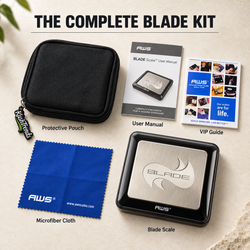
Choosing a scale for lawful ammunition reloading involves more than finding a product that displays grains. A suitable scale must offer useful resolution, documented accuracy, consistent repeatability, sufficient capacity, and a clear calibration procedure. Its platform, power supply, response time, and sensitivity to environmental conditions also affect its performance.
Scale specifications can be misleading when viewed separately. More displayed digits do not necessarily mean greater accuracy, and more capacity is not always beneficial when weighing small amounts. The best scale is one whose complete set of specifications matches the intended measurement process.
A reloading scale is only a measuring instrument. It cannot select a safe load, confirm that components are interchangeable, or replace current published information from reputable manuals and component manufacturers. Always follow every tool and component instruction, positively identify all materials, and comply with applicable laws.
This buying guide covers scale selection and measurement practices without providing charge recipes or load-development instructions.
Why the Right Reloading Scale Matters
A dependable scale can support an organized quality-control process. Depending on its specifications and intended use, it may help users:
-
Verify the performance of a measuring or dispensing system
-
Check appropriate reference weights
-
Compare component weights
-
Identify unexpected measurement changes
-
Confirm that repeated readings remain consistent
-
Check whether the display returns to zero
-
Document measurements
-
Verify one instrument against another
Industry organizations such as the Sporting Arms and Ammunition Manufacturers’ Institute provide technical standards and information related to firearms and ammunition. Current published data and manufacturer instructions should always take priority over informal advice.
Accuracy, Capacity, and Calibration: The Three Essentials
Accuracy, capacity, and calibration are three of the most important specifications in a reloading scale. They describe different aspects of performance and must be evaluated together.
Accuracy
Accuracy describes how closely a displayed measurement agrees with the actual value within the manufacturer’s stated tolerance and operating conditions.
Capacity
Capacity is the maximum physical load the scale can support and measure.
Calibration
Calibration establishes or adjusts the relationship between a known reference weight and the scale’s displayed result.
A scale can have ample capacity and a straightforward calibration process yet still be unsuitable if its resolution is too coarse. It can also display many decimal places without producing accurate or repeatable measurements.
Understanding Scale Accuracy
When evaluating accuracy, look for an actual specification rather than relying on marketing phrases such as:
-
High precision
-
Laboratory quality
-
Professional grade
-
Ultra-accurate
-
Advanced sensor technology
A documented tolerance is more useful than promotional language. The accuracy specification may be expressed as a fixed amount, a percentage, a number of divisions, or a combination of factors.
Accuracy can be influenced by:
-
Calibration
-
Temperature
-
Airflow
-
Vibration
-
Static electricity
-
Power condition
-
Electronic interference
-
Platform contamination
-
Off-center loading
-
Accidental overload
When comparing AWS precision scales, review the complete product specifications, weighing modes, calibration requirements, and operating instructions.
Resolution Is Not Accuracy
Resolution is the smallest increment shown on the display. It may also be called readability, graduation, or division size.
Examples include:
-
1 grain
-
0.1 grain
-
0.01 gram
-
0.001 gram
A scale displaying 0.01 gram is not automatically accurate to exactly 0.01 gram. The displayed increment and the accuracy tolerance are related but separate specifications.
For many reloading-related measurement tasks, users choose at least 0.1-grain resolution. Whole-grain scales are generally too coarse for fine work.
Finer resolution may be helpful only when the scale’s accuracy, repeatability, calibration, and operating environment support it. Extra fluctuating digits do not create more dependable measurements.
The NIST Office of Weights and Measures offers educational resources about weighing systems, standards, and measurement terminology. Personal reloading scales are not necessarily regulated commercial instruments, but understanding these concepts helps buyers interpret specifications.
Grain Mode Versus Gram Mode
The grain is commonly used in ammunition and reloading information. A scale with native grain mode allows measurements to be compared directly with reputable published sources.
The conversion is:
1 gram = approximately 15.432 grains
A 0.01-gram increment equals approximately 0.154 grain. A 0.001-gram increment equals approximately 0.015 grain.
Gram-only scales can still produce useful measurements, but conversion adds calculation, rounding, and transcription steps. Native grain mode is generally more practical for this application.
Confirm the supported weighing modes before buying. Do not assume that every precision or milligram scale displays grains.
How Much Resolution Should You Buy?
A 0.1-grain resolution provides a practical starting point for many small measurements. It offers more detail than a whole-grain scale without necessarily requiring the environmental controls of an extremely sensitive analytical instrument.
Consider finer resolution only when:
-
The stated accuracy supports it
-
Repeatability remains consistent
-
The workbench is stable
-
Air movement can be controlled
-
Static and electronic interference are managed
-
The additional detail is genuinely useful
If the final digits continually fluctuate, the scale may be displaying environmental noise rather than useful measurement information.
How Much Capacity Do You Need?
The scale’s capacity must include the entire physical load:
-
The weighing pan
-
A container or tray
-
The material being measured
-
Calibration and verification weights
-
Any accessory resting on the platform
-
A margin below the maximum capacity
A range of approximately 100 to 500 grams is sufficient for many small measurement applications. Higher capacity may be appropriate for general workshop use, but it can be accompanied by coarser resolution.
Why Excessive Capacity Can Be a Disadvantage
A scale designed to weigh several kilograms may use 1-gram divisions. Since one gram equals approximately 15.432 grains, that resolution is typically too coarse for fine reloading-related measurements.
Choose enough capacity for the pan and intended load without sacrificing useful readability.
Tare Does Not Increase Capacity
When the empty pan is placed on the scale and tare is pressed, the display returns to zero. The pan’s physical weight remains on the load cell.
If a 20-gram pan is tared on a 100-gram scale, only 80 grams of physical capacity remains. An overload can damage the scale even when the displayed net value appears lower than the maximum.
Why Repeatability Matters
Repeatability describes whether the scale produces the same or closely grouped results when the same item is measured repeatedly under unchanged conditions.
Test repeatability with an appropriate known check weight:
-
Place the scale on a rigid, level surface.
-
Allow it to stabilize.
-
Confirm that the platform is empty.
-
Verify that the display reads zero.
-
Apply the check weight.
-
Wait for the reading to settle.
-
Record the result.
-
Remove the weight.
-
Confirm that the display returns to zero.
-
Repeat several times.
If the readings vary, check:
-
Calibration
-
Battery condition
-
Platform cleanliness
-
Pan placement
-
Air movement
-
Vibration
-
Static
-
Temperature
-
Nearby electronics
A scale with more decimal places but poor repeatability is not necessarily a better purchase.
What to Look for in a Calibration System
A suitable scale should provide a clear user-calibration procedure.
Before purchasing, confirm:
-
The required calibration-weight denomination
-
Whether a weight is included
-
Whether compatible weights are available separately
-
How calibration mode is accessed
-
Whether multiple weights are required
-
How the scale confirms successful calibration
-
Whether calibration is retained after shutdown
-
When the manufacturer recommends recalibration
American Weigh Scales offers calibration weights for compatible products. Use the exact denomination specified in the scale’s instructions.
Do not substitute a coin, projectile, cartridge case, or another object of assumed weight. Nominal component weight is not an appropriate calibration standard. Manufacturing tolerance, wear, residue, dirt, and oxidation can alter actual mass.
Calibration Versus Verification
Calibration and verification serve different purposes.
Calibration establishes or adjusts the scale using a specified known weight. Verification checks whether the scale currently produces an expected result.
Verify a scale:
-
Before beginning a measurement session
-
After moving it
-
After replacing batteries
-
Following extended storage
-
After a temperature change
-
When it fails to return to zero
-
When a result appears unexpected
-
After impact or overload
If verification fails, stop using the scale for critical measurements until the cause has been identified.
The current NIST Handbook 44 explains technical concepts used for regulated commercial weighing devices. Although those requirements do not automatically apply to personal scales, the handbook provides useful background about scale divisions, tolerances, and performance.
Pocket Scale or Bench Scale?
Pocket Scales
A pocket scale may be suitable when portability and compact storage matter.
Potential benefits include:
-
Small footprint
-
Battery operation
-
Protective cover
-
Easy transport
-
Fine resolution on selected models
-
Use as a secondary verification instrument
The AWS pocket scale collection includes different capacities, graduations, platform sizes, and unit modes. Confirm that a specific model offers grains and the required calibration features.
Bench Scales
Bench scales may provide:
-
A larger platform
-
A more substantial housing
-
A larger display
-
Continuous AC power
-
More room for containers
-
Permanent placement
Not every bench scale offers suitable resolution. Kitchen, postal, and shipping scales may provide ample capacity but use divisions that are too coarse.
Milligram Scales
A milligram scale reads in thousandths of a gram. The selection of AWS milligram scales may be useful for applications requiring finer resolution.
However, a milligram display does not automatically establish suitability. Review grain mode, accuracy, repeatability, capacity, calibration, and environmental sensitivity.
Platform and Pan Design
The platform must support the pan securely and consistently.
Choose a design with:
-
A level platform
-
Enough room for the intended pan
-
Clearance around the scale housing
-
A removable pan that can be cleaned
-
Controls separate from the weighing area
-
A display visible from the normal working position
-
A protective platform cover
A pan that rocks, slides, touches the scale housing, or presses a button can interfere with readings.
A compact model such as the ZEO50 high-precision digital milligram scale may be worth comparing when fine resolution is important. Verify its current specifications, weighing modes, capacity, and intended uses before purchasing.
Tare and Zero Performance
Tare subtracts the empty pan from the displayed measurement. A dependable scale should establish and maintain zero consistently.
The scale should:
-
Start at zero with an empty platform
-
Tare the pan promptly
-
Hold a stable zero
-
Return to zero after unloading
-
Allow convenient re-zeroing
-
Behave predictably when the pan is removed
If the scale does not return to zero, investigate rather than continuing. Look for debris, pan contact, weak batteries, temperature drift, airflow, vibration, or static.
Response Time
Response time describes how quickly the scale recognizes a load and settles at a stable value.
A scale that responds too slowly can interrupt repeated checks. A display that changes constantly can make the result impossible to interpret.
Look for a balance between prompt response and stable settling. Test whether the scale:
-
Recognizes an appropriate check weight
-
Reaches a stable result
-
Holds the result
-
Returns to zero
-
Repeats the same measurement
-
Continues performing consistently over time
Power Options
Battery Power
Batteries provide portability and may reduce exposure to poor-quality AC power. Weak batteries can contribute to unreliable performance, so a low-battery indicator is important.
Rechargeable Power
Rechargeable scales reduce disposable-battery use. Confirm whether the scale can operate while charging and whether doing so affects measurement stability.
AC Power
AC power is useful for permanent bench installations. Use only the manufacturer-specified adapter and keep the cord from pulling on the scale.
Whenever the power source changes, perform the appropriate zero, calibration, and verification checks.
Automatic Shutoff
Automatic shutoff conserves battery life but may interrupt a session.
An adjustable timeout is helpful. If the scale switches off:
-
Remove all loads.
-
Restart the instrument.
-
Allow it to stabilize.
-
Confirm zero.
-
Perform verification.
-
Resume only when performance is consistent.
Environmental Factors
Airflow
Fans, open windows, HVAC vents, and breathing over the pan may affect sensitive readings. Choose a location away from drafts.
Vibration
Reloading presses, tumblers, case-preparation equipment, speakers, power tools, flexible tables, and foot traffic can transfer movement. Use a rigid surface separate from active machinery.
Temperature
Let the scale and reference weights acclimate after transportation or storage. Do not calibrate immediately after moving the instrument between substantially different temperatures.
Static Electricity
Plastic containers, synthetic clothing, dry air, and packaging can generate static. Follow manufacturer-approved precautions and never introduce improvised electrical devices near energetic materials.
Electronic Interference
Phones, radios, chargers, lighting equipment, and other electronics may affect certain scales. If a device changes the reading, move it away and verify the scale again.
Essential Feature Comparison
| Feature | Buying priority |
|---|---|
| Grain mode | Essential for convenient direct readings |
| Resolution | Commonly 0.1 grain or finer |
| Accuracy | Look for a documented tolerance |
| Repeatability | Repeated checks should remain closely grouped |
| Capacity | Must cover the pan and complete load |
| Calibration | User-accessible with specified weights |
| Tare | Must establish a stable zero |
| Platform | Should support the pan securely |
| Response time | Prompt but stable |
| Power | Appropriate for portable or bench use |
| Warnings | Low-battery and overload indicators |
| Storage | Protective cover or case |
The broader American Weigh Scales collection offers multiple combinations of portability, capacity, graduation, and platform design.
Independent Verification
A second suitable scale or manufacturer-recommended checking method can help identify unexpected drift or disagreement.
If two instruments produce different results:
-
Stop measuring
-
Confirm both units
-
Check both calibration procedures
-
Inspect the reference weights
-
Replace weak batteries
-
Clean the platforms
-
Allow temperature stabilization
-
Eliminate drafts and vibration
-
Move electronic devices away
-
Repeat the verification process
Do not choose whichever reading appears more convenient.
Safety and Health Considerations
Scale selection is only one part of responsible reloading. Always:
-
Use current published data from reputable sources
-
Follow all equipment and component instructions
-
Positively identify every material
-
Retain original labels
-
Use approved storage containers
-
Wear appropriate eye protection
-
Keep the workspace clean and organized
-
Eliminate smoking, flames, sparks, and ignition sources
-
Keep children and unauthorized persons away
-
Avoid distractions
-
Stop when tired or uncertain
-
Never exceed published limits
-
Never substitute components unless current published information explicitly permits it
-
Follow applicable laws
The National Shooting Sports Foundation provides general firearm-safety and responsible-storage resources.
Reloading activities may also involve potential lead exposure from certain projectiles, primers, residues, or surfaces. Review OSHA’s lead information and CDC/NIOSH lead resources when developing hygiene, ventilation, and cleaning procedures.
Avoid eating or drinking at the workbench, and wash your hands after handling components or cleaning the workspace.
Common Buying Mistakes
Avoid these common scale-selection mistakes:
-
Choosing by price alone
-
Confusing resolution with accuracy
-
Assuming more digits guarantee better results
-
Ignoring repeatability
-
Buying excessive capacity
-
Failing to include the pan in capacity calculations
-
Assuming tare restores physical capacity
-
Buying a scale without grain mode
-
Using a coin or component for calibration
-
Ignoring platform dimensions
-
Overlooking automatic shutoff
-
Placing the scale beside vibrating equipment
-
Using it under a fan or vent
-
Continuing after verification fails
-
Relying on one unchecked instrument
-
Treating a scale reading as a replacement for current published data
Reloading Scale Buying Checklist
Before ordering a scale, confirm:
-
Native grain mode
-
Appropriate resolution
-
Documented accuracy
-
Repeatable readings
-
Sufficient physical capacity
-
User calibration
-
Availability of the specified calibration weight
-
Reliable tare and zero
-
A suitable platform and pan
-
Practical response time
-
Low-battery warning
-
Overload indication
-
Appropriate power options
-
Suitable automatic shutoff
-
Protective storage
-
Clear instructions
-
Manufacturer support and warranty information
Frequently Asked Questions
What accuracy should a reloading scale have?
Choose a model with a clearly documented accuracy tolerance appropriate for its intended use. Do not assume the accuracy equals the smallest displayed increment.
What resolution should I choose?
Many users choose at least 0.1-grain resolution. Finer resolution is beneficial only when supported by accuracy, repeatability, correct calibration, and stable environmental conditions.
How much capacity is necessary?
Approximately 100 to 500 grams is sufficient for many small measurement applications. Include the pan and every item resting on the platform.
How often should a scale be calibrated?
Follow the manufacturer’s instructions. Calibration may also be appropriate after transportation, storage, battery replacement, temperature changes, impact, overload, or failed verification.
Can I use a component as a calibration weight?
No. Use the specified calibration weight. Components may differ from their nominal mass and are not substitutes for appropriate reference weights.
Should I use a second scale?
An independent verification method can help identify drift, setup errors, or instrument disagreement. If two suitable scales disagree, stop and investigate before proceeding.
Final Thoughts
The best reloading scale combines appropriate resolution with documented accuracy, reliable repeatability, sufficient capacity, user calibration, stable tare performance, and a secure weighing platform.
For many small measurement applications, native grain mode, 0.1-grain resolution, and approximately 100 to 500 grams of capacity provide a practical starting point. These specifications must still be evaluated alongside calibration, response time, power, platform design, and environmental stability.
Most importantly, a precise scale cannot replace current published information, correct component identification, manufacturer instructions, independent verification, or responsible firearm-safety practices. Select the scale carefully, use the specified reference weights, control the environment, and stop whenever measurements become inconsistent.