
Meta Title: Soap Fragrance Oils Scale Buying Guide: Accuracy and Calibration
Meta Description: Choose the right soap fragrance oil scale by comparing accuracy, capacity, readability, calibration, tare, platform size, stability, and maintenance.
Suggested URL Slug: /soap-fragrance-oils-scale-buying-guide/
Primary Keyword: soap fragrance oils scale buying guide
Secondary Keywords: fragrance oil scale, scale for soap making, precision scale for fragrance oils, digital soap scale, fragrance scale accuracy, soap scale calibration, essential oil scale
Soap Fragrance Oils Scale Buying Guide: Accuracy, Capacity and Calibration
A reliable scale is one of the most important tools in a soap-making workspace. It helps you measure fragrance oils consistently, reproduce successful formulas, control small adjustments, and maintain useful batch records.
The right scale must combine three essential qualities:
-
Accuracy appropriate for your process
-
Enough capacity for the container and ingredients
-
Suitable readability for the smallest quantity you measure
Calibration, repeatability, tare, platform size, stabilization time, environmental sensitivity, and spill protection also affect whether a scale performs well in daily production.
For most soap makers, a digital scale with 0.1-gram readability is appropriate for routine fragrance measurements. A scale with 0.01-gram readability is better for small test batches, fragrance blending, samples, and low-weight additives. Large production vessels may require a separate high-capacity scale for base oils, water, and soap batter.
This buying guide explains how to compare soap fragrance oil scales and select the right capacity, accuracy, resolution, and calibration method for your work.
Quick Buying Recommendations
| Application | Suggested Capacity | Suggested Readability |
|---|---|---|
| Tiny fragrance tests | 100–500 g | 0.01 g |
| Fragrance-blend development | 500–1,000 g | 0.01 g |
| Sample soap batches | 500–1,000 g | 0.01–0.1 g |
| Regular home soap batches | 1,000–3,000 g | 0.1 g |
| Larger fragrance quantities | 3,000–5,000 g | 0.1–1 g |
| Base oils and soap batter | Based on vessel and total batch | 1 g may be sufficient |
| Large production vessels | Above the maximum combined load | Based on process tolerance |
For many soap makers, the most practical system includes two scales:
-
A compact precision scale for fragrances and small additives
-
A higher-capacity scale for bulk ingredients and mixing vessels
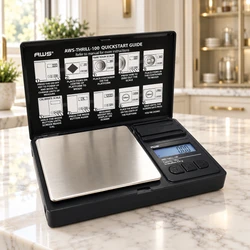
AWS offers both digital pocket scales for small measurements and kitchen scales for higher-capacity formulation tasks.
Why Fragrance Oils Should Be Measured by Weight
Fragrance oils are liquids, but measuring them by volume can introduce inconsistencies.
Different fragrance oils may have different densities. A tablespoon of one oil may not weigh the same as a tablespoon of another. Volume measurements can also be influenced by:
-
Measuring-cup shape
-
Meniscus interpretation
-
Oil remaining on container walls
-
Dropper design
-
Drop size
-
Temperature
-
Air bubbles
-
Surface tension
-
User technique
Weight provides a more repeatable basis for formulation. If a recipe specifies a fragrance quantity in grams, you can reproduce that measurement without relying on the apparent volume of the liquid.
Weight-based formulas are also easier to scale. A fragrance amount can be recalculated for a larger or smaller batch while preserving the intended ratio.
The scale does not determine the correct fragrance percentage. It measures the amount chosen for the formula. The manufacturer must still evaluate current supplier documentation, applicable fragrance standards, and the requirements relevant to the finished product.
Accuracy, Precision, Resolution, and Repeatability
These terms are often used interchangeably, but they describe different scale characteristics.
Accuracy
Accuracy describes how closely a scale’s indication agrees with an accepted reference value.
If an appropriate 100-gram reference is placed on a scale and the display shows 100.0 grams, the reading agrees closely with that reference. A display of 103.2 grams would indicate a significant difference under those test conditions.
Precision
In casual product descriptions, precision may refer generally to fine measurement. Technically, it is often associated with the closeness of repeated results.
A scale can be precise but inaccurate. It might display nearly the same result every time while remaining consistently offset from the reference value.
Resolution or Readability
Resolution is the smallest increment displayed by the scale.
Common examples include:
-
1 g
-
0.1 g
-
0.01 g
-
0.001 g
A scale with 0.01-gram readability displays hundredths of a gram. That does not necessarily mean every reading is accurate within exactly 0.01 gram.
Repeatability
Repeatability describes whether the same stable load produces similar readings when weighed repeatedly under the same conditions.
For production work, repeatability matters because you need a scale to behave consistently from one measurement to the next.
The National Institute of Standards and Technology’s Office of Weights and Measures provides broader information about weighing, measurement standards, and reliable measurement practices.
How Accurate Should a Fragrance-Oil Scale Be?
The scale should be accurate and repeatable enough that its measurement uncertainty is small relative to the ingredient quantity and your acceptable process tolerance.
A scale appropriate for a 100-gram fragrance addition may not be suitable for a 0.25-gram test ingredient. The smaller the target quantity, the more important fine readability and controlled weighing conditions become.
Rather than asking whether a scale is “accurate” in the abstract, ask:
-
What is the smallest amount I will measure?
-
What variation can the formula tolerate?
-
Does the manufacturer state an accuracy or tolerance?
-
Is the scale repeatable at my working weight?
-
Can it be calibrated or checked?
-
Will my workspace support its level of sensitivity?
-
Is the container appropriate for the platform?
-
Will the scale operate well below maximum capacity?
A scale should be selected for the process, not merely because it displays many decimal places.
Choosing the Right Capacity
Capacity is the maximum total load the scale is designed to support.
The total load includes:
-
The empty container
-
The fragrance oil
-
A weighing tray
-
Additional ingredients in the vessel
-
Any permitted platform accessory
Use this formula:
Required capacity = container weight + maximum ingredient weight + reasonable safety margin
Example: Small Fragrance Cup
-
Container: 20 g
-
Fragrance: 50 g
-
Total: 70 g
A 100-gram scale could support the load, but a 200- or 500-gram model would provide more flexibility.
Example: Glass Beaker
-
Container: 180 g
-
Fragrance: 250 g
-
Total: 430 g
A 500-gram scale has enough theoretical capacity, although it leaves limited room for accidental additions.
Example: Production Pitcher
-
Container: 700 g
-
Fragrance: 500 g
-
Total: 1,200 g
A 1,000-gram scale would be overloaded. A scale with at least 2,000 grams of capacity would be more appropriate.
Tare Does Not Increase Capacity
Pressing tare makes the display return to zero, but the physical container remains on the sensor.
If a 500-gram scale supports a 150-gram container, only approximately 350 grams of capacity remain. Adding 500 grams after taring would create a 650-gram physical load.
How Much Capacity Is Best?
100–300 Grams
Best for:
-
Tiny scent tests
-
Lightweight containers
-
Individual fragrance components
-
Small additive quantities
Limitations include small platforms and restricted container choice.
500 Grams
Best for:
-
Fragrance blending
-
Sample batches
-
Small test formulas
-
Precision additives
-
Lightweight glass or plastic containers
A 500 g × 0.01 g scale is a practical dedicated fragrance scale for many makers.
1,000 Grams
Best for:
-
Larger fragrance blends
-
Heavier beakers
-
Small commercial batches
-
Makers wanting more container flexibility
Check whether the model provides 0.01- or 0.1-gram readability.
2,000–5,000 Grams
Best for:
-
Routine soap batches
-
Larger fragrance quantities
-
Heavier containers
-
Oils and other ingredients
-
Makers seeking one versatile scale
At this capacity, 0.1-gram readability is often more common and practical.
Above 5,000 Grams
Best for:
-
Bulk oils
-
Water
-
Complete soap batter
-
Large mixing vessels
-
Production-scale batches
A separate precision scale is usually needed for small fragrance components. Makers requiring larger platforms can compare AWS digital balance scales while checking each model’s actual capacity and readability.
Choosing the Right Readability
One-Gram Readability
Whole-gram readability can work for:
-
Large fragrance quantities
-
Bulk oils
-
Water
-
Soap batter
-
Heavy production vessels
It is generally too coarse for small test batches and detailed fragrance blending.
0.1-Gram Readability
This is the most versatile option for many soap makers.
It works well for:
-
Routine fragrance measurements
-
Home soap batches
-
Small commercial batches
-
Essential oils
-
Moderate additives
-
Recipe scaling
A 0.1-gram scale usually offers a useful combination of capacity, stability, and measurement control.
0.01-Gram Readability
Choose hundredth-gram readability for:
-
Sample batches
-
Small test formulas
-
Multi-component fragrance blends
-
Ingredients used below one gram
-
Product-development work
-
Detailed scent-ratio adjustments
This level is more sensitive to drafts, vibration, static, and temperature changes.
0.001-Gram Readability
Milligram readability is appropriate only when the formulation genuinely requires it. Ordinary soap fragrance quantities rarely need this level of resolution.
AWS milligram scales may be useful for specialized development, but they require suitable handling and environmental control.
Matching Capacity With Readability
Capacity and readability must be evaluated together.
| Scale Specification | Best Application | Main Limitation |
|---|---|---|
| 100 g × 0.01 g | Tiny tests | Very limited capacity |
| 500 g × 0.01 g | Fragrance blending | May not support heavy containers |
| 1,000 g × 0.01 g | Detailed formulation | Greater environmental sensitivity |
| 2,000 g × 0.1 g | Routine soap batches | Less suitable below 1 g |
| 5,000 g × 0.1–1 g | Larger batches | Coarser small-ingredient control |
| High capacity × 1 g | Bulk ingredients | Separate precision scale often needed |
Avoid selecting a scale solely because it has the highest capacity or finest resolution. Either extreme can create an instrument poorly matched to your process.
Calibration Explained
Calibration compares the scale’s indication with a known reference under defined conditions. Some scales also allow adjustment based on that comparison.
The words “calibration” and “adjustment” are sometimes used interchangeably in consumer instructions, but they are not exactly the same:
-
Calibration determines how the instrument compares with a reference.
-
Adjustment changes the instrument’s response when supported by its design.
Not every scale supports user adjustment. Some are configured at the factory and provide no consumer calibration mode.
What You Need for Calibration
A user-calibrated scale may require:
-
A specific reference mass
-
A level and stable surface
-
An empty, clean platform
-
A defined sequence of button presses
-
A stable indoor environment
-
Time for the scale to initialize
-
Confirmation from the display
Use the exact reference mass specified for the model. Do not substitute coins, packaged products, or household objects whose actual masses are uncertain.
AWS offers calibration weights and sets for compatible scale procedures.
General Calibration Process
Always follow the manual for the exact model. A common procedure may include:
-
Place the scale on a stable, level surface.
-
Keep the platform empty.
-
Turn on the scale.
-
Allow it to initialize or warm up when required.
-
Enter calibration mode.
-
Wait for the requested mass to appear.
-
Place the correct calibration weight in the center.
-
Avoid touching the table during calibration.
-
Wait for confirmation.
-
Remove the weight.
-
Exit calibration mode.
-
Perform a verification check.
Do not assume that instructions from a similar-looking scale apply to yours.
How Often Should You Calibrate a Soap Scale?
The appropriate interval depends on:
-
Frequency of use
-
Required process control
-
Scale sensitivity
-
Operating environment
-
Manufacturer instructions
-
History of stable performance
-
Whether the scale is moved
-
Your quality procedures
Check or calibrate the scale:
-
Before initial use
-
Before critical production
-
After relocation
-
After replacing batteries
-
After a drop or impact
-
After an overload
-
When readings become inconsistent
-
At scheduled production intervals
Calibration cannot repair a damaged load cell, liquid intrusion, a cracked platform, or a failing battery.
Calibration Versus a Repeatability Check
A repeatability check evaluates whether the scale produces similar results when the same object is measured repeatedly.
To perform one:
-
Place the scale on a stable surface.
-
Allow it to initialize.
-
Confirm zero.
-
Place a stable test load on the platform.
-
Record the result.
-
Remove the load completely.
-
Wait for the scale to return to zero.
-
Repeat several times.
Closely grouped readings suggest consistent operation under those conditions.
A repeatability check is not a formal calibration because it does not necessarily compare the result with a traceable or appropriate reference. It is still useful for detecting:
-
Environmental instability
-
Weak batteries
-
Platform interference
-
Poor handling
-
Sensor problems
-
Inconsistent zeroing
Why Tare Matters
Tare subtracts the displayed weight of the container.
A reliable workflow is:
-
Turn on the unloaded scale.
-
Select grams.
-
Place the empty container on the platform.
-
Wait for stability.
-
Press tare.
-
Confirm a stable zero.
-
Add fragrance gradually.
-
Record the final actual weight.
A scale with a slow or unreliable tare function can interrupt production and increase error risk.
Remember that the container continues to count toward maximum capacity after taring.
Platform Size and Container Compatibility
The platform must support the container without instability or external contact.
A poorly matched container may:
-
Block the display
-
Wobble
-
Tip
-
Touch the countertop
-
Press against the scale housing
-
Make pouring difficult
-
Increase spill risk
Measure the bases of your common fragrance containers and compare them with the platform dimensions.
If the container is too large, use a smaller weighing vessel and transfer the measured fragrance to the main batch. Do not balance a large soap pot on a compact pocket scale.
Stabilization Time
Stabilization time describes how long the scale takes to settle after the load changes.
A responsive scale helps you approach the target weight without excessive waiting. However, fast response is valuable only when the displayed reading is stable.
To avoid overshooting:
-
Pour quickly only at the beginning.
-
Slow the flow near the target.
-
Use a pipette for the final amount.
-
Pause between additions.
-
Wait for the reading to stabilize.
-
Record the actual result.
If the scale has a stable-weight indicator, wait for it before finalizing the measurement.
Environmental Factors That Affect Accuracy
Uneven Surfaces
Use a hard, level countertop. Avoid flexible tables, padded surfaces, uneven tile, and moving carts.
Vibration
Mixers, blenders, refrigerators, washing machines, foot traffic, and nearby machinery can cause fluctuations.
Air Movement
Fans, vents, open windows, and rapid movement can affect high-resolution scales. A draft shield may be useful for 0.01- or 0.001-gram models.
Temperature
Allow the scale and ingredients to adjust to the workspace after hot or cold storage.
Static
Plastic containers, powders, clothing, and dry air can create static effects that are more noticeable at fine resolutions.
Weak Batteries
Low power can cause dim displays, slow response, shutdowns, or unstable operation.
A precision scale cannot compensate for an unsuitable environment.
Essential Scale Features
Gram Mode
Grams are convenient for small quantities and percentage-based formulations. Verify the unit symbol before every measurement.
Tare
Tare should be responsive, stable, and easy to activate without disturbing the container.
Backlit Display
A clear display helps you monitor small additions and reduces misreading.
Low-Battery Indicator
This warning gives you time to replace the battery before beginning a batch.
Overload Indicator
Remove the load immediately when an overload message appears. Continuing to apply weight may damage the sensor.
Automatic Shutoff
Automatic shutoff conserves power, but the delay should be long enough for your process. Adjustable auto-off is helpful for slow formulation work.
Protective Cover
A cover can protect the platform during storage and may function as a tray when the manufacturer permits.
Easy-to-Clean Platform
A smooth platform is easier to wipe after minor drips. It does not make the entire scale waterproof.
Manufacturer Support
Clear instructions, calibration information, replacement-battery details, and accessible support make the scale easier to maintain correctly.
Spill Protection and Cleaning
Fragrance oil can leave residue, carry a persistent aroma, and enter seams around buttons and displays.
Protect the scale by:
-
Using a container with adequate empty space
-
Adding fragrance slowly
-
Keeping the bottle away from the display
-
Using a pipette near the target
-
Closing bottles promptly
-
Cleaning drips immediately
-
Avoiding direct spray cleaners
-
Following approved cleaning instructions
-
Never submerging a non-waterproof scale
A stainless steel platform may be easy to wipe, but the housing, electronics, battery compartment, and display can remain vulnerable.
Review AWS recommendations for scale maintenance in addition to the manual for the specific model.
Using a Scale for Fragrance-Oil Measurement
Step 1: Review the Formula
Confirm the intended weight, formula version, and applicable fragrance guidance before starting.
Step 2: Prepare the Workspace
Use a stable surface away from drafts, vibration, and active mixers.
Step 3: Inspect the Scale
Check the platform, display, buttons, batteries, and housing for damage or contamination.
Step 4: Verify Capacity
Confirm that the combined container and fragrance weight will remain below the scale’s limit.
Step 5: Turn On and Zero the Scale
Allow it to initialize with the platform empty.
Step 6: Select Grams
Check the unit symbol rather than relying on the previous setting.
Step 7: Place and Tare the Container
Center the vessel, wait for stability, and press tare.
Step 8: Add Fragrance Gradually
Slow down near the target and use a controlled transfer tool.
Step 9: Record the Actual Weight
Document what was measured rather than only the intended quantity.
Step 10: Clean and Store the Scale
Remove residue, allow the surface to dry, and protect the platform from pressure during storage.
Fragrance Safety and Documentation
A scale helps you follow a formula, but it does not determine whether the fragrance level is safe.
Before using a fragrance oil:
-
Confirm its identity.
-
Obtain current supplier documentation.
-
Review the intended product category.
-
Check the applicable usage level.
-
Read the Safety Data Sheet.
-
Use appropriate protective equipment.
-
Maintain suitable ventilation.
-
Label temporary containers.
-
Record lot information when applicable.
-
Prevent cross-contamination.
-
Keep materials away from children and pets.
The International Fragrance Association provides information about its safe-use standards and documentation. Usage limits may differ among fragrances and product categories.
The Occupational Safety and Health Administration explains the information found in Safety Data Sheets, including hazards, first aid, storage, handling, exposure controls, and accidental-release measures.
Soap and Cosmetic Regulatory Considerations
The regulatory status of a product may depend on its composition, intended use, labeling, and marketing claims.
A product marketed solely for cleansing may be treated differently from one promoted with cosmetic or therapeutic benefits. The U.S. Food and Drug Administration discusses this distinction in its frequently asked questions about soap.
Fragrance labeling is another consideration for scented personal-care products. FDA guidance about fragrances in cosmetics provides additional context for manufacturers and sellers.
Accurate weighing supports formulation control and documentation. It does not independently establish regulatory compliance.
One Scale or Two?
One-Scale System
A 3,000- to 5,000-gram scale with 0.1-gram readability may cover:
-
Regular fragrance quantities
-
Moderate base oils
-
Small mixing vessels
-
Colorants
-
Additives
This system works when your ingredient quantities and container weights remain within a relatively narrow range.
Two-Scale System
Use:
-
A high-capacity scale for base oils, water, soap batter, and large vessels
-
A 0.01- or 0.1-gram scale for fragrances and small additives
This is usually the best solution when you produce both small test batches and larger commercial batches.
Common Buying Mistakes
Choosing Resolution Without Checking Capacity
A 0.01-gram scale is useless if the container exceeds its maximum load.
Choosing Capacity Without Checking Resolution
A high-capacity scale may be unable to display small fragrance additions.
Assuming Readability Equals Accuracy
Extra digits do not guarantee correct measurements.
Forgetting the Container Weight
The container counts toward capacity even after taring.
Buying a Platform That Is Too Small
An oversized container can block the display or touch surrounding surfaces.
Ignoring Calibration Requirements
The required reference weight may not be included with the scale.
Calibrating With a Household Object
Coins, packaged products, and other everyday objects are not necessarily appropriate calibration references.
Ignoring Automatic Shutoff
The scale may power down while you pause and lose the tare state.
Assuming a Metal Platform Is Waterproof
Liquid can still enter the buttons, seams, display, or battery compartment.
Using Fine Resolution in an Uncontrolled Environment
A 0.001-gram scale may fluctuate constantly beside a fan, mixer, or flexible table.
Operating at Maximum Capacity
Leave a margin to reduce accidental overload risk.
Soap Fragrance Scale Buying Checklist
Before purchasing, confirm:
-
What is the smallest amount I measure?
-
What is the largest fragrance quantity?
-
What does my heaviest container weigh?
-
What is the maximum combined load?
-
Do I need 1-, 0.1-, 0.01-, or 0.001-gram readability?
-
Does the scale measure in grams?
-
Is tare included?
-
Is the platform large enough?
-
Will the container block the display?
-
How quickly does the reading stabilize?
-
Is user calibration supported?
-
Which calibration mass is required?
-
Is the weight included?
-
Can the scale be checked for repeatability?
-
Does it have overload protection?
-
Is there a low-battery warning?
-
Will automatic shutoff interrupt the process?
-
Is the platform easy to clean?
-
Can the workspace control drafts and vibration?
-
Would two specialized scales work better than one?
Frequently Asked Questions
What is the best scale for soap fragrance oils?
For most soap makers, a scale with 0.1-gram readability, sufficient capacity, gram mode, tare, and a stable platform is the best starting point. Use 0.01 gram for small tests and fragrance blending.
How much capacity do I need?
Add the weight of your heaviest container to the largest fragrance quantity and choose a scale rated comfortably above that total.
Is 0.1 gram accurate enough for fragrance oils?
It is suitable for many routine soap batches. Smaller test formulas may require 0.01-gram readability.
Do I need a 0.01-gram scale?
Choose 0.01 gram when measuring ingredients below a few grams, creating samples, or developing fragrance blends.
Does 0.01-gram readability mean 0.01-gram accuracy?
No. Readability is the smallest displayed increment. Accuracy must be evaluated separately.
What is scale repeatability?
Repeatability is the ability to produce similar results when the same load is measured repeatedly under the same conditions.
Does tare increase scale capacity?
No. Tare resets the displayed value, but the container still contributes to the physical load.
Can I calibrate a fragrance scale myself?
Only if the manufacturer provides a user-calibration procedure. Use the exact reference mass and instructions specified for the model.
How often should the scale be calibrated?
Follow the manufacturer’s instructions and your production schedule. Check it after relocation, battery replacement, impact, overload, or unexplained changes in performance.
Can I use coins to calibrate a scale?
Coins are not an ideal substitute for the specified calibration mass. Use an appropriate reference weight.
Why does my scale drift?
Drafts, vibration, static, temperature changes, weak batteries, surface instability, contamination, or sensor damage can cause drifting readings.
Can I use one scale for fragrance and soap batter?
Yes, if it provides enough capacity and suitable readability for both. Two scales are often more practical.
Should I measure fragrance in grams or ounces?
Either unit can work when used consistently, but grams are generally easier for small quantities and percentage calculations.
Is a stainless steel scale waterproof?
Not necessarily. A stainless steel platform does not guarantee protection for the buttons, housing, display, or electronics.
Does an accurate scale guarantee a safe fragrance level?
No. The scale only measures the amount selected. Safe use depends on current supplier documentation, applicable standards, product category, and relevant requirements.
Final Thoughts
The best soap fragrance oil scale is the one that matches your smallest ingredient quantity, heaviest container, largest batch, and working environment.
For routine fragrance measurement, choose:
-
0.1-gram readability
-
Enough capacity for the container and fragrance
-
Gram mode
-
Reliable tare
-
A stable, appropriately sized platform
-
Clear calibration instructions
-
A visible display
-
Overload and low-battery indicators
For samples and scent development, choose:
-
0.01-gram readability
-
500- to 1,000-gram capacity when suitable
-
Draft protection
-
Fast stabilization
-
A compatible calibration weight
-
A controlled work surface
For large batches, use a separate high-capacity scale for bulk ingredients and vessels.
Accuracy, capacity, and calibration work together. Capacity determines whether the scale can safely support the load. Readability determines how finely it displays changes. Calibration and verification help establish confidence in the result.
When these factors are matched to the soap-making process, a dependable scale improves consistency, documentation, and control while reducing guesswork and unnecessary fragrance waste.