
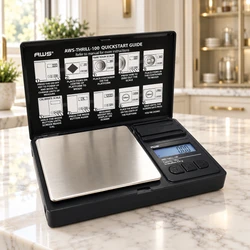
A reliable tea scale makes it easier to reproduce your favorite tea-to-water ratio, compare brewing methods, portion samples, and create consistent blends. Choosing the right model, however, requires more than looking for the greatest number of decimal places.
The scale needs sufficient capacity for everything placed on its platform, appropriate resolution for the smallest tea quantity you measure, dependable repeatability, and a practical calibration process.
For most home tea preparation, a digital scale with 500 to 2,000 grams of capacity and 0.1-gram resolution offers a useful balance. It can measure typical loose-leaf portions while supporting many cups, gaiwans, and small teapots. A scale with 0.01-gram resolution is more suitable for small samples, detailed tasting comparisons, rare teas, and blending ingredients.
Before purchasing a tea scale, determine:
-
Your normal tea portion
-
Your smallest important measurement
-
The weight of your container
-
Whether you will weigh brewing water
-
The heaviest complete load
-
The size of your brewing vessel
-
The level of repeatability required
-
Whether the scale can be calibrated
-
How the scale will be protected from water, steam, and heat
This tea leaves scale buying guide explains the relationship among accuracy, capacity, resolution, repeatability, and calibration so you can select an instrument suited to your brewing process.
Why Weigh Loose-Leaf Tea?
Loose-leaf tea comes in many shapes and densities, including:
-
Fine broken leaves
-
Large whole leaves
-
Flat leaves
-
Long twisted leaves
-
Tightly rolled pellets
-
Compressed tea fragments
-
Powders
-
Flowers
-
Herbs
-
Fruit pieces
-
Spices
A teaspoon measures volume rather than mass. Two teas occupying the same amount of space may have different weights.
A spoonful of dense rolled oolong may contain more tea than an equally full spoon of large white-tea leaves. Measuring both in grams provides a consistent reference regardless of their physical shape.
Using a scale can improve:
-
Tea-to-water consistency
-
Brewing records
-
Comparative tasting
-
Recipe development
-
Sample preparation
-
Tea blending
-
Package filling
-
Inventory estimates
-
Cost calculations
-
Communication between tea professionals
The National Institute of Standards and Technology provides an overview of SI units for mass, including grams and milligrams. Using grams throughout a tea recipe reduces the need for conversions and creates a clear basis for comparison.
The Four Core Tea-Scale Specifications
When comparing scales, begin with four specifications:
-
Resolution
-
Accuracy
-
Repeatability
-
Capacity
These terms describe different aspects of performance.
Resolution
Resolution is the smallest weight increment shown on the display.
A scale with 0.1-gram resolution displays:
-
5.0 g
-
5.1 g
-
5.2 g
A scale with 0.01-gram resolution displays:
-
5.00 g
-
5.01 g
-
5.02 g
Accuracy
Accuracy describes how closely the scale’s reading agrees with an accepted reference value.
Repeatability
Repeatability describes how consistently the same load produces the same result when the measurement is repeated under similar conditions.
Capacity
Capacity is the maximum physical load that the scale can support.
A good tea scale must combine these characteristics appropriately. Fine resolution is not useful when the scale cannot support the brewing vessel, and high capacity is not useful when the displayed increments are too large for individual tea portions.
Resolution Is Not the Same as Accuracy
A scale displaying 5.00 grams may appear more accurate than one displaying 5.0 grams, but the additional decimal place represents resolution—not proof of accuracy.
The scale may display hundredths of a gram while its stated measurement tolerance is larger than 0.01 gram. Environmental factors can also influence the last displayed digit.
Consider these separate questions:
-
What is the smallest increment shown?
-
How close is the reading expected to be to a reference?
-
Does the scale repeat the same reading?
-
What is the minimum recommended load?
-
Does performance remain consistent across the weighing range?
-
Was the scale calibrated correctly?
-
Is the environment stable?
Do not assume that the last digit is exact merely because it appears on the screen.
How Much Resolution Do Tea Leaves Need?
The appropriate resolution depends on the smallest quantity you need to distinguish.
One-Gram Resolution
A whole-gram scale displays 3, 4, or 5 grams without showing the amounts between them.
This is generally too coarse for individual tea portions. If a recipe uses 3 grams, a one-gram difference represents one-third of that quantity.
Whole-gram resolution may be suitable for:
-
Large cold-brew batches
-
Bulk quantities
-
Large blending batches
-
Approximate inventory measurements
-
Applications where small differences are unimportant
0.1-Gram Resolution
For most tea drinkers, 0.1 gram is the practical choice.
It can measure portions such as:
-
2.5 g
-
3.0 g
-
4.7 g
-
5.0 g
-
7.5 g
This resolution is suitable for:
-
Everyday loose-leaf tea
-
Western-style brewing
-
Gongfu-style brewing
-
Herbal infusions
-
Cold-brew recipes
-
General tea preparation
-
Larger tea blends
A 5-gram serving covers 50 displayed increments on a 0.1-gram scale, giving the user meaningful control.
The AWS kitchen scales collection includes larger-capacity options that can work for tea leaves, brewing vessels, and other food-preparation tasks.
0.01-Gram Resolution
A 0.01-gram scale is helpful for:
-
Portions below approximately 2 grams
-
Small tea samples
-
Detailed tasting comparisons
-
Expensive or limited teas
-
Tea-blending ingredients
-
Product-development work
-
Sample packaging
-
Botanical additions
A target of 1.25 grams cannot be displayed directly on a 0.1-gram scale. A 0.01-gram model provides the needed detail.
The AWS pocket scales category includes compact models suitable for dry tea portions and portable tea kits.
0.001-Gram Resolution
A scale displaying 0.001 gram reads in milligram increments.
This is normally unnecessary for brewing tea. Potential specialized applications include:
-
Laboratory analysis
-
Research
-
Very small blending components
-
Controlled formulation work
The AWS milligram scales collection is intended for applications requiring this finer readability.
Milligram-resolution equipment is more sensitive to drafts, vibration, static electricity, temperature changes, and movement. More decimal places can introduce complexity without improving an ordinary cup of tea.
Understanding Scale Accuracy
A tea scale’s accuracy should be evaluated within the context of its intended use.
For casual brewing, a small difference may have little practical effect. For comparative tasting, blend development, or commercial portioning, the acceptable difference may be narrower.
Review the available specifications for:
-
Measurement tolerance
-
Repeatability
-
Linearity
-
Minimum load
-
Stabilization time
-
Operating temperature
-
Calibration method
-
Maximum overload
-
Recommended reference weight
Accuracy at One Point Does Not Prove Accuracy Everywhere
A scale that reads correctly with a 100-gram reference has demonstrated performance at that particular point under those conditions.
It does not automatically prove identical performance:
-
Near zero
-
At 5 grams
-
At 250 grams
-
Near maximum capacity
-
In a different environment
This is related to linearity, or performance across the weighing range.
For more controlled measurement or tea-blending work, an AWS balance scale may provide a more appropriate weighing format than a basic kitchen model.
Repeatability: Essential for Brewing Consistency
Repeatability is often more useful to tea drinkers than chasing extremely fine resolution.
If the same 5-gram portion is placed on the scale several times, a repeatable scale should provide closely agreeing readings.
Example of better repeatability:
-
5.02 g
-
5.02 g
-
5.03 g
-
5.02 g
-
5.02 g
Example of poor repeatability:
-
4.81 g
-
5.16 g
-
4.92 g
-
5.21 g
-
4.87 g
A scale that produces stable, repeatable readings supports meaningful brewing comparisons. A scale that displays extra digits but fluctuates constantly does not.
How to Check Repeatability
-
Place the scale on a stable surface.
-
Allow it to reach room temperature.
-
Confirm that the platform is clean.
-
Turn it on and allow the reading to stabilize.
-
Place an appropriate reference weight in the center.
-
Record the reading.
-
Remove the weight.
-
Wait for the display to return to zero.
-
Repeat several times.
-
Compare the results.
Use a suitable reference weight rather than an object with an assumed mass.
Minimum Load and the Lower Weighing Range
Tea portions are relatively small, so minimum-load behavior matters.
A scale may display 0.01 gram without being ideal for measuring a critical addition of exactly 0.01 gram. The first few increments above zero can be affected by:
-
Zero tracking
-
Internal filtering
-
Load-cell sensitivity
-
Static electricity
-
Air movement
-
Platform vibration
-
The manufacturer’s minimum-load specification
Whenever possible, choose a scale for which the smallest important quantity spans several displayed increments.
For example:
-
A 5-gram portion on a 0.1-gram scale spans 50 increments.
-
A 0.1-gram addition on a 0.1-gram scale spans only one increment.
-
A 0.1-gram addition on a 0.01-gram scale spans 10 increments.
The last example gives the user more information and control, provided the scale’s accuracy and environment support the finer resolution.
Choosing the Correct Capacity
Capacity must account for every item placed on the platform.
Use this equation:
Required physical capacity = container + tea + water + lid + accessories
Example 1: Dry Leaves in a Cup
-
Empty cup: 40 g
-
Tea leaves: 5 g
-
Total load: 45 g
A 100-gram scale could accommodate this setup, but additional capacity would allow the use of heavier containers.
Example 2: Tea Sample Packaging
-
Empty package: 4 g
-
Tea sample: 25 g
-
Total load: 29 g
A 100- or 200-gram pocket scale may provide sufficient capacity.
Example 3: Gaiwan and Water
-
Gaiwan and lid: 190 g
-
Tea: 6 g
-
Water: 110 g
-
Total load: 306 g
A 500-gram scale provides more practical capacity than a 300-gram model.
Example 4: Ceramic Teapot
-
Teapot and lid: 700 g
-
Tea: 8 g
-
Water: 500 g
-
Total load: 1,208 g
A scale with 1,500 or 2,000 grams of capacity would be more appropriate than a 1,000-gram model.
Example 5: Bulk Tea Container
-
Empty container: 400 g
-
Tea: 1,000 g
-
Total load: 1,400 g
A 2,000-gram scale would leave some margin. If larger batches are expected, additional capacity may be needed.
Why You Need a Capacity Margin
Avoid selecting a scale whose maximum capacity barely exceeds the expected load.
A capacity margin accommodates:
-
Differences among containers
-
A heavier lid
-
Additional water
-
Accidental overfilling
-
Filters and accessories
-
Larger future batches
Operating too close to maximum capacity also increases the risk of accidental overload.
Do not automatically choose the highest-capacity model, however. Greater capacity can come with coarser resolution. The objective is enough capacity for the complete load while preserving the readability needed for the smallest important tea quantity.
Tare and Physical Capacity
Tare allows the user to place a container on the scale and reset the display to zero.
Example:
-
Empty vessel: 250 g
-
Scale capacity: 500 g
-
Reading after tare: 0.0 g
-
Remaining physical capacity: approximately 250 g
Tare changes the displayed value. It does not remove the vessel’s physical weight from the load cell.
This is especially important when adding brewing water. A heavy vessel can consume most of the scale’s capacity before the display is reset.
Maintain a separate understanding of the total load even when the screen displays only the net weight.
Recommended Capacity and Resolution
| Tea application | Suggested capacity | Suggested resolution |
|---|---|---|
| Individual dry portions | 100–500 g | 0.01–0.1 g |
| Everyday brewing | 500–2,000 g | 0.1 g |
| Gongfu brewing | 500–1,000 g | 0.01–0.1 g |
| Small tea samples | 100–500 g | 0.01 g |
| Tea blending | 500–2,000 g | 0.01–0.1 g |
| Teapot plus water | 1,500–2,000 g or more | 0.1 g |
| Bulk packaging | 1,000 g or more | 0.1–1 g |
| Research applications | Process-dependent | 0.001–0.01 g |
These are general starting points. Review the specifications of the individual model and calculate your own maximum load.
Tea Scale Calibration
Calibration compares the scale’s response with a known reference and, when the scale permits, adjusts its response.
Proper calibration requires:
-
The correct reference weight
-
A stable surface
-
A clean platform
-
Minimal air movement
-
Minimal vibration
-
A stable temperature
-
The procedure specified for the model
Suitable AWS calibration weights can support the calibration or checking of compatible scales.
Do Not Calibrate With Coins
Coins, utensils, packaged foods, tea tins, and jewelry are not appropriate calibration references.
Their masses may differ because of:
-
Manufacturing tolerances
-
Wear
-
Dirt
-
Residue
-
Damage
-
Packaging variation
Use the reference mass specified by the scale manufacturer.
Calibration, Verification and Adjustment
These terms are related but not interchangeable.
Calibration
Calibration compares the scale’s indication with a reference.
Verification
Verification checks whether the scale’s reading is within an acceptable range for the process.
Adjustment
Adjustment changes the scale’s response when the instrument supports it.
A scale can be verified without being adjusted. Likewise, completing an adjustment does not prove perfect performance at every point in the weighing range.
How to Calibrate a Tea Scale
Always follow the instructions for the exact model. A general process may include:
-
Place the scale on a firm, level surface.
-
Remove sources of air movement and vibration.
-
Allow the scale and reference weight to reach room temperature.
-
Clean and inspect the platform.
-
Turn on the scale.
-
Allow the display to stabilize.
-
Enter calibration mode.
-
Place the specified calibration weight in the center.
-
Wait for the confirmation signal.
-
Remove the weight as directed.
-
Exit calibration mode.
-
Perform a separate verification check.
Do not improvise a calibration sequence. Different models may require different reference weights and button combinations.
When Should You Calibrate or Check the Scale?
There is no universal interval that applies to every user.
Calibration or verification may be appropriate:
-
When the scale is new
-
Before an important tasting
-
Before blend-development work
-
According to the manufacturer’s schedule
-
After moving the scale
-
After traveling
-
After battery replacement
-
After a major temperature change
-
After an accidental impact
-
After an overload
-
When readings become unstable
-
When a reference check produces an unexpected result
-
According to a commercial quality procedure
A scale used occasionally at home may have different requirements from one used daily for tea packaging.
What Calibration Cannot Correct
Calibration cannot compensate for:
-
A container touching the table
-
An unstable work surface
-
A draft
-
Kettle steam
-
Static electricity
-
A hot vessel
-
Low batteries
-
A damaged load cell
-
An overloaded scale
-
A weighing platform obstructed by debris
-
A sample below the useful weighing range
If readings remain unstable after calibration, inspect the environment, power source, container placement, and scale condition.
Platform Size and Container Fit
The platform must support the base of the chosen vessel.
A scale can have sufficient capacity while being too small physically for a teapot or bowl.
An oversized container may:
-
Cover the display
-
Contact the table
-
Rest on the scale housing
-
Press a button
-
Shift during pouring
-
Apply an off-center load
-
Increase spill risk
Measure the base of your common vessels and compare it with the listed platform dimensions.
A lightweight but bulky tea, such as a large-leaf white tea or herbal blend, may also require a wider weighing container than a dense rolled tea.
Display Position and Visibility
The display should remain visible while the container is on the platform.
Look for:
-
Large digits
-
High contrast
-
Backlighting
-
A forward-facing position
-
A stable-reading indicator
-
A low-battery warning
-
An overload indicator
If a large teapot blocks the display, the scale may be difficult to use even when its other specifications are suitable.
Response Speed
A responsive scale updates quickly as tea or water is added.
This is particularly important when:
-
Pouring brewing water
-
Approaching a small target
-
Filling sample packages
-
Preparing several portions
-
Measuring blending ingredients
A slow display can continue rising after the user stops pouring.
Response speed should be paired with stability. A display that reacts rapidly but fluctuates constantly is not practical.
Auto-Off Settings
Automatic shutoff preserves battery life but can interrupt:
-
Gongfu sessions
-
Long steeps
-
Comparative tasting
-
Tea-blending work
-
Packaging tasks
Look for an adjustable auto-off interval or the ability to disable it.
If the scale shuts down, the previous tare value may be lost. This can be inconvenient or create errors when a filled container remains on the platform.
Timer Function
A built-in timer can be helpful because tea preparation depends on both quantity and time.
A combined scale and timer allows the user to monitor:
-
Tea weight
-
Water weight
-
Pour duration
-
Steep time
-
Time between infusions
A timer is useful but optional. Measurement quality, capacity, platform size, and tare performance should be prioritized.
Power Options
Common power sources include:
-
Replaceable batteries
-
Rechargeable batteries
-
USB power
-
AC power
Battery power offers portability. External power may be useful for long tea sessions or repeated package filling.
If using a cable:
-
Keep it away from water
-
Prevent it from pulling the scale
-
Do not place it under a scale foot
-
Confirm that the scale remains level
Replace or recharge weak batteries when the display becomes dim, unstable, or unresponsive.
Cleaning and Maintenance
Tea scales may encounter:
-
Leaf dust
-
Broken leaves
-
Water droplets
-
Steam
-
Powdered tea
-
Sticky botanical ingredients
Use a clean cup, tray, or weighing paper rather than placing tea directly on a platform that may have contacted unrelated materials.
Do not immerse a scale unless it is specifically designed for immersion. A metal platform does not mean that the buttons, display, battery compartment, and electronics are waterproof.
The AWS guide to scale maintenance and care provides additional information for protecting a scale during normal use.
Environmental Factors That Affect Accuracy
Drafts
Fans, air-conditioning vents, open windows, and breathing can influence fine readings or move lightweight tea leaves.
Vibration
Footsteps, refrigerators, kettles, grinders, and unstable tables can cause fluctuations.
Static Electricity
Dry tea and plastic containers may create static. Leaves can cling to trays or transfer tools, and fine-scale readings may drift.
Temperature Changes
Allow a scale moved between environments to stabilize before precise use.
Heat and Steam
A hot teapot or kettle steam may affect readings or damage a scale that is not designed for those conditions.
Uneven Surfaces
Use a firm, level worktop. Soft mats, towels, beds, and flexible trays can reduce stability.
Container Contact
Make sure the vessel touches only the weighing platform. Contact with another surface can support part of the load and produce an incorrect result.
How to Evaluate a New Tea Scale
Zero-Stability Test
Turn on the empty scale and observe whether it settles at zero.
Repeatability Test
Weigh the same appropriate reference several times, removing it between measurements.
Tare Test
Place your normal container on the platform, tare it, and verify that the reading remains stable.
Platform Test
Confirm that the container fits without touching another surface or obscuring the display.
Response Test
Add tea gradually and observe how quickly the display updates.
Capacity Test
Calculate the total load of your heaviest setup. Do not intentionally overload the scale to test its limit.
Auto-Off Test
Time how long the scale remains on and confirm that the setting suits your tea sessions.
Water-Pouring Test
If you plan to weigh water, practice using a compatible vessel within the scale’s capacity and temperature limits.
Using a Tea Scale Correctly
A consistent procedure improves measurement quality.
1. Set Up the Workspace
Choose a firm, level surface away from drafts, vibration, steam, and direct sunlight.
2. Inspect the Scale
Confirm that the platform is clean, the batteries are adequate, and nothing obstructs the weighing mechanism.
3. Select Grams
Use one unit consistently throughout the recipe and brewing notes.
4. Place the Container Centrally
Center the cup, tray, gaiwan, or teapot on the platform.
5. Press Tare
Wait for a stable zero before adding tea.
6. Add Tea Gradually
Approach the target slowly, especially when using a 0.01-gram scale.
7. Record the Actual Amount
If the target is 5.0 grams and the actual reading is 5.2 grams, record 5.2 grams when maintaining detailed tasting notes.
8. Add Water Only Within Capacity
Account for the vessel, lid, tea, filter, and water.
9. Remove Spills and Debris
Clean according to the manufacturer’s instructions.
10. Protect the Scale During Storage
Use the supplied cover and do not place heavy objects on the platform.
Tea-to-Water Ratios
A scale allows tea and water to be recorded as a ratio.
| Tea weight | Water weight | Ratio |
|---|---|---|
| 2 g | 200 g | 1:100 |
| 3 g | 250 g | 1:83 |
| 5 g | 250 g | 1:50 |
| 5 g | 100 g | 1:20 |
| 8 g | 120 g | 1:15 |
These are mathematical examples rather than universal brewing recommendations.
Preferred ratios vary based on:
-
Tea type
-
Leaf shape
-
Processing method
-
Brewing vessel
-
Water temperature
-
Steep time
-
Number of infusions
-
Personal taste
Use the scale to control the starting quantities and adjust one variable at a time.
Tea Composition and Brewing Variables
A scale measures the mass of dry tea and water. It does not directly measure the composition of the finished beverage.
The USDA’s FoodData Central provides available food-composition data for many foods and beverages. The composition of a particular tea infusion can vary based on the tea, amount used, water, temperature, and steeping method.
Accurate weighing does not determine:
-
Caffeine content
-
Nutrient content
-
Freshness
-
Ingredient purity
-
Contaminant levels
-
Product suitability for an individual
-
Flavor quality
These questions require information and methods beyond a general tea scale.
Commercial Tea Packaging
Tea businesses may use scales to:
-
Fill retail packages
-
Prepare samples
-
Divide bulk stock
-
Measure blending ingredients
-
Check net quantity
-
Track production loss
Commercial use can involve additional equipment and procedural requirements.
NIST provides resources about legal metrology and weights and measures. A scale suitable for home brewing should not automatically be assumed suitable for a commercial transaction based on weight.
The FDA provides information concerning food labeling and nutrition. Applicable requirements may depend on the product, package, claims, quantity, sales channel, and jurisdiction.
Businesses should confirm federal, state, and local rules before using a scale to determine the quantity sold.
Food-Handling Considerations
Keep the scale and weighing containers clean and dry. Protect tea from moisture, strong odors, pests, and cross-contamination.
The FDA publishes the Food Code as a model for food-safety practices in retail and food-service settings.
Good practices can include:
-
Using clean, food-appropriate containers
-
Preventing cross-contact
-
Removing leaf dust and residue
-
Protecting tea from water
-
Cleaning spills promptly
-
Separating tea from strongly scented products
-
Following applicable commercial procedures
A scale measures mass. It does not establish sanitation, freshness, or regulatory compliance.
Common Tea-Scale Buying Mistakes
Choosing Based Only on Decimal Places
Additional digits do not guarantee better accuracy or repeatability.
Buying a Whole-Gram Scale
Whole-gram resolution is usually too coarse for small individual portions.
Ignoring the Container Weight
The container counts toward capacity even after tare is pressed.
Forgetting the Water
A teapot may fit within capacity when empty but exceed it after water is added.
Assuming Tare Restores Capacity
Tare changes the displayed result, not the physical load.
Choosing Excessive Capacity
A high-capacity scale may use increments that are too large for small tea portions.
Choosing Insufficient Capacity
A fine pocket scale may work for leaves but not for a brewing vessel.
Ignoring the Minimum Load
The smallest displayed increment may not be the best working minimum.
Using an Oversized Container
A vessel touching another surface can produce an incorrect reading.
Calibrating With Coins
Coins and household objects are not appropriate reference standards.
Exposing the Scale to Heat or Steam
Hot vessels and kettle steam can damage equipment not designed for those conditions.
Ignoring Auto-Off
A short shutoff interval can interrupt brewing and erase the tare state.
Tea Scale Buying Checklist
Accuracy and Performance
-
Is the stated resolution appropriate?
-
Are accuracy or tolerance specifications available?
-
Are readings repeatable?
-
Is the minimum load identified?
-
Does the display stabilize quickly?
-
Can the scale be calibrated?
Capacity
-
What is the empty container weight?
-
What is the maximum tea quantity?
-
Will water be added?
-
What is the complete physical load?
-
Is there a capacity margin?
Platform and Display
-
Does the container base fit?
-
Will the display remain visible?
-
Is the tare button accessible?
-
Is the platform easy to clean?
-
Will the vessel remain stable?
Calibration
-
Which reference weight is required?
-
Is the calibration procedure available?
-
Can performance be verified separately?
-
How often should the scale be checked?
-
Does the intended process require records?
Brewing Convenience
-
Does the scale measure in grams?
-
Is the response fast enough for water?
-
Is a timer included?
-
Can auto-off be adjusted?
-
Is the power source practical?
Environment
-
Is the scale protected from drafts?
-
Is the surface level and stable?
-
Will steam or water reach it?
-
Is the vessel within the temperature limit?
-
Can the scale be stored safely?
Frequently Asked Questions
What is the best scale for tea leaves?
For most tea drinkers, a scale with 500 to 2,000 grams of capacity and 0.1-gram resolution offers the best general balance. Smaller samples and detailed blending may justify 0.01-gram resolution.
Is 0.1 gram accurate enough for tea?
A scale with 0.1-gram resolution is suitable for most tea portions. Accuracy and repeatability should still be evaluated separately.
When do I need 0.01-gram resolution?
Choose 0.01 gram for portions below approximately 2 grams, small samples, detailed tasting comparisons, expensive tea, or low-weight blending ingredients.
Do tea leaves require a milligram scale?
Ordinary tea brewing does not require milligram resolution. A 0.001-gram scale is more relevant to specialized research and controlled formulation work.
What capacity should a tea scale have?
Calculate the container, tea, water, lid, and accessories. For leaves alone, 200 to 500 grams may be enough. For a teapot and water, 1,500 to 2,000 grams or more may be necessary.
Does tare increase the scale’s capacity?
No. Tare resets the display, but the container continues to count toward the physical load.
What is the difference between resolution and accuracy?
Resolution is the smallest increment displayed. Accuracy describes how closely the result agrees with a reference value.
How do I test repeatability?
Weigh the same appropriate reference several times under unchanged conditions, removing it between measurements, and compare the readings.
Can I calibrate a tea scale with a coin?
No. Use the calibration weight specified by the manufacturer.
Why is my tea scale drifting?
Possible causes include drafts, vibration, static electricity, temperature changes, steam, low batteries, an unstable surface, or a container touching another object.
Can I place a hot teapot on a digital scale?
Only if the manufacturer states that the scale is designed for the vessel’s temperature. Excessive heat may damage the scale or affect readings.
Is a household tea scale legal for commercial sales?
Not automatically. Commercial transactions may require approved equipment and compliance with applicable weights-and-measures rules.
Final Thoughts
Choosing a tea scale requires balancing accuracy, capacity, resolution, repeatability, platform size, and calibration.
For most daily brewing, a scale with 0.1-gram resolution and 500 to 2,000 grams of capacity offers practical control without unnecessary sensitivity. A 0.01-gram scale is useful for small samples, tea blending, rare teas, and detailed comparison work. Milligram resolution should be reserved for specialized applications that genuinely require it.
Before purchasing:
-
Identify your smallest important measurement.
-
Calculate the complete physical load.
-
Include a capacity margin.
-
Measure the base of your brewing vessel.
-
Review accuracy and repeatability specifications.
-
Confirm the calibration procedure.
-
Check auto-off, response speed, and display visibility.
-
Protect the scale from steam, heat, water, drafts, and vibration.
The best tea scale is not simply the model with the most digits. It is the scale that performs reliably throughout your actual working range and fits naturally into the way you brew, taste, blend, or package tea.