
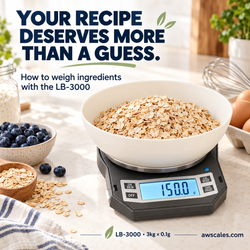
Choosing between a 1500g x 0.1g scale and a 3000g x 0.1g scale starts with one straightforward difference: the 3000g model supports twice the maximum load, while both display weight in 0.1g increments.
A 1500g scale may provide enough capacity for smaller portions, loose components, and lightweight containers. A 3000g scale offers more room for larger batches, heavier bowls, and weighing several ingredients in one container.
However, matching readability does not mean that two scales have identical accuracy or repeatability. To choose the right digital scale, you need to consider the complete load, the smallest quantity you measure, and the performance specifications of the individual model.
This guide explains how the two capacity options compare and what to check before buying.
1500g x 0.1g vs 3000g x 0.1g: Quick Comparison
| Feature | 1500g x 0.1g scale | 3000g x 0.1g scale |
|---|---|---|
| Maximum rated capacity | 1500 grams | 3000 grams |
| Capacity in kilograms | 1.5kg | 3kg |
| Display increment | 0.1g | 0.1g |
| Maximum capacity divided by display increment | 15,000 increments | 30,000 increments |
| Room for heavy containers | Less | More |
| Potential applications | Smaller portions, lightweight materials, compact batches | Larger portions, heavier vessels, expanded batches |
| Guaranteed accuracy from these specifications alone | Not established | Not established |
| Platform size and portability | Depend on the model | Depend on the model |
| Main buying consideration | Whether the complete load fits within 1500g | Whether additional capacity benefits your workflow |
The main takeaway: a 3000g x 0.1g scale doubles the rated weighing capacity without changing the displayed gram increment. It does not automatically double accuracy or provide finer resolution.
What Does 1500g x 0.1g Mean?
A scale specification written as 1500g x 0.1g describes two separate characteristics:
-
1500g: the maximum rated load.
-
0.1g: the increment between displayed readings in grams.
The display might show 125.0g, 125.1g, or 125.2g. That tells you how finely the result is displayed, but it does not establish how close the reading is to the actual mass.
The 1500g capacity equals 1.5 kilograms. For reference, NIST’s guide to SI mass units explains the relationship between grams and kilograms.
For shoppers exploring this capacity, American Weigh Scales offers the Chrome 1500g Digital Pocket Scale Series. Review the individual product specifications and instructions before deciding whether its platform and features suit your application.
What Does 3000g x 0.1g Mean?
A 3000g x 0.1g digital scale supports a maximum rated load of 3000 grams, or 3 kilograms, while displaying results in 0.1g increments.
Compared with a 1500g model, it provides an additional 1500g of load capacity. That extra room can matter when your weighing vessel is heavy or when your process involves adding several ingredients to the same bowl.
For example, a container weighing 500g and materials weighing 1200g create a total load of 1700g. That exceeds a 1500g scale’s capacity, even though the materials alone weigh less than 1500g. A 3000g model has sufficient rated capacity for that combined load.
The AWS BARISTA-3KG Coffee/Kitchen Scale is an example of an American Weigh Scales model listed with a 3kg capacity and 0.1g readability. Its suitability still depends on the rest of its specifications and your intended workflow.
Do Both Scales Have the Same Precision?
Both scales have the same stated readability, but their actual measurement performance may differ.
In everyday shopping language, “precision” often refers to the number of decimal places shown on the screen. In measurement work, precision concerns how closely repeated results agree.
That distinction matters when comparing digital scales.
Readability
Readability is the smallest displayed increment. Both scales in this comparison display grams in 0.1g steps.
A 0.1g display does not prove that every addition of 0.1g will produce an immediate, reliable change. Response behavior and performance at low loads depend on the model.
Accuracy
Accuracy concerns how closely a measurement agrees with the reference value.
A scale can display one decimal place and still have an error greater than 0.1g. You need additional performance information to assess its suitability for your tolerance requirements.
Repeatability
Repeatability concerns how closely the scale’s readings agree when the same object is weighed repeatedly under the same conditions.
A scale that gives stable repeated results is useful for consistent portioning and batch preparation. However, repeated agreement alone does not establish that those results are accurate.
NIST’s weighing and scales FAQs provide further background on scale divisions, weighing terminology, and device requirements.
When comparing two products, look beyond the capacity and display increment. Consider published repeatability, linearity, operating conditions, and calibration requirements where available.
Why Tare Weight Matters When Comparing Capacity
The tare function lets you remove a container’s weight from the displayed result. It makes weighing the contents easier, but it does not increase the scale’s physical load capacity.
If you place a 400g bowl on a 1500g scale and press tare, the screen may return to zero. The bowl still contributes 400g to the load on the platform.
Your remaining rated capacity is therefore:
1500g − 400g = 1100g
On a 3000g scale, the same bowl leaves:
3000g − 400g = 2600g
Container Weight Example
| Weighing setup | Container weight | Contents weight | Total platform load | Capacity assessment |
|---|---|---|---|---|
| Lightweight cup with a small portion | 100g | 250g | 350g | Within both capacities |
| Bowl with a moderate batch | 350g | 900g | 1250g | Within both capacities |
| Heavy bowl with a larger batch | 600g | 1200g | 1800g | Exceeds 1500g; within 3000g |
| Large container with bulk ingredients | 750g | 2000g | 2750g | Exceeds 1500g; within 3000g |
These examples illustrate capacity calculations, not performance guarantees for a particular scale.
Always include the container, lid, tray, and everything else resting on the platform. AWS’s scale FAQs address overload precautions and common weighing problems.
When to Choose a 1500g x 0.1g Scale
A 1500g x 0.1g scale can be a practical choice when your complete weighing load stays comfortably below 1500g and the model meets your measurement requirements.
Smaller Food Portions
Smaller ingredient portions and lightweight food containers may fit easily within a 1500g capacity.
For example, a 150g container holding a 400g portion creates a 550g total load. Additional capacity may offer little benefit if that represents your normal workflow.
Lightweight Parts and Craft Materials
A 1500g scale may be suitable for weighing groups of beads, hardware, packaging components, or craft materials when 0.1g readability and the model’s actual performance meet the task’s needs.
For very small individual items, assess whether finer readability is necessary.
Limited Work Space
Some 1500g models are compact enough for small desks or portable setups. However, capacity alone does not establish physical size.
Compare platform dimensions, overall measurements, power options, and protective features rather than assuming every lower-capacity scale is smaller.
Consistent, Predictable Loads
If your process always involves similar loads well below 1500g, choosing a suitable 1500g scale can keep your setup simple.
Leave room for the heaviest container and the largest batch you realistically expect to weigh.
When to Choose a 3000g x 0.1g Scale
A 3000g x 0.1g scale becomes more useful when larger total loads are part of your regular process.
Heavier Bowls and Brewing Vessels
Coffee and kitchen workflows may involve a vessel, ingredients, and accumulated liquid on the platform simultaneously.
A higher capacity gives you more room for the complete setup. Check that the platform supports the vessel securely and that the display remains visible during use.
Larger Ingredient Batches
A batch containing 1600g of ingredients exceeds a 1500g scale’s capacity before you add a container.
A 3000g model may accommodate that batch and its vessel, allowing you to weigh it in one operation.
Adding Ingredients Sequentially
If you add ingredients to one bowl and tare between additions, the total physical load continues to increase.
More capacity can reduce the need to split a recipe across multiple weighing sessions. Keep track of the cumulative load rather than relying on the current net display alone.
Expanding Workflows
A 3000g scale may be the more practical choice if you expect your batch sizes to increase.
Consider your likely future loads alongside current requirements. Also compare features, dimensions, and price; capacity alone does not establish overall value.
Is a 3000g Scale Less Accurate Than a 1500g Scale?
There is no universal rule that the higher-capacity scale is less accurate.
Both can display 0.1g increments, while differing in sensor performance, electronics, calibration, and construction. The specification “1500g x 0.1g” or “3000g x 0.1g” does not provide enough information to rank accuracy.
A useful comparison asks:
-
What accuracy or tolerance information does the manufacturer provide?
-
How repeatable are readings at your normal working loads?
-
Does the scale perform adequately at your smallest required quantity?
-
What calibration procedure and reference weights are required?
-
Under what environmental conditions should it operate?
NIST’s guidance on metrological traceability also explains that traceability alone does not guarantee measurement uncertainty is adequate for a particular purpose. Your acceptance criteria must match your application.
Is 0.1g Readability Fine Enough for Your Application?
The amount being weighed helps determine whether 0.1g readability is appropriate.
As a simple comparison:
| Quantity being weighed | One 0.1g display increment as a percentage of that quantity |
|---|---|
| 1g | 10% |
| 10g | 1% |
| 100g | 0.1% |
| 1000g | 0.01% |
These percentages describe the size of one display increment relative to the load. They are not accuracy specifications or estimates of total measurement error.
They show why a scale with 0.1g readability may be useful for larger portions yet unsuitable for some tiny quantities.
If your task requires distinguishing changes smaller than 0.1g, consider finer readability together with suitable accuracy, repeatability, and minimum-load performance. AWS’s product FAQ offers additional guidance on choosing display resolution.
Calibration and Performance Checks
Calibration and routine checks serve different purposes.
Calibration establishes the relationship between a scale’s indications and reference values. Some user-operated “calibration” procedures also adjust the scale’s response. A routine check compares the displayed result with a suitable known reference to help identify a problem.
NIST’s introduction to calibration explains calibration in relation to reference standards and instrument response.
For either capacity, follow the instructions for the exact model.
Use the Required Reference Weight
Do not assume that a 1500g scale requires a 1500g calibration weight or that a 3000g scale requires a 3000g weight.
The manufacturer specifies the required calibration load and procedure. Weight quality should also match the scale and your measurement requirements.
If you are considering the AWS Calibration Weight Kit, compare its included weights and stated class with your model’s requirements before purchasing.
Check Performance at Relevant Loads
A check at one load does not establish performance across the entire weighing range.
Where your process requires it, use suitable reference weights at representative working loads. Repeated measurements can also help reveal unstable results.
NIST’s discussion of check standards describes their role in monitoring measurement bias and variability over time.
Follow the Model’s Instructions
Setup, calibration steps, power requirements, and operating limits vary between scales. Consult the American Weigh Scales manuals for the instructions associated with your model.
How to Get More Consistent Weighing Results
Good weighing habits help you make better use of either capacity.
-
Use a stable surface. A firm counter or bench helps reduce movement during weighing.
-
Follow the setup instructions. Allow any specified stabilization time and use the scale within its operating conditions.
-
Check zero before weighing. Confirm that the unloaded display is ready before placing an item on the platform.
-
Keep the load centered. Position the container securely without letting it touch nearby surfaces.
-
Avoid drafts and vibration. Air movement and nearby activity can interfere with sensitive readings.
-
Wait for a stable result. Give the scale time to settle after each addition.
-
Stay within capacity. Include the container and all accumulated contents.
-
Handle the platform gently. Place loads carefully and avoid impacts.
If readings change unexpectedly, investigate setup, environmental conditions, power, and calibration rather than assuming that capacity is the cause.
Common Buying Mistakes
Treating Readability as Guaranteed Accuracy
A scale displaying 0.1g does not automatically have a maximum error of ±0.1g. Check the individual model’s performance information.
Forgetting Container Weight
A heavy bowl can use a substantial share of a 1500g capacity. Calculate the complete platform load before choosing.
Assuming Tare Creates More Capacity
Tare changes the displayed net result. It does not remove the container’s physical load from the scale.
Choosing Capacity Without Checking Platform Size
A scale may have sufficient rated capacity but an awkward platform for your vessel. Confirm fit, stability, and display visibility.
Buying Extra Capacity When You Need Finer Readability
Moving from 1500g x 0.1g to 3000g x 0.1g increases capacity. If you need finer displayed increments, compare scales with 0.01g or 0.001g readability and appropriate performance specifications instead.
Frequently Asked Questions
What is the difference between a 1500g x 0.1g and a 3000g x 0.1g scale?
The 3000g scale has twice the maximum rated capacity. Both display gram readings in 0.1g increments. Accuracy, repeatability, features, and physical size depend on the individual models.
Is a 3000g x 0.1g scale more precise?
It has the same stated readability as a 1500g x 0.1g scale. You need repeatability and other performance information to compare measurement precision.
Can a 1500g scale weigh 1500g of ingredients in a bowl?
Only if the complete load, including the bowl, stays within the rated capacity. A bowl plus 1500g of ingredients exceeds a 1500g maximum.
Does pressing tare reset the available capacity?
No. The container remains on the platform and continues to count toward the maximum load.
Which capacity is better for coffee?
Choose based on the combined weight of the brewing vessel, coffee, and liquid, along with platform fit and the model’s response and features. A 3000g capacity offers more room for heavier setups.
Which scale is better for small quantities?
Capacity alone cannot answer that question. Compare readability, minimum-load suitability, repeatability, and accuracy at the quantities you actually weigh.
Can either scale be used for selling products by weight?
Do not infer legal-for-trade suitability from capacity or readability. Confirm the specific device’s approval and the requirements that apply to your location and transaction.
Which Scale Should You Choose?
Choose a 1500g x 0.1g scale when your complete loads stay comfortably below 1500g and the model meets your requirements for performance, platform size, and features.
Choose a 3000g x 0.1g scale when heavier containers, larger batches, or growing workloads make the additional capacity useful.
Both offer the same stated 0.1g readability. The right choice is the model that accommodates your full load and delivers suitable measurement performance at the quantities you use most often.