
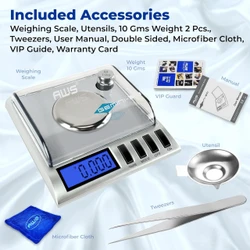
A 20g x 0.001g scale and a 50g x 0.001g scale provide the same displayed resolution: both show weight in increments of 0.001 gram, or one milligram. The key difference is capacity.
A 50-gram scale supports 2.5 times as much total weight as a 20-gram scale:
50 g ÷ 20 g = 2.5
That additional capacity provides more room for:
-
Larger samples
-
Heavier containers
-
Multiple items
-
Bigger weighing trays
-
Greater overload protection
-
Future changes in the weighing process
The 20-gram model may still be the better choice when extreme portability, compact storage and lightweight samples are the priorities.
The basic comparison is:
| Specification | 20g x 0.001g Scale | 50g x 0.001g Scale |
|---|---|---|
| Maximum capacity | 20 g | 50 g |
| Readability | 0.001 g | 0.001 g |
| Displayed increment | 1 mg | 1 mg |
| Displayed divisions | 20,000 | 50,000 |
| Relative capacity | 1× | 2.5× |
| Container flexibility | Limited | Greater |
| Best for | Tiny samples | Wider range of samples |
A 50g x 0.001g scale is generally more versatile. A 20g x 0.001g scale is appropriate when every combined load remains comfortably below 20 grams and the smaller design offers a meaningful advantage.
What the Specifications Mean
Scale specifications commonly use the following format:
Maximum capacity × readability
Therefore:
20g x 0.001g
-
Maximum load: 20 grams
-
Display increment: 0.001 gram
-
Milligram equivalent: 1 milligram
-
Total displayed divisions: 20,000
50g x 0.001g
-
Maximum load: 50 grams
-
Display increment: 0.001 gram
-
Milligram equivalent: 1 milligram
-
Total displayed divisions: 50,000
NIST explains the SI system for mass in its guide to SI units for mass. One milligram equals 0.001 gram.
The Main Difference Is Capacity, Not Readability
Both scales show three decimal places in gram mode.
For example, both may display:
-
0.001 g
-
0.125 g
-
1.428 g
-
12.736 g
The 20-gram scale cannot support a total load above 20 grams. The 50-gram scale continues through:
-
25.000 g
-
35.000 g
-
45.000 g
-
50.000 g maximum
If the only comparison is displayed resolution, neither scale has an advantage. Both display one-milligram increments.
The 50-gram model wins on operating range.
Readability Does Not Equal Accuracy
A displayed increment of 0.001 gram does not automatically guarantee accuracy within exactly ±0.001 gram.
Readability
The smallest increment shown on the display.
Accuracy
Closeness of the reading to an accepted reference value.
Repeatability
Consistency when the same load is weighed repeatedly under unchanged conditions.
Linearity
Performance at different points across the weighing range.
Minimum Practical Load
The smallest quantity that can be measured dependably for the intended task.
NIST explains the distinction between a displayed scale division and verification scale division. A smaller displayed division does not necessarily prove equivalent verified accuracy.
The 50-gram scale is not automatically less precise because it has more capacity. Likewise, the 20-gram scale is not automatically more accurate because its range is smaller.
Compare the manufacturer’s complete specifications and test performance under the intended conditions.
Capacity Includes the Container
The maximum capacity applies to everything placed on the platform:
-
Sample
-
Tray
-
Weighing paper
-
Container
-
Scoop
-
Protective liner
This is where the difference between 20 and 50 grams becomes most important.
Example One: Lightweight Tray
-
Tray: 3 g
-
Sample: 8 g
-
Total load: 11 g
Both scales can support the load.
Example Two: Glass Dish
-
Dish: 14 g
-
Sample: 10 g
-
Total load: 24 g
The 20-gram scale is overloaded. The 50-gram scale can support it.
Example Three: Multiple Components
-
Container: 8 g
-
Components: 30 g
-
Total load: 38 g
Only the 50-gram scale is suitable.
Tare Does Not Restore Capacity
Tare resets the displayed value to zero after a container is placed on the scale. It does not remove that container’s physical weight.
Suppose a container weighs 12 grams.
On a 20-Gram Scale
-
Physical load before sample: 12 g
-
Display after tare: 0.000 g
-
Approximate remaining capacity: 8 g
On a 50-Gram Scale
-
Physical load before sample: 12 g
-
Display after tare: 0.000 g
-
Approximate remaining capacity: 38 g
This is why the 50-gram model offers much greater flexibility even though both scales have identical readability.
Capacity Margin
A scale should not routinely operate at its maximum.
If the heaviest combined load is 19 grams:
-
It technically fits on a 20-gram scale.
-
It leaves only one gram of capacity.
-
A slight overfill can cause an overload.
-
A heavier replacement tray may exceed the limit.
A 50-gram scale would provide substantially more operating margin.
Choose 20 Grams When:
-
Combined loads usually remain below 10–15 grams.
-
Containers are extremely lightweight.
-
The scale will be protected from accidental overload.
-
Portability matters more than range.
-
Samples will not grow in size.
Choose 50 Grams When:
-
Combined loads sometimes exceed 15 grams.
-
Glass or metal containers are used.
-
Several pieces are weighed together.
-
Future applications may require more range.
-
Overload margin is important.
Comparing AWS Gemini Models
The GEMINI-20 Precision Milligram Scale and GEMINI-50 Precision Milligram Scale illustrate this capacity tradeoff.
| Feature | GEMINI-20 | GEMINI-50 |
|---|---|---|
| Capacity | 20 g | 50 g |
| Readability | 0.001 g | 0.001 g |
| Display increment | 1 mg | 1 mg |
| Platform | 1.3 × 1.3 in | 1.3 × 1.3 in |
| Units | g, oz, ozt, dwt, ct, gn | g, oz, ozt, dwt, ct, gn |
| Power | 2 AAA batteries | 2 AAA batteries |
| Included calibration weight | 20 g | 20 g |
| Best advantage | Focused low-capacity precision | Higher-capacity versatility |
The two models share a similar compact platform and unit selection. The principal practical difference is the maximum load.
AWS provides a dedicated Gemini-20 versus Gemini-50 comparison for shoppers deciding between the two capacities.
Best Applications for a 20g x 0.001g Scale
A 20-gram model is appropriate for tightly focused precision work.
Small Gemstones
It can handle:
-
Individual gemstones
-
Small diamonds
-
Lightweight parcels
-
Tiny jewelry findings
Twenty grams equals 100 carats, but the container also consumes capacity.
Tiny Electronics
Suitable examples include:
-
Small resistors
-
Capacitors
-
Diodes
-
Lightweight integrated circuits
-
Miniature connectors
It is generally too limited for complete circuit-board assemblies.
Watch and Miniature Hardware
Possible items include:
-
Springs
-
Screws
-
Pins
-
Clips
-
Gears
-
Watch components
Powders and Pigments
A 20-gram model can handle very small samples when a lightweight tray is used and the environment is controlled.
Focused Educational Work
It may support demonstrations involving small reference masses and nonregulated samples.
Best Applications for a 50g x 0.001g Scale
A 50-gram model covers the same small-sample work while allowing larger loads.
Larger Gemstone Parcels
Fifty grams equals 250 carats, before accounting for the container.
This allows:
-
Multiple gemstones
-
Larger stones
-
Heavier trays
-
Jewelry assemblies
Electronics Batches
A 50-gram capacity can support:
-
Multiple components
-
Larger connectors
-
Small modules
-
Hardware batches
-
Lightweight assemblies
Laboratory-Style Samples
Additional capacity accommodates:
-
Larger weighing dishes
-
Sample containers
-
Multiple reference materials
-
Comparative batches
A consumer milligram scale should not automatically be treated as a certified analytical balance.
Craft and Model-Making Materials
A 50-gram model offers flexibility for:
-
Resin additives
-
Pigments
-
Tiny fasteners
-
Miniature parts
-
Specialty materials
Portability Comparison
A 20-gram scale may feel more focused and compact, but capacity alone does not always determine physical size.
When comparing products, check:
-
Overall dimensions
-
Platform size
-
Carrying case
-
Battery requirement
-
Protective cover
-
Included trays
-
Total kit weight
If 20- and 50-gram models share the same body dimensions, the higher-capacity version may provide greater versatility without a portability penalty.
Platform Size
Capacity does not describe the platform.
A 50-gram scale may still have a small platform, while a lower-capacity balance could have a larger weighing surface.
The container should:
-
Fit completely or securely
-
Stay centered
-
Avoid the scale housing
-
Not touch a draft shield
-
Leave the display visible
-
Remain stable
Any external contact can transfer weight away from the platform.
Displayed Divisions
The number of displayed divisions is calculated as:
Capacity ÷ readability
20-Gram Scale
20 g ÷ 0.001 g = 20,000 divisions
50-Gram Scale
50 g ÷ 0.001 g = 50,000 divisions
The larger number does not automatically guarantee better performance. It means the 50-gram scale displays one-milligram increments across a wider range.
Maintaining dependable performance across more divisions requires good:
-
Sensor design
-
Electronics
-
Calibration
-
Repeatability
-
Linearity
-
Environmental control
Minimum Load
Neither capacity specification establishes the minimum dependable load.
A scale may display one-milligram increments but require a larger sample for reliable quantitative work.
Establish a minimum practical load by considering:
-
Repeatability
-
Accuracy tolerance
-
Environmental stability
-
Required confidence
-
Application risk
NIST offers additional explanations of these concepts through its weighing and scales FAQs.
Repeatability Testing
Test either scale by following the same procedure:
-
Place the scale on a rigid, level surface.
-
Protect it from drafts.
-
Allow it to reach room temperature.
-
Turn it on.
-
Wait for zero to stabilize.
-
Apply a suitable reference weight.
-
Record the result.
-
Remove the weight.
-
Wait for zero.
-
Repeat at least ten times.
-
Compare the results.
The scale should produce consistent readings within the requirements of the application.
Linearity Testing
Test at several points across the range.
Suggested 20-Gram Evaluation Points
-
Low working load
-
5 g
-
10 g
-
15 g
-
Upper working range
Suggested 50-Gram Evaluation Points
-
Low working load
-
10 g
-
20 g
-
30 g
-
40 g
-
Upper working range
Use appropriate reference weights and never exceed capacity.
Calibration Weight Differences
The required calibration mass depends on the model—not simply its maximum capacity.
A 20-gram scale may calibrate with:
-
10 g
-
20 g
-
Another value specified by the manufacturer
A 50-gram scale may calibrate with:
-
20 g
-
50 g
-
Another specified value
Do not assume that the calibration weight must always equal maximum capacity.
AWS provides compatible calibration weights for supported models.
Calibration Weight Handling
At milligram readability:
-
Handle weights with tweezers or clean gloves.
-
Keep them free from dust and oil.
-
Store them in protective cases.
-
Allow them to acclimate.
-
Place them gently in the platform center.
-
Do not slide them.
-
Avoid touching them with bare fingers.
Small contamination can matter when readings are displayed in one-milligram increments.
Calibration Versus Verification
Calibration
Establishes or adjusts the scale response.
Verification
Checks performance using a known reference mass.
Do not recalibrate automatically whenever a reading appears unusual. First check:
-
Batteries
-
Drafts
-
Surface stability
-
Platform cleanliness
-
Static
-
Temperature
-
Unit setting
-
Weight condition
-
Container contact
Follow the model-specific procedure in the AWS collection of digital scale manuals.
Environmental Sensitivity
Both scales display the same one-milligram increment, so both require similar environmental care.
Drafts
Air-conditioning vents, fans and open doors can move the final digits.
Vibration
Foot traffic, machinery, flexible tables and printers can create unstable readings.
Temperature
Allow the scale, samples and weights to reach a common stable temperature.
Static
Plastic trays, powders and dry air can produce static charges.
Humidity
Some materials gain or lose moisture as humidity changes.
Surface Level
Use a rigid, level bench.
Neither the 20- nor 50-gram model has an automatic advantage against these influences simply because of capacity.
Draft Shields
A draft shield reduces the influence of air movement.
It is especially useful for:
-
Powders
-
Pigments
-
Lightweight samples
-
Tiny hardware
-
Gemstones
-
Fine components
Check the internal dimensions of the shield. A 50-gram capacity provides little benefit if the required container cannot fit inside the weighing chamber.
Power Options
Compare:
-
Battery type
-
Battery quantity
-
External adapter compatibility
-
Rechargeability
-
Low-battery indicator
-
Auto-off settings
Battery power supports portability. External power is helpful during long bench sessions.
Power-source differences can affect convenience more than the 20-versus-50-gram capacity distinction.
Units of Measurement
Common milligram-scale units include:
-
Grams
-
Ounces
-
Troy ounces
-
Pennyweight
-
Carats
-
Grains
NIST explains gram-based decimal units in its overview of metric SI prefixes.
Select grams for most scientific and formulation applications. Confirm conversions before using specialty units.
Accuracy and Legal Metrology
A scale used for regulated commercial transactions may have requirements that go beyond readability.
NIST discusses accuracy classes and commercial scale suitability in its guide to Class II scale applications.
Current model requirements for commercial weighing devices are published in NIST Handbook 44.
A consumer milligram scale should not automatically be treated as:
-
Legal for trade
-
Laboratory-certified
-
Medical equipment
-
Pharmaceutical equipment
-
Suitable for safety-critical dosing
Use application-approved equipment for regulated work.
When a 20-Gram Scale Is the Better Choice
Choose 20g x 0.001g when:
-
Every total load remains comfortably below 20 grams.
-
Containers weigh only a few grams.
-
Samples are individual pieces.
-
Portability is the main priority.
-
The model costs less.
-
A larger capacity provides no practical benefit.
A 20-gram scale is especially logical for individual gemstones, tiny components and tightly controlled samples.
When a 50-Gram Scale Is the Better Choice
Choose 50g x 0.001g when:
-
Containers weigh more than a few grams.
-
Samples vary widely.
-
Multiple items are weighed together.
-
Future applications may be heavier.
-
You need more overload margin.
-
Both models have similar dimensions.
-
The price difference is acceptable.
For most users who genuinely need 0.001-gram readability, the 50-gram configuration offers greater versatility.
When Neither Is the Right Choice
Choose a different specification when:
You Need More Capacity
Consider:
-
100g x 0.001g
-
500g x 0.01g
-
1,000g x 0.1g
You Do Not Need Milligram Readability
A 0.01- or 0.1-gram scale may be easier to use, faster to stabilize and more affordable.
You Need Formal Laboratory Performance
Choose a suitable analytical or precision balance with documented performance.
You Need Commercial Approval
Use a device approved for the applicable legal-for-trade use.
Browse the complete AWS milligram scale selection to compare additional capacities and designs.
Common Buying Mistakes
Assuming the 20-Gram Scale Is More Precise
Both specifications provide 0.001-gram readability.
Ignoring Container Weight
The container counts toward capacity even after tare.
Choosing Capacity With No Margin
A 19-gram routine load is too close to a 20-gram limit.
Assuming More Capacity Reduces Readability
Both scales display the same one-milligram increments.
Ignoring Platform Size
A higher capacity does not guarantee a larger platform.
Treating Readability as Accuracy
Three decimal places do not establish the full accuracy tolerance.
Calibrating With Coins
Use the specified calibration weight.
Ignoring Environmental Conditions
Drafts, vibration and static can overwhelm the final digit.
Buying Checklist
Before choosing 20 or 50 grams, determine:
-
Heaviest sample
-
Container weight
-
Total combined load
-
Desired capacity margin
-
Required readability
-
Stated accuracy
-
Repeatability
-
Minimum practical load
-
Platform dimensions
-
Draft-shield clearance
-
Available units
-
Calibration weight
-
Power options
-
Auto-off settings
-
Protective case
-
Intended regulated or nonregulated use
Frequently Asked Questions
Is a 20g x 0.001g scale more precise than a 50g x 0.001g scale?
Not based on readability alone. Both display one-milligram increments. Compare accuracy, repeatability and linearity separately.
How much more capacity does the 50-gram scale provide?
It provides 2.5 times the maximum capacity of a 20-gram scale.
Does a 50-gram scale still read one milligram?
Yes. A 50g x 0.001g scale displays weight in one-milligram increments.
Does tare restore full capacity?
No. The container continues to apply a physical load.
Which scale is better for gemstones?
A 20-gram model can suit individual stones and lightweight trays. A 50-gram model is better for parcels, multiple stones and heavier containers.
Which scale is better for electronic components?
A 20-gram scale may handle individual tiny parts. A 50-gram scale offers more flexibility for multiple components and small assemblies.
Is the 50-gram scale safer from overload?
It offers more capacity margin, but it can still be damaged by loads above 50 grams or by impact.
Do both scales need protection from drafts?
Yes. Both display 0.001-gram increments and can be affected by air movement.
Can I use the same calibration weight for both?
Possibly, but only if both manuals specify that value. Follow the procedure for each model.
Are these scales legal for trade?
Not automatically. Confirm approval requirements with the appropriate authority.
Final Verdict
A 20g x 0.001g scale and a 50g x 0.001g scale offer the same displayed precision: one-milligram increments.
Choose the 20-gram version when:
-
Loads are consistently very light.
-
Containers use little capacity.
-
Compactness is valuable.
-
The narrow range is not restrictive.
Choose the 50-gram version when:
-
You need heavier containers.
-
Samples vary in size.
-
Multiple items are weighed together.
-
Additional overload margin matters.
-
You want greater long-term flexibility.
For most buyers, the 50g x 0.001g scale is the more versatile choice because it provides 2.5 times the capacity without sacrificing displayed resolution. The 20-gram version remains a strong option for highly focused, lightweight applications.
Whichever capacity you choose, remember that 0.001 gram describes readability—not guaranteed accuracy. Control drafts, vibration, temperature and static; use suitable calibration weights; and verify performance across the actual working range.