
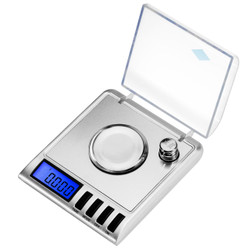
The AWS Gemini-20 and Gemini-50 are compact digital milligram scales designed for measurements requiring 0.001g readability. They share the same platform size, physical dimensions, display size, measurement units, operating-temperature range, and portable design.
The primary difference is capacity.
The Gemini-20 can weigh up to 20 grams, while the Gemini-50 can weigh up to 50 grams. Both display measurements in one-milligram increments, but the Gemini-50 provides an additional 30 grams of capacity.
For most buyers, the Gemini-50 is the more versatile option because it can accommodate heavier objects and containers without sacrificing 0.001g readability. The Gemini-20 remains an excellent choice for lightweight gemstones, jewelry components, fine craft materials, and other items that consistently remain below 20 grams.
This comparison examines the specifications, features, accessories, applications, and limitations of both milligram scales.
Gemini-20 vs. Gemini-50: Quick Comparison
| Feature | AWS Gemini-20 | AWS Gemini-50 |
|---|---|---|
| Maximum capacity | 20g | 50g |
| Readability | 0.001g | 0.001g |
| Equivalent readability | 1mg | 1mg |
| Calibration weight | 20g included | 20g included |
| Weighing units | g, oz, ozt, dwt, ct, gn | g, oz, ozt, dwt, ct, gn |
| Platform size | 1.3 × 1.3 inches | 1.3 × 1.3 inches |
| Display size | 0.4 × 1.2 inches | 0.4 × 1.2 inches |
| Dimensions | 3.5 × 4 × 0.8 inches | 3.5 × 4 × 0.8 inches |
| Power | Two AAA batteries | Two AAA batteries |
| Batteries included | Yes | Yes |
| Operating temperature | 50°F–86°F | 50°F–86°F |
| Warranty | 10 years | 10 years |
| Best for | Very lightweight items | Greater versatility and capacity |
The Short Answer: Which Gemini Scale Is Better?
Choose the Gemini-20 Precision Milligram Scale if every item, tray, and container you intend to weigh will remain comfortably below 20 grams.
Choose the Gemini-50 Precision Milligram Scale if you want more flexibility. It supports up to 50 grams while maintaining the same 0.001g readability.
The Gemini-50 is the stronger all-purpose choice. Its additional capacity accommodates heavier jewelry, larger gemstones, groups of small components, more substantial trays, and applications that may grow over time.
The Gemini-20 can still be the right choice when your work is strictly limited to very lightweight materials and you do not need extra capacity.
What Does 0.001g Readability Mean?
Both Gemini models display measurements in increments of 0.001 gram.
Since one gram equals 1,000 milligrams:
0.001 gram equals one milligram.
The display can therefore show values such as:
- 0.001g
- 0.002g
- 0.015g
- 1.247g
- 12.568g
This readability is ten times finer than that of a 0.01g pocket scale.
Milligram readability is useful for gemstones, jewelry findings, precious metal samples, beads, pigments, technical components, and other small objects where a difference of only a few milligrams may matter.
Readability should not be confused with guaranteed accuracy under every condition. Calibration, airflow, vibration, temperature, surface stability, static electricity, and user technique can all affect a milligram-scale reading.
AWS Gemini-20 Overview
The Gemini-20 is a compact milligram scale with a 20g maximum capacity and 0.001g readability.
It measures approximately 3.5 by 4 by 0.8 inches, making it easy to store in a pocket, purse, backpack, drawer, or equipment bag. Its flip-down cover protects the weighing surface during transportation and can help shield lightweight objects from moving air.
The scale includes a 20g calibration weight, tweezers, weighing tray, carrying case, and two AAA batteries.
Gemini-20 Specifications
- Maximum capacity: 20g
- Readability: 0.001g
- Calibration: 20g calibration weight included
- Units: Grams, ounces, troy ounces, pennyweights, carats and grains
- Platform: 1.3 by 1.3 inches
- Display: 0.4 by 1.2 inches
- Dimensions: 3.5 by 4 by 0.8 inches
- Power: Two included AAA batteries
- Operating temperature: 50°F to 86°F
- Warranty: 10-year manufacturer’s warranty
Gemini-20 Features
The Gemini-20 includes:
- Backlit LCD
- Tare function
- Mode selection
- Add-up function
- Automatic shutoff
- Easy calibration
- Flip-down protective shield
- Anti-skid padding
- Six weighing units
- Portable carrying case
What Is the Gemini-20 Best For?
The Gemini-20 is best for:
- Loose gemstones
- Jewelry findings
- Small precious metal samples
- Lightweight coins
- Beads
- Fine pigments
- Tiny electronic components
- Miniature hardware
- Educational projects
- Portable precision weighing
Its 20g limit is sufficient for many tiny items, but it leaves relatively little room for heavy containers or grouped materials.
AWS Gemini-50 Overview
The Gemini-50 has a 50g maximum capacity and the same 0.001g readability as the Gemini-20.
Its platform, display, dimensions, supported units, power requirements, calibration weight, and operating-temperature range are equivalent to those of the 20g model. The key advantage is the additional 30 grams of capacity.
The Gemini-50 includes a 20g calibration weight, tweezers, a weighing pan or funnel, a microfiber cloth, and two AAA batteries.
Gemini-50 Specifications
- Maximum capacity: 50g
- Readability: 0.001g
- Calibration: 20g calibration weight included
- Units: Grams, ounces, troy ounces, pennyweights, carats and grains
- Platform: 1.3 by 1.3 inches
- Display: 0.4 by 1.2 inches
- Dimensions: 3.5 by 4 by 0.8 inches
- Power: Two included AAA batteries
- Operating temperature: 50°F to 86°F
- Warranty: 10-year manufacturer’s warranty
What Is the Gemini-50 Best For?
The Gemini-50 is best for:
- Larger gemstones
- Jewelry and precious metal samples
- Coins and collectibles
- Grouped beads
- Craft components
- Fine powders and pigments
- Small technical parts
- Heavier weighing containers
- Projects requiring greater flexibility
The 50g capacity makes it easier to use a tray or container without approaching the scale’s maximum load.
The Biggest Difference: 20g vs. 50g Capacity
The Gemini-50 can support two and a half times as much total weight as the Gemini-20.
This difference matters because maximum capacity includes everything placed on the scale—not only the material being measured.
For example, suppose you are using a tray weighing 8 grams.
With the Gemini-20:
- Maximum capacity: 20g
- Tray weight: 8g
- Remaining capacity: Approximately 12g
With the Gemini-50:
- Maximum capacity: 50g
- Tray weight: 8g
- Remaining capacity: Approximately 42g
Pressing tare resets the display to zero, but it does not remove the tray’s physical weight from the load cell.
If you regularly use containers or weigh grouped items, the Gemini-50 provides considerably more practical working capacity.
Does the Gemini-50 Provide Better Precision?
No. Both scales provide the same 0.001g readability.
The Gemini-50 does not show smaller measurement increments than the Gemini-20. Its advantage is additional capacity, not finer display resolution.
Both models can display a result such as 5.247g. The Gemini-50 can simply continue weighing objects after the Gemini-20 has reached its 20g limit.
Users who need one-milligram readability can select either model. The decision should be based primarily on the heaviest total load expected.
Is the Gemini-20 More Accurate?
A lower maximum capacity does not automatically make a scale more accurate.
Both models are designed to display measurements in 0.001g increments. Measurement performance depends on:
- Correct calibration
- A stable surface
- Protection from drafts
- Consistent temperature
- Proper item placement
- Battery condition
- Avoiding overload
- Correct handling
The Gemini-20 should not be considered more accurate simply because its capacity is lower. Similarly, the Gemini-50 should not be considered more accurate because it can support more weight.
Which Scale Is Better for Gemstones?
Both models are suitable for gemstones.
Choose the Gemini-20 when weighing:
- Small loose gems
- Individual stones
- Lightweight mineral samples
- Objects well below 20 grams
Choose the Gemini-50 when weighing:
- Larger gemstones
- Groups of stones
- Gems inside trays
- Heavier mineral specimens
- Projects that may exceed 20 grams
Both models support carat measurements, making them convenient for gemstone-related applications.
Remember that weight alone does not determine the identity, quality, or value of a gemstone. Professional evaluation may require specialized gemological equipment and expertise.
Which Scale Is Better for Jewelry?
The Gemini-20 works well for small jewelry components, earrings, findings, and lightweight pieces.
The Gemini-50 is more practical for:
- Rings
- Pendants
- Chains
- Bracelets
- Multiple components
- Jewelry placed inside a tray
Complete jewelry pieces can exceed 20 grams, especially when they contain substantial metal or multiple stones. The Gemini-50 provides more capacity while maintaining milligram readability.
For jewelry heavier than 50 grams, consider a higher-capacity pocket scale with 0.01g readability.
Which Scale Is Better for Coins?
Many individual coins weigh less than 20 grams, making the Gemini-20 suitable for small coins, tokens, and lightweight collectibles.
The Gemini-50 is more flexible for:
- Heavier coins
- Medals
- Multiple coins
- Coins in capsules
- Small sets
- Protective holders
When a holder or tray is used, include its physical weight when determining whether the total load fits within the scale’s capacity.
A scale can help compare a coin’s weight with a published specification, but weight alone cannot authenticate a coin.
Which Scale Is Better for Crafts?
Choose the Gemini-20 for:
- Individual beads
- Jewelry findings
- Fine pigments
- Miniature hardware
- Tiny model-making parts
Choose the Gemini-50 for:
- Groups of beads
- Larger pigment quantities
- Multiple components
- Heavier trays
- Small batches of craft materials
Both models are designed for very lightweight precision tasks. Larger craft projects involving substantial resin, clay, paint, or containers may require a higher-capacity scale.
Which Gemini Scale Is Better for Travel?
Both models have the same compact dimensions and use two AAA batteries, so neither requires significantly more storage space.
Each scale measures approximately:
- 3.5 inches wide
- 4 inches long
- 0.8 inches thick
The Gemini-20 includes a carrying case and protective cover, making it convenient for portable use. The Gemini-50 offers the advantage of increased capacity within essentially the same compact footprint.
For most travelers, the Gemini-50 delivers more flexibility without requiring a larger scale.
Why the Draft Shield Matters
A scale with 0.001g readability can respond to very small environmental changes.
Possible sources of interference include:
- Fans
- Air-conditioning vents
- Open windows
- Breathing near the platform
- People walking nearby
- Vibrating equipment
- Speakers
- Unstable tables
The Gemini’s flip-down cover can function as a protective shield around the weighing area. Close it when possible and allow the display to stabilize before recording the result.
Comparing the Included Accessories
Both Gemini scales provide accessories for handling and weighing small items.
Gemini-20 Accessories
- 20g calibration weight
- Tweezers
- Weighing tray
- Carrying case
- Two AAA batteries
Gemini-50 Accessories
- 20g calibration weight
- Tweezers
- Weighing pan or funnel
- Microfiber cloth
- Two AAA batteries
Accessories may vary by production run or product configuration, so confirm the current product listing before purchasing.
How to Calibrate the Gemini-20 or Gemini-50
Both models include a 20g calibration weight.
Follow the instructions supplied with the scale. A typical process includes:
- Place the scale on a hard, level surface.
- Keep it away from drafts and vibration.
- Turn on the scale.
- Allow the display to reach zero.
- Activate calibration mode.
- Place the included 20g weight in the center of the platform.
- Wait for the scale to confirm calibration.
- Remove the weight.
- Confirm that the display returns to zero.
Do not use coins, jewelry, or household objects as substitute calibration weights.
How to Obtain Consistent Milligram Measurements
For better results:
- Use the scale on a hard, stable and level surface.
- Keep the platform clean.
- Operate the scale between 50°F and 86°F.
- Allow it to adjust after a temperature change.
- Calibrate it when necessary.
- Keep it away from fans and air vents.
- Use tweezers for very small objects.
- Place objects in the center of the platform.
- Use tare for trays and containers.
- Close the protective shield.
- Wait for the reading to stabilize.
- Repeat important measurements.
Do not use the scale on carpet, fabric, a bed, sofa, unstable table, or vibrating surface.
Avoiding Overload
Never place more than 20 grams on the Gemini-20 or more than 50 grams on the Gemini-50.
Overloading can:
- Damage the internal load cell
- Cause unstable readings
- Affect calibration
- Reduce measurement consistency
- Permanently damage the scale
Taring a container does not restore the capacity used by that container.
If an empty tray weighs 10 grams, the Gemini-20 has only approximately 10 grams of remaining physical capacity. The Gemini-50 has approximately 40 grams remaining.
Can the Gemini Scales Be Used for Medication?
The Gemini scales can display small weights, but consumer milligram scales should not be used as the sole device for medication, pharmaceutical compounding, or other safety-critical dosing unless the equipment is specifically approved for that application.
Medication dosing may require professional guidance, validated procedures, certified equipment, and application-specific accuracy standards.
For hobbies, jewelry, collectibles, crafts, and general precision weighing, the Gemini scales provide convenient milligram-level readability.
Gemini-20 Pros and Cons
Advantages
- 0.001g readability
- Compact and portable
- Six weighing units
- Calibration weight included
- Carrying case included
- Protective draft shield
- Tweezers and weighing tray
- Backlit LCD
- 10-year warranty
Considerations
- Limited to 20g total capacity
- Heavy containers reduce usable capacity
- Less flexible for grouped items
- Sensitive to drafts and vibration
- Not intended to replace certified analytical equipment
Gemini-50 Pros and Cons
Advantages
- 0.001g readability
- 50g maximum capacity
- Same compact dimensions as the Gemini-20
- Six weighing units
- Calibration weight included
- Tweezers and weighing pan included
- Backlit display
- Greater flexibility for containers
- 10-year warranty
Considerations
- Still limited to lightweight objects
- Small 1.3-inch platform
- Sensitive to environmental conditions
- Larger items may require a pocket or balance scale
- Not intended to replace certified analytical equipment
Frequently Asked Questions
What is the difference between the Gemini-20 and Gemini-50?
The primary difference is maximum capacity. The Gemini-20 supports up to 20 grams, while the Gemini-50 supports up to 50 grams. Both provide 0.001g readability.
Is the Gemini-50 more precise than the Gemini-20?
No. Both models display measurements in one-milligram increments. The Gemini-50 provides greater capacity, not finer readability.
Is the Gemini-20 more accurate?
Not necessarily. Capacity does not determine accuracy. Correct calibration, environmental conditions and handling affect measurement performance.
Does the Gemini-50 measure one milligram?
Yes. Its 0.001g readability is equivalent to one milligram.
Which scale is better for gemstones?
The Gemini-20 is suitable for individual lightweight gemstones. The Gemini-50 is better for larger stones, groups of gems, or items placed inside a tray.
Which scale is better for jewelry?
The Gemini-50 is generally more versatile for jewelry because complete pieces and containers may exceed the Gemini-20’s 20g capacity.
Do both scales include calibration weights?
Yes. Both models include a 20g calibration weight.
Do both scales use the same batteries?
Yes. Each model uses two AAA batteries, which are included.
Are the Gemini-20 and Gemini-50 the same size?
Yes. Both are listed at approximately 3.5 by 4 by 0.8 inches with a 1.3-by-1.3-inch platform.
What measurement units do they support?
Both support grams, ounces, troy ounces, pennyweights, carats and grains.
Can I use the protective cover as a draft shield?
Yes. The flip-down cover helps protect the weighing surface and limit the effects of moving air around lightweight items.
Which Gemini scale should a beginner buy?
The Gemini-50 is generally the better beginner option because it offers more capacity while maintaining the same readability and compact size.
Final Verdict: Gemini-20 or Gemini-50?
The Gemini-20 and Gemini-50 are closely related milligram scales. Both offer:
- 0.001g readability
- Six measurement units
- A 20g calibration weight
- Compact dimensions
- A backlit digital display
- Battery-powered portability
- Draft protection
- A 10-year manufacturer’s warranty
Choose the Gemini-20 if you exclusively weigh very lightweight items and know that the total load—including the container—will remain below 20 grams.
Choose the Gemini-50 if you want greater versatility. Its 50g capacity provides more room for jewelry, gemstones, coins, trays, grouped components, and future applications without sacrificing one-milligram readability.
For most users, the Gemini-50 is the better overall choice.
Compare the Gemini-20 and Gemini-50, or browse the complete selection of American Weigh Scales milligram scales.