
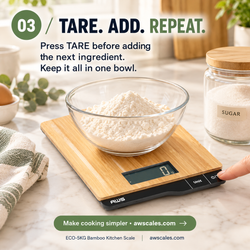
A 5000g x 1g digital scale has a maximum rated capacity of 5000 grams and displays gram measurements in increments of 1 gram.
That means it supports a total load of up to 5 kilograms and shows readings such as 250g, 251g, and 252g. This specification can suit everyday cooking, baking, meal preparation, and other tasks involving moderately large loads.
However, capacity and readability are only part of the buying decision. They do not establish guaranteed accuracy, minimum usable load, platform dimensions, or repeatability.
This guide explains what the specification means, how container weight affects capacity, and what to check before choosing an American Weigh Scales model.
What Does 5000g x 1g Mean?
The two numbers describe different characteristics.
5000g: Maximum Rated Capacity
The first number is the maximum rated load supported by the scale during weighing.
5000 grams equals 5 kilograms, or approximately 11.02 pounds. NIST’s guide to SI mass units explains the relationship between grams and kilograms.
Capacity includes everything resting on the platform:
-
The container.
-
Its contents.
-
Any tray, lid, or accessory supported by the scale.
A 5000g scale cannot accommodate 5000g of ingredients plus a bowl without exceeding its capacity.
1g: Displayed Gram Increment
The second number describes readability: the smallest step between displayed readings in grams.
A scale with 1g readability displays whole-gram measurements. It can show 100g or 101g, but it cannot show 100.4g in gram mode.
Readability is not a guarantee of accuracy. A 1g display does not automatically mean measurement error is limited to ±1g.
For an AWS example in this category, explore the WIZARD-5KG Digital Kitchen Scale, which is listed with 5000g capacity and 1g readability.
5000g x 1g Specifications at a Glance
| Specification | Meaning | What to check |
|---|---|---|
| 5000g capacity | Maximum rated load is 5000 grams | Include the container and contents |
| 5kg capacity | Another expression of 5000g | Useful when comparing product listings |
| 1g readability | Gram readings appear in whole-gram increments | Decide whether fractional gram readings matter |
| 5000 nominal display increments | Capacity divided by readability | Does not establish accuracy or certification |
| Accuracy | Not established by the headline specification | Review model-specific performance information |
| Minimum usable load | Not established by capacity | Check suitability for your smallest quantity |
| Platform size | Separate specification | Confirm secure container support |
| Calibration procedure | Model specific | Follow the manufacturer’s instructions |
Readability, Accuracy, and Repeatability
These terms help explain what a scale can actually do.
Readability Describes the Display
Readability tells you how finely a result is displayed.
A 5000g x 1g scale provides whole-gram readings. A scale with 0.1g readability provides tenths-of-a-gram readings.
More displayed detail can be useful, but it does not independently establish better measurement performance.
Accuracy Concerns Agreement With a Reference
Accuracy concerns how closely a measurement agrees with the reference value.
A scale displaying 500g does not prove that the load’s actual mass is exactly 500g. Calibration, environmental conditions, and instrument performance affect the result.
Repeatability Concerns Consistency
Repeatability describes agreement between repeated measurements under the same conditions.
For example, repeatedly removing and replacing the same reference object can help reveal whether readings remain consistent at that load.
Consistent results can still contain a systematic error, so repeatability and accuracy must be considered separately.
NIST’s weighing and scales FAQs provide background on scale divisions and weighing terminology.
Who Should Consider a 5000g x 1g Scale?
A 5kg digital scale is worth considering when your complete loads fit within capacity and whole-gram readings meet your requirements.
Home Cooking
Weighing ingredients can make recipes easier to repeat.
A 5000g capacity may accommodate a bowl and a substantial quantity of vegetables, flour, rice, or other ingredients. Confirm that the bowl fits securely and does not obscure the display.
Baking
Larger recipes can involve several kilograms of ingredients and a heavy mixing vessel.
A 5kg scale offers more capacity than a 3kg model, though some large dough batches may still exceed its limit.
For small ingredient additions requiring fractional gram measurements, a separate finer-readability scale may be useful.
Meal Preparation
A scale can help portion food consistently.
Whole-gram readability may be suitable for many larger portions, provided the model’s actual performance meets your needs.
Craft Materials and General Weighing
A 5000g x 1g scale may suit larger quantities of craft materials or groups of components where whole-gram readings are sufficient.
For tiny individual components, capacity alone is not a useful indicator of suitability. Consider the smallest quantity and the tolerance required.
Another AWS option in this specification range is the EDGE-5K Digital Kitchen Scale, listed with 5000g capacity and 1g readability.
How Container Weight Affects Capacity
The container can use a substantial share of the available capacity.
Calculate your complete load with this formula:
Total platform load = container weight + contents weight + other supported items
For example:
900g bowl + 2800g ingredients = 3700g total load
That fits within a 5000g maximum.
However:
1200g bowl + 4200g ingredients = 5400g total load
That exceeds capacity.
Example Load Calculations
| Container weight | Contents weight | Total load | Within 5000g capacity? |
|---|---|---|---|
| 200g | 500g | 700g | Yes |
| 600g | 2000g | 2600g | Yes |
| 1000g | 3500g | 4500g | Yes |
| 1000g | 4000g | 5000g | At the rated maximum |
| 1200g | 4200g | 5400g | No |
Allow practical room for variations in containers and batch sizes. If your normal setup approaches the maximum, consider a higher-capacity model.
What Does the Tare Function Do?
Tare subtracts the container’s weight from the displayed reading so you can measure the contents directly.
A typical process is:
-
Place the empty container on the platform.
-
Wait for the reading to stabilize.
-
Press tare.
-
Confirm the display returns to zero.
-
Add the material.
-
Read the net contents weight.
Tare does not increase physical capacity.
A 700g bowl leaves 4300g of rated capacity on a 5000g scale, even after the display returns to zero.
When adding ingredients sequentially, every previous addition remains part of the physical load. Pressing tare between additions changes the displayed result, not the total supported weight.
Is 1g Readability Fine Enough?
The answer depends on the quantity and how much variation your process allows.
| Quantity being weighed | One 1g display increment relative to the quantity |
|---|---|
| 5g | 20% |
| 10g | 10% |
| 100g | 1% |
| 500g | 0.2% |
| 1000g | 0.1% |
These percentages describe the display increment relative to the load. They are not accuracy ratings or measurement-error estimates.
A whole-gram display may provide useful detail for a 1000g batch but be too coarse for a target of 2.5g.
If fractional gram targets matter, compare models with 0.1g or finer readability and suitable performance at your working loads. The AWS product FAQ offers additional guidance on selecting resolution.
How 5000g x 1g Compares With Other Specifications
| Scale specification | Maximum capacity | Gram readability | Main tradeoff |
|---|---|---|---|
| 500g x 0.01g | 500g | 0.01g | Finer displayed detail, limited capacity |
| 1500g x 0.1g | 1500g | 0.1g | Decimal gram readings, lower capacity |
| 3000g x 0.1g | 3000g | 0.1g | Finer readability, less capacity |
| 5000g x 1g | 5000g | 1g | More capacity with whole-gram readings |
| 5000g x 0.1g | 5000g | 0.1g | Same capacity with finer readability |
These comparisons describe capacity and readability. They do not rank accuracy, durability, or overall quality.
Choose the specification that matches your loads and required measurement detail, then evaluate the individual model.
Features to Check Before Buying
Platform Dimensions
Make sure your usual container sits securely without touching nearby surfaces.
A 5kg rating does not guarantee a large platform.
Display Visibility
A bowl should not block the reading. Check where the display sits and whether it remains visible during use.
Tare Controls
Accessible buttons make repeated ingredient additions easier.
Response Time
Consider how quickly the display updates and settles. This matters when you continuously pour or add material.
Power Options
Review battery requirements, adapter compatibility, and included accessories.
Automatic Shutoff
Long pauses during a recipe can make a short shutoff interval inconvenient. Check the model’s behavior before choosing.
Cleaning and Spill Protection
Follow the care instructions. A smooth platform does not establish waterproofing, and a removable washable container does not make the electronic body washable.
Calibration and Routine Performance Checks
Calibration establishes the relationship between instrument readings and reference values. Some user procedures also adjust the scale’s response.
NIST’s introduction to calibration explains the role of reference standards in this process.
Follow the Exact Model’s Procedure
Do not assume a 5000g scale requires a 5000g calibration weight.
The required load and procedure depend on the model. Some products support user calibration, while others have different service requirements.
Consult the American Weigh Scales manuals before purchasing calibration accessories or attempting an adjustment.
Use Suitable Reference Weights
Reference weights should match the required load and have appropriate quality for the task.
If considering the AWS Calibration Weight Kit, check that its included denominations and stated weight class meet your model’s requirements.
Check Representative Loads
A successful check at one load does not establish performance across the entire range.
Where your process requires it, use appropriate references at representative loads and compare repeated readings.
NIST’s guidance on check standards describes how check measurements help monitor bias and variability over time.
Match Measurement Quality to Your Application
Traceability alone does not guarantee that measurement uncertainty is small enough for a particular purpose.
NIST’s metrological traceability guidance explains this distinction.
Your acceptance criteria should reflect what the process actually requires.
How to Get More Consistent Weighing Results
Use a repeatable routine:
-
Place the scale on a stable surface.
-
Follow its operating conditions and setup instructions.
-
Allow any required stabilization time.
-
Check that the unloaded display is ready.
-
Center the container.
-
Keep the container clear of surrounding objects.
-
Tare when appropriate.
-
Wait for a stable reading.
-
Keep the complete load within capacity.
-
Clean and store the scale according to its instructions.
Avoid impacts, vibration, and drafts. If readings behave unexpectedly, investigate the setup, power, environment, and calibration requirements.
Common Buying Mistakes
Assuming 1g Readability Means ±1g Accuracy
Readability describes the display. Accuracy requires additional performance information.
Forgetting Container Weight
A heavy bowl can make a batch exceed capacity even when the ingredients weigh less than 5kg.
Buying High Capacity for Tiny Samples
A 5kg capacity does not establish reliable measurement of very small quantities.
Treating Tare as Extra Capacity
Tare subtracts weight from the displayed reading. The physical load remains.
Ignoring Platform Fit
A container may be within capacity but awkward or unstable on the platform.
Assuming Unit Conversion Improves Resolution
Changing the displayed unit does not establish finer underlying measurement performance.
Frequently Asked Questions
What does 5000g x 1g mean?
It means the scale supports a maximum rated load of 5000 grams and displays gram readings in increments of 1 gram.
Is 5000g the same as 5kg?
Yes. There are 1000 grams in a kilogram, so 5000g equals 5kg.
Is a 5000g x 1g scale accurate to ±1g?
That cannot be determined from the specification alone. Check the individual model’s performance information.
Can it display 0.5g?
A scale with 1g readability cannot display 0.5g in gram mode.
Can I weigh 5kg of ingredients in a bowl?
The bowl and ingredients together must stay within the rated capacity. A bowl containing 5kg of ingredients exceeds the limit.
Is it suitable for baking?
It may suit larger ingredient quantities when its performance meets the recipe’s requirements. Small additions requiring decimal gram targets may need a finer-readability scale.
Is it suitable for coffee?
It may suit larger coffee batches where whole-gram readings are sufficient. For fractional gram dosing or brewing measurements, consider finer readability and appropriate response behavior.
Can it measure liquid volume?
A scale measures mass. Converting mass to volume requires the liquid’s density. Do not assume that 1g equals 1mL for every liquid.
Does it need a 5kg calibration weight?
Not necessarily. Follow the instructions for the exact model.
Choosing Your 5000g x 1g Digital Scale
Start by identifying your heaviest complete load, smallest important quantity, and acceptable measurement tolerance.
A 5000g x 1g digital scale is worth considering when you need capacity for larger portions or heavier vessels and whole-gram readings meet your requirements.
Explore the American Weigh Scales kitchen scale collection and compare individual models for platform fit, controls, power, calibration requirements, and performance.
Choose a model that supports your entire load and provides useful measurements for the quantities you weigh most often.