
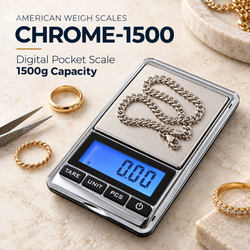
Choosing between a 750g x 0.1g scale and a 1500g x 0.1g scale comes down primarily to how much total weight you need to place on the platform. Both specifications describe a scale that displays weight in increments of one-tenth of a gram. The 1500g version offers twice the maximum capacity.
That extra capacity can matter when weighing ingredients in a bowl, sorting larger groups of collectibles, or measuring supplies in a workshop. However, a higher capacity does not automatically mean better accuracy, a larger platform, or more dependable readings.
The most useful comparison considers the complete weighing task: the items, their container, the smallest measurement that matters, and the space where the scale will be used.
For buyers exploring the digital pocket scale selection at American Weigh Scales, understanding these differences makes it easier to choose a practical specification without paying for capacity that does not improve the task.
What Does 750g x 0.1g Mean?
A scale labeled 750g x 0.1g has two separate specifications:
- 750g capacity: The maximum rated load.
- 0.1g readability: The smallest displayed increment in gram mode.
For example, its display may show 25.0g, 25.1g, or 25.2g. It does not display hundredths of a gram, such as 25.14g.
The capacity includes everything physically supported by the weighing platform. If you use a cup, tray, or bowl, that container consumes part of the available capacity.
A 750g model can be a useful choice for lighter weighing tasks where portability and tenth-gram readings matter. Whether a particular model fits your work also depends on its platform, controls, and operating instructions.
Converting the capacity into kilograms
A 750g capacity is equivalent to 0.75kg. A 1500g capacity is equivalent to 1.5kg.
These are different expressions of the same mass values. The BIPM SI Brochure provides the international reference for SI units and their prefixes. Switching the scale’s unit mode changes how a measurement is displayed; it does not increase the scale’s capacity. BIPM
What Does 1500g x 0.1g Mean?
A scale labeled 1500g x 0.1g supports a maximum rated load of 1500 grams and displays gram measurements in 0.1g increments.
Compared with a 750g x 0.1g scale, it provides:
- An additional 750g of rated capacity.
- Twice the maximum total load.
- The same stated display increment in gram mode.
This makes the specification attractive for buyers whose container and contents regularly exceed 750g.
However, the specification alone does not tell you the platform dimensions, minimum useful sample weight, calibration requirements, or measurement error. Those details must be evaluated for the individual model.
750g x 0.1g vs 1500g x 0.1g: Comparison Table
| Specification or consideration | 750g x 0.1g scale | 1500g x 0.1g scale |
|---|---|---|
| Maximum rated load | 750g | 1500g |
| Capacity in kilograms | 0.75kg | 1.5kg |
| Displayed increment in gram mode | 0.1g | 0.1g |
| Capacity divided by displayed increment | 7,500 | 15,000 |
| Available capacity with a 200g container | 550g | 1300g |
| Suitable for an 800g total load | No | Within the stated capacity |
| Suitable for a 1400g total load | No | Within the stated capacity |
| Guaranteed accuracy from these numbers alone | Not established | Not established |
| Platform dimensions | Depend on model | Depend on model |
| Best fit | Lighter loads that stay comfortably below 750g | Heavier loads or containers requiring more capacity |
The division counts are arithmetic comparisons of the stated specifications. They do not establish a legal weighing classification or prove that one scale produces more accurate measurements.
Does the Same 0.1g Readability Mean the Same Accuracy?
No. Two scales can have the same readability and different measurement performance.
Readability describes the increment shown on the display. Accuracy concerns how closely a measurement agrees with the relevant reference value. Repeatability concerns how consistently the scale measures the same load under the same conditions.
These concepts are related, but they are not interchangeable. The International Vocabulary of Metrology is a reference for the terminology used to describe measurement performance. BIPM
Consider an illustrative example: two scales both display a reference weight to one decimal place. One repeatedly shows 100.0g. Another produces readings of 100.2g, 100.4g, and 100.1g.
Both have tenth-gram displays, but their results behave differently. The number of decimal places alone cannot explain or resolve that difference.
When comparing actual models, look for information about:
- Stated accuracy or permissible error.
- Repeatability.
- Calibration procedures.
- Operating temperature.
- Recommended minimum loads.
- Platform size and loading requirements.
Avoid interpreting “0.1g” as an automatic guarantee that every result is within exactly 0.1g of the true mass.
Tare Weight Can Determine Which Capacity You Need
One of the easiest buying mistakes is selecting a scale based only on the weight of the material being measured.
The container matters too.
Example: Weighing ingredients in a bowl
Suppose your empty bowl weighs 220g and your ingredients weigh 600g.
The total platform load is:
220g + 600g = 820g
That exceeds the capacity of a 750g scale. A 1500g scale has sufficient rated capacity for this example.
Pressing tare may reset the display to zero before you add the ingredients, but it does not remove the bowl’s physical weight from the weighing mechanism.
Example: Weighing a smaller batch
Now suppose the container weighs 120g and the contents weigh 400g.
The total load is:
120g + 400g = 520g
Both capacities can accommodate this load. If your tasks consistently resemble this second example, the additional capacity of a 1500g model may offer little immediate benefit.
How to calculate your required capacity
Use this formula before choosing a scale:
Required capacity = heaviest expected contents + container + other supported accessories
Any tray or accessory resting on the platform contributes to the load. Leave practical room for normal variation in your batches rather than choosing a capacity that your routine load nearly reaches.
When a 750g x 0.1g Scale Makes Sense
A 750g x 0.1g scale is a practical option when your total loads remain comfortably below 750g and tenth-gram increments are appropriate.
Coffee and tea portions
For weighing dry coffee beans or loose tea, the total load may be modest. A lightweight cup can help preserve available capacity.
For brewing directly on the scale, calculate the combined weight of the brewing vessel, ingredients, and liquid. Also consider platform stability, moisture exposure, and whether you need a timer.
Coins and collectibles
A 750g scale can accommodate many individual collectibles and smaller groups of coins.
However, tenth-gram readability may be too coarse for certain identification or authentication tasks. A larger capacity would not solve that limitation; finer readability may be the relevant upgrade.
Craft supplies and small hardware
Beads, fasteners, findings, and other supplies can be weighed in small trays. Capacity becomes important when moving from individual items to larger grouped loads.
Portable weighing
If you move your equipment frequently, compare the dimensions and protective features of actual models. Capacity alone does not determine whether a scale is convenient to carry.
One verified option is the MS-750 digital pocket scale. Its listed specifications include 750g capacity, 0.1g readability, a 2.2 x 2.8-inch platform, and two AAA batteries. Its removable cover also serves as an expansion tray. AWScales
Another option is the TR-750 digital pocket scale, which lists the same capacity and readability with a 2.0 x 3.0-inch platform. Comparing these dimensions illustrates why models with identical headline specifications can fit different containers. AWScales
When a 1500g x 0.1g Scale Makes Sense
The 1500g x 0.1g specification is the more practical choice when your total loads exceed 750g or regularly approach that limit.
Heavier containers
A substantial glass bowl or metal vessel can consume much of a 750g scale’s capacity before any ingredients are added.
Additional capacity lets you use a suitable container without dividing every task into smaller portions.
Larger ingredient batches
If your batches weigh 800g, 1000g, or 1200g, a 750g model cannot measure the entire batch in one loading.
A 1500g scale may accommodate the task, provided the container and contents together remain within its rating.
Workshop materials
Larger quantities of hardware or craft materials may benefit from the extra capacity. Check that the intended tray sits securely and that its sides do not contact the surrounding surface.
Greater flexibility
If your weighing tasks vary substantially, additional capacity may reduce the need for a second scale.
Still, flexibility has limits. A 1500g x 0.1g scale does not replace a milligram scale for very small measurements, and it cannot accommodate loads above its own capacity.
Platform Size Matters Alongside Capacity
A scale can have sufficient rated capacity and still be awkward for the intended container.
Before buying, compare:
- The platform dimensions.
- The container’s base dimensions.
- Display visibility with the container in place.
- Clearance around the platform.
- Whether the load can remain stable and centered.
For example, a wide bowl may hide the display on a compact scale. A long tray might touch the countertop, transferring some of the load away from the platform and compromising the measurement.
A larger capacity does not guarantee a larger platform. Read both specifications separately.
Calibration and Reference Weights
Calibration requirements are model specific. Do not assume that a 1500g scale requires a 1500g calibration weight, or that every 750g scale uses the same procedure.
For example, the MS-750 listing specifies a 500g calibration weight, not included. That requirement applies to that model rather than to every scale with a 750g capacity. AWScales
Follow the manufacturer’s instructions for the required weight and calibration sequence.
The NIST guidance on balance and scale calibration and uncertainties highlights reference-standard selection, weighing errors, uncertainty, and minimum sample quantities as important parts of evaluating weighing instruments. NIST
Checking performance between calibrations
A reference weight can help you notice a change in a scale’s behavior. Under consistent conditions, place the weight on the platform, record the reading, remove it, and repeat the measurement.
This is a practical check, not a complete assessment of performance across the entire weighing range.
Where documented measurement quality matters, NIST’s policy on metrological traceability explains the importance of a documented calibration chain and associated measurement uncertainty. Owning a weight labeled with a nominal mass does not, by itself, establish traceability for every result. NIST
How Your Environment Affects Readings
The surrounding conditions can influence either scale.
A stable, level surface is a better starting point than a flexible tabletop or a bench shared with vibrating equipment. Drafts, temperature changes, dirty platforms, and unstable containers can also make weighing harder.
American Weigh Scales’ scale maintenance guidance recommends allowing a scale to adjust to room temperature and explains that temperature differences can cause readings to drift. It also addresses routine calibration and battery maintenance. awscales.com
Use a consistent routine:
- Place the scale on a firm, level surface.
- Allow it to acclimate after a temperature change.
- Confirm that the platform is clean and unobstructed.
- Check the unloaded display.
- Position the container securely.
- Tare if you need a net measurement.
- Add material gently and wait for a stable reading.
For additional background on weighing vessels and procedures, NIST’s Use of Analytical Balances discusses weighing operations and sources of error. Analytical balances are a different instrument class, but careful handling and appropriate procedures remain relevant principles. NIST
Is 0.1g Readability Enough for Your Task?
Capacity answers how much you can load. Readability helps determine whether the displayed detail suits your work.
A 0.1g increment is relatively small compared with a 500g batch. It is much larger compared with a 1g sample.
For illustration:
| Sample mass | One 0.1g display increment as a percentage of the sample |
|---|---|
| 1g | 10% |
| 10g | 1% |
| 100g | 0.1% |
| 500g | 0.02% |
These percentages describe the size of one displayed increment relative to the sample. They are not accuracy estimates.
If the task requires distinguishing changes smaller than 0.1g, neither specification provides that display detail in gram mode.
For tightly controlled work, select equipment based on the required tolerance and documented measurement performance rather than the capacity alone.
Can Either Scale Be Used for Selling Products by Weight?
The specification 750g x 0.1g or 1500g x 0.1g does not establish that a scale is approved for commercial transactions.
If measured weight determines a selling price, confirm that the exact equipment and setup meet applicable requirements before using them for that purpose.
NIST Handbook 44 provides specifications, tolerances, and technical requirements for weighing and measuring devices. Neither capacity nor decimal display alone demonstrates compliance. NIST
Common Buying Mistakes
Choosing capacity based only on contents
Include the container and every accessory supported by the platform.
Assuming more capacity means greater accuracy
A 1500g model supports more weight. Its accuracy must be evaluated separately.
Treating 0.1g as a guaranteed error limit
The displayed increment does not establish the complete measurement uncertainty.
Ignoring the platform dimensions
A container that fits poorly can undermine an otherwise suitable specification.
Buying more capacity when finer readings are needed
If the problem is measuring tiny quantities, a different readability may be more useful than a higher maximum load.
Using an improvised calibration weight
Follow the model’s instructions and use an appropriate reference weight rather than an object assumed to have an exact mass.
Frequently Asked Questions
Is a 1500g x 0.1g scale more precise than a 750g x 0.1g scale?
The specifications establish equal readability in gram mode and different capacities. They do not establish which model has better precision, repeatability, or accuracy.
Can a 750g scale weigh 750g of ingredients in a bowl?
Only if the complete supported load remains within 750g. A bowl adds physical weight, even after tare resets the display.
Does tare increase the maximum capacity?
No. Tare changes the displayed reference point; it does not increase the rated capacity.
Does 0.1g mean 100 milligrams?
Yes. One-tenth of a gram equals 100 milligrams. That is the displayed increment, not a guarantee that samples of that size can be measured reliably.
Is 1500g capacity better for baking?
It may be more convenient for batches and bowls that exceed 750g together. Larger recipes may require still more capacity, while small ingredients may require finer readability.
Which specification should I choose for lighter items?
If your complete loads remain comfortably below 750g, a 750g model may be sufficient. Compare its platform, protective features, calibration instructions, and measurement performance with the alternatives.
Which Scale Should You Choose?
Choose a 750g x 0.1g scale when your complete loads stay comfortably below 750g and the model’s platform and features fit your routine.
Choose a 1500g x 0.1g scale when heavier containers or larger batches require additional capacity while tenth-gram readability remains appropriate.
Before ordering, write down your heaviest container-and-contents combination and the smallest measurement difference your task needs to reveal. Those two numbers provide a clearer starting point than capacity alone.
Explore the weighing equipment available at American Weigh Scales, or use AWS product support for help matching a scale’s specifications to your intended use.