
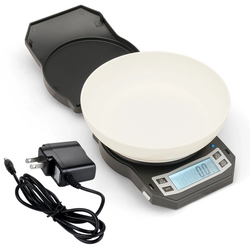
The American Weigh Scales LB-3000 is a compact digital bowl scale designed for users who need more precision than a typical whole-gram kitchen scale without moving into the limited capacity and extreme sensitivity of a milligram scale. Its headline specification is 3000g x 0.1g, meaning it can support up to 3,000 grams while displaying weight in increments of one-tenth of a gram.
That combination gives the LB-3000 a particularly useful middle ground. It offers enough capacity for many food ingredients, coffee, crafts, small parts, coins, precious-metal items, and household projects while retaining much finer readability than many general-purpose kitchen scales.
The removable bowl, backlit display, tare function, parts-counting capability, multiple weighing units, and choice of battery or adapter power make it more versatile than a basic food scale. However, its 3-kilogram limit and compact platform mean it is not the right choice for every task.
This AWS LB-3000 review examines its accuracy, capacity, features, limitations, and best uses so you can decide whether it matches the way you weigh.
AWS LB-3000 Specifications at a Glance
| Feature | AWS LB-3000 specification |
|---|---|
| Maximum capacity | 3,000g / 6.6 lb |
| Gram readability | 0.1g |
| Weighing units | g, oz, ozt and dwt |
| Ounce range | Up to 105.82 oz in 0.005 oz increments |
| Troy-ounce range | Up to 96.45 ozt in 0.005 ozt increments |
| Pennyweight range | Up to 1,929 dwt in 0.1 dwt increments |
| Platform diameter | Approximately 5.2–5.3 inches |
| Scale dimensions | Approximately 7.3 x 5.5 x 1.5 inches |
| Display | Backlit LCD with optional backlight |
| Container | Removable expansion/weighing bowl |
| Key functions | Tare, memory/cumulative weighing and parts counting |
| Power | Four AA batteries or 6V AC adapter |
| Calibration reference | 2,000g calibration weight, not included |
| Stated linearity | ±2 display divisions |
| Stated repeatability | ±2 display divisions |
| Recommended operating temperature | 50°F–86°F / 10°C–30°C |
| Warranty | 10-year limited manufacturer's warranty |
Specifications can be revised over a product's lifetime, so buyers should confirm the details on the current product page and in the manual supplied with their scale.
What Does 3000g x 0.1g Mean?
The label 3000g x 0.1g describes capacity and readability:
-
3000g is the maximum total load the scale is designed to support.
-
0.1g is the smallest displayed increment in gram mode.
The LB-3000 can therefore show readings such as 25.4g, 786.2g, or 2,999.9g. It provides ten displayed increments within one gram, compared with a standard 1g kitchen scale that displays only whole grams.
The 0.1g figure describes readability, not a universal accuracy guarantee or minimum usable weight. Accuracy also depends on calibration, environment, load placement, batteries, condition, and the manufacturer's tolerance specifications.
Capacity: Is 3,000 Grams Enough?
Three thousand grams equals 3 kilograms, approximately 105.82 ounces, or about 6.6 pounds. That is enough capacity for many compact household, kitchen, workshop, and hobby tasks.
The LB-3000 can comfortably accommodate many quantities of:
-
Flour, sugar, rice, grains, and other dry ingredients
-
Coffee beans and grounds
-
Produce and meal portions
-
Small hardware and components
-
Craft materials
-
Coins and compact precious-metal items
-
Containers filled with lightweight materials
Its capacity is less suitable for large mixing bowls filled with heavy ingredients, full shipping parcels, bulk inventory, or objects exceeding 6.6 pounds.
Remember That the Bowl Counts Toward Capacity
The tare function resets the display to zero after a bowl or container is placed on the scale, but it does not remove that container's physical weight from the load cell.
If a container weighs 400g, approximately 2,600g of the scale's capacity remains for its contents. The displayed result may begin at 0.0g after taring, but the combined physical load must still remain below 3,000g.
This matters when working with heavy glass, ceramic, or metal containers. The included lightweight bowl preserves more of the scale's available capacity.
Readability: Why 0.1g Matters
The LB-3000 displays grams to the nearest tenth. That is ten times finer than a 1g scale and can make a meaningful difference when measuring coffee, spices, yeast, craft ingredients, small components, or items being compared by weight.
For example, a whole-gram scale might display two samples as 18g. The LB-3000 could show them as 17.6g and 18.4g, revealing a difference hidden by the coarser display.
At the same time, a 0.1g scale is typically easier to use in an ordinary room than a 0.01g or 0.001g scale. It is still a precision instrument, but small drafts, table movement, and static are less likely to dominate the display than they would on a milligram scale.
The result is a practical balance: detailed enough for many precision-oriented daily tasks, but with enough capacity for ingredients and containers.
How Accurate Is the AWS LB-3000?
The LB-3000's official product information lists 0.1g readability, with stated repeatability and linearity of ±2 display divisions. Because one display division is 0.1g, two divisions correspond to 0.2g.
In practical terms, the scale is designed to provide consistent tenth-of-a-gram readings when it is calibrated, placed on a suitable surface, used within its range, and protected from environmental interference.
Readability should not be confused with guaranteed accuracy. A display showing 0.1g increments does not mean every measurement is always within exactly 0.1g of the true mass. The scale's tolerance, setup, and operating conditions all matter.
Conditions That Support Better Accuracy
For more repeatable readings:
-
Place the scale on a hard, flat, level surface.
-
Keep it away from fans, open windows, and air-conditioning vents.
-
Avoid tables that shake when you walk, type, or operate an appliance.
-
Let the scale reach room temperature after transportation or storage.
-
Turn it on with the platform empty and wait for zero.
-
Place items or the bowl near the center of the platform.
-
Wait for the reading to stabilize.
-
Use fresh batteries or the correct included adapter.
-
Keep the platform and bowl clean and dry.
-
Check calibration when a known reference reads outside the acceptable tolerance.
Repeatability Is More Useful Than One Random Reading
To check performance, place an appropriate reference weight in the center, record the result, remove it, and let the display return to zero. Repeat this several times without moving the scale.
Consistent results within the stated tolerance provide more useful evidence than a single reading. If the numbers vary substantially, first inspect the surface, airflow, temperature, power supply, and platform before recalibrating.
Calibration and Adjustment
The LB-3000 is calibrated and adjusted at the factory, but its measurement can shift slightly during transportation or after a major change in location or temperature. The manual recommends checking calibration and provides a user-adjustment procedure.
The LB-3000 calls for a 2,000g calibration weight with an appropriate accuracy class. That weight is not included with the LB-3000 package, so it must be obtained separately if calibration is required.
The basic model-specific procedure is:
-
Place the scale on a stable, level surface.
-
Allow it to reach room temperature and stabilize.
-
Turn it on with an empty platform.
-
Press and hold the MODE/CAL key until
CALappears. -
Press MODE/CAL again and wait for the requested calibration value.
-
Place the correct 2,000g weight in the center.
-
Wait for the scale to display
PASSand return to normal operation. -
Remove the weight and verify the result.
Use the exact instructions included with the current scale, as product revisions can change procedures or calibration requirements. Do not substitute coins, food packages, or household objects for a proper reference weight.
Removable Bowl: A Practical Advantage
The expansion bowl is one of the features that differentiates the LB-3000 from a flat pocket scale. It helps contain loose, rolling, or irregular materials such as:
-
Coffee beans
-
Grains and rice
-
Chopped ingredients
-
Beads and craft components
-
Small fasteners
-
Coins
-
Loose parts
The bowl is removable, which makes transferring contents and routine cleaning easier. Current product information describes it as plastic and dishwasher safe. Users should still follow the care instructions supplied with the product and keep the scale body itself away from water.
Because the bowl fits the scale, it is generally more convenient than balancing a large household container on the compact platform. You can place the empty bowl on the scale, press tare, and measure only the contents.
Tare Function
Tare allows the scale to subtract the weight of the bowl or another container.
To use it:
-
Place the empty container on the platform.
-
Wait for the displayed weight to stabilize.
-
Press TARE/PRINT.
-
Confirm the display returns to zero.
-
Add the material to view its net weight.
Removing a tared container may cause the display to show a negative value equal to the container's weight. This is normal. Clear the tare or restart the scale with the platform empty before a new task.
Counting Function
The LB-3000 includes a parts-counting mode for estimating the number of identical items based on their average piece weight. The scale supports sample quantities of 5, 10, 20, or 50 pieces.
Counting can be useful for:
-
Beads
-
Screws and washers
-
Small craft pieces
-
Connectors
-
Coins or tokens
-
Uniform production components
For better counting results, use the largest practical sample quantity and items with consistent individual weight. A sample of 50 generally establishes a more representative average than a sample of five.
The function is not ideal when pieces vary substantially, when each item is extremely light relative to the scale's 0.1g increment, or when exact inventory counts are legally or financially critical.
Memory and Cumulative Weighing
The LB-Series manual also describes a memory function that allows users to add multiple stabilized weights and review a cumulative total. This can be convenient when several batches cannot fit on the platform or in the bowl at the same time.
Users should follow the manual closely because the ON/MEM and TARE/PRINT keys perform multiple functions. Recording each batch consistently helps avoid accidentally clearing or duplicating a value.
Weighing Units
The LB-3000 supports four weighing modes:
-
Grams (g): general kitchen, coffee, craft, and household use
-
Standard ounces (oz): common U.S. weight measurements
-
Troy ounces (ozt): traditionally used for precious metals
-
Pennyweights (dwt): used in some jewelry and precious-metal applications
The LB-3000 does not list carats or grains among its standard modes. Buyers who specifically need those units should compare another model, such as a jewelry-focused pocket or milligram scale.
Backlit Display and Controls
The large LCD is designed to keep results visible, including in dimmer work areas. The backlight can be switched on or off, which is helpful when preserving battery life.
The controls provide direct access to power, memory, calibration/mode selection, tare, and printing-related functions. Some keys perform more than one action, so new users may need a few minutes with the manual before every feature feels intuitive.
Battery and AC Power
The LB-3000 can run on four AA batteries or a 6V AC adapter, and product information indicates both power options are included.
Battery operation is useful when:
-
The scale must be moved between work areas
-
An outlet is not nearby
-
A clean, cordless workspace is preferred
Adapter power is useful for:
-
Frequent daily weighing
-
A permanent countertop or workstation setup
-
Reducing battery replacement
Weak batteries can cause erratic readings, slow startup, or power problems. If the scale behaves unexpectedly, fresh batteries are one of the first troubleshooting steps.
Best Uses for the AWS LB-3000
1. Coffee Beans and Brewing Ingredients
The 0.1g readability is well suited to repeatable coffee doses, while the 3,000g capacity leaves room for many brewing containers. The included bowl makes it easy to portion beans before grinding.
For timed espresso extraction or pour-over brewing, some users may prefer a dedicated coffee scale with a built-in timer and water resistance. For straightforward weight-based dosing, the LB-3000 is a capable option.
2. Baking and Small-Batch Cooking
The scale is useful for flour, sugar, yeast, salt, spices, and other ingredients when tenth-of-a-gram detail is beneficial. Its tare function supports adding multiple ingredients to the same bowl.
The 3kg capacity is adequate for many small and medium recipes. Larger mixing bowls or heavy batches may require a 5kg or higher-capacity kitchen scale.
3. Crafts and Resin Projects
The bowl and fine readability can help users portion pigments, beads, wax, small inclusions, and other craft materials. Always follow the material manufacturer's ratios and safety guidance.
For ratios requiring more precision than 0.1g, select a finer scale rather than estimating between increments.
4. Parts Counting and Hardware
The counting function makes the LB-3000 useful in workshops, stockrooms, repair benches, and small businesses that handle consistent lightweight parts. It can provide a quick estimate without counting every piece manually.
5. Coins and Precious-Metal Items
Troy-ounce and pennyweight modes make the LB-3000 relevant for coins and compact precious-metal objects. Its 3kg capacity handles larger collections than many pocket scales.
For tiny gemstones or extremely lightweight jewelry components, a 0.01g or 0.001g model may be more suitable. Weight alone also cannot establish authenticity, purity, or value.
6. General Household Weighing
The combination of a removable bowl, multiple units, tare, counting, and portable power makes the scale useful for many everyday jobs—from sorting small objects to measuring ingredients or comparing product weights.
Where the LB-3000 Is Less Suitable
The LB-3000 may not be the best choice for:
-
Items heavier than 3,000g
-
Large shipping boxes or packages
-
Full-size mixing bowls that overhang the platform
-
Measurements requiring 0.01g or 0.001g readability
-
Gemstones requiring carat mode
-
Legal-for-trade transactions unless applicable certification is confirmed
-
Wet or wash-down environments
-
Medical, pharmaceutical, or regulated laboratory applications without appropriate approval
-
Users who need a built-in kitchen or coffee timer
These are not flaws so much as boundaries of the model's design. Choosing the correct scale means matching its range and features to the task.
AWS LB-3000 vs. LB-1000
The LB-3000 and LB-1000 share the same 0.1g readability and LB-Series format. The primary difference is capacity:
| Feature | LB-3000 | LB-1000 |
| Capacity | 3,000g | 1,000g |
| Readability | 0.1g | 0.1g |
| Best advantage | More room for containers and heavier loads | Suitable when only smaller loads are needed |
Choose the LB-3000 if your combined item-and-container load may exceed 1,000g. Choose the LB-1000 if 1kg is sufficient and you do not need the additional headroom.
AWS LB-3000 vs. LB-501
The LB-501 prioritizes finer readability, while the LB-3000 prioritizes capacity:
| Feature | LB-3000 | LB-501 |
| Capacity | 3,000g | 500g |
| Readability | 0.1g | 0.01g |
| Primary advantage | Six times the capacity | Ten times finer gram display |
| Better suited for | Food, coffee, containers, batches, parts | Jewelry, small objects and finer comparisons |
The LB-3000 is the more versatile general bench and bowl scale. The LB-501 is the better fit when hundredth-of-a-gram detail matters more than capacity.
Pros and Cons
Advantages
-
Useful 3,000g maximum capacity
-
Fine 0.1g readability
-
Removable bowl for loose materials
-
Tare function for net weighing
-
Parts-counting mode
-
Memory/cumulative weighing feature
-
Grams, ounces, troy ounces, and pennyweights
-
Large backlit LCD
-
Battery and adapter power options
-
Compact footprint
-
Long limited warranty
Limitations
-
Not suitable for loads over 3kg
-
No 0.01g or milligram readability
-
Calibration weight is not included with the LB-3000
-
Compact platform may not suit large bowls
-
No listed carat or grain mode
-
No built-in timer
-
Sensitive measurements still require a stable environment
Who Should Buy the AWS LB-3000?
The LB-3000 is a strong fit for someone who wants one compact scale for multiple moderate-capacity tasks and needs more detail than a basic kitchen scale provides.
Consider it if you:
-
Weigh up to 3kg and need 0.1g readability
-
Regularly work with loose ingredients or small parts
-
Want a removable bowl and tare function
-
Need a basic counting feature
-
Use troy ounces or pennyweights
-
Prefer the choice of battery or wall power
-
Want a scale for both household and hobby use
Consider another model if your work requires milligram precision, more than 3kg of capacity, a much larger platform, waterproof construction, or application-specific certification.
Frequently Asked Questions
What is the capacity of the AWS LB-3000?
The maximum capacity is 3,000 grams, approximately 6.6 pounds or 105.82 standard ounces. The container and contents together must remain within this limit.
How precise is the LB-3000?
It displays measurements in 0.1g increments. Official specifications list repeatability and linearity at ±2 display divisions under the stated conditions.
Does the LB-3000 include a bowl?
Yes. It includes a removable expansion/weighing bowl designed to hold loose ingredients, components, and other small items.
Is the LB-3000 bowl dishwasher safe?
Current product information describes the removable plastic bowl as dishwasher safe. Follow the care instructions supplied with the product, and never place the electronic scale body in a dishwasher or immerse it in water.
Does it have a tare function?
Yes. Tare subtracts the visible weight of a container so the display shows the net contents. The container still counts toward maximum capacity.
Can the LB-3000 count pieces?
Yes. It includes a parts-counting mode that can be set using sample sizes of 5, 10, 20, or 50 matching pieces.
Which units does it measure?
The LB-3000 supports grams, standard ounces, troy ounces, and pennyweights.
Does it run on batteries?
Yes. It can use four AA batteries or the included 6V AC adapter.
What calibration weight does the LB-3000 require?
The current manual specifies a 2,000g calibration weight for the LB-3000. The calibration weight is not included with this model.
Is the LB-3000 good for coffee?
Yes, its 0.1g readability and 3kg capacity work well for dosing beans and many brewing setups. It does not include a built-in timer, so users who time extraction on the scale may prefer a coffee-specific model.
Is it good for jewelry?
It can weigh many jewelry and precious-metal items and supports troy ounces and pennyweights. For very lightweight pieces, gemstones, or hundredth-of-a-gram measurements, a smaller 0.01g or milligram scale may be better.
Is the LB-3000 legal for trade?
Do not assume that it is approved for transactions based on weight. Confirm the model's certification and local weights-and-measures requirements before using any scale commercially.
Final Verdict: Is the AWS LB-3000 Worth It?
The AWS LB-3000 is a versatile compact bench and bowl scale for users who need a practical blend of capacity and precision. Its 3,000g limit handles substantially more than a typical pocket scale, while its 0.1g readability provides ten times more displayed detail than many whole-gram kitchen scales.
The included removable bowl, tare function, counting mode, memory feature, multiple weighing units, large backlit display, and dual power options broaden its usefulness across kitchens, coffee stations, craft rooms, workshops, stock areas, and household projects.
Its main limitations are straightforward: it is not a milligram scale, it cannot handle more than 3kg, its compact platform may not accommodate large containers, and the required 2,000g calibration weight is sold separately.
For buyers whose typical loads stay below 6.6 pounds and who value tenth-of-a-gram readings, the American Weigh Scales LB-3000 offers a well-rounded specification set and an unusually broad range of practical uses in one compact design.