
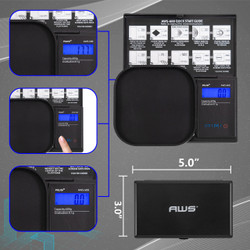
The AWS-600 is worth considering if you want a portable digital scale for moderate loads and tenths-of-a-gram display increments. Its compact format makes it convenient for weighing small collections, ingredients and hobby materials without dedicating much storage space.
Its appeal is straightforward: useful capacity in a pocket-sized body. The key buying question is whether its readability and actual measurement performance meet your requirements.
This AWS-600 review examines published manufacturer specifications and their practical implications. It does not include independent hands-on accuracy testing.
AWS-600 Specifications at a Glance
The AWS-600 digital pocket scale has the following published specifications.
| Specification | Published detail |
|---|---|
| Maximum capacity | 600g |
| Readability in grams | 0.1g |
| Equivalent gram display increment | 100mg |
| Weighing units | g, oz, ozt and dwt |
| Specified calibration weight | 500g, not included |
| Listed platform dimensions | 1.9 × 3.3 inches |
| Overall dimensions | 5 × 3 × 0.9 inches |
| Listed display dimensions | 0.7 × 0.9 inches |
| Power | Two AAA batteries, included |
| Weighing surface | Stainless steel |
| Protective feature | Hinged plastic cover |
| Display feature | Backlit LCD with different colors for unit modes |
Dimensions above follow the current product listing. Check the documentation supplied with your exact version if platform fit is important.
What Does 600g × 0.1g Mean?
The specification describes two separate properties.
600g is the maximum load. Everything placed on the weighing platform contributes to that load, including your container.
0.1g is the readability. In gram mode, the display changes in tenths of a gram. That increment equals 100 milligrams.
For background on metric mass measurement, see NIST’s guide to mass units.
A display reading of 125.4g shows the available decimal place. It does not establish that the true mass is within 0.1g of that value.
Readability Does Not Establish the Minimum Sample Weight
A scale that displays 0.1g increments should not automatically be assumed capable of reliably weighing a 0.1g sample.
The smallest suitable working load depends on actual measurement performance and the tolerance your task allows. If you need to measure very small quantities, evaluate equipment with appropriate readability and verified capability.
How Accurate Is the AWS-600?
The published capacity and readability are useful selection criteria. This review does not have independent test results establishing a numerical accuracy tolerance.
Three concepts matter when evaluating a digital scale:
| Concept | What it describes |
|---|---|
| Readability | The smallest displayed increment |
| Repeatability | Agreement between repeated measurements of the same object |
| Accuracy | Agreement with an appropriate reference value |
A scale can repeat a result consistently while showing an offset from a reference. It can also display fine increments while readings vary.
For the AWS-600, the practical question is whether results meet your tolerance at the loads you actually weigh.
A Useful Repeatability Check
You can examine consistency by weighing the same suitable object several times:
-
Set up the scale according to its instructions.
-
Place the object near the platform’s center.
-
Allow the indication to settle and record it.
-
Remove the object and check zero return.
-
Repeat under consistent conditions.
Compare the spread of readings with your requirements.
An ordinary object can reveal inconsistent readings. It cannot establish absolute accuracy unless its mass is appropriately known.
Features That Matter in Everyday Use
Compact Design and Protective Cover
The slim body makes the AWS-600 a practical candidate for carrying between work areas or storing in a drawer.
The hinged cover protects the weighing surface during storage. Avoid packing heavy objects against the platform or subjecting the scale to pressure during transport.
Before weighing, place it on a firm, level surface. A portable design still requires suitable measuring conditions.
Stainless Steel Weighing Surface
The metal platform provides a convenient surface for positioning small objects.
Keep it clean and follow the manufacturer’s care instructions. Loose residue can affect later measurements, and material beneath the platform can interfere with operation.
Backlit Display
Display lighting can make readings easier to see in dim surroundings. The listed color changes between unit modes may also help distinguish modes visually.
Confirm the unit symbol before recording a result. Screen color should supplement that check rather than replace it.
Unit Options for General and Precious-Metal Mass Records
The listed modes include grams, ounces, troy ounces and pennyweights.
These options may suit general measurements and records involving precious-metal mass. The current specification does not list carats or grains.
Ounces and troy ounces differ. The NIST SI units reference provides background on standardized measurement notation; recording units alongside values helps avoid ambiguity.
Best Uses for the AWS-600
Coins and Small Collections
The AWS-600 is a candidate for individual coins and grouped collectibles when the total load and required tolerance fit its capabilities.
Its capacity provides room for collections that exceed the limits of some lower-capacity pocket scales.
Define the purpose of the measurement. Checking approximate group mass differs from detecting subtle differences between individual coins. Weight alone does not establish authenticity.
Jewelry and Precious-Metal Items
The scale may suit heavier jewelry items or grouped components when tenths-of-a-gram readability is sufficient and performance has been checked.
Its troy-ounce and pennyweight options can simplify certain records. However, mass does not establish metal purity or gemstone quality.
For more selection criteria, consult the AWS digital scale buying guide for jewelry.
Buyers handling tiny loose stones or needing finer indicated differences should compare other models.
Coffee Beans and Modest Ingredient Quantities
The AWS-600 may be useful for weighing beans or ingredients in a lightweight container.
Account for the full load and make sure the container sits securely. The compact platform can become inconvenient with large bowls even when their weight remains within capacity.
For heavy containers and substantial batches, compare the AWS kitchen scale range.
Small Hardware and Hobby Materials
Lightweight fasteners, craft supplies and grouped components may fit this scale’s working range.
If estimating quantities from group mass, account for variation between individual pieces. A calculated count can be unreliable when the assumed piece weight does not represent the group.
Tare and Container Weight
Tare lets you subtract a container’s indicated weight so the display shows the contents separately.
The important limitation is physical load: tare does not restore capacity.
For example, a 100g container leaves a theoretical 500g of sample capacity. Leave headroom while adding material to reduce the chance of accidental overload.
Make sure the container rests entirely on the platform without touching the housing, table or another support.
Calibration: What You Need
The standard package does not include the specified calibration weight.
Follow the procedure for your exact unit through the AWS scale manuals. Use the required mass and sequence rather than substituting coins or objects of assumed weight.
NIST’s calibration overview explains how instrument indications relate to reference values. Some consumer-scale routines also adjust the instrument’s response.
Verify Performance at Typical Loads
Completing a calibration routine does not establish acceptable performance across every load.
Use suitable reference weights near your working range, repeat measurements and compare results with your tolerance. Keep records if consistency over time matters.
NIST’s guidance on check standards describes using reference checks to monitor measurement performance.
An AWS calibration weight kit may provide useful masses. Confirm that its contents and specifications suit both the manufacturer’s procedure and your verification needs.
A nominal weight value does not establish certified traceability. NIST’s metrological traceability guidance explains the documented calibration chain needed to relate measurement results to a reference.
How to Get More Consistent Readings
Good setup makes weighing easier to evaluate.
-
Use a firm, level surface.
-
Avoid fans, open windows and nearby vibration.
-
Keep the platform and container clean.
-
Position the load near the center.
-
Allow the indication to settle.
-
Follow the manual’s startup and battery instructions.
If readings fluctuate, inspect the environment, container contact and battery condition before recalibrating.
Calibration cannot correct an overloaded platform or a container that is supported partly by another surface.
AWS-600 Advantages and Limitations
| Advantages | Limitations |
|---|---|
| Useful capacity in a compact body | Readability may be too coarse for small mass differences |
| Hinged cover for storage | Platform needs protection from pressure and overload |
| Backlit display | Display resolution does not establish accuracy |
| Troy-ounce and pennyweight modes | Carats and grains are not listed |
| Battery-powered portability | Stable setup remains necessary |
| Calibration function | Specified weight is purchased separately |
The strongest reason to consider the AWS-600 is its combination of moderate capacity and convenient storage.
When Another Scale Makes More Sense
Consider different equipment if you need:
-
Finer display increments for small differences.
-
Higher capacity for your container and sample.
-
A larger platform for bulky objects.
-
Documented accuracy or measurement uncertainty.
-
Approved equipment for commercial sales by weight.
If finer readability is your priority, explore the AWS milligram scale range and compare verified performance as well as capacity.
For commercial weighing, check applicable requirements. NIST’s weighing and scales FAQs provide background on device requirements. A calibration function does not establish legal-for-trade approval.
Frequently Asked Questions
Is the AWS-600 accurate to 0.1g?
Its published readability is 0.1g. That specification alone does not establish a guaranteed accuracy of ±0.1g.
Does the AWS-600 include a calibration weight?
The standard listing does not. Check the exact package when ordering.
Can the AWS-600 weigh gold?
It can be considered for metal items when the load and required tolerance fit its capabilities. Weight does not establish purity, and sales by weight may require approved equipment.
Does tare increase capacity?
No. The container and contents still contribute to the physical load.
Is the AWS-600 a milligram scale?
Its gram display increment corresponds to 100mg. It does not offer the one-milligram readability associated with 0.001g models.
Should You Buy the AWS-600?
The AWS-600 is worth considering for portable weighing of moderate loads when tenths-of-a-gram readability and verified performance meet your needs.
Before buying, calculate your full load, check container fit and define your acceptable tolerance. Those requirements will show whether this pocket scale suits your work or whether you need finer readability, more capacity or a larger platform.