
Choose the AWS-600 when you need extra capacity for heavier loads. Choose the SM-501 when hundredth-gram display increments and a removable tray-style cover better suit your work.
Both are compact American Weigh Scales models, but their specifications create a useful tradeoff. The AWS-600 accommodates more mass, while the SM-501 displays smaller changes in indicated weight.
This comparison uses published manufacturer specifications rather than independent hands-on testing. Here, SM-501 refers to the currently listed SM-501-BLK ScaleMate.
AWS-600 vs SM-501: Specifications Compared
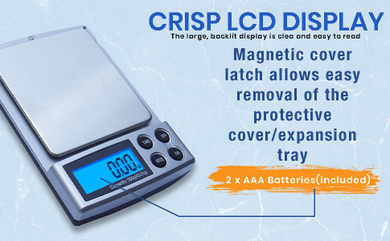
The AWS-600 digital pocket scale offers greater load capacity. The SM-501 ScaleMate pocket scale combines finer readability with a removable magnetic cover that doubles as an expansion tray.
| Specification | AWS-600 | SM-501-BLK |
|---|---|---|
| Maximum capacity | 600g | 500g |
| Readability in grams | 0.1g | 0.01g |
| Equivalent gram display increment | 100mg | 10mg |
| Listed units | g, oz, ozt, dwt | g, oz, gn, ct, ozt, dwt |
| Specified calibration weight | 500g, not included | 500g, not included |
| Listed platform dimensions | 1.9 × 3.3 inches | 2.86 × 2.6 inches |
| Overall dimensions | 5 × 3 × 0.9 inches | 4.48 × 2.99 × 0.77 inches |
| Power | Two AAA batteries, included | Two AAA batteries, included |
| Protective cover | Hinged lid | Removable magnetic cover |
| Additional carrying accessory | Not listed | Vinyl pouch |
| Cover doubles as expansion tray | Not listed | Yes |
The AWS-600 offers 100g more capacity, or 20% more than the SM-501. The SM-501’s gram display increment is ten times smaller.
That difference describes readability. It does not prove a tenfold improvement in accuracy.
Capacity: Which Scale Fits Your Full Load?
Start with the heaviest combined load you expect to weigh.
Include the sample, container and any accessories resting on the platform. A scale must support the full load even when you use tare to display only the contents.
For example:
| Container | Sample | Combined load | Capacity fit |
|---|---|---|---|
| 30g | 150g | 180g | Within both limits |
| 60g | 420g | 480g | Within both, but near the SM-501 limit |
| 80g | 450g | 530g | AWS-600 only |
| 100g | 550g | 650g | Exceeds both limits |
These examples illustrate capacity only. They do not establish measurement accuracy at those loads.
Tare Does Not Increase Capacity
Tare subtracts the container’s indicated weight from the display. Its physical load remains on the sensor.
A 50g container leaves a theoretical 450g of sample capacity on the SM-501 and 550g on the AWS-600.
Leave headroom while adding material. If your usual load approaches the maximum, a higher-capacity model may be easier to use.
An Expansion Tray Does Not Increase Capacity Either
The SM-501’s removable cover can provide a convenient surface for containing or positioning material. It does not raise the scale’s load limit.
Include the tray’s weight when planning your measurement, and make sure it does not touch the housing or another support.
Readability: When Is 0.01g Worth Choosing?
The SM-501 displays gram readings to two decimal places. The AWS-600 displays them to one.
One hundredth of a gram equals 10mg, while one tenth equals 100mg. NIST’s guide to mass units provides background on metric mass measurement.
Suppose your task involves observing changes of 0.03g. That difference spans three SM-501 display increments but is smaller than one AWS-600 increment.
The SM-501 therefore offers more suitable readability for representing that difference. Its actual performance must still meet your tolerance.
For heavier quantities where tenths of a gram are sufficient, the AWS-600 may provide the more useful combination of capacity and readability.
Is the SM-501 More Accurate?
Its readability is finer. This comparison does not include testing that establishes better accuracy.
Three concepts help explain the distinction:
| Term | Meaning |
|---|---|
| Readability | The smallest displayed increment |
| Repeatability | Agreement between repeated measurements of the same object |
| Accuracy | Agreement with an appropriate reference value |
A scale can display additional decimal places while readings fluctuate. It can also repeat a result consistently while showing an offset from a reference.
Neither model’s specification establishes its minimum reliable sample weight. A 10mg display increment should not be interpreted as proof of acceptable accuracy for a 10mg sample.
If your task requires a particular tolerance, check performance at the loads you actually use.
Which Scale Is Better for Jewelry and Gemstones?
SM-501: Consider It for Finer Indicated Differences
The SM-501 is a candidate for jewelry components and loose stones when hundredth-gram readability is relevant.
Its listed carat mode may simplify gemstone mass records. The tray-style cover may also help contain groups of small pieces.
However, the scale must still meet your required tolerance. Mass alone does not establish gemstone identity, quality or metal purity.
For additional selection criteria, read the AWS digital scale buying guide for jewelry.
AWS-600: Consider It for Heavier Groups
The AWS-600 may better accommodate larger collections when their combined load exceeds the SM-501’s capacity.
Both models list troy ounces and pennyweights. If those units fit your records and tenths-of-a-gram readability is sufficient, the AWS-600 may be a practical choice.
Buyers needing both heavier capacity and finer readability should compare other equipment.
Unit Options: The SM-501 Offers More Listed Modes
Both models list grams, ounces, troy ounces and pennyweights. The SM-501 also lists carats and grains.
That difference can matter if you want to read your preferred unit directly rather than calculate a conversion.
Confirm the unit before recording a result. Grams and grains differ, as do ounces and troy ounces.
The NIST SI units reference provides background on standardized units and notation. Record the unit alongside every value to keep measurements clear.
Which Scale Is Better for Coffee and Ingredients?
The AWS-600 is the stronger capacity candidate when your container and ingredients exceed the SM-501’s limit.
The SM-501 may be preferable for modest quantities when finer display increments help your workflow. Its removable cover can also be useful for containing dry material.
Neither model replaces the convenience of a larger platform when working with heavy bowls or bulky containers. For those tasks, compare the AWS kitchen scale range.
Do not assume that fine readability establishes reliable measurement of extremely small additions.
Which Scale Is Better for Crafts and Small Parts?
The SM-501 may suit lightweight components and craft materials when smaller indicated differences matter.
The AWS-600 may suit heavier groups when additional capacity is more useful than another decimal place.
Before choosing, define the job:
-
Comparing small mass differences: Favor sufficient readability, then verify performance.
-
Weighing larger groups: Prioritize capacity and container fit.
-
Containing loose pieces: Consider tray convenience.
-
Estimating quantities from mass: Account for variation between individual pieces.
A calculated count may be inaccurate when the assumed piece weight does not represent the group.
Portability and Cover Design
Both models are compact, but their cover designs support different habits.
The AWS-600’s hinged lid remains attached to the body, which can be convenient when opening and closing the scale frequently.
The SM-501’s removable magnetic cover doubles as an expansion tray. Its listed pouch adds a carrying option, though the detached cover must be kept with the scale.
Choose the layout that fits how you handle samples. Neither design removes the need for a stable surface during weighing.
Calibration Requirements
Both standard listings specify a calibration weight that is purchased separately.
Follow the instructions for your exact model through the AWS scale manuals. Use the required weight and sequence rather than substituting objects of assumed mass.
NIST’s calibration overview explains how instrument indications relate to reference values. Some consumer-scale routines also adjust the instrument’s response.
Verify Performance at Your Working Loads
Completing the manufacturer’s procedure does not establish acceptable performance at every load.
Use suitable reference weights near your typical working range, repeat measurements and compare the results with your tolerance. Check that the indication returns to zero after removing the load.
Keeping reference-check records can help reveal changes over time. NIST’s guidance on check standards describes this approach to monitoring measurement performance.
An AWS calibration weight kit may provide useful masses. Confirm that its contents and specifications suit your procedure and verification needs.
A weight’s nominal value does not establish certified traceability. NIST’s metrological traceability guidance explains the documented calibration chain needed to relate results to a reference.
How to Get More Consistent Results
For either scale, use a firm, level surface away from drafts and vibration.
Keep the platform and container clean, center the load and allow the indication to settle. Make sure the container or expansion tray does not touch another surface.
If readings fluctuate, inspect the setup and battery condition before recalibrating. Calibration cannot correct an overloaded platform or a container partly supported by the table.
Are These Scales Suitable for Commercial Sales?
Check applicable equipment requirements before selling goods by weight.
Capacity, readability and a calibration function do not establish legal-for-trade approval. NIST’s weighing and scales FAQs provide background on commercial weighing requirements.
AWS-600 vs SM-501: Buying Recommendations
| Your priority | Model to consider |
|---|---|
| Smaller gram display increments | SM-501 |
| Combined loads between 500g and 600g | AWS-600 |
| Direct carat or grain selection | SM-501 |
| Removable cover that doubles as a tray | SM-501 |
| Attached protective lid | AWS-600 |
| More capacity for heavier groups | AWS-600 |
| Documented accuracy or uncertainty | Evaluate performance and equipment further |
Frequently Asked Questions
Is SM-501 the same as SM-500?
No. The manufacturer’s series manual distinguishes these models. The SM-501 has finer gram readability than the SM-500. Confirm the SKU when ordering.
Is the SM-501 more accurate than the AWS-600?
It has finer readability. Comparative testing would be needed to establish an accuracy advantage at specific loads.
Does the SM-501 expansion tray increase capacity?
No. The tray and its contents still contribute to the physical load.
Does either standard package include a calibration weight?
No. Check the exact package when ordering because bundles may differ.
Which model is better for heavier samples?
The AWS-600 offers more capacity, provided the container and sample remain within its limit.
Which AWS Scale Should You Choose?
Choose the SM-501 when finer readability, additional units and tray convenience fit your workflow.
Choose the AWS-600 when extra load capacity and an attached cover matter more.
Calculate your full load and define your acceptable measurement tolerance before buying. Then verify performance at the weights you actually use.