
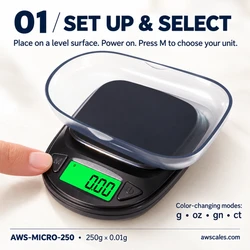
The AWS-Micro-250 is a pocket scale worth considering for light objects, small quantities and portable weighing. Its appeal centers on a compact format, a protective cover that doubles as a tray and color-changing weighing modes.
Its suitability depends on your complete load and measurement tolerance. A fine display increment can be useful, but it does not establish accuracy by itself.
This AWS-Micro-250 review examines published manufacturer information for AWS-MICRO-250-BLK. It does not include independent hands-on testing.
AWS-Micro-250 Specifications at a Glance
The AWS-Micro-250 pocket scale lists the following features:
| Specification | Manufacturer information |
|---|---|
| Model | AWS-MICRO-250-BLK |
| Maximum capacity | 250g |
| Gram readability | 0.01g |
| Weighing units | g, oz, gn, ct |
| Protective cover | Clear plastic |
| Cover use | Doubles as a weighing tray |
| Display feature | Color-changing weighing modes |
| Intended format | Portable pocket scale |
| Calibration mass | Not specified in the reviewed listing |
| Battery requirements | Not specified in the reviewed listing |
| Exact dimensions | Not specified in the reviewed listing |
Confirm missing details through the supplied instructions or AWS before buying accessories. Information from another model should not be assumed to apply.
What Does 250g x 0.01g Mean?
The first number describes maximum capacity. The second describes the smallest gram increment shown on the screen.
A hundredth of a gram equals 10mg. NIST’s guide to mass units provides background on metric mass measurement.
These two specifications answer different buying questions:
-
Capacity: Will the complete load fit within the instrument’s range?
-
Readability: Are the displayed increments appropriate for the task?
For example, a dish and sample might fit comfortably within capacity while the task still requires finer measurement performance. Conversely, a scale may have suitable display increments but insufficient capacity for the container.
Does “Micro” Mean Single-Milligram Measurement?
No. The product name does not establish a single-milligram display increment.
Read the numerical specification and evaluate the equipment against your required tolerance. A model name alone cannot define measurement capability.
AWS-Micro-250 Accuracy: What Can You Expect?
The reviewed listing establishes readability, but it does not provide a detailed accuracy specification across the weighing range or a repeatability test report.
An accuracy claim such as “within ±0.01g” should therefore not be inferred from the display increment.
Three terms help explain the distinction:
| Term | Meaning |
|---|---|
| Readability | Smallest increment displayed |
| Repeatability | Agreement between repeated measurements of the same load |
| Accuracy | Agreement with an appropriate reference value |
A scale can produce consistent readings while remaining offset from a reference. It can also show variation between repeated trials.
How to Decide Whether Performance Is Good Enough
Start with the allowed error for your task.
If your project permits only a small deviation, the instrument’s observed error and variation must fit within that allowance. Extra decimal places do not settle that question.
Check suitable reference masses near your working loads. Repeat the measurements and observe zero return after unloading.
The smallest displayed increment also does not establish the minimum reliable sample weight. Very light samples need particular care because measurement variation can represent a substantial share of their mass.
Capacity: Count the Tray and Container
Everything supported by the platform contributes to the physical load.
That includes the sample, dish, liner and any accessory tray. A container that seems light can still consume a meaningful portion of the available capacity.
Consider these hypothetical examples:
| Container or tray | Contents | Total load | Within a 250g limit? |
|---|---|---|---|
| 10g | 50g | 60g | Yes |
| 30g | 150g | 180g | Yes |
| 50g | 190g | 240g | Yes, with little headroom |
| 70g | 200g | 270g | No |
These examples illustrate load calculations rather than verified weighing performance.
Leave room for additions. Working close to the limit makes it easier to overload the scale accidentally.
Tare Does Not Restore Capacity
Tare subtracts the container’s indicated weight from the display. Its physical load remains on the sensor.
For example, a 40g container leaves a theoretical 210g for contents on an instrument with a 250g limit.
Always calculate the complete load, even when the screen shows only the contents.
Protective Cover and Tray Handling
A cover that also serves as a tray can reduce the number of separate accessories needed for loose objects.
When using any removable tray, placement matters. It should sit securely and touch no other support.
If part of the tray rests on the table or stationary housing, some load may bypass the weighing mechanism. The displayed result can then be misleading, even if it appears stable.
For better handling:
-
Center the tray and contents.
-
Keep loose material away from controls and openings.
-
Include tray mass in capacity calculations.
-
Remove residue between samples.
-
Protect the platform from pressure during storage.
A larger usable surface does not increase the instrument’s load rating.
Weighing Modes and Recordkeeping
Check the unit symbol before every measurement, particularly when switching between projects.
Grams and grains are different units. Carats describe mass in gemstone measurement; they do not establish gemstone quality or metal purity.
NIST’s SI units reference provides background on standardized measurement units and notation. Record the unit alongside every result.
A visual display cue can help you notice a mode change, but the unit symbol remains the reference to check before recording a value.
Best Uses for the AWS-Micro-250
The strongest potential applications involve light loads, manageable containers and tolerances that the instrument can demonstrably meet.
Jewelry Components
Small groups of findings, chains and other components may suit this type of pocket scale.
Before relying on a result, consider how much difference matters. A task involving broad inventory categories has different requirements from evaluating a very small gemstone.
The AWS digital scale buying guide for jewelry provides additional selection criteria.
Mass alone does not establish authenticity, purity or value.
Coins and Collectibles
Individual coins and modest groups can be candidates for portable weighing.
Use a clean, appropriate holder when needed, and include its mass in the total load. Compare repeated results before interpreting a small difference between objects.
Weight can contribute to an assessment, but it cannot independently authenticate a coin.
Crafts and Small Components
Small hardware, beads and other craft materials may fit this weighing range.
When estimating a quantity from total mass, account for differences between individual pieces. A sample average may not represent every item in a mixed batch.
For mixtures, follow the material supplier’s required proportions and tolerance. Confirm that the measuring equipment can support the smallest addition.
Small Ingredient Portions
A lightweight dish and modest ingredient quantity may be compatible with a pocket scale.
Large mixing bowls, complete batches and full brewing setups introduce different capacity requirements. Calculate the maximum load before placing them on the platform.
For other portable options, browse the AWS pocket scale collection.
When to Consider a Different Scale
Choose equipment with more capacity when your sample and container approach the limit during normal use.
Consider finer measurement equipment when your required additions or distinctions are too small for the instrument’s verified performance.
Also evaluate alternatives when you need features such as:
-
A larger supported weighing area.
-
Documented uncertainty or repeatability.
-
Specific unit modes.
-
A specialized brewing function.
-
Approval for a particular commercial application.
Select according to the complete task instead of choosing solely by the number of decimal places.
Calibration: Confirm the Correct Procedure
The reviewed product page does not establish the required calibration mass or sequence.
Find the exact instructions through the AWS scale manuals or contact AWS for model-specific guidance.
Do not assume the calibration mass must equal maximum capacity. Do not borrow a button sequence from a similar-looking scale.
NIST’s calibration overview explains how instrument indications relate to reference values. Some consumer calibration routines also adjust the instrument’s response.
Verify Performance After Calibration
Use appropriate reference masses near the loads you normally measure.
Repeat the check, removing the mass between trials. Observe whether the scale returns to zero and whether the results remain within your tolerance.
Keep a short record if consistency over time matters. NIST’s guidance on check standards describes monitoring measurement performance with reference checks.
An AWS calibration weight kit may offer useful masses. Confirm its contents, quality specifications and compatibility with the required procedure before buying.
A nominal weight value does not establish certified traceability. NIST’s metrological traceability guidance explains the documented calibration chain relating measurement results to a reference.
How to Get More Consistent Readings
Use a firm, level surface away from drafts and vibration.
Allow the instrument and objects to reach stable room conditions. Center the load, avoid touching the platform and wait for the indication to settle.
If results fluctuate:
-
Remove the load and check zero.
-
Confirm that the tray touches no other support.
-
Move away from airflow or vibration.
-
Inspect the power condition using the supplied instructions.
-
Repeat a suitable reference check.
Calibration cannot correct an overloaded platform, external container contact or an unstable surface.
Clean according to the manufacturer’s instructions. Avoid introducing moisture or debris into the instrument.
Can You Use the Micro-250 for Commercial Sales?
Check applicable requirements before using a weighing result to determine a selling price.
Readability, portability and calibration functions do not establish legal-for-trade approval. NIST’s weighing and scales FAQs provide background on commercial equipment requirements.
Frequently Asked Questions
Is the AWS-Micro-250 accurate to ±0.01g?
That accuracy guarantee is not established by the reviewed listing. Readability alone does not define the error at a given load.
Can it weigh a 250g sample in a container?
A container adds physical load. A sample at maximum capacity would leave no allowance for the container.
Which batteries does it use?
The reviewed listing does not specify them. Check the supplied instructions or confirm with AWS.
Which calibration weight should I buy?
Obtain the exact model’s calibration instructions first. The required mass is not established by the reviewed page.
Can the cover increase capacity?
No. A tray helps support or contain material but contributes to the total load itself.
Is the AWS-Micro-250 Worth Considering?
The AWS-Micro-250 is a candidate for light objects and portable weighing when its capacity and checked performance meet your needs.
Before buying, confirm the missing power and calibration details, calculate your complete load and identify your required tolerance. Those checks will tell you more about suitability than the display increment alone.