
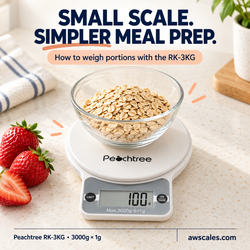
The best 3000g x 0.1g digital scale is one that accommodates your complete load, provides suitable measurement performance, and makes your daily weighing tasks easier.
For American Weigh Scales shoppers, two options worth comparing are the LB-3000 Digital Bowl Scale and the BARISTA-3KG Coffee/Kitchen Scale. Both offer a 3000g capacity and 0.1g readability, but their features serve different workflows.
The LB-3000 is worth considering for loose ingredients, craft materials, and small components. The BARISTA-3KG is especially relevant for coffee preparation because it includes a built-in timer.
The recommendations below are based on published AWS specifications and features rather than independent hands-on testing. “Best” refers to the fit for a particular application, not a demonstrated accuracy ranking.
Best AWS 3000g x 0.1g Scales at a Glance
| Model | Recommended use | Published features | Main consideration |
|---|---|---|---|
| LB-3000 | Loose ingredients, small parts, general bowl weighing | Removable bowl, tare, parts counting, backlit display, battery or adapter operation | Check platform fit and calibration requirements |
| BARISTA-3KG | Coffee preparation and timed brewing | Built-in timer, backlit display, silicone mat, splash-resistant design | Check vessel fit, machine clearance, and response during brewing |
AWS lists both models with 3kg capacity and 0.1g readability. Their different accessories and functions help determine which is more useful for your setup.
What Does 3000g x 0.1g Mean?
The specification describes maximum capacity and displayed readability.
3000g capacity means the maximum rated load is 3000 grams, or 3 kilograms. 0.1g readability means gram readings appear in tenths-of-a-gram increments.
For example, the display can show 125.0g, 125.1g, and 125.2g.
NIST’s explanation of SI mass units provides the relationship between grams and kilograms.
This specification does not establish:
-
Guaranteed accuracy of ±0.1g.
-
Reliable measurement of a standalone 0.1g object.
-
Repeatability across the entire range.
-
Suitability for every precision application.
-
Legal-for-trade approval.
Those details require additional model information and an understanding of your measurement requirements.
Best for Loose Ingredients and General Weighing: AWS LB-3000
The LB-3000 is a practical option when your workflow involves materials that benefit from a bowl.
AWS describes it as a compact bowl scale with a removable container, tare function, parts-counting mode, backlit display, and battery or adapter power options.
Why Consider It?
A removable bowl helps contain loose or rolling materials. That can simplify weighing and transferring ingredients or components.
The bowl format may be useful for:
-
Coffee beans.
-
Rice and grains.
-
Culinary ingredients.
-
Beads and craft components.
-
Small fasteners.
-
Groups of loose parts.
These are potential applications. Whether the scale meets your needs depends on the quantity, required tolerance, and operating conditions.
Parts Counting Adds Flexibility
The LB-3000’s parts-counting function can help estimate the number of matching components using a representative sample.
Counting performance depends on piece-weight consistency and the sample used. Mixed components or pieces with substantial weight variation can produce misleading estimates.
For detailed model information, read the AWS LB-3000 review and application guide.
What to Check Before Buying
Confirm that your container fits securely and that the display remains visible.
Also review calibration requirements. AWS’s published guide identifies a 2000g calibration weight requirement, with the weight sold separately. Confirm the instructions supplied with the selected model.
Recommended fit: users who want a bowl-based scale for moderate loads and decimal gram readings.
Best for Coffee Preparation: AWS BARISTA-3KG
The BARISTA-3KG Coffee/Kitchen Scale is the more relevant option when weighing and timing are part of the same coffee workflow.
Its published features include 3kg capacity, 0.1g readability, a built-in timer, a backlit display, a removable silicone mat, and a splash-resistant design.
Why the Timer Matters
Coffee preparation often involves tracking both mass and elapsed time.
An integrated timer can reduce the need for a separate device when monitoring a pour-over or espresso preparation process.
It does not guarantee a particular brewing result. It gives you another measurement to record and compare.
Capacity for the Complete Brewing Setup
A coffee scale may support more than beans or grounds. Depending on the method, it may also hold a cup, brewer, carafe, and accumulated liquid.
Calculate the entire supported load before choosing a scale.
For example:
500g vessel + 30g coffee + 500g water = 1030g total load
This example fits within a 3000g capacity, assuming all components are supported securely and used according to the instructions.
Check Fit and Response
For espresso output weighing, confirm that the scale fits the machine’s drip tray and leaves enough clearance for the cup.
For active pouring, assess response behavior. A lagging display can make it harder to stop near a target mass. The presence of a timer and 0.1g readability does not independently establish response speed.
Recommended fit: coffee users who want weighing and timing features in one device.
Which Model Is Better for Your Application?
| Your task | Model to consider first | Reason |
|---|---|---|
| Weighing loose beans or grains in a bowl | LB-3000 | Bowl format helps contain the load |
| Timing a pour-over while weighing | BARISTA-3KG | Built-in timer supports the workflow |
| Estimating quantities of matching small parts | LB-3000 | Published parts-counting function |
| General ingredient weighing | Either | Compare container fit and preferred features |
| Espresso beverage weighing | BARISTA-3KG | Coffee features are relevant; verify clearance and response |
| Very small samples needing 0.01g readings | A finer-readability model | Neither displays hundredths of a gram in gram mode |
| Complete loads exceeding 3000g | A higher-capacity model | Neither has enough rated capacity |
The best choice depends on the task. A timer may be valuable for brewing, while a removable bowl may be more useful for loose materials.
How to Compare Precision Weighing Performance
Capacity and readability are only the starting point.
Readability
Readability describes the smallest displayed increment. Both models display gram readings in 0.1g steps.
Repeatability
Repeatability describes agreement between repeated measurements under the same conditions.
Consistent readings are useful when portioning or comparing materials. However, repeated agreement does not prove agreement with the reference value.
Accuracy
Accuracy concerns agreement with the reference value.
A scale displaying 100.0g is not necessarily accurate to ±0.1g. Check the individual model’s published performance information and its operating requirements.
NIST’s weighing and scales FAQs explain scale divisions and related weighing terminology.
For more help matching displayed resolution to a task, consult the AWS product FAQ.
Include Container Weight in Your Capacity Calculation
A 3000g capacity applies to everything resting on the platform.
The tare function removes container weight from the displayed result. It does not remove the container’s physical load.
If a bowl weighs 650g, the remaining rated capacity is:
3000g − 650g = 2350g
Example Capacity Calculations
| Container | Contents | Total load | Capacity assessment |
|---|---|---|---|
| 150g | 500g | 650g | Within capacity |
| 400g | 1500g | 1900g | Within capacity |
| 700g | 2000g | 2700g | Within capacity |
| 900g | 2300g | 3200g | Exceeds capacity |
When adding ingredients and pressing tare between additions, remember that all previous ingredients remain part of the total load.
Choose a higher-capacity scale if your normal setup approaches or exceeds 3000g.
Is 0.1g Readability Suitable for Small Quantities?
A tenth of a gram can be a small or large increment depending on the amount being weighed.
| Quantity | One 0.1g increment relative to the quantity |
|---|---|
| 1g | 10% |
| 10g | 1% |
| 100g | 0.1% |
| 1000g | 0.01% |
These percentages describe display increments, not measurement error.
A 0.1g scale may provide useful detail for many portions and batches. For tiny samples or tighter tolerances, finer readability and better-established low-load performance may be necessary.
Choose based on the smallest difference that matters to your process.
Calibration and Performance Checks
Calibration establishes the relationship between an instrument’s readings and reference values. Some user calibration procedures also adjust the instrument’s response.
NIST’s introduction to calibration explains the role of reference standards in this process.
Follow the Exact Model’s Instructions
Do not assume that every 3000g scale requires the same calibration load.
Read the instructions for the selected model and verify whether the required weight is included. The American Weigh Scales manuals provide model-specific guidance.
Choose Appropriate Reference Weights
The reference weight must match the required load and have suitable quality for the measurement task.
If considering the AWS Calibration Weight Kit, compare its included weights and stated class with the model’s requirements. A kit is useful only if it contains appropriate references for your procedure.
Monitor Performance at Relevant Loads
Routine checks can help identify changes in readings.
Where required by your process, check representative loads rather than assuming one successful measurement establishes performance across the range.
NIST’s discussion of check standards explains their role in monitoring bias and variability.
Match Measurement Quality to Your Tolerance
A traceable result is not automatically suitable for every purpose. Its uncertainty must be appropriate for the application.
NIST’s metrological traceability guidance explains that distinction.
Features That Make Daily Weighing Easier
A Secure Platform
Check that your usual vessel sits securely and does not contact nearby objects.
A scale with enough load capacity may still have an inconvenient platform for a large container.
A Visible Display
Make sure the bowl or carafe does not obscure the reading.
A backlight helps visibility, but display placement also matters.
Accessible Controls
Tare and other buttons should remain accessible with your container in place.
This becomes especially useful when adding ingredients repeatedly.
Appropriate Power Options
Compare battery requirements, adapter compatibility, and included accessories.
Check automatic shutoff behavior if your process involves long pauses.
Practical Cleaning
Follow the model’s cleaning instructions.
Splash resistance does not establish that a scale can be submerged, and a removable washable bowl does not make the electronic body washable.
How to Get More Consistent Results
Use a repeatable setup:
-
Place the scale on a firm, stable surface.
-
Follow its operating conditions and stabilization instructions.
-
Confirm the unloaded reading is ready.
-
Center the container.
-
Tare when appropriate.
-
Add material carefully.
-
Wait for a stable reading.
-
Keep the entire load within capacity.
-
Perform suitable reference checks when your process requires them.
Avoid drafts, vibration, impacts, and contact between the container and surrounding surfaces.
Frequently Asked Questions
What is the best 3000g x 0.1g digital scale?
Within the AWS options discussed here, the LB-3000 is worth considering for bowl weighing and small parts, while the BARISTA-3KG is worth considering for coffee preparation with timing. The best choice depends on your workflow and performance requirements.
Are 3000g x 0.1g scales accurate to 0.1g?
The specification establishes readability, not guaranteed accuracy. Check the individual model’s performance information.
Which AWS model includes a brewing timer?
AWS lists the BARISTA-3KG with a built-in timer.
Which model includes a removable weighing bowl?
AWS describes the LB-3000 as including a removable expansion/weighing bowl.
Can I weigh 3000g of ingredients in a container?
Only if the complete supported load stays within capacity. A container plus 3000g of ingredients exceeds the limit.
Are these scales suitable for jewelry?
They may suit some items when their performance meets the task’s requirements. Very lightweight jewelry, gemstones, or measurements requiring hundredths of a gram may call for finer readability.
Can I use a 3kg scale to sell products by weight?
Capacity and readability do not establish legal-for-trade approval. Confirm the specific model’s certification and applicable requirements for the transaction.
Choose the Scale That Fits Your Weighing Routine
The LB-3000 is a useful starting point for buyers who want a removable bowl and functions relevant to loose materials and small parts.
The BARISTA-3KG is a useful starting point for coffee users who want a built-in timer alongside 3kg capacity and 0.1g readability.
Explore the American Weigh Scales kitchen scale collection and compare the selected model’s specifications with your containers, loads, and measurement tolerances.
The right 3000g x 0.1g digital scale gives you suitable capacity, useful displayed detail, and features that support the way you weigh.