
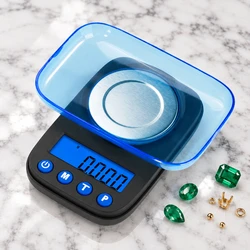
A 50g x 0.001g digital scale provides an unusually useful combination: one-milligram readability with enough capacity for small containers, individual components, and groups of lightweight objects.
These scales occupy a practical position between lower-capacity 20g milligram scales and higher-capacity models that may sacrifice portability or cost more. They are commonly used for gemstones, jewelry components, electronics, miniature hardware, craft materials, coins, pigments, botanical samples, and other nonregulated precision-weighing applications.
American Weigh Scales currently offers several models with this specification. Although each one provides a 50-gram capacity and 0.001-gram readability, their designs, accessories, platform sizes, calibration systems, and special functions differ.
Our leading choices are:
-
GEMINI-50 — best overall portable 50g milligram scale
-
AWS-ULTRA-50G — best for piece counting and modern functionality
-
ZEO-50 — best for a larger platform and complete accessory set
-
MINIPRO50 — best premium compact precision balance
This guide compares these options and explains how to select the right 50g x 0.001g digital scale for your work.
Best 50g x 0.001g Digital Scales at a Glance
| Model | Capacity | Readability | Standout feature | Best for |
|---|---|---|---|---|
| GEMINI-50 | 50g | 0.001g | Portable kit with six units | Best overall |
| AWS-ULTRA-50G | 50g | 0.001g | Piece-counting function | Repetitive component work |
| ZEO-50 | 50g | 0.001g | 2.6 x 2.6-inch platform | Larger containers and accessories |
| MINIPRO50 | 50g | 0.001g | Compact precision-balance format | Dedicated precision work |
All four models display measurements in increments of one-thousandth of a gram, equivalent to one milligram.
However, readability is only one part of scale selection. Platform size, calibration requirements, draft protection, controls, accessories, portability, and the total weight placed on the sensor are equally important.
What Does 50g x 0.001g Mean?
The first number represents capacity:
50g = maximum rated load
The second number represents readability:
0.001g = smallest displayed increment
Because one gram contains 1,000 milligrams:
0.001g = 1mg
A 50g x 0.001g scale may display readings such as:
-
1.426g
-
1.427g
-
1.428g
-
1.429g
The complete measuring range contains 50,000 displayed divisions:
50g ÷ 0.001g = 50,000
The NIST guide to metric SI prefixes explains the decimal relationships behind units such as grams, milligrams, and kilograms.
A 0.001g scale provides ten times finer displayed increments than a 0.01g scale. This does not automatically mean it is ten times more accurate. Readability describes the display increment, while accuracy depends on the complete instrument, calibration, environment, and measurement procedure.
1. GEMINI-50: Best Overall 50g x 0.001g Digital Scale
The GEMINI-50 Precision Milligram Scale is our best overall choice for shoppers who want milligram readability in a compact, portable package.
GEMINI-50 Key Specifications
-
Capacity: 50g
-
Readability: 0.001g
-
Platform: 1.3 x 1.3 inches
-
Display: 0.4 x 1.2 inches
-
Power: Two AAA batteries
-
Calibration: 20g calibration weight included
-
Operating range: 50°F to 86°F
-
Units: g, oz, ozt, dwt, ct, and gn
Its accessory package includes a calibration weight, tweezers, weighing pan or funnel, and microfiber cloth.
Why the GEMINI-50 Stands Out
The GEMINI-50 offers a balanced combination of:
-
Portability
-
Fine readability
-
Useful accessories
-
Multiple weighing modes
-
Simple battery operation
-
More capacity than a 20g milligram scale
Its six unit modes make it adaptable to jewelry, gemstones, coins, precious-metal components, small hardware, and general precision applications.
The compact platform is most appropriate for small objects or containers. Users who routinely work with broader containers may prefer the ZEO-50’s larger platform.
Best Uses for the GEMINI-50
The GEMINI-50 is well suited to:
-
Loose gemstones
-
Jewelry findings
-
Watch components
-
Electronic components
-
Small screws and washers
-
Beads and charms
-
Individual coins
-
Lightweight collectibles
-
Pigments and craft materials
-
Small nonregulated samples
Who Should Choose It?
Choose the GEMINI-50 if you want a portable all-around milligram scale with an included calibration weight and useful handling accessories.
It is particularly appealing for buyers moving up from a 20g model who want additional capacity without giving up 0.001g readability.
2. AWS-ULTRA-50G: Best for Piece Counting
The AWS-ULTRA-50G Milligram Scale combines 50g capacity and 0.001g readability with a piece-counting function.
AWS also lists six color-changing weighing modes for the model.
Why the AWS-ULTRA-50G Stands Out
Piece counting can be useful for estimating quantities of small, consistently manufactured objects.
Examples include:
-
Washers
-
Screws
-
Beads
-
Connectors
-
Terminals
-
Electronic components
-
Jewelry findings
-
Small craft pieces
The scale calculates an estimated quantity based on the average weight of a reference sample.
Understanding Piece Counting
Piece counting does not identify objects individually. It estimates quantity using weight.
For example, if 20 identical components have a combined weight of 8.000g, the calculated average is:
8.000g ÷ 20 = 0.400g per component
If a larger batch weighs 16.000g, the scale may estimate:
16.000g ÷ 0.400g = 40 components
Results depend on how consistent the pieces are. If individual parts have significant weight variation, the estimated count may differ from the actual quantity.
For better counting results:
-
Use a sufficiently large reference sample.
-
Count the reference pieces manually.
-
Use components from the same production group.
-
Keep the platform free of debris.
-
Verify important quantities manually.
-
Do not exceed the scale’s 50g gross capacity.
Best Uses for the AWS-ULTRA-50G
This model is most attractive for:
-
Electronics organization
-
Jewelry-component inventory
-
Craft supply sorting
-
Miniature hardware counting
-
Bead and charm counting
-
Repetitive component work
-
Comparing small batches
Who Should Choose It?
Choose the AWS-ULTRA-50G when piece counting adds practical value to your workflow.
It remains a precision weighing scale first, but the counting feature can reduce the time required to estimate quantities of uniform lightweight parts.
3. ZEO-50: Best Larger-Platform 50g Milligram Scale
The ZEO-50 High-Precision Digital Milligram Scale offers a larger 2.6 x 2.6-inch platform and a generous collection of included accessories.
ZEO-50 Key Specifications
-
Capacity: 50g
-
Readability: 0.001g
-
Platform: 2.6 x 2.6 inches
-
Display: 1.4 x 3.0 inches
-
Dimensions: 5.9 x 3.8 x 2.5 inches
-
Calibration: 50g calibration weight included
-
Power: Four AAA batteries
-
Operating range: 50°F to 86°F
-
Units: g, oz, ozt, dwt, ct, and gn
-
Accessories: tray, scoop, and tweezers
These specifications make the ZEO-50 physically larger than many compact pocket-style milligram scales.
Why the ZEO-50 Stands Out
The larger platform can make it easier to position:
-
Broader weighing trays
-
Small cups
-
Wider gemstones
-
Jewelry pieces
-
Component groups
-
Irregularly shaped objects
Platform size does not increase capacity. The scale still supports a maximum gross load of 50g. However, a wider platform may improve convenience when an object does not fit comfortably on a smaller surface.
The included 50g calibration weight, tray, scoop, and tweezers create a comprehensive starting kit.
Best Uses for the ZEO-50
The ZEO-50 is a strong option for:
-
Gemstones and jewelry components
-
Small containers
-
Craft and model-making materials
-
Small hardware
-
Precious-metal items
-
Coins and collectibles
-
Pigments
-
Botanical samples
-
Dedicated tabletop weighing
Who Should Choose It?
Choose the ZEO-50 if platform space and included accessories matter more than having the smallest possible scale.
Its larger body may be less pocket-friendly than compact alternatives, but it can be more comfortable for stationary precision work.
4. MINIPRO50: Best Premium Compact Precision Balance
The MINIPRO50 Compact Precision Balance Scale is a higher-end option designed for buyers who prefer a dedicated precision-balance format.
AWS currently lists it with:
-
50g capacity
-
0.001g readability
-
A 50g calibration weight
-
Hard plastic cover
-
Weighing tray
-
Multiple weighing units
The listing also indicates that the model can calibrate with a 20g or 50g weight, with a 50g weight included.
Why the MINIPRO50 Stands Out
The MINIPRO50 is positioned as a compact precision balance rather than a basic pocket scale. Its protective cover and tray support a more stationary, methodical weighing workflow.
It may appeal to users who prioritize:
-
A dedicated benchtop setup
-
Protective coverage
-
A structured weighing area
-
Repeatable operating procedures
-
Long-term precision use
Best Uses for the MINIPRO50
Potential applications include:
-
Jewelry-component comparison
-
Gemstone weighing
-
Small-parts quality checks
-
Educational measurements
-
Craft formulation
-
Product development
-
Hobby and workshop precision tasks
Who Should Choose It?
Choose the MINIPRO50 when you want a premium compact balance and expect to use it primarily in one controlled location.
For occasional portable measurements, a smaller and more affordable model may provide sufficient functionality.
Which 50g x 0.001g Scale Is Best?
The best model depends on your priorities.
| Your priority | Recommended model |
|---|---|
| Best overall balance of portability and accessories | GEMINI-50 |
| Piece counting | AWS-ULTRA-50G |
| Larger weighing platform | ZEO-50 |
| Premium compact balance format | MINIPRO50 |
| Smallest objects and portable work | GEMINI-50 or AWS-ULTRA-50G |
| Containers and broader objects | ZEO-50 |
| Dedicated controlled workspace | MINIPRO50 |
| Counting uniform parts | AWS-ULTRA-50G |
For most general users, the GEMINI-50 offers the best combination of portability, multiple units, included accessories, and milligram readability.
The ZEO-50 is the better choice when a larger platform makes objects or containers easier to position. The AWS-ULTRA-50G is the most attractive for component-counting workflows, while the MINIPRO50 targets users seeking a more dedicated precision-balance experience.
What Can a 50g x 0.001g Scale Weigh?
A 50g milligram scale is designed for lightweight objects and small samples.
Examples include:
-
Loose stones
-
Jewelry findings
-
Watch screws
-
Electronic components
-
Small connectors
-
Seeds
-
Beads
-
Charms
-
Fishing tackle components
-
Fly-tying materials
-
Miniature hardware
-
Model-building parts
-
Individual coins
-
Small precious-metal pieces
-
Craft pigments
-
Nonregulated powder samples
-
Small product-development samples
The main question is not whether the object alone weighs less than 50g. The combined physical load must stay within the capacity.
Container Weight Counts Toward Capacity
A scale’s tare function can reset the display to zero after a container is placed on the platform. It does not remove the container’s physical weight from the weighing mechanism.
For example:
-
Container: 16g
-
Sample: 29g
-
Gross load: 45g
This combination remains within the 50g capacity.
However:
-
Container: 16g
-
Sample: 37g
-
Gross load: 53g
This exceeds the scale’s capacity, even if the display shows only 37g after taring.
Use this formula:
Gross load = container weight + sample weight
Then add a reasonable working margin. Avoid selecting a scale that will operate at its absolute limit during every measurement.
Is 0.001g Readability the Same as Accuracy?
No. A 0.001g specification usually describes readability: the smallest increment shown on the display.
Accuracy describes how close the result is to an accepted reference value.
The NIST explanation of scale division “d” and verification scale division “e” explains why the displayed division should not be treated as a complete accuracy guarantee.
A scale’s performance depends on:
-
Calibration
-
Repeatability
-
Linearity
-
Environmental stability
-
Sample placement
-
Temperature
-
Vibration
-
Static electricity
-
Battery condition
-
Proper handling
-
Condition of the load sensor
A display reading of 3.417g contains more detail than 3.42g, but the extra digit is meaningful only when the complete measuring process supports it.
Important Performance Terms
Readability
Readability is the smallest displayed increment. Every scale in this comparison reads in 0.001g increments.
Accuracy
Accuracy is the closeness of a measurement to an accepted reference value under defined conditions.
Repeatability
Repeatability describes how closely repeated measurements agree.
If the same object produces:
-
5.216g
-
5.216g
-
5.217g
-
5.216g
the readings show closer agreement than results that vary across several hundredths of a gram.
Linearity
Linearity describes scale performance across the complete weighing range. Performance near 5g may differ from performance near 45g.
Stability
Stability refers to the scale’s ability to settle on a reading. Persistent movement may indicate drafts, vibration, temperature changes, static, sample movement, weak batteries, or an unsuitable surface.
Minimum Practical Load
A scale that displays one-milligram increments should not automatically be assumed to measure every one-milligram object reliably.
The practical minimum depends on scale performance, repeatability, conditions, and the allowable uncertainty of the application.
The NIST Weighing and Scales FAQs provide additional context on weighing equipment and commercial requirements.
Calibration Requirements
Calibration is especially important for a scale displaying thousandths of a gram.
Before calibrating:
-
Place the scale on a stable, level surface.
-
Keep it away from drafts and vibration.
-
Allow the scale and calibration weight to reach room temperature.
-
Clean the platform.
-
Confirm that the batteries are in good condition.
-
Select the correct weighing mode.
-
Use the calibration mass specified by the manufacturer.
-
Follow the exact sequence in the model’s manual.
Do not assume that every 50g scale uses the same calibration weight.
Examples from the current AWS models include:
-
GEMINI-50: 20g calibration weight
-
ZEO-50: 50g calibration weight
-
MINIPRO50: 50g weight included, with its listing referencing 20g or 50g calibration
AWS offers separate calibration weights for maintaining compatible scale models.
Reference weights should be kept clean, dry, protected, and free from physical damage. Oils, dirt, corrosion, or wear can affect a small weight enough to matter in milligram-level work.
The OIML R 111-1 recommendation describes technical and metrological requirements for reference weights from 1mg through 5,000kg.
Environmental Control Matters
A 0.001g scale is more sensitive to its environment than a typical 0.01g or 0.1g pocket scale.
Air Currents
Fans, vents, open windows, and breathing near the platform can cause the last digit to move.
Use the scale away from airflow and close any protective cover before recording a result.
Vibration
A flexible table, nearby appliance, speaker, workshop machine, or foot traffic can affect readings.
Place the scale on a rigid surface and avoid touching the table during measurement.
Static Electricity
Plastic containers, dry materials, clothing, and low humidity can create static forces. These forces may cause drifting or inconsistent readings.
Use appropriate antistatic practices when static becomes a recurring issue.
Temperature
Rapid temperature changes can destabilize precision measurements.
Allow the scale, container, sample, and calibration weight to acclimate before use. Keep the instrument away from direct sunlight and heating or cooling vents.
Uneven Placement
The scale should rest flat without rocking. Place objects near the center of the platform and ensure the container does not touch the surrounding housing.
How to Obtain More Consistent Results
Use the following procedure for routine precision weighing:
-
Select a firm, level work surface.
-
Eliminate direct airflow.
-
Allow the scale to acclimate.
-
Install fresh batteries when needed.
-
Confirm that the platform is empty and clean.
-
Turn on the scale.
-
Allow the display to stabilize.
-
Calibrate according to the manual.
-
Place the empty container on the platform.
-
Wait for a stable reading.
-
Press tare.
-
Add the object or sample carefully.
-
Avoid touching the table.
-
Wait for the display to stabilize.
-
Record the result.
-
Remove the object.
-
Confirm that the scale returns to zero.
-
Repeat the measurement if consistency matters.
Never press down on the platform. Even brief pressure can overload a sensitive load cell.
Features to Compare Before Buying
Platform Dimensions
A larger platform accommodates broader objects, but it does not increase capacity. Compare the dimensions of your usual container with the platform specification.
Protective Cover
A cover protects the platform during storage and may reduce drafts during operation. Some covers can also serve as trays.
Included Calibration Weight
Confirm both inclusion and nominal value. A scale that includes its required calibration weight can be easier to maintain from the first use.
Tare Function
Tare is essential for containers, but remember that the container still consumes physical capacity.
Piece Counting
Piece counting is useful for uniform components. It is less reliable when individual pieces vary substantially in weight.
Weighing Units
Common unit modes include:
-
Grams
-
Ounces
-
Troy ounces
-
Pennyweights
-
Carats
-
Grains
Choose a model that supports the units relevant to your work.
Accessories
Useful accessories can include:
-
Tweezers
-
Scoop
-
Weighing tray
-
Funnel
-
Calibration weight
-
Microfiber cloth
-
Protective case
Power
Battery-powered scales provide portability. Consider battery availability, auto-off behavior, and whether the model will remain on long enough for your normal workflow.
Display
The display should be clear, sufficiently large, and easy to view without leaning over the weighing platform.
50g x 0.001g Versus Other Specifications
| Specification | Capacity | Display increment | Best for |
|---|---|---|---|
| 20g x 0.001g | 20g | 1mg | Very light samples |
| 30g x 0.001g | 30g | 1mg | Portable milligram measurements |
| 50g x 0.001g | 50g | 1mg | Balanced capacity and fine readability |
| 100g x 0.001g | 100g | 1mg | Heavier containers with milligram readability |
| 100g x 0.01g | 100g | 10mg | General precision weighing |
| 200g x 0.01g | 200g | 10mg | Coins, jewelry, and small batches |
| 500g x 0.01g | 500g | 10mg | Larger parts and containers |
A 50g x 0.001g scale is best when one-milligram readability matters and the total load remains comfortably below 50g.
If your containers and samples regularly approach the limit, a 100g x 0.001g model may offer a more practical working range.
If differences smaller than 0.01g do not affect your decisions, a higher-capacity 0.01g scale may be more versatile.
When a Consumer Milligram Scale Is Not Enough
Consumer milligram scales are useful for general precision measurements, but they should not automatically be considered:
-
Legal-for-trade
-
Laboratory-certified
-
Pharmaceutical equipment
-
Medical dosing instruments
-
Analytical balances
-
Safety-certified formulation systems
-
Suitable for regulated commercial transactions
The correct equipment depends on the application, required uncertainty, governing regulations, and quality-control procedures.
NIST Handbook 44 addresses specifications and tolerances for commercial weighing devices.
NIST also provides guidance on Class II scale applications, which illustrates why instrument class and intended use must be considered separately from the number of digits on a display.
For regulated, clinical, pharmaceutical, commercial, or safety-critical work, use equipment specifically approved for that application.
Common Mistakes to Avoid
Choosing Based Only on Price
Compare calibration equipment, platform size, accessories, controls, and intended use—not just the initial price.
Assuming Every 50g Scale Is Identical
Models with the same headline specification can have different platforms, covers, calibration systems, functions, and accessories.
Ignoring the Container
A 15g tray leaves only 35g of nominal capacity for the sample.
Confusing Readability With Accuracy
A three-decimal display does not guarantee perfect ±0.001g accuracy.
Operating at Maximum Capacity
Leave working room rather than planning every measurement around a 49g or 50g gross load.
Using the Wrong Calibration Mass
Follow the exact model instructions.
Weighing in Moving Air
A fan or HVAC vent can destabilize a milligram reading.
Ignoring Static
Static forces can influence tiny objects and dry materials.
Trusting One Unstable Reading
Wait for stabilization and repeat important measurements.
Overloading the Platform
Overloading may produce an error or damage the sensor permanently.
Frequently Asked Questions
What is the best 50g x 0.001g digital scale?
The GEMINI-50 is our best overall choice because it combines portability, six weighing modes, a calibration weight, tweezers, and a weighing pan or funnel. The best model still depends on your platform, counting, and workspace requirements.
Which model has the largest platform?
Among the models detailed here, the ZEO-50 lists a 2.6 x 2.6-inch platform, making it a strong choice for broader objects and containers.
Which scale offers piece counting?
The AWS-ULTRA-50G includes a piece-counting function for estimating quantities of uniform components.
Does 0.001g equal one milligram?
Yes. The NIST SI mass reference provides more information about metric mass units.
Can these scales hold 50 grams plus a container?
No. The container and sample together must remain within the 50g capacity.
Does pressing tare restore the full 50g capacity?
No. Tare resets the displayed value but does not remove physical weight from the sensor.
Can I weigh a 50g object exactly?
The rated limit is 50g, but operating at the maximum leaves no practical margin. Choose more capacity if your objects regularly approach 50g.
Are these scales accurate to exactly one milligram?
They display in one-milligram increments. That is not the same as a universal guarantee of ±1mg accuracy under all conditions.
Why does the last digit move?
Drafts, vibration, static, temperature changes, weak batteries, unstable surfaces, and sample movement can all affect the reading.
Which scale is best for jewelry?
The GEMINI-50 is a strong portable option, while the ZEO-50 provides more platform space. The ideal choice depends on the size of the jewelry and container.
Which scale is best for electronics components?
The AWS-ULTRA-50G is particularly useful when piece counting matters. The GEMINI-50 is a good general option for weighing individual lightweight components.
Which scale is easiest to calibrate?
All should be calibrated according to their manuals. Ease depends partly on whether the required weight is included and whether the controls are intuitive.
Can these scales be used for commercial sales?
Do not assume so. Commercial transactions based on weight may require an approved legal-for-trade device and inspection under applicable laws.
Final Recommendations
For the best all-around combination of portability, accessories, and one-milligram readability, choose the GEMINI-50.
For counting uniform small parts, choose the AWS-ULTRA-50G.
For a larger platform and comprehensive accessory set, choose the ZEO-50.
For a premium compact precision-balance format, consider the MINIPRO50.
Before purchasing, calculate the weight of your heaviest object and container together. Confirm that the gross load remains comfortably below 50g. Then decide which platform size, calibration system, accessories, and special functions best match your workflow.
A 50g x 0.001g digital scale can be an excellent precision tool when its capacity and environment are appropriate. The right model is not simply the one with the most features—it is the one that makes your normal measurements easier, safer, and more repeatable.