
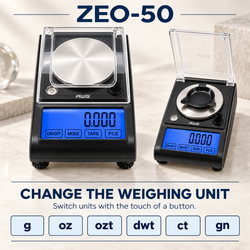
The best digital scale for diamonds needs to do more than display a lot of decimal places.
Diamond weighing requires the right combination of:
-
Resolution
-
Capacity
-
Carat mode
-
Repeatability
-
Calibration
-
Stable zero
-
Tare
-
Platform size
-
Draft control
-
Environmental stability
For general jewelry and larger loose-stone weighing, a scale with:
0.01 g readability
can be useful.
For smaller loose diamonds and applications where small differences in carat weight matter, a scale with:
0.001 g readability
is generally the more appropriate starting point.
Why?
Because diamonds are sold and described by carat weight, and relatively small differences in mass can matter.
American Weigh Scales offers several precision pocket scales covering both 0.01 g and 0.001 g measurement ranges.
The correct scale depends on whether you need to weigh:
-
Individual loose diamonds
-
Small diamonds
-
Diamond parcels
-
Mounted diamonds
-
Diamond rings
-
Finished jewelry
-
Other gemstones and precious-metal items
The best diamond scale is therefore not simply the model with:
the highest capacity
or:
the greatest number of decimal places.
It is the scale that matches the actual weight range and precision requirements of the diamonds you handle.
Quick Answer: What Is the Best Digital Scale for Diamonds?
Use this as a practical starting point:
| Diamond Weighing Task | Suggested Readability | Capacity Priority |
|---|---|---|
| General loose diamonds | 0.001–0.01 g | Low to moderate |
| Very small diamonds | 0.001 g | 20–50 g often sufficient |
| Larger loose diamonds | 0.001–0.01 g | Low capacity usually sufficient |
| Diamond parcels | 0.001 g | 50 g+ can be useful |
| Diamond rings | 0.01 g | Higher capacity useful |
| Finished diamond jewelry | 0.01 g | 100–500 g useful |
| General jewelry + diamonds | 0.01 g | Around 500 g versatile |
| Fine loose-stone work | 0.001 g | 20–50 g common |
| Portable diamond weighing | 0.001–0.01 g | Depends on application |
A simple rule is:
small loose diamonds → consider 0.001 g
general jewelry and mixed weighing → 0.01 g can provide greater capacity
How Are Diamonds Weighed?
Diamonds are weighed in:
metric carats.
According to the Gemological Institute of America carat-weight guidance:
1 carat = exactly 0.20 gram.
A carat is divided into:
100 points.
Therefore:
-
0.25 ct = 25 points
-
0.50 ct = 50 points
-
0.75 ct = 75 points
-
1.00 ct = 100 points
This makes relatively small weight differences meaningful.
Diamond Carat-to-Gram Conversion
Because:
1 ct = 0.20 g
then:
1 g = 5 ct.
Here are common conversions:
| Diamond Weight | Gram Weight |
|---|---|
| 0.05 ct | 0.01 g |
| 0.10 ct | 0.02 g |
| 0.25 ct | 0.05 g |
| 0.50 ct | 0.10 g |
| 0.75 ct | 0.15 g |
| 1.00 ct | 0.20 g |
| 1.50 ct | 0.30 g |
| 2.00 ct | 0.40 g |
| 3.00 ct | 0.60 g |
| 5.00 ct | 1.00 g |
| 10.00 ct | 2.00 g |
This table immediately demonstrates why a standard:
1 g kitchen scale
is unsuitable for individual diamond weighing.
A 1-carat diamond weighs only:
0.20 g.
Carat Is Weight, Not Physical Size
This distinction is critical.
Carat describes:
mass.
It does not directly describe:
-
Diameter
-
Width
-
Depth
-
Visual size
Two diamonds with identical carat weights can look different in size because of differences in:
-
Cut
-
Proportions
-
Depth
-
Shape
Likewise, two diamonds that look similar from above may not have identical carat weights.
The GIA's diamond grading guidance on carat weight explains that carat is a standardized metric measurement of diamond mass.
Use a scale to determine weight.
Do not rely on visual dimensions alone.
Why Diamond Weight Requires Fine Measurement
A diamond can weigh:
0.20 g
and represent:
1.00 ct.
A difference of only:
0.01 g
equals:
0.05 ct.
That means a scale displaying only hundredths of a gram may move directly from an equivalent of:
1.00 ct
to:
1.05 ct
in its displayed gram increments.
For finer loose-diamond work, this can be too coarse.
What Does 0.01 g Mean for Diamond Weighing?
A 0.01 g digital scale displays measurements such as:
0.18 g
0.19 g
0.20 g
0.21 g
Since:
0.01 g = 0.05 ct,
each display step corresponds to:
five carat points.
This can still be useful for:
-
Finished diamond jewelry
-
Rings
-
Pendants
-
General inventory
-
Approximate internal checks
-
Larger gemstones
But it is not the finest choice for small loose-diamond weighing.
What Does 0.001 g Mean for Diamonds?
A 0.001 g milligram scale displays:
0.198 g
0.199 g
0.200 g
0.201 g
Since:
0.001 g = 0.005 ct,
each display increment corresponds to:
half of one carat point.
That provides ten times finer displayed resolution than:
0.01 g.
This makes 0.001 g much more relevant for small loose diamonds.
0.01 g vs. 0.001 g Diamond Scales
| Feature | 0.01 g Scale | 0.001 g Scale |
|---|---|---|
| Gram increment | 0.01 g | 0.001 g |
| Carat equivalent | 0.05 ct | 0.005 ct |
| Relative resolution | Fine | Much finer |
| Typical capacity | Higher | Lower |
| Finished jewelry | Excellent | Often capacity-limited |
| Loose diamonds | General use | Better for finer work |
| Small diamonds | Coarser | More suitable |
| Environmental sensitivity | Lower | Higher |
| Draft sensitivity | Moderate | Greater |
| Platform size | Often larger | Often smaller |
This leads to one of the most important diamond-scale rules:
choose resolution based on the smallest meaningful diamond weight difference—not on how impressive the display looks.
Does 0.001 g Mean the Scale Is Accurate to ±0.001 g?
No.
This is a common misunderstanding.
A scale displaying:
0.001 g
has:
0.001 g readability or resolution.
That does not automatically guarantee:
±0.001 g accuracy under every condition.
These concepts are different.
Readability
The smallest displayed increment.
Accuracy
How close the measurement is to the relevant true or reference mass.
Repeatability
How consistently the same diamond produces similar measurements under the same conditions.
A good diamond weighing setup must consider all three.
Why Repeatability Matters for Diamonds
Suppose you weigh the same loose diamond five times.
Ideally, under stable conditions, readings should remain reasonably consistent.
If your measurements are:
0.203 g
0.203 g
0.203 g
0.203 g
that suggests stable performance under those conditions.
If the same diamond produces:
0.198 g
0.207 g
0.202 g
0.209 g
investigate the weighing environment.
Possible causes include:
-
Airflow
-
Vibration
-
Static
-
Calibration
-
Temperature change
-
Low battery
-
Platform contamination
-
Unstable surface
More decimal places are useful only when the measurement itself is sufficiently stable.
What Capacity Does a Diamond Scale Need?
Individual diamonds are extremely light relative to the capacity of most pocket scales.
Consider:
1 ct = 0.20 g
5 ct = 1 g
10 ct = 2 g
25 ct = 5 g
50 ct = 10 g
100 ct = 20 g
Therefore:
20 g capacity equals 100 carats.
For individual diamonds, even a 20 g capacity can be enormous.
When 20 g Capacity Is Enough
A:
20 g × 0.001 g
scale can be useful when you primarily weigh:
-
Individual loose diamonds
-
Small loose diamonds
-
Very lightweight parcels
-
Tiny jewelry components
and your tray is lightweight.
Why 50 g Can Be Better
A:
50 g × 0.001 g
scale provides:
250 carats of theoretical capacity.
The additional capacity becomes useful for:
-
Diamond parcels
-
Multiple stones
-
Larger gem cups
-
Heavier trays
while retaining milligram readability.
Best Milligram Range for Diamonds
American Weigh Scales currently offers multiple models in the 0.001 g category.
The AWS milligram scale comparison includes configurations such as:
-
20 g × 0.001 g
-
30 g × 0.001 g
-
50 g × 0.001 g
-
100 g × 0.001 g
For diamond weighing, the correct capacity depends primarily on:
diamond + tray + parcel + container.
20 g vs. 50 g for Diamonds
Choose 20 g × 0.001 g When:
-
Individual loose diamonds are the primary application
-
Parcels are small
-
The weighing tray is lightweight
-
Compact size matters
Choose 50 g × 0.001 g When:
-
You weigh larger parcels
-
Multiple diamonds are weighed together
-
You use a heavier tray
-
You want more capacity headroom
AWS's Gemini-20 vs. Gemini-50 comparison illustrates this capacity tradeoff while retaining 0.001 g readability.
Do You Really Need 500 g Capacity for Diamonds?
For individual diamonds:
probably not.
But diamond professionals and jewelry businesses rarely weigh only loose diamonds.
You may also need to weigh:
-
Diamond rings
-
Earrings
-
Pendants
-
Bracelets
-
Chains
-
Precious metals
-
Gemstone parcels
-
Trays
That changes the capacity requirement.
500 g × 0.01 g for Mixed Jewelry Work
A:
500 g × 0.01 g
scale provides significantly more flexibility for finished jewelry.
The SC501g Precision Digital Pocket Scale is one example of this format.
It combines:
-
500 g capacity
-
0.01 g readability
-
Carat mode
-
Gram mode
-
Tare
-
Stainless-steel weighing platform
-
Multiple units
This configuration is better suited to:
diamonds + finished jewelry
than a low-capacity milligram scale alone.
Compact 500 g Option
The SM-501-BLK ScaleMate also provides:
500 g × 0.01 g
with a compact form factor.
This type of scale can be useful for:
-
Jewelers
-
Collectors
-
Trade shows
-
Jewelry buying appointments
-
Finished diamond pieces
A 0.01 g model should not automatically replace a milligram scale for small loose diamonds, however.
Each serves a different purpose.
A Two-Scale Setup Can Be Better
For businesses handling both:
small loose diamonds + finished jewelry
one scale may force an unnecessary compromise.
A better setup can be:
Fine Diamond Scale
20–50 g × 0.001 g
for:
-
Small loose diamonds
-
Diamond parcels
-
Fine sorting
General Jewelry Scale
500 g × 0.01 g
for:
-
Diamond rings
-
Pendants
-
Bracelets
-
Larger trays
-
General jewelry
This provides both:
fine resolution and practical capacity.
Capacity Includes the Diamond Tray
Never calculate capacity from diamond weight alone.
Suppose:
Scale capacity = 20 g
Tray weight = 8 g
Diamond parcel = 10 g
Total physical load:
8 + 10 =
18 g.
That leaves only:
2 g of capacity.
Even though the diamonds themselves weigh only 10 g, the tray matters.
Tare Does Not Restore Capacity
You can place the tray on the scale and press:
TARE.
The display returns to:
0.000 g.
But the scale is still supporting:
8 g.
Tare changes the displayed zero point.
It does not remove physical mass from the scale.
This becomes particularly important with:
20 g and 50 g milligram scales.
Choose Enough Capacity Headroom
Do not routinely operate directly at maximum capacity.
If your complete weighing setup normally reaches:
18–19 g,
a 20 g scale gives little room for:
-
Larger parcel
-
Different tray
-
Additional stones
A higher-capacity model may provide a more practical working range.
Carat Mode Matters
A diamond scale that directly displays:
ct
simplifies workflow.
Without carat mode, you can calculate:
grams × 5 = carats.
For example:
0.20 g × 5 = 1.00 ct
0.25 g × 5 = 1.25 ct
0.30 g × 5 = 1.50 ct
But direct carat mode reduces repeated conversions.
Carat vs. Karat
Do not confuse:
carat
with:
karat.
Carat describes gemstone weight.
Karat describes gold purity.
Examples:
1.00 ct diamond
versus:
18K gold ring.
The measurements describe completely different characteristics.
Diamond Carat Weight Does Not Determine Value Alone
A 2-carat diamond is not automatically twice as valuable as a 1-carat diamond.
Diamond value also depends heavily on:
-
Cut
-
Color
-
Clarity
Carat is only one of the familiar:
4Cs.
Two diamonds with the same carat weight can have very different values.
Why Small Weight Differences Can Matter Commercially
Diamond weight is not merely an interesting technical measurement.
It can be part of how a diamond is:
-
Listed
-
Described
-
Priced
-
Compared
-
Documented
The FTC's consumer diamond and gemstone guidance explains that when diamond weight is described in decimal carats, the stated number should accurately reflect the weight when rounded to the stated decimal place.
For businesses selling diamonds, measurement quality therefore matters.
Diamond Weight Advertising
The FTC's guidance for advertising diamonds, gemstones and pearls specifically addresses diamond-weight representations.
For example, when a decimal weight such as:
0.30 carat
is advertised, the underlying weight must support that decimal representation according to the applicable rounding convention.
This means a scale used for commercial diamond representation should be selected with greater care than one used solely for informal hobby comparison.
Consumer Scale vs. Legal-for-Trade Equipment
A general precision pocket scale should not automatically be assumed to be:
-
Legal for trade
-
Laboratory certified
-
Suitable for every regulated commercial transaction
If the scale is being used in a regulated transaction where product price is determined directly by measured weight, verify the applicable legal metrology requirements.
The current NIST Handbook 44 contains specifications and technical requirements used by weights-and-measures authorities for commercial weighing and measuring equipment.
For commercial operations:
check applicable local and regulatory requirements rather than assuming any pocket scale qualifies.
Calibration Matters
A diamond scale should be calibrated according to:
the manufacturer's procedure.
Different models may require different calibration masses.
Possible requirements might include:
-
20 g
-
50 g
-
100 g
-
500 g
depending on the scale.
Do not assume one calibration weight is suitable for every model.
Do Not Calibrate With Diamonds
A diamond whose weight is merely assumed should not replace a proper calibration reference.
Likewise, avoid using:
-
Coins
-
Rings
-
Bolts
-
Household items
as precision calibration standards.
Use the calibration weight specified by the scale manufacturer.
Why Coins Are Poor Calibration References
Coins can differ in actual mass because of:
-
Manufacturing tolerance
-
Circulation wear
-
Dirt
-
Damage
-
Corrosion
A nominal coin weight is not the same thing as a proper scale-calibration standard.
Calibration vs. Verification
These two terms are related but not identical.
Calibration
Establishes or adjusts the scale's measurement response according to its specified procedure.
Verification
Checks whether the scale produces an expected reading when a suitable known reference is measured.
Routine verification can help detect:
-
Drift
-
Impact damage
-
Unexpected scale behavior
-
Calibration issues
Check Repeatability
Before weighing an important diamond, it can be useful to ensure the scale is behaving consistently.
If the same appropriate reference or stone produces substantially different readings repeatedly, investigate before relying on the measurement.
Possible causes include:
-
Draft
-
Vibration
-
Static
-
Calibration
-
Temperature instability
-
Platform contamination
-
Battery condition
Drafts Matter at 0.001 g
Milligram scales are much more sensitive to their environment than ordinary kitchen scales.
Air movement from:
-
HVAC vents
-
Fans
-
Open windows
-
Breathing
can influence highly sensitive readings.
When using 0.001 g readability:
keep the weighing area calm.
A Draft Shield Can Help
A protective enclosure around the weighing area can reduce the effect of air movement.
This becomes increasingly valuable as:
resolution becomes finer.
Some milligram-scale designs incorporate protective covers or shields around the platform.
Vibration Matters Too
A milligram scale should be placed on a:
-
Hard
-
Stable
-
Level
-
Vibration-resistant
surface.
Avoid:
-
Wobbly tables
-
Flexible shelves
-
Counters connected to machinery
-
Surfaces frequently bumped
A scale cannot provide stable measurements when the platform itself is constantly moving.
Static Electricity Can Affect Fine Weighing
Static becomes increasingly relevant when working at milligram-level resolution.
Potential sources include:
-
Plastic trays
-
Synthetic cloth
-
Dry environments
-
Packaging materials
If a scale remains unstable after checking:
-
Calibration
-
Drafts
-
Surface stability
static may be worth considering.
Temperature Stability Is Important
Precision electronics can behave differently after being moved between significantly different environments.
For example:
cold vehicle → warm jewelry store
may require some stabilization time.
Follow the manufacturer's operating instructions before expecting the finest repeatability.
Keep the Weighing Platform Clean
At 0.001 g resolution:
1 milligram matters.
Dust, debris or residue therefore becomes more relevant than on a coarse household scale.
Before weighing:
-
Inspect the platform
-
Remove debris
-
Make sure no previous stones remain
-
Check the tray
This is also important for avoiding lost diamonds.
Use a Diamond or Gem Tray
Loose diamonds are small and easy to misplace.
A suitable lightweight tray can help:
-
Contain stones
-
Prevent rolling
-
Group parcels
-
Make transfer easier
Place the empty tray on the scale.
Tare it.
Then add the diamond.
Remember:
the tray still consumes physical capacity.
Platform Size Matters
Individual diamonds are tiny, but the tray may not be.
Compare:
-
Weighing platform dimensions
-
Tray dimensions
-
Scale housing
-
Display position
Make sure the tray does not touch:
-
The surrounding scale body
-
The table
-
Another object
during weighing.
Any external contact can interfere with the measurement.
Best Digital Scale for a 1-Carat Diamond
A 1-carat diamond weighs:
0.20 g.
A 1 g scale is therefore completely unsuitable.
A:
0.01 g
scale provides only hundredth-of-a-gram displayed increments.
For fine loose-diamond work, consider:
0.001 g readability.
Best Scale for Small Diamonds
For stones substantially below 1 carat, finer resolution becomes increasingly important.
A:
20–50 g × 0.001 g
milligram scale is a more natural fit than a 500 g × 0.01 g general jewelry scale when the primary purpose is weighing small loose diamonds.
Best Scale for Diamond Parcels
Parcel weighing requires both:
fine resolution + enough capacity.
For example:
Small parcel + lightweight tray:
20 g × 0.001 g may work.
Larger parcel + tray:
50 g × 0.001 g may be more practical.
Large parcel where milligram-level detail is unnecessary:
a higher-capacity 0.01 g model may be sufficient depending on the application.
Best Scale for Diamond Rings
A ring includes:
-
Diamond
-
Gold or platinum
-
Setting
-
Additional stones
For complete ring weight, capacity matters much more.
A:
500 g × 0.01 g
scale provides plenty of capacity for most rings and other jewelry.
However, the measurement is the weight of:
the entire ring—not the diamond alone.
You Cannot Get Loose Diamond Weight From Total Ring Weight
Suppose a diamond ring weighs:
6.82 g.
You cannot simply treat:
6.82 g
as the diamond's weight.
That reading includes:
-
Metal
-
Setting
-
Diamond
-
Additional stones
-
Structural components
Determining the diamond's individual weight while mounted is a different problem.
Can You Estimate Diamond Weight From Measurements?
Diamond measurements can sometimes be used to estimate weight, particularly when shape and proportions are known.
But an estimate is not the same as directly weighing a loose stone.
Actual carat weight should come from an appropriate weighing process when direct weighing is possible and required.
Round Diamond Size vs. Carat Weight
Consumers frequently associate certain millimeter diameters with certain carat weights.
But cut proportions matter.
A diamond may carry more weight:
deep in the pavilion
rather than displaying that mass in face-up diameter.
This is another reason:
carat weight and visual size are not interchangeable.
Diamond Shape Also Matters
Common shapes include:
-
Round
-
Oval
-
Cushion
-
Pear
-
Emerald
-
Marquise
-
Princess
-
Radiant
Two diamonds with identical carat weights but different shapes can have very different visible dimensions.
The scale tells you:
mass.
It does not tell you:
how large the diamond will appear when worn.
Does Carat Weight Prove a Diamond Is Real?
No.
Weight cannot independently identify a diamond.
Materials such as:
-
Cubic zirconia
-
Moissanite
-
Glass
-
Other simulants
have different physical properties, but mass alone is not a sufficient authentication method.
Diamond identification requires appropriate gemological testing.
Can a Scale Tell Natural From Lab-Grown Diamond?
No.
A scale cannot determine whether a diamond is:
-
Natural
-
Laboratory-grown
Both are diamonds and can exist at the same carat weight.
Identification requires appropriate testing and documentation.
Can a Scale Determine Diamond Quality?
No.
A digital scale can determine mass.
It cannot grade:
-
Cut
-
Color
-
Clarity
These require separate evaluation.
Can a Scale Determine Diamond Value?
No.
Carat weight contributes to value, but value depends on much more than weight alone.
Diamond valuation can also depend on:
-
Cut
-
Color
-
Clarity
-
Shape
-
Market conditions
-
Certification
-
Fluorescence
-
Other quality characteristics
Use the scale as:
a measurement tool—not a complete valuation system.
Best Diamond Scale for Jewelers
A jeweler handling both loose diamonds and completed jewelry may benefit from two measurement ranges.
Fine Diamond Scale
20–50 g × 0.001 g
for:
-
Loose diamonds
-
Small parcels
-
Fine stone measurement
General Jewelry Scale
500 g × 0.01 g
for:
-
Rings
-
Earrings
-
Pendants
-
Bracelets
-
Finished jewelry
This prevents a single scale from being forced to compromise between:
very fine readability and higher capacity.
Best Diamond Scale for Collectors
A collector primarily weighing loose stones should consider:
-
0.001 g readability
-
Carat mode
-
Tare
-
Protective cover
-
Calibration capability
-
Stable zero
High capacity is usually not necessary for individual diamonds.
Best Diamond Scale for Jewelry Sellers
A jewelry seller may need more capacity because products are commonly weighed as complete pieces.
A:
500 g × 0.01 g
scale provides greater flexibility for:
-
Rings
-
Necklaces
-
Bracelets
-
Pendants
-
Watches
If the business also weighs loose diamonds:
add a 0.001 g milligram scale.
Best Diamond Scale for Trade Shows
For mobile use, prioritize:
-
Compact size
-
Protective cover
-
Battery operation
-
Carat mode
-
Tare
-
Secure transport
But remember that trade-show environments can introduce:
-
Table vibration
-
Foot traffic
-
HVAC airflow
which may affect extremely fine weighing.
Pocket Scale vs. Bench Scale for Diamonds
Pocket Scale
Advantages:
-
Portable
-
Compact
-
Easy to store
-
Convenient for travel
Best for:
-
Dealers
-
Collectors
-
Mobile work
Bench Scale or Balance
Advantages can include:
-
Larger workspace
-
More stable setup
-
Specialized measurement performance
Best for:
-
Permanent workstations
-
Professional laboratory or commercial workflows
Choose based on the level of measurement assurance required.
Diamond Scale Buying Checklist
Before buying a digital diamond scale, ask:
-
Am I weighing loose diamonds or finished jewelry?
-
What is the smallest diamond I expect to weigh?
-
What is the largest total load?
-
Do I need 0.01 g readability?
-
Do I need 0.001 g readability?
-
Is the scale intended for commercial weight representation?
-
Do legal-for-trade requirements apply?
-
Does the scale display carats?
-
Does it display grams?
-
What is its maximum capacity?
-
Will I weigh diamond parcels?
-
Will I use a tray?
-
How much does the tray weigh?
-
Is there enough capacity headroom?
-
Does the scale offer tare?
-
Is the platform large enough for the tray?
-
What calibration weight is required?
-
Is the proper calibration weight available?
-
Are readings repeatable?
-
Is the zero stable?
-
Will airflow affect the scale?
-
Does it have draft protection?
-
Is the work surface stable?
-
Could vibration affect readings?
-
Could static affect measurements?
-
Is the operating temperature stable?
-
Will the scale travel frequently?
-
Does it have a protective cover?
-
Is battery operation sufficient?
-
Am I confusing readability with accuracy?
-
Am I using the scale only for mass—not identification?
-
Would two scales provide a better workflow?
-
Does the scale fit my diamond-weight range?
-
Can I verify its performance periodically?
-
Does the equipment meet requirements for my intended commercial use?
Common Diamond Scale Mistakes
Using a Kitchen Scale
A 1 g scale is far too coarse for loose-diamond weighing.
Choosing 0.01 g for Extremely Fine Diamond Work
0.01 g equals 0.05 ct, which can be coarse for small loose diamonds.
Assuming 0.001 g Means ±0.001 g Accuracy
Readability and accuracy are different specifications.
Buying More Capacity Than You Need
High capacity is not automatically useful for tiny loose stones.
Buying Too Little Capacity
The tray and parcel also count toward the load.
Forgetting Tray Weight
Capacity includes every object touching the platform.
Assuming Tare Restores Capacity
It does not.
Ignoring Carat Mode
Direct ct display can simplify work.
Calibrating With Coins
Use the specified calibration weight.
Ignoring Repeatability
A fluctuating last digit may not represent useful information.
Weighing Near an HVAC Vent
Drafts can affect milligram measurements.
Using a Wobbly Table
Vibration can destabilize measurements.
Ignoring Static
Static can become relevant at fine resolution.
Treating Ring Weight as Diamond Weight
A ring includes metal and other components.
Assuming Carat Means Physical Size
Carat is mass.
Assuming Weight Identifies a Diamond
It does not.
Assuming Weight Determines Value
Carat is only one quality and valuation factor.
Frequently Asked Questions
What is the best digital scale for diamonds?
For small loose diamonds, start by considering:
20–50 g capacity × 0.001 g readability.
For general jewelry containing diamonds:
500 g × 0.01 g
can provide greater versatility.
Is 0.01 g precise enough for diamonds?
It may be useful for:
-
Finished jewelry
-
General checks
-
Larger items
But 0.01 g corresponds to:
0.05 carat.
For finer loose-diamond weighing, 0.001 g is generally more appropriate.
Is 0.001 g good for diamonds?
It provides substantially finer displayed resolution and is useful for small loose stones.
Remember that 0.001 g readability does not automatically mean every measurement is accurate to ±0.001 g.
What is 0.001 g in carats?
0.001 g equals:
0.005 ct.
What is 0.01 g in carats?
0.01 g equals:
0.05 ct.
How much does a 1-carat diamond weigh?
Exactly:
0.20 g.
How much does a 2-carat diamond weigh?
0.40 g.
How much does a 5-carat diamond weigh?
1.00 g.
How many carats are in one gram?
5 carats.
Is 20 g capacity enough for diamonds?
For many loose-diamond applications, yes.
20 g equals:
100 carats.
Is 50 g capacity enough?
50 g equals:
250 carats.
It provides significantly more room for trays and parcels.
Why would I need a 500 g diamond scale?
Usually not for the loose diamond alone.
The extra capacity becomes useful when also weighing:
-
Rings
-
Pendants
-
Bracelets
-
Finished jewelry
-
Larger containers
Does a diamond scale need carat mode?
It is not mandatory, but direct carat mode is highly convenient.
Does tare increase capacity?
No.
The physical container remains part of the load.
Can I calibrate a diamond scale with a diamond?
Use the manufacturer-specified calibration reference rather than a stone of assumed mass.
Can I calibrate with coins?
Use an appropriate calibration weight instead.
Why does my diamond scale fluctuate?
Possible causes include:
-
Air movement
-
Vibration
-
Static
-
Calibration
-
Temperature
-
Battery condition
-
Surface instability
Can a digital scale tell whether a diamond is genuine?
No.
It measures mass only.
Can it distinguish lab-grown from natural diamonds?
No.
That requires appropriate gemological identification methods.
Does carat weight tell me diamond size?
Not directly.
Carat measures mass.
Visible size depends on shape, proportions and cut.
Can two 1-carat diamonds look different in size?
Yes.
Their face-up dimensions can differ because of:
-
Shape
-
Depth
-
Cut proportions
Is a diamond's value based only on carat weight?
No.
Cut, color, clarity and other market and quality factors also matter.
Do jewelers need two scales?
It can be very useful.
A:
20–50 g × 0.001 g
scale covers fine loose-diamond work.
A:
500 g × 0.01 g
scale covers finished jewelry and higher-capacity tasks.
Final Verdict: What Is the Best Digital Scale for Diamonds?
The best digital scale for diamonds depends primarily on whether you are weighing:
loose diamonds or finished diamond jewelry.
For small loose diamonds:
start by considering:
20–50 g × 0.001 g.
Why?
Because:
0.001 g = 0.005 ct
which provides substantially finer displayed resolution than:
0.01 g = 0.05 ct.
For diamond rings, pendants, bracelets and general jewelry:
500 g × 0.01 g
provides much greater capacity and flexibility.
The strongest professional-style setup for mixed work may therefore be:
0.001 g milligram scale for loose diamonds
plus:
0.01 g higher-capacity scale for finished jewelry.
Whatever scale you choose, also evaluate:
-
Repeatability
-
Calibration
-
Stable zero
-
Carat mode
-
Tare
-
Platform size
-
Capacity headroom
-
Draft protection
-
Work-surface stability
-
Static
-
Temperature
Remember:
resolution is not the same as accuracy.
And:
carat weight is not the same as visible diamond size.
A scale can tell you:
how much a diamond weighs.
It cannot independently tell you:
-
Whether the diamond is natural or laboratory-grown
-
Its cut grade
-
Its color grade
-
Its clarity grade
-
Its market value
For a diamond-specific buying decision, use this sequence:
define the smallest diamond → determine required carat resolution → choose 0.001 g or 0.01 g → calculate complete load including tray → choose capacity → verify carat mode → check calibration → evaluate repeatability → control drafts and vibration.
That approach will lead to a far more useful diamond scale than simply choosing:
the model with the most decimal places.