
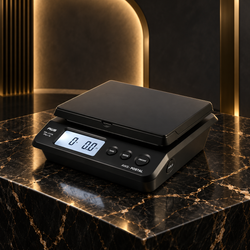
The best digital scale for postal mail should help you weigh letters, padded envelopes, small boxes and larger packages accurately before purchasing a shipping label. It needs enough capacity for your heaviest shipment, sufficient resolution for lightweight mail, a platform that supports your packaging and a display that remains visible while the package is being weighed.
For most home offices and small businesses, a shipping scale with a capacity between 25 and 110 pounds and a resolution of approximately 0.1 ounce provides a practical balance between range and measurement detail. If you primarily mail letters, documents, jewelry or other very light products, a smaller scale with finer gram or ounce increments may be more useful.
The right choice ultimately depends on what you ship. A scale used for ordinary envelopes has different requirements from one used for subscription boxes, online-store orders or bulkier commercial packages.
This guide explains how to select the best digital scale for postal mail based on capacity, resolution, accuracy, calibration, platform size and everyday shipping workflow.
Why You Need a Digital Scale for Postal Mail
Postal and carrier prices can depend on multiple shipment characteristics, including:
-
Actual package weight
-
Package dimensions
-
Shipping service
-
Destination
-
Package shape
-
Mailing category
-
Additional services
-
Dimensional weight, when applicable
A digital postal scale gives you the actual weight needed to compare available services and purchase an appropriate label.
The USPS Postage Verification information explains that inaccurate package information can result in postage adjustments. USPS may verify submitted weights and dimensions through its automated systems.
Using a dependable postal scale can help reduce:
-
Underpaid postage
-
Unexpected adjustments
-
Returned mail
-
Overpayment
-
Time spent weighing packages at a retail counter
-
Shipping delays
-
Manual data-entry mistakes
-
Inconsistent fulfillment procedures
A scale is especially helpful for businesses that print labels through an ecommerce platform, marketplace, carrier account or online postage provider.
Best Digital Scale for Postal Mail: Quick Recommendation
For a versatile home office or small-business shipping station, look for a scale with:
-
Capacity of at least 25–55 pounds
-
Resolution of 0.1 ounce or finer
-
Ounce, pound-ounce, pound, gram and kilogram units
-
Tare or zero functionality
-
Hold functionality
-
A platform large enough for common packages
-
A remote or extended display for large boxes
-
Battery and AC or USB power options
-
Overload indication
-
Auto-off controls
-
Compatible calibration capability
Businesses that frequently send larger boxes may prefer a capacity of 110 pounds or more. People mailing lightweight envelopes and small padded mailers may prioritize finer resolution over high capacity.
American Weigh Scales offers dedicated digital shipping scales for postal mail, ecommerce fulfillment and package-weighing applications.
Postal Scale Recommendations by Mailing Type
| Mailing Application | Suggested Capacity | Useful Resolution | Recommended Scale Type |
|---|---|---|---|
| Letters and documents | 500–2,000 g | 0.1–1 g | Compact letter or bench scale |
| Jewelry and lightweight products | 500–5,000 g | 0.1 g | Precision or compact postal scale |
| Padded envelopes | 5–25 lb | 0.1 oz | Small shipping scale |
| Small ecommerce packages | 25–55 lb | 0.1 oz | Digital postal scale |
| Subscription boxes | 50–110 lb | 0.1–0.2 oz | Medium-capacity shipping scale |
| Large online-store orders | 110–440 lb | 0.1–0.2 lb | High-capacity platform scale |
| Mixed letters and parcels | Dual-scale setup | Fine and medium | Letter scale plus shipping scale |
These ranges are general recommendations. Your scale should be chosen based on the heaviest fully packaged shipment—not merely the weight of the product inside it.
Understanding Postal-Scale Capacity
Capacity is the maximum load the scale is designed to support. It must accommodate the complete shipment, including:
-
Product
-
Product packaging
-
Protective materials
-
Shipping box or envelope
-
Inserts
-
Documentation
-
Promotional materials
-
Tape
-
Shipping accessories
A product may weigh only 20 pounds, but its prepared shipment could weigh several pounds more after the box and packing materials are added.
Choose Capacity Based on Your Heaviest Package
Review your recent shipments and identify the heaviest complete package. Then select a scale with additional capacity above that weight.
For example:
-
Heaviest package: 18 lb
-
Practical scale capacity: At least 25 lb
-
More flexible option: 50 or 55 lb
The extra range gives you room for packaging changes, larger orders and temporary peak-season shipments.
Avoid Excessive Capacity
More capacity is not always better. A high-capacity warehouse scale may display weight in larger increments than a compact postal scale. That can make it less suitable for letters or lightweight parcels.
If your heaviest shipment weighs two pounds, purchasing a 400-pound scale may provide unnecessary capacity at the expense of useful measurement detail.
Never Intentionally Overload the Scale
An overloaded scale may display an error, produce unreliable results or sustain permanent damage.
If the package exceeds the rated capacity:
-
Remove it immediately.
-
Do not press down on the package.
-
Do not attempt to balance only part of the package on the platform.
-
Use a higher-capacity scale.
-
Verify the original scale before returning it to service.
A scale’s maximum capacity should be treated as a limit, not a routine operating target.
How Much Resolution Does a Postal Scale Need?
Resolution is the smallest weight increment displayed by the scale.
A postal scale might display weight in:
-
0.1-ounce increments
-
0.01-pound increments
-
Whole grams
-
0.1-gram increments
A smaller increment provides more detailed information, but the finest available resolution is not automatically necessary for every mailing operation.
Resolution for Letters
Light letters and small envelopes benefit from finer measurement increments. A few sheets of paper, an insert or a small accessory can represent a meaningful portion of the total weight.
For letters and very light mail, consider:
-
Capacity: 500–2,000 grams
-
Resolution: 0.1–1 gram
-
Units: Grams and ounces
A high-capacity package scale may not provide enough detail for lightweight letters.
Resolution for Small Parcels
For padded envelopes and small boxes, 0.1-ounce resolution is often a useful target. It allows the operator to see relatively small differences without requiring laboratory-level sensitivity.
This configuration is useful for:
-
Cosmetics
-
Accessories
-
Books
-
Replacement parts
-
Electronics
-
Clothing
-
Handmade products
-
Collectibles
-
Small household goods
Resolution for Larger Boxes
Larger shipments generally do not require extremely fine gram-level resolution. A scale designed for 100 pounds or more may use larger increments than a compact letter scale.
The appropriate resolution depends on:
-
Carrier requirements
-
Package weight
-
Shipping software
-
Operational tolerance
-
The price difference between weight bands
-
Whether the scale is used for internal estimates or formal commercial transactions
Resolution Is Not the Same as Accuracy
A scale that displays 0.1 ounce is not necessarily accurate to exactly ±0.1 ounce under every condition.
Resolution describes the size of the displayed increment. Accuracy describes how closely the reading corresponds to the accepted mass of the item.
Other performance characteristics include:
-
Repeatability
-
Linearity
-
Stability
-
Minimum practical load
-
Corner-load performance
-
Calibration quality
-
Environmental sensitivity
A good postal scale should provide stable, repeatable readings—not simply a long string of decimal places.
Test Repeatability
You can perform a basic repeatability check:
-
Place a representative package in the center of the platform.
-
Record the reading.
-
Remove the package.
-
Wait for the display to return to zero.
-
Repeat the process at least five times.
-
Compare the readings.
The results should remain consistent within the tolerance required for your shipping process.
If the readings fluctuate, examine the power source, platform, surrounding environment and calibration status.
Actual Weight Versus Dimensional Weight
A digital scale measures actual weight. Some packages may instead be billed according to dimensional weight when their size is large relative to their physical weight.
Dimensional weight reflects the space occupied by a package. Depending on the carrier and service, the billed weight may be the greater of:
-
Actual scale weight
-
Calculated dimensional weight
The UPS guide to package dimensions and weight explains that dimensional weight is calculated using the package’s length, width and height with an applicable divisor.
FedEx similarly explains that a shipment may be rated according to actual or dimensional weight, whichever is greater, in its guide to understanding dimensional weight.
Why the Scale Is Still Essential
Dimensional pricing does not make a postal scale unnecessary. Shipping systems may need both the package’s physical dimensions and its actual weight before determining the billable weight.
A complete shipping station should therefore include:
-
A digital postal scale
-
A dependable measuring tape or dimensioning tool
-
Current carrier software or rate calculator
-
Standardized packaging
-
A method for recording package information
Do not estimate either weight or dimensions by sight.
Platform Size and Package Support
Capacity alone does not determine whether a scale can handle a package. The platform must also support the shipment safely and consistently.
A box can weigh less than the scale’s maximum but still be difficult to measure if it:
-
Hangs over every side
-
Covers the display
-
Touches the table or wall
-
Rocks on the platform
-
Presses against the controls
-
Prevents the load from being centered
Any contact between the package and a surrounding surface can transfer weight away from the platform and create an incorrect result.
Choose a Platform for Your Packaging
Consider the dimensions of your most frequently used:
-
Boxes
-
Padded envelopes
-
Poly mailers
-
Mailing tubes
-
Product cartons
-
Shipping trays
The platform does not always need to match the entire footprint of a rigid box, but the package must remain stable and make no contact with anything other than the weighing platform.
Remote Displays Help With Large Boxes
A separate or pull-out display can be valuable when a package would otherwise block the screen.
Useful display configurations include:
-
Detachable wired displays
-
Wall-mounted displays
-
Angled front displays
-
Backlit readouts
-
Long display cables
The operator should be able to read the weight without moving, tilting or lifting the package.
Essential Features in a Postal Mail Scale
Tare Function
Tare subtracts the weight of an empty container or tray from the displayed result.
This is useful when:
-
Products are weighed before final packaging
-
Loose items are placed in a bin
-
A reusable basket holds small mailers
-
Protective trays are used on the platform
Tare does not increase physical capacity. If a five-pound tray is placed on a 55-pound scale and tared, approximately 50 pounds of load capacity remain.
Hold Function
The hold feature keeps a stable result on the display after the package is removed or after the reading stabilizes.
This is particularly useful when:
-
A large box blocks the display
-
The operator must remove the package to see the result
-
The shipping computer is several feet away
-
The reading needs to be recorded manually
Some scales apply hold automatically, while others require the operator to press a button.
Multiple Weighing Units
A versatile shipping scale may display:
-
Grams
-
Kilograms
-
Ounces
-
Pounds
-
Pounds and ounces
Pounds-and-ounces mode is convenient for many domestic shipping workflows, while grams and kilograms are useful for metric records and international shipments.
Before buying, confirm that the scale displays units in the exact format accepted by your shipping software.
Backlit Display
A bright display makes readings easier to see in warehouses, packing rooms and home offices. Large digits can reduce transcription mistakes during repetitive label preparation.
Adjustable Auto-Off
Auto-off conserves battery power, but a very short shutdown interval can interrupt fulfillment work.
Look for a model that allows auto-off to be:
-
Adjusted
-
Extended
-
Disabled when using an adapter
Power Options
Battery power provides portability. AC or USB power is useful at a permanent packing station.
A dual-power scale can continue operating during:
-
Power interruptions
-
Mobile fulfillment
-
Temporary events
-
Warehouse reconfiguration
-
Shipping-volume surges
If the scale uses an adapter, confirm whether it is included.
Overload and Low-Battery Indicators
An overload warning helps protect the weighing mechanism. A low-battery indicator alerts the operator before weak power begins disrupting the workflow.
Durable, Cleanable Platform
Shipping stations collect:
-
Cardboard dust
-
Adhesive residue
-
Packing material
-
Product debris
-
Dirt from incoming cartons
A smooth platform that can be wiped easily will be simpler to maintain. Follow the manufacturer’s cleaning instructions and prevent liquid from entering the scale housing.
Best Digital Scale for Home Mailing
A home postal scale should be compact, easy to store and simple to operate.
A practical home configuration may include:
-
Capacity: 25–55 lb
-
Resolution: 0.1 oz
-
Units: lb, oz, g and kg
-
Tare function
-
Hold function
-
Battery power
-
Auto-off
-
Medium-size platform
This setup can handle many common letters, return shipments, gifts, online sales and occasional packages.
If you send only small envelopes or lightweight merchandise, a compact precision model may be enough. AWS pocket scales can be useful for very light items, although platform size and maximum capacity must be considered before using one for mail.
Best Digital Scale for a Small Business
A small ecommerce business typically needs a more permanent shipping station.
Look for:
-
50–110 lb capacity
-
0.1 oz or similarly useful resolution
-
Large platform
-
Hold function
-
Remote or extended display
-
AC power
-
Battery backup
-
Adjustable auto-off
-
Easy-to-clean surface
-
Stable feet
-
Clear unit selection
Businesses shipping a mixture of small and large products may benefit from two scales:
-
A compact precision scale for letters and very light parcels
-
A medium- or high-capacity shipping scale for boxes
This combination avoids forcing one scale to cover applications with very different capacity and resolution requirements.
Best Scale for Lightweight Postal Mail
When most shipments weigh only a few ounces, prioritize resolution and minimum practical load.
A compact scale may be appropriate for:
-
Jewelry
-
Coins
-
Trading cards
-
Stickers
-
Small replacement parts
-
Seeds
-
Craft supplies
-
Documents
-
Samples
The package should still be weighed after all materials are added. A product’s listed weight is not the same as its final mailing weight.
For additional selection guidance, see the AWS guide on how to choose a scale for postage.
Best Scale for Packages and Boxes
For boxes, prioritize:
-
Adequate capacity
-
Stable platform
-
Visible display
-
Hold functionality
-
Durable construction
-
Convenient power options
A dedicated package scale is usually more appropriate than a kitchen scale or bathroom scale. Bathroom scales may have large platforms, but their minimum load, resolution and operating design may not be suitable for lightweight postal packages.
If you send shipments approaching the upper end of your scale’s capacity, upgrade rather than repeatedly operating near the limit.
Portable Versus Stationary Postal Scales
Portable Postal Scale
A portable model is useful for:
-
Occasional sellers
-
Traveling vendors
-
Craft fairs
-
Temporary packing stations
-
Shared office spaces
-
Home users
-
Inventory rooms
Prioritize low weight, battery power and protective storage.
Stationary Shipping Scale
A stationary model is better for:
-
Daily order fulfillment
-
Warehouses
-
Retail backrooms
-
Subscription businesses
-
Mailrooms
-
Production facilities
Prioritize platform size, continuous power, durability, visibility and repeatability.
How to Weigh Postal Mail Correctly
Use the following procedure for dependable results:
-
Place the scale on a firm, level surface.
-
Keep it away from vibration and air movement.
-
Turn it on without anything touching the platform.
-
Confirm that the display reads zero.
-
Select the correct unit.
-
Place the complete package in the center.
-
Make sure the package does not touch the table, wall or display.
-
Wait for the reading to stabilize.
-
Record the weight exactly.
-
Measure the package dimensions separately.
-
Enter the information into the carrier or postage system.
-
Confirm the shipping service and label before purchase.
The shipment should include all tape, inserts, labels and protective material before its final weight is recorded.
The official USPS Postage Price Calculator can then use shipment details to help determine available mailing options and pricing.
Should You Round the Weight?
Do not invent a rounding method. Follow the rules of the carrier, service and shipping platform you are using.
Some postal services round weights according to specific increments when determining postage. Entering an inaccurate lower weight can lead to an adjustment even when the difference seems small.
The USPS recommends using a scale and provides detailed information about package size and weight in its parcel size, weight and fee standards.
A sensible operational approach is to:
-
Record the stable scale result
-
Use the required unit
-
Follow the carrier’s instructions
-
Avoid rounding downward
-
Keep packaging consistent
-
Recheck borderline shipments
Calibration and Verification
A postal scale should be checked periodically to confirm that it is performing as expected.
What Is Calibration?
Calibration establishes or adjusts the relationship between the scale’s reading and a known reference mass.
Some scales use:
-
External calibration weights
-
Internal calibration systems
-
Factory calibration only
-
Model-specific procedures
Always consult the scale’s manual before entering calibration mode.
What Is Verification?
Verification is a performance check using a known reference weight.
A basic verification procedure is:
-
Place the scale on a level surface.
-
Turn it on and allow it to stabilize.
-
Confirm zero.
-
Apply a suitable known test weight.
-
Compare the displayed result with the expected value.
-
Repeat the test.
-
Document the results if required.
Verification does not necessarily adjust the scale. It tells you whether the scale is performing within your acceptable tolerance.
AWS offers compatible calibration weights for scales that support external calibration.
When Should a Postal Scale Be Checked?
Verify the scale:
-
When it is first installed
-
After it is moved
-
After an overload
-
After a hard impact
-
When results appear inconsistent
-
After major temperature changes
-
After long storage
-
At regular intervals
-
Before high-volume shipping periods
Do not assume that recalibration is the first solution to every unusual reading. Check the surface, battery, platform, environment and zero setting first.
Environmental Factors That Affect Postal Scales
Uneven Surfaces
A soft, sloped or unstable surface may prevent consistent load distribution. Use a solid desk, counter or packing bench.
Vibration
Nearby conveyors, printers, fans and machinery can cause the display to fluctuate.
Air Movement
Drafts usually have little effect on heavy boxes but may influence sensitive measurements of lightweight envelopes.
Temperature Changes
Allow a scale moved from a cold delivery vehicle or storage area to reach room temperature before critical weighing.
Weak Batteries
Low power can cause intermittent operation or unexpected shutdowns. Replace batteries when the indicator appears.
Package Contact
Make sure an oversized box is not leaning against a wall, table, cable or display.
Debris
Remove cardboard dust, tape fragments and packing debris from the platform and surrounding area.
For ongoing care, review the AWS information on scale maintenance.
Common Postal Scale Mistakes
Weighing Only the Product
Always weigh the completed shipment. Boxes, inserts and packing materials add weight.
Ignoring Dimensions
The scale measures actual weight, not dimensional weight. Measure the package as well.
Choosing Too Little Capacity
A scale should handle the heaviest complete shipment with a reasonable margin.
Choosing Too Much Capacity
Excessive capacity may come with coarser resolution, making the scale less useful for lightweight mail.
Letting the Package Touch Another Surface
Any outside contact may reduce the load applied to the scale.
Blocking the Display
Use a hold feature or remote display instead of moving the package to read the result.
Confusing Resolution With Accuracy
Fine display increments do not guarantee equivalent accuracy.
Guessing the Weight
Product listings, packaging estimates and previous shipments are not substitutes for weighing the completed package.
Ignoring Calibration
A scale can drift or become unreliable after movement, overload or physical impact.
Using the Wrong Units
Confusing decimal pounds with pounds and ounces can cause data-entry errors. Confirm both the display format and the shipping software format.
Postal Scale Buying Checklist
Before choosing a digital scale, answer these questions:
-
What is the lightest mailpiece you send?
-
What is your heaviest complete package?
-
What package sizes do you use?
-
Will boxes block the display?
-
Do you need a remote display?
-
What weight increments are useful?
-
Which units does your shipping software require?
-
Will the scale remain in one location?
-
Do you need battery power?
-
Is AC or USB power available?
-
Do you need adjustable auto-off?
-
Does the scale include tare?
-
Does it include hold?
-
Can it be calibrated?
-
Are compatible reference weights available?
-
Will the scale be used for commercial transactions?
-
Do you need to maintain verification records?
These answers will narrow the choice more effectively than comparing maximum capacity alone.
Is a Postal Scale Required to Be Legal for Trade?
Requirements depend on how the scale is used and the applicable jurisdiction.
A scale used internally to estimate postage or prepare shipment information may be treated differently from a scale used to determine a customer’s charge directly by weight.
The NIST National Type Evaluation Program evaluates commercial weighing devices for legal-for-trade applications. NIST notes that devices used for legal-for-trade purposes in the United States are subject to applicable evaluation and approval requirements.
If weight directly determines a customer’s price, consult your state or local weights-and-measures authority before relying on a scale.
Recommended Digital Postal Scale Setups
Setup One: Occasional Home Mailer
-
Capacity: 25–55 lb
-
Resolution: 0.1 oz
-
Power: Batteries
-
Features: Tare, hold and auto-off
-
Best for: Returns, gifts and occasional online sales
Setup Two: Small Ecommerce Business
-
Capacity: 50–110 lb
-
Resolution: 0.1 oz
-
Power: AC adapter plus battery backup
-
Features: Hold, large platform and remote display
-
Best for: Daily padded mailers and boxes
Setup Three: Lightweight Product Seller
-
Capacity: 2–10 lb
-
Resolution: 0.1 oz or finer
-
Power: Battery or USB
-
Features: Tare and fine unit selection
-
Best for: Jewelry, cards, accessories and samples
The AWS article about the best digital scale for postage provides additional guidance for matching a scale to common mailing tasks.
Setup Four: Mixed-Volume Shipping Department
-
Compact scale for light mail
-
110-pound or higher-capacity scale for boxes
-
Standardized packaging
-
Measuring tape or dimensioning tool
-
Regular verification schedule
-
Dedicated packing bench
A two-scale setup is often more useful than expecting one device to weigh both tiny letters and heavy boxes with equally suitable resolution.
Frequently Asked Questions
What is the best digital scale for postal mail?
The best general-purpose postal scale typically offers 25–110 pounds of capacity, approximately 0.1-ounce resolution, tare, hold, multiple units and a platform suited to the packages being mailed.
What capacity postal scale should I buy?
Choose a capacity above the weight of your heaviest complete shipment. Include the product, box, protective material, inserts and tape.
Is a kitchen scale accurate enough for postal mail?
A kitchen scale may work for some lightweight parcels if its capacity, platform size, resolution and accuracy are suitable. A dedicated shipping scale is usually more convenient for boxes and regular fulfillment.
Can I use a bathroom scale for packages?
A bathroom scale may provide a rough reading for heavy boxes, but it may not perform well at low weights or display sufficiently small increments. A postal scale is generally a better choice.
Do I need a scale if I use flat-rate packaging?
A scale remains useful for confirming eligibility, comparing services and weighing shipments that are not sent under a qualifying flat-rate option. Always follow the current carrier rules for the specific packaging and service.
Should I weigh a package before or after sealing it?
Weigh the completed package after all products, packing materials, inserts and tape have been added. If a label is unusually heavy, include it as well.
Is 0.1-ounce resolution enough?
It is suitable for many small parcels and ecommerce shipments. Very light letters may benefit from gram-level measurement, while heavy boxes may not require such fine increments.
What is the difference between tare and hold?
Tare subtracts the weight of a container or resets the display to zero. Hold keeps a stable weight visible, which helps when a package blocks the display.
Does tare increase the scale’s capacity?
No. Tare changes the displayed net weight but does not remove the physical load from the weighing mechanism.
Why does my scale show different readings?
Possible causes include an uneven surface, vibration, low batteries, package contact, temperature changes, debris, overload or improper calibration.
How often should I calibrate a postal scale?
Follow the manufacturer’s instructions. Verify performance regularly and after the scale is moved, overloaded or subjected to impact. Calibrate when verification indicates a meaningful error and the model supports calibration.
Does a postal scale calculate shipping prices?
Most scales measure weight only. The weight, dimensions, destination and service must be entered into a carrier or postage platform to calculate a price.
Can a postal scale measure dimensional weight?
A scale measures actual mass. Dimensional weight is calculated from package measurements using the carrier’s current rules.
Final Verdict
The best digital scale for postal mail is one that matches the real range of your shipments.
For most home offices and small ecommerce businesses, a 25- to 110-pound shipping scale with 0.1-ounce resolution, tare, hold and multiple weighing units will cover a wide variety of letters, padded envelopes and boxes.
Choose a lower-capacity precision scale if your business primarily ships lightweight products. Select a higher-capacity platform scale if large boxes are common. If your shipments range from tiny envelopes to heavy cartons, use two scales rather than compromising at both ends of the range.
Most importantly, weigh each shipment after it is fully packed, measure its dimensions, keep the platform free from outside contact and verify the scale periodically. A dependable postal scale cannot choose the shipping service for you, but it can provide the accurate weight needed to make better shipping decisions, reduce adjustments and maintain a more efficient fulfillment process.