
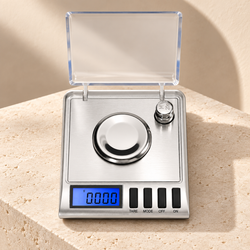
The best digital scale for postage is the one that accurately handles the packages you ship most often without forcing you to choose between insufficient capacity and unnecessary precision.
A home seller mailing lightweight products may need a very different scale from a warehouse sending 40-pound cartons.
For many home businesses and eCommerce sellers, useful starting ranges include:
-
Up to 13 lb for lightweight parcels and general household shipping
-
Up to 55 lb for broader home and small-business package shipping
-
Up to 110 lb for larger cartons and higher-volume shipping
-
Higher-capacity shipping scales for heavy commercial packages
For general small-business shipping, a scale in the:
55–110 lb capacity range
with approximately:
0.1 oz readability
can cover a broad range of mailing and package-weighing tasks.
But capacity is only one specification.
A good postal scale should also offer an appropriate combination of:
capacity + readability + repeatability + tare + platform size + display visibility + calibration + power options
Most importantly, remember that shipping rates may depend on more than actual scale weight. USPS, UPS and FedEx can also use package dimensions or dimensional-weight rules depending on the shipment.
Quick Answer: What Postage Scale Do You Need?
| Shipping Application | Useful Capacity Range | Useful Readability |
|---|---|---|
| Letters and very light mail | Low-capacity postal scale | Fine ounce/gram increments |
| Jewelry and small accessories | 5–13 lb | 0.1 oz or finer |
| Cosmetics and small products | 13–25 lb | 0.1 oz |
| Small eCommerce packages | 25–55 lb | 0.1 oz |
| Regular small-business shipping | 55 lb | 0.1 oz |
| Medium cartons | 55–110 lb | 0.1 oz |
| Larger eCommerce packages | 110 lb+ | Appropriate shipping readability |
| Heavy commercial packages | High-capacity shipping scale | Appropriate to carrier workflow |
For many online sellers:
55 lb × 0.1 oz
is a strong general-purpose configuration.
For businesses routinely shipping larger cartons:
110 lb × 0.1 oz
provides substantially more capacity.
Why You Need a Digital Scale for Postage
Shipping prices often depend partly on package weight.
Guessing can create problems.
If you underestimate weight, the carrier may:
-
Recalculate shipment charges
-
Apply corrections
-
Adjust billing
-
Flag incorrect shipment information
If you consistently overestimate weight, you may pay more than necessary.
UPS specifically advises shippers to enter accurate package details to help avoid shipping-charge corrections.
A postage scale helps you establish actual package weight before buying a shipping label.
That can be useful when shipping through:
-
USPS
-
UPS
-
FedEx
-
Marketplace shipping systems
-
eCommerce platforms
-
Third-party shipping software
Actual Package Weight Includes the Packaging
One of the most common mistakes is weighing the product instead of the final shipment.
Suppose your product weighs:
12.0 oz
Then you add:
Box = 3.5 oz
Packing material = 1.2 oz
Instruction card = 0.3 oz
Tape and label = 0.2 oz
Your complete shipment is approximately:
17.2 oz
The carrier is interested in the shipping package, not merely the product inside it.
For the most useful postage measurement:
weigh the package after it is packed and ready to ship.
What Capacity Should a Postage Scale Have?
Capacity tells you the maximum physical load the scale is designed to support.
Postal scales come in many capacity ranges.
Common use cases can be divided roughly into:
-
Lightweight mail
-
Small packages
-
Medium packages
-
Large cartons
-
Heavy commercial shipments
The best choice depends on your heaviest normal package.
Is a 5 lb Postage Scale Enough?
A low-capacity postage scale can work if you only ship:
-
Jewelry
-
Small accessories
-
Documents
-
Lightweight beauty products
-
Small replacement parts
-
Compact consumer products
But the limited capacity can become restrictive as soon as your product catalog grows.
If you occasionally ship heavier packages, purchasing more capacity from the beginning may be more practical.
Is a 13 lb Postage Scale Enough?
A 13 lb scale can be useful for:
-
Small eCommerce orders
-
Cosmetics
-
Electronics accessories
-
Apparel
-
Books
-
Small home products
-
Subscription boxes
-
Lightweight multi-item orders
AWS currently offers the AMW-13 Compact Digital Bench Scale, rated for approximately 13 lb / 6000 g, with 0.1 oz / 1 g readability and a 6 × 6-inch platform.
You can review the AWS AMW-13 Compact Digital Bench Scale for current specifications.
For many small packages, 13 lb provides plenty of working range.
But sellers whose orders occasionally become much heavier may prefer more capacity.
Is a 25 lb Postage Scale Enough?
A 25 lb scale expands the practical range for:
-
Multi-item orders
-
Larger apparel shipments
-
Home goods
-
Medium-size subscription boxes
-
Small wholesale orders
However, sellers with rapidly changing inventories may find themselves approaching 25 lb surprisingly quickly.
That is one reason 50–55 lb postal scales are popular for more general-purpose shipping.
Why 55 lb Is a Useful Postage Scale Capacity
A 55 lb scale covers a much broader range than a lightweight mail scale while remaining practical for a desktop shipping station.
It can handle:
-
Lightweight mailers
-
Small cartons
-
Multi-product orders
-
Medium eCommerce shipments
-
Larger home-business packages
AWS currently lists the PS-25 Digital Package Postage Scale with:
55 lb capacity × 0.1 oz readability
along with lb, kg, kg:g and lb:oz weighing modes.
You can review the AWS PS-25 Digital Package Postage Scale for current specifications.
For many home sellers and small businesses, this is a particularly practical capacity range.
When Do You Need 110 lb Capacity?
If you regularly ship larger cartons, 55 lb may eventually become restrictive.
A 110 lb shipping scale gives you considerably more headroom for:
-
Larger eCommerce orders
-
Wholesale shipments
-
Multi-item cartons
-
Bulk products
-
Industrial parts
-
Larger home goods
AWS currently lists the SE-50 Digital Shipping Scale at:
110 lb × 0.1 oz
with lb:oz, lb, kg and g weighing modes, plus a remote display and both battery and AC power options.
You can review the AWS SE-50 Digital Shipping Scale for current specifications.
When Do You Need More Than 110 lb?
Higher capacity becomes important if your operation routinely ships:
-
Heavy equipment
-
Large wholesale cartons
-
Bulk merchandise
-
Industrial components
-
Multiple units in one package
AWS’s current shipping-scale range also includes higher-capacity options beyond 110 lb.
You can browse the full AWS Shipping Scales collection to compare current postal and package-scale options.
Leave Capacity Headroom
Do not buy a 55 lb scale because your heaviest package weighs exactly 55 lb.
Your normal working range should leave room for:
-
Larger orders
-
Different boxes
-
More packing material
-
Seasonal bundles
-
Product catalog expansion
If your regular packages already reach:
45–50 lb
a 110 lb scale may be a smarter choice than a 55 lb model.
What Readability Does a Postage Scale Need?
Readability is the smallest increment displayed by the scale.
For postage scales, you may see measurements in:
-
Pounds
-
Ounces
-
Pounds and ounces
-
Grams
-
Kilograms
A scale might display, for example:
5 lb 6.2 oz
rather than simply:
5 lb
Finer readability gives you more detailed information about actual package weight.
Is 0.1 oz Readability Good for Postage?
For many home and small-business shipping applications:
0.1 oz
is a useful readability level.
It gives more detail than a scale that reads only whole ounces.
This can be especially useful for:
-
Lightweight packages
-
Small products
-
Shipments close to carrier pricing thresholds
-
Multi-item orders
Both the AWS PS-25 and SE-50 currently provide 0.1 oz readability.
Do You Need 0.01g for Postage?
Usually not.
A postage scale generally does not need the type of fine readability associated with jewelry, milligram or formulation scales.
For example, the difference between:
2,000.00g
and:
2,000.01g
is rarely useful in a normal package-shipping workflow.
Postage-scale selection should generally prioritize:
-
Appropriate capacity
-
Useful ounce or gram readability
-
Repeatable readings
-
Platform size
-
Display accessibility
rather than extreme decimal precision.
Readability Is Not the Same as Accuracy
A scale showing measurements in 0.1 oz increments does not automatically guarantee that every reading is accurate to exactly ±0.1 oz.
Readability describes the smallest displayed increment.
Actual measurement performance can also involve:
-
Accuracy specification
-
Repeatability
-
Calibration
-
Load placement
-
Surface stability
-
Environmental conditions
This distinction matters whenever you are choosing any digital scale.
Repeatability Matters for Shipping
Suppose you weigh the same sealed box three times.
You might see:
4 lb 8.2 oz
4 lb 8.2 oz
4 lb 8.2 oz
That is much more useful than:
4 lb 8.2 oz
4 lb 10.0 oz
4 lb 7.1 oz
AWS discusses possible reasons for changing measurements in its guidance on why digital scales give different readings.
A stable shipping scale helps produce a more dependable packing workflow.
Actual Weight vs. Dimensional Weight
One of the most important things to understand about shipping is:
your scale does not necessarily determine your final billable weight.
A scale measures actual mass.
Carriers may also calculate dimensional weight based on package size.
FedEx describes dimensional weight as a measurement reflecting the amount of space a package occupies relative to its actual weight and says shipments can be charged according to actual or dimensional weight, whichever is greater.
Why Dimensional Weight Matters
Consider two packages.
Package A
Small box
Actual weight:
10 lb
Package B
Very large box
Actual weight:
10 lb
They weigh exactly the same.
But Package B consumes substantially more truck or aircraft space.
Dimensional-weight pricing accounts for this difference.
That means:
the scale solves the weight part of the shipping calculation, but you still need package dimensions.
UPS and Dimensional Weight
UPS states that dimensional weight reflects how much space a package occupies relative to actual weight and may apply to domestic and international package services. UPS also instructs customers to measure package length, width and height when preparing shipments.
Therefore, an accurate shipping workflow often requires:
scale + tape measure + shipping software
rather than a scale alone.
FedEx and Dimensional Weight
FedEx similarly explains that the charge for many shipments can be based on dimensional weight or actual weight, whichever is greater.
So even a perfectly accurate postal scale cannot tell you the final shipping charge by itself.
You also need:
-
Package dimensions
-
Destination
-
Service level
-
Carrier rules
-
Applicable surcharges
USPS Package Weight
USPS recommends having a kitchen or postage scale available when shipping from home if you are not using applicable Flat Rate packaging.
USPS also provides an online Retail Postage Price Calculator where users enter shipment weight and package characteristics.
This makes an accurate package-weight measurement a valuable first step before purchasing postage.
USPS Weight Limits Matter Too
USPS package rules vary by service, and USPS states that many domestic mailpieces generally may not exceed 70 lb, subject to specific service standards and exceptions.
That means a very high-capacity scale does not automatically mean a particular USPS service will accept the package.
Always check the rules for the service being used.
Scale Capacity and Carrier Limit Are Different
These two numbers should never be confused.
For example:
Your scale capacity:
110 lb
Carrier/service maximum:
may be something different.
The fact that a scale can physically weigh an object does not mean that shipment qualifies for every postal or parcel service.
Best Digital Scale for USPS Packages
For USPS home shipping, a good general-purpose scale should provide:
-
Enough capacity for your packages
-
Readable ounce measurements
-
A stable platform
-
Clear display
-
Easy unit switching
If your normal packages are under approximately 13 lb:
a 13 lb bench scale
may be sufficient.
For broader use:
a 55 lb postal scale
provides more capacity.
For businesses handling larger parcels:
110 lb
offers additional headroom.
Best Digital Scale for UPS Packages
UPS permits packages up to 150 lb under its general package size and weight guidance, although particular shipment requirements may differ.
Therefore, sellers shipping through UPS should consider:
-
Their heaviest normal carton
-
Their largest dimensions
-
Whether dimensional weight applies
-
Whether their scale platform supports the box
-
Whether the display remains visible
A 55 lb scale may be excellent for smaller sellers.
A 110 lb or higher-capacity model may be better for heavier shipping workflows.
Best Digital Scale for FedEx Packages
For FedEx shipments, choose capacity according to actual package weight while remembering that FedEx may use dimensional weight for rate calculation.
For an eCommerce business:
55–110 lb
is a flexible general-purpose scale range.
Larger commercial shipments may justify additional capacity.
Best Postage Scale for eCommerce
An eCommerce seller should think about the entire order range.
Suppose individual products weigh:
Product A = 4 oz
Product B = 12 oz
Product C = 3 lb
Product D = 7 lb
A customer may order several products together.
The shipping scale therefore needs enough capacity for:
the largest realistic combined order
not merely the heaviest individual SKU.
Best Postage Scale for Etsy Sellers
Many Etsy sellers ship:
-
Jewelry
-
Crafts
-
Candles
-
Art
-
Handmade accessories
-
Clothing
-
Home décor
A lower-capacity scale may be sufficient for consistently lightweight inventories.
But sellers handling:
-
Candles
-
Ceramics
-
Multi-item sets
-
Larger décor
may benefit from 25–55 lb capacity.
Best Postage Scale for eBay Sellers
eBay product sizes can vary enormously.
One seller may ship:
-
Trading cards
while another ships:
-
Electronics
-
Auto components
-
Collectibles
-
Tools
Therefore, there is no universal capacity.
A general reseller handling many product categories may benefit from:
55–110 lb capacity
to avoid outgrowing a lightweight scale.
Best Postage Scale for Small Businesses
Small businesses often need a shipping scale that can handle:
-
Daily packages
-
Returns
-
Multi-item orders
-
Wholesale samples
-
Supply shipments
-
Replacement orders
In this environment, usability becomes almost as important as raw capacity.
Look for:
-
Clear display
-
Large platform
-
Stable readings
-
Multiple weighing units
-
Battery or AC power
-
Easy-to-clean surface
-
Appropriate capacity
AWS provides additional shipping guidance in How to Reduce Shipping Costs Using a Digital Scale.
Why Platform Size Matters
A scale's weight capacity tells only half the story.
Suppose a scale supports:
55 lb
but your carton is:
24 × 18 × 12 inches
The package may cover the scale and display.
A larger package may also be difficult to center properly.
Look at both:
capacity and platform dimensions.
The Package Should Be Fully Supported
The package should rest appropriately on the scale.
Avoid situations where a box is:
-
Leaning on a wall
-
Touching the table
-
Supported by another package
-
Resting partly off the weighing setup
External support can alter the measurement.
Remote Displays Can Be Useful
Large boxes can cover an integrated display.
A remote display solves this problem by separating:
weighing platform
from:
weight display.
This is particularly useful for:
-
Wide cartons
-
Large boxes
-
Warehouse shipping
-
Packing tables
The AWS SE-50 uses a separate remote display, making it easier to read weight when a larger package occupies the platform.
Tilt-Up Platforms Can Help With Mail
Some postal-scale designs include features intended to support awkward mail pieces.
The AWS PS-25, for example, currently uses a tilt-up platform designed to help with items such as mailing tubes and large envelopes.
That can be useful when the item would otherwise obscure the display.
Tare on a Postage Scale
Tare allows you to subtract the displayed weight of a container.
For normal parcel shipping, you will generally want the final packed shipment's complete weight.
But tare can still be useful in warehouse workflows.
For example:
Empty tote = 2.4 lb
Press tare.
Add products.
Display shows:
product weight
This can help during packing or inventory operations.
Do Not Tare Away Shipping Packaging When Buying Postage
When calculating actual shipment weight, packaging normally needs to remain part of the measured shipment.
That includes:
-
Box
-
Mailer
-
Padding
-
Tape
-
Product
-
Inserts
If the carrier receives all of it, it contributes to the shipment's actual mass.
So before purchasing postage:
weigh the finished package.
Calibration Matters
Digital shipping scales can require calibration according to the model's instructions.
Before buying, check:
-
Is calibration supported?
-
What calibration weight is required?
-
Is the calibration weight included?
-
Is the procedure documented?
AWS explains the general process in How to Calibrate a Digital Scale for Accurate Results.
Do not assume every scale uses the same procedure.
Calibration Weight Is Model-Specific
A scale's maximum capacity does not necessarily tell you which calibration mass it requires.
For example, the current AWS PS-25 specification calls for a 10 kg calibration weight, which is not included.
The AMW-13 currently specifies a 5000 g calibration weight.
Always follow the instructions for the exact model.
Stable Surface Matters
Place your postal scale on a:
-
Hard
-
Flat
-
Stable
-
Level
work surface.
Avoid:
-
Carpet
-
Soft packing foam
-
Flexible tables
-
Uneven shelving
A dedicated packing table is ideal.
Center Packages Appropriately
Position packages so the load is supported properly.
Avoid:
-
Extreme edge loading
-
Boxes leaning on surrounding objects
-
Packages touching walls
-
Cords interfering with the platform
Consistent placement helps produce more stable readings.
Battery vs. AC Power
Postage scales may use:
-
Disposable batteries
-
USB power
-
AC adapters
-
Multiple power methods
Battery Power
Useful for:
-
Mobile packing stations
-
Occasional sellers
-
Temporary workspaces
AC or USB Power
Useful for:
-
Daily shipping
-
eCommerce businesses
-
Warehouse stations
-
Repeated weighing
For high-volume use, having a continuous power option can be especially convenient.
Auto-Off: Helpful or Annoying?
Auto-off can preserve battery life.
However, aggressive auto-off can interrupt a busy packing workflow.
If you ship many orders consecutively, consider:
-
AC-powered operation
-
USB power
-
A model designed for continuous shipping-station use
Multiple Weighing Units
Useful shipping units include:
-
lb
-
lb:oz
-
oz
-
g
-
kg
The most useful modes depend on:
-
Carrier
-
Shipping software
-
Country
-
Product catalog
US sellers often benefit from an easy:
lb:oz
display for lightweight packages.
Example: Lightweight eCommerce Order
Product = 5.2 oz
Mailer = 0.8 oz
Insert = 0.2 oz
Tape and label = 0.1 oz
Total:
6.3 oz
A postage scale with 0.1 oz readability provides a clear measurement.
Example: Multi-Item Order
Three products:
2.4 lb
1.8 lb
3.1 lb
Packaging:
0.7 lb
Total:
8.0 lb
A 13 lb scale can handle this order.
But if larger multi-item orders are possible, more capacity provides additional headroom.
Example: 42 lb Package
Suppose your completed package weighs:
42 lb
A 13 lb scale cannot measure it.
A:
55 lb postal scale
provides adequate capacity.
However, because 42 lb is already a significant percentage of 55 lb, businesses expecting larger packages may prefer 110 lb capacity.
Example: 72 lb Package
Suppose:
Package = 72 lb
A 55 lb postal scale cannot measure it.
A:
110 lb scale
provides sufficient capacity.
Always verify that the chosen carrier and service accept the specific size, weight and contents.
Example: Lightweight but Large Package
Suppose your scale says:
8 lb
but the box is extremely large.
The shipping charge may not necessarily be based on only 8 lb.
Dimensional weight can become relevant because carriers consider package size as well as actual mass.
This is why a complete shipping station needs both:
a scale and dimensional measurements.
Do You Need a Connected USB Shipping Scale?
Some shipping environments use scales integrated directly with software.
UPS, for example, provides workflows for compatible USB-connected scales in certain online shipping systems.
Whether this matters depends on your order volume.
For occasional shipping:
manual entry is usually simple.
For high-volume fulfillment:
software-connected weighing can reduce repetitive data entry.
Home Shipping vs. Warehouse Shipping
Home Shipping
Prioritize:
-
Compact size
-
25–55 lb capacity
-
Easy storage
-
Battery/USB power
-
Simple operation
Small Business Shipping
Prioritize:
-
55–110 lb capacity
-
Durable platform
-
Clear display
-
AC power
-
Repeatability
Warehouse Shipping
Prioritize:
-
High capacity
-
Large platform
-
Remote display
-
Continuous power
-
Integration possibilities
-
Durable construction
Postal Scale vs. Kitchen Scale
A kitchen scale can sometimes weigh lightweight packages.
USPS itself notes that a kitchen or postage scale can be useful for shipping packages from home in applicable situations.
However, a dedicated postage scale often offers:
-
Higher package capacity
-
Larger platform
-
lb:oz display
-
Better support for boxes
-
Remote or elevated display features
If shipping is frequent, a dedicated postage scale usually offers a more practical workflow.
Postal Scale vs. Pocket Scale
Pocket scales specialize in:
-
Very small items
-
Compact size
-
Fine resolution
Postage scales prioritize:
-
Higher capacity
-
Larger packages
-
Ounce/pound measurement
-
Shipping workflow
A pocket scale that reads 500g × 0.01g may be excellent for jewelry but unusable for a 12 lb package.
How a Digital Scale Can Help Control Shipping Costs
AWS discusses the role of package weighing in its guide to reducing shipping costs using a digital scale.
The key advantage is not that a scale magically lowers carrier prices.
Instead, accurate measurement helps you:
-
Enter shipment information correctly
-
Compare carrier options
-
Avoid guessing
-
Evaluate packaging choices
-
Identify unnecessarily heavy packaging
But always remember:
actual weight is only one part of carrier pricing.
Dimensions, service, destination and surcharges may also matter.
Common Mistakes When Buying a Postage Scale
Buying Too Little Capacity
A lightweight scale may become useless as your business grows.
Buying Based Only on Maximum Capacity
A 300 lb scale may be unnecessary if every order weighs under 10 lb.
Ignoring Readability
Fine enough increments matter for lightweight packages.
Confusing Readability With Accuracy
Display increment and accuracy are not identical concepts.
Weighing Only the Product
Shipments include packaging.
Forgetting Dimensional Weight
Large lightweight boxes can be priced differently from compact boxes.
Ignoring Platform Size
Large packages can cover small platforms and displays.
Allowing the Box to Touch Another Surface
External support can affect the reading.
Ignoring Calibration
Follow the model-specific calibration process.
Guessing Calibration Weight
Use the weight required for that particular scale.
Ignoring Power Options
Daily shipping operations may benefit from AC or USB power.
Buying Extreme Precision You Do Not Need
A milligram scale is not a postage scale.
Assuming the Scale Calculates Shipping Price
A scale measures mass.
The carrier or shipping software calculates postage based on its rules.
Assuming Scale Capacity Equals Carrier Limit
It does not.
Ignoring Carrier Rule Changes
Carrier pricing and dimensional-weight rules can change.
Always confirm current requirements when buying postage.
Best AWS Digital Scales for Postage by Use Case
Lightweight Shipping: AMW-13
Current capacity:
13 lb / 6000 g
Current readability:
0.1 oz / 1 g
Good fit for:
-
Lightweight eCommerce
-
Small products
-
Home shipping
-
Smaller cartons
General Home and Small-Business Shipping: PS-25
Current capacity:
55 lb
Current readability:
0.1 oz
Useful features include:
-
lb
-
kg
-
kg:g
-
lb:oz
-
Tilt-up platform
-
Battery or USB power
Good fit for:
-
eCommerce
-
Home businesses
-
Medium packages
-
Daily postage work
Larger Packages: SE-50
Current capacity:
110 lb
Current readability:
0.1 oz
Useful features include:
-
Remote display
-
lb:oz
-
lb
-
kg
-
g
-
Battery power
-
AC adapter power
Good fit for:
-
Larger cartons
-
Small businesses
-
Shipping rooms
-
Light industrial use
Current AWS specifications for these models should always be checked on the product pages before purchase.
Postage Scale Buying Checklist
Before buying a digital postage scale, ask:
-
What is my lightest package?
-
What is my heaviest package?
-
How heavy could a multi-item order become?
-
Do I need 13 lb capacity?
-
Do I need 55 lb?
-
Do I need 110 lb?
-
Do I need more than 110 lb?
-
How much capacity headroom do I have?
-
Do I need 0.1 oz readability?
-
Which weighing units do I use?
-
Do I need lb:oz mode?
-
Is the platform large enough?
-
Will large boxes block the display?
-
Would a remote display help?
-
Do I ship mailing tubes?
-
Do I need a tilt-up platform?
-
Does the scale support tare?
-
Can it be calibrated?
-
What calibration weight is required?
-
Is the calibration weight included?
-
Does it use batteries?
-
Does it support USB power?
-
Does it support an AC adapter?
-
Will I use it every day?
-
Do I need software integration?
-
Is my packing table stable?
-
Will boxes rest entirely on the scale?
-
Do I know the dimensions of each package?
-
Have I accounted for dimensional weight?
-
Will this scale still fit my business if order sizes grow?
Frequently Asked Questions
What is the best digital scale for postage?
For many home and small-business shipping applications:
55 lb × 0.1 oz
is an excellent general-purpose range.
Businesses routinely shipping larger packages may prefer:
110 lb × 0.1 oz
or greater capacity.
Is a 55 lb postage scale enough?
For many eCommerce businesses, yes.
It covers small and medium packages while offering considerably more capacity than lightweight kitchen or bench scales.
Is 110 lb better?
If your packages sometimes exceed 55 lb, yes.
If everything you ship weighs under 10 lb, the extra capacity may not be necessary.
What accuracy do I need for a shipping scale?
Look for a scale with appropriate readability, stable repeatability and specifications suited to your shipping workflow.
For many package scales:
0.1 oz readability
provides useful shipping detail.
Do I need a 0.01g scale for postage?
Generally no.
That level of fine resolution is designed for much smaller precision-weighing applications.
Should I weigh the product or the final package?
For postage purposes, weigh the:
fully packed shipment
including its box, mailer and packing materials.
Does a cardboard box count toward shipping weight?
Yes.
Packaging contributes to actual package weight.
Does tape count toward shipping weight?
Yes.
Everything included in the shipment contributes to actual mass, even if each individual packaging component is light.
Does USPS recommend using a postage scale?
USPS recommends having a kitchen or postage scale when preparing applicable packages from home rather than using Flat Rate packaging.
Does package size affect postage?
It can.
Carriers may use dimensional-weight or package-size rules in addition to actual scale weight.
What is dimensional weight?
Dimensional weight reflects the space a package occupies compared with its actual mass.
Depending on carrier and service rules, shipping charges may be based on the greater applicable billable weight.
Can a postage scale calculate dimensional weight?
A standard scale measures actual mass.
You normally need package:
-
Length
-
Width
-
Height
to determine dimensional weight.
Can I use a kitchen scale for postage?
For lightweight packages within its capacity, potentially yes.
For frequent shipping, a dedicated postage scale often provides more useful capacity, platform size and shipping-oriented units.
Can I use a bathroom scale for packages?
It may provide a rough measurement for some heavy objects, but a purpose-built shipping scale is generally better suited for regular parcel weighing because of platform design, display positioning and shipping-oriented readability.
What size postage scale should an Etsy seller buy?
If products are consistently small, a 13 lb scale may be sufficient.
For a broader product range:
25–55 lb
provides more flexibility.
What size postage scale should an eBay seller buy?
Because eBay inventories can vary significantly, many resellers benefit from:
55–110 lb
capacity.
What size scale should a small business buy?
For a broad small-business shipping range:
55–110 lb
is a useful starting point.
Choose according to the heaviest realistic packed order.
Does tare increase scale capacity?
No.
Tare changes the displayed zero but does not increase physical capacity.
Why does my shipping scale give different readings?
Possible causes include:
-
Uneven surface
-
Package touching another object
-
Unstable load placement
-
Weak batteries
-
Platform interference
-
Calibration issues
-
Scale damage
Should I calibrate my postage scale?
Follow the manufacturer's instructions for the exact model.
If readings become inconsistent or the scale has been moved, overloaded or otherwise disturbed, checking calibration may be appropriate.
Do all postage scales use the same calibration weight?
No.
Calibration requirements are model-specific.
Is a remote display worth it?
It can be very useful for larger packages because the box may otherwise obscure an integrated display.
What is the best postage scale for large boxes?
Look for:
-
Sufficient capacity
-
Large enough platform
-
Remote display
-
Stable construction
-
Suitable readability
For heavier small-business parcels, a 110 lb-class scale can provide substantially more flexibility than lightweight models.
Final Verdict: What Is the Best Digital Scale for Postage?
The best digital scale for postage depends primarily on:
your heaviest realistic packed shipment
and:
how precisely you need to measure lighter packages.
For lightweight home shipping:
up to 13 lb
may be sufficient.
For a broad home-business and eCommerce range:
55 lb × 0.1 oz
is particularly versatile.
For larger packages and growing small businesses:
110 lb × 0.1 oz
provides significantly more headroom.
When comparing postage scales, prioritize:
capacity, readability, repeatability, platform size, display position, calibration and power options.
Do not choose based on maximum capacity alone.
And do not assume that an accurate scale reading automatically equals your carrier's billable weight.
Your scale determines:
actual package weight.
Your carrier may also consider:
package dimensions, dimensional weight, destination, service level and applicable surcharges.
For many small businesses, the strongest shipping-station setup is therefore:
a 55–110 lb digital postage scale with approximately 0.1 oz readability
combined with:
accurate package-dimension measurements and current carrier shipping software.
That gives you the information needed to enter package details accurately, compare services and build a more reliable shipping workflow.