
The best kitchen scale for making macarons should offer precise gram measurements, consistent readings, a dependable tare function, and enough capacity for your mixing bowls. A model with 0.1-gram readability is ideal for serious macaron bakers because relatively small differences in almond flour, powdered sugar, egg whites, or meringue sugar can affect the finished shells.
Macarons have a reputation for being difficult, but the process becomes much more manageable when the ingredients are measured accurately. Volume measurements can introduce unnecessary variation. Almond flour settles, powdered sugar compacts, egg whites vary by egg, and a spoonful of powdered food coloring can be difficult to reproduce.
A digital scale gives you a dependable formula. Once you find a recipe that works in your kitchen, you can repeat the same ingredient masses, divide batter consistently, standardize fillings, and diagnose problems more logically.
A scale will not control oven temperature, humidity, macaronage, piping technique, or resting time. It will, however, remove inaccurate ingredient measurement as a major source of failure.
This guide explains what to look for in a macaron scale, why 0.1-gram readability is useful, how to weigh every ingredient, how to scale a macaron recipe, and how to troubleshoot shells using measurable information.
Why Macarons Require Precise Measurements
Macaron shells usually contain only a few primary ingredients:
-
Almond flour
-
Powdered sugar
-
Egg whites
-
Granulated sugar
-
Optional coloring or flavoring
The limited ingredient list leaves less room for major measurement errors.
A small change in egg-white mass can alter the relationship between the dry mixture and meringue. Excess almond flour or powdered sugar can change the batter’s consistency. Too little or too much granulated sugar may influence meringue stability and shell texture.
Volume measurements are especially problematic because these ingredients behave differently inside cups and spoons.
Almond flour can be:
-
Loosely spooned
-
Compressed
-
Sifted
-
Settled
-
Clumpy
-
Coarsely or finely ground
Powdered sugar can also settle or become compacted. Egg whites are naturally inconsistent because individual eggs vary in size.
A recipe measured in grams avoids much of this uncertainty. One hundred grams of almond flour remains 100 grams regardless of how much space it occupies in a measuring cup.
Browse American Weigh Scales kitchen scales to compare high-capacity baking scales, removable-bowl models, and compact precision scales for macaron ingredients.
Quick Answer: What Is the Best Scale for Macarons?
For most macaron bakers, choose a scale with:
-
Readability of 0.1 gram
-
Capacity of at least 2,000 grams
-
Gram measurement mode
-
Reliable tare function
-
Stable platform
-
Fast stabilization
-
Backlit or easy-to-read display
-
Controls accessible beneath a bowl
-
Easy-to-clean surface
-
Compact but practical dimensions
A capacity of 2,000 grams is usually enough for ordinary macaron batches when lightweight bowls are used. A five-kilogram model offers greater flexibility for large batches and other baking projects.
The KF-5KG digital kitchen scale combines a 5,000-gram capacity with 0.1-gram readability, making it a versatile choice for macaron ingredients, mixing bowls, fillings, and general kitchen use.
Why Grams Are Better Than Cups for Macarons
Cups measure volume. Scales measure mass.
The amount of almond flour in a cup can vary depending on how it was filled. Scooping directly from a container may compress the flour. Spoon-filling may create a lighter cup. Sifting before measuring can change how much space it occupies.
The same issue affects powdered sugar. A cup containing compacted powdered sugar may weigh more than a cup filled lightly.
Measuring egg whites by count creates another variable. One recipe’s three egg whites may not equal the mass of three egg whites used in your kitchen.
Gram measurements solve these problems.
If the formula requires 100 grams of egg whites, you can weigh exactly 100 grams regardless of whether that amount comes from three eggs, slightly more than three eggs, or pasteurized egg whites from a carton when the recipe permits their use.
The National Institute of Standards and Technology recommends measuring kitchen ingredients by mass when improved accuracy and repeatability are desired. Its metric kitchen measurement guidance explains why mass measurements can be more consistent than cups and other volume tools.
Understanding Capacity
Capacity is the maximum total mass a scale can support.
The load includes:
-
The empty bowl
-
Almond flour
-
Powdered sugar
-
Egg whites
-
Granulated sugar
-
Finished batter
-
Any other ingredients
Pressing tare resets the display to zero, but the container’s physical mass remains on the scale.
Suppose:
-
Scale capacity: 2,000 grams
-
Empty glass bowl: 1,000 grams
-
Ingredients: 800 grams
The total load is 1,800 grams, which is within capacity.
If the bowl weighs 1,300 grams and the ingredients weigh 900 grams, the combined load is 2,200 grams and exceeds the limit—even if the display shows only 900 grams after taring.
Is a Two-Kilogram Scale Enough?
A two-kilogram model is sufficient for many home macaron batches, particularly when used with lightweight stainless-steel or plastic bowls.
The AMW-2000 compact digital bench scale provides a 2,000-gram capacity with 0.1-gram readability. It offers enough capacity for many small and medium macaron recipes while maintaining the fine measurements needed for individual ingredients.
When Is Five-Kilogram Capacity Better?
Choose a five-kilogram scale when you:
-
Prepare large batches
-
Use heavy glass bowls
-
Make macarons commercially
-
Weigh complete bowls of batter
-
Produce several colors at once
-
Want one scale for all baking tasks
-
Prepare large quantities of buttercream or ganache
-
Weigh packaged macarons
Capacity provides flexibility, but it should not come at the expense of useful readability.
Understanding Scale Readability
Readability is the smallest increment the scale displays.
A one-gram scale might show:
-
98 grams
-
99 grams
-
100 grams
A 0.1-gram scale can show:
-
99.8 grams
-
99.9 grams
-
100.0 grams
A 0.01-gram scale may show:
-
99.98 grams
-
99.99 grams
-
100.00 grams
Is One-Gram Readability Enough?
A one-gram kitchen scale can work for macarons, particularly for recipes containing 100 grams or more of each major ingredient.
However, finer readability gives you better information when:
-
Scaling a small recipe
-
Measuring powdered food coloring
-
Adjusting dry ingredients
-
Testing new ratios
-
Dividing batter
-
Weighing extracts or flavor powders
-
Portioning fillings
-
Creating miniature macarons
A scale that rounds to the nearest gram may display 100 grams even when the true mass is slightly above or below that amount.
Is 0.1-Gram Readability Best?
For most macaron bakers, yes. Tenth-gram readability offers a practical balance between precision, capacity, platform size, and cost.
You do not need to make every ingredient end in exactly “.0.” The value comes from being able to distinguish 99.5 grams from 100.5 grams rather than seeing both as approximately 100 grams.
Do Macarons Require 0.01-Gram Readability?
Hundredth-gram readability is not necessary for most recipes. It can be useful for:
-
Very small test batches
-
Highly concentrated powdered colors
-
Potent flavoring ingredients
-
Formula development
-
Detailed production experiments
-
Comparing moisture loss from aged egg whites
-
Measuring individual decorative components
The ACPRO-220 digital pocket scale provides a 220-gram capacity with 0.01-gram readability. It can complement a larger kitchen scale by measuring small ingredients separately.
Accuracy, Readability, and Repeatability
These specifications describe different qualities.
Accuracy
Accuracy refers to how close the displayed measurement is to the actual mass.
Readability
Readability is the smallest increment shown by the scale.
Repeatability
Repeatability indicates whether the scale produces the same or nearly the same reading when an item is weighed multiple times under stable conditions.
A macaron scale should return to zero correctly after taring and produce stable readings. A fluctuating display makes it difficult to measure egg whites or sugar confidently.
More decimal places do not automatically guarantee accuracy. A scale must also be used properly, maintained, calibrated when necessary, and kept within its capacity.
Essential Features for a Macaron Scale
Gram Measurement Mode
Macaron formulas are most reliably followed in grams. Confirm that gram mode is easy to select and identify on the display.
Reliable Tare Function
Tare subtracts the displayed mass of a container.
For example:
-
Place a bowl on the scale.
-
Press tare.
-
Add almond flour.
-
Read only the ingredient mass.
You can tare between ingredients, but weighing separately is often safer for macarons because overshooting an ingredient in a combined bowl can be difficult to correct.
Fast Response
The scale should respond quickly as sugar, flour, or egg whites are added. A delayed display may cause you to overshoot the target.
Slow down when approaching the desired mass and allow the reading to stabilize.
Stable Platform
The bowl must sit securely without rocking. It should not touch the countertop, backsplash, mixer, or another object.
If the container contacts another surface, part of its mass may be supported outside the scale.
Visible Display
A wide mixing bowl can cover the display. Look for a screen positioned far enough forward to remain visible.
Easy Cleaning
Almond flour, powdered sugar, food coloring, egg white, and sticky fillings can reach the scale. A smooth platform is easier to clean.
Unless the manufacturer identifies a model as waterproof, do not rinse or submerge it.
Practical Auto-Off Timing
Macaron preparation involves several steps. If the scale turns off too quickly while a bowl is loaded, you may lose the tare value.
Select a model with an auto-off interval suited to your workflow, or keep the display active according to the manufacturer’s instructions.
Best Bowl Scale for Macarons
A removable bowl can be useful for weighing and sifting dry ingredients.
Benefits include:
-
Keeping almond flour contained
-
Preventing powdered sugar from spreading
-
Easier ingredient transfer
-
Simplified cleanup
-
Reduced contact with buttons
-
Convenient weighing of ganache or buttercream
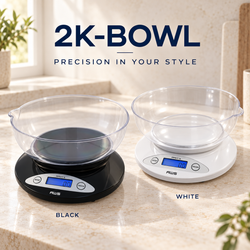
The 2K-BOWL digital bowl scale has a 2,000-gram capacity, 0.1-gram readability, and a removable bowl suitable for dry ingredients and small baking projects.
Do not mix or press ingredients vigorously while the bowl is sitting on the scale. Remove it before whisking, folding, or using a mixer.
How to Weigh Macaron Ingredients
Step 1: Set the Scale on a Firm Surface
Use a hard, level counter. Avoid towels, soft mats, uneven boards, or surfaces that vibrate.
Step 2: Turn On the Empty Scale
Wait for the display to show zero.
Step 3: Select Grams
Confirm the unit before weighing any ingredient.
Step 4: Add a Clean Container
Place a bowl, cup, or sheet of weighing paper in the center of the platform.
Step 5: Press Tare
Wait until the display returns to zero.
Step 6: Add the Ingredient Slowly
Pour quickly at first, then reduce the flow as you approach the target.
Step 7: Wait for Stabilization
Allow the display to settle before recording the final amount.
Step 8: Weigh Ingredients Separately
Separate containers are particularly useful for macarons. If you accidentally add too much sugar or egg white, you can correct the measurement before combining it with anything else.
Step 9: Record Actual Measurements
If the recipe called for 100 grams and you used 101.2 grams, record the actual amount. Accurate notes make troubleshooting more useful.
Weighing Almond Flour
Almond flour should be measured before following any recipe-specific processing directions.
A typical workflow is:
-
Place a bowl on the scale.
-
Press tare.
-
Add almond flour to the target mass.
-
Transfer it for sifting or processing as directed.
-
Account for any material lost during sifting if the recipe requires a final sifted mass.
Some recipes specify weighing before sifting. Others may require a final quantity after large pieces are removed. Follow the recipe’s wording.
Do not force oversized pieces through a sieve simply to preserve the original mass. If the recipe depends on the final sifted quantity, weigh again and replace the discarded material with properly fine almond flour.
Weighing Powdered Sugar
Powdered sugar can compact, making gram measurement preferable to cups.
Weigh it separately before combining it with almond flour.
Powdered sugar can create airborne dust, so:
-
Pour slowly
-
Use a sufficiently large bowl
-
Keep the scale away from strong airflow
-
Clean the display and platform afterward
-
Avoid breathing concentrated sugar dust
King Arthur Baking provides weight conversions for almond flour, confectioners’ sugar, granulated sugar, and many other ingredients in its ingredient weight chart.
Weighing Egg Whites
Egg whites should be weighed without the shells and yolks.
Because eggs vary, measuring by count is less precise than measuring by mass.
To weigh egg whites:
-
Separate each egg over a small bowl.
-
Transfer the clean white to the weighing bowl.
-
Repeat one egg at a time.
-
Stop before exceeding the target.
-
Beat an additional egg white separately if only a small amount is needed.
-
Add the final portion gradually.
Separating each egg over a separate cup prevents a broken yolk from contaminating the entire batch.
If the target is 100 grams and you have 103 grams, remove a small amount with a clean spoon or dropper.
Should Egg Whites Be Aged?
Some macaron methods instruct bakers to age egg whites, while others use fresh whites. Follow the chosen recipe.
If you age egg whites, record their mass before and after the process. Evaporation may reduce their mass, so ensure you are following the recipe’s intended measurement stage.
Handle eggs safely. The USDA’s shell egg safety guidance explains proper refrigeration, preparation, and handling.
Weighing Granulated Sugar
Granulated sugar is normally added gradually while whipping the meringue.
Weigh the complete quantity in a separate bowl before starting. This prevents you from losing track of how much has been added.
Do not place the mixer bowl on the scale while the mixer is running. Vibration and force interfere with measurement and may damage the scale.
The sugar should be measured before whipping begins and added according to the recipe’s method.
Weighing Food Coloring and Flavoring
Food coloring products differ in concentration.
Possible forms include:
-
Gel
-
Powder
-
Paste
-
Liquid
-
Oil-based color
Use a product appropriate for the recipe. A large amount of liquid color can alter batter consistency.
For powdered colors, a 0.01-gram scale may help reproduce small quantities. For gel colors, it may be more practical to weigh the container before and after dispensing.
If a container weighs 25.6 grams before use and 25.1 grams afterward, approximately 0.5 gram was added.
Avoid relying on informal descriptions such as “a little red” when developing a formula for commercial production. Record the brand, color name, and mass whenever practical.
Weighing Italian-Method Macarons
Italian-method macarons typically involve hot sugar syrup added to whipping egg whites. The exact procedure depends on the recipe.
Accurate measurement is important for:
-
Sugar
-
Water
-
Egg whites
-
Almond flour
-
Powdered sugar
Weighing water is straightforward because one gram of water is approximately equivalent to one milliliter under ordinary kitchen conditions.
Measure the syrup ingredients in an appropriate heat-safe container, then follow the recipe’s temperature and handling instructions.
A scale measures the ingredients, but a dependable thermometer is necessary for controlling syrup temperature.
Weighing French-Method Macarons
French-method macarons generally involve gradually adding sugar to whipping egg whites before folding in the dry mixture.
A scale helps ensure the relationship between:
-
Egg whites
-
Granulated sugar
-
Almond flour
-
Powdered sugar
The method still depends on correct meringue development and macaronage. Accurate measurements do not compensate for underwhipped egg whites or overmixed batter.
King Arthur Baking’s macaron recipe and instructions provide an example of a gram-based formula and explain preparation, piping, resting, and baking.
Weighing Swiss-Method Macarons
Swiss-method preparation generally heats egg whites and sugar together before whipping.
The bowl and ingredients should be weighed before applying heat. Do not place a hot bowl directly on a scale unless the manufacturer states that the platform is suitable for it.
Heat can affect electronic components and readings.
Use a heat-safe bowl, follow the recipe’s temperature instructions, and keep steam and condensation away from the scale.
Dividing Macaron Batter Into Colors
A scale makes it easier to divide one batch into multiple colors or flavors.
Suppose the finished batter weighs 900 grams and you want three equal colors:
Each bowl should receive 300 grams.
For a design requiring different proportions:
-
Main color: 60%
-
Secondary color: 30%
-
Accent color: 10%
For 900 grams of batter:
-
Main color: 540 grams
-
Secondary color: 270 grams
-
Accent color: 90 grams
Divide the batter carefully and avoid excessive handling. Additional mixing during coloring can change consistency.
A KITCHEN Pro-5KG digital bowl scale provides a five-kilogram capacity and 0.1-gram readability for larger batches, multiple bowls, and general baking work.
Calculating Macaron Recipe Yield
Weigh the finished batter before transferring it into a piping bag.
Suppose the batch contains 800 grams of batter.
If each complete macaron requires approximately 24 grams of batter—12 grams per shell—the theoretical yield is:
The batch may produce approximately 33 assembled macarons before accounting for batter left in the bowl or piping bag.
This information helps you:
-
Plan orders
-
Estimate cost
-
Choose shell size
-
Prepare enough filling
-
Determine packaging requirements
-
Reduce unexpected shortages
The theoretical and actual yield may differ. Record both numbers.
Weighing Individual Macaron Shells
Piping equal shell sizes depends mainly on technique, piping-tip size, template size, and batter consistency. However, a scale can be used during testing.
Place a parchment square or small tray on the scale, tare it, and pipe one test shell. Record the mass.
Once you understand the correct quantity, practice reproducing the same visual size.
Weighing every shell is usually inefficient and can disturb the batter. Instead:
-
Weigh several test portions.
-
Determine the average.
-
Use a piping template.
-
Hold the bag consistently.
-
Count or time the piping motion.
-
Check sample shells periodically.
Portioning Macaron Filling
Filling affects appearance, flavor, cost, and storage stability.
Common fillings include:
-
Buttercream
-
Ganache
-
Jam
-
Curd
-
Caramel
-
Cream-cheese frosting
-
Nut-based fillings
The scale can help determine how much filling each macaron receives.
Suppose 20 filled macarons use 200 grams of buttercream:
Each macaron receives an average of 10 grams.
If you want a more generous 12-gram portion for 50 macarons:
Prepare at least 600 grams, plus a reasonable allowance for filling left in the piping bag or bowl.
Matching Shells and Controlling Finished Weight
Macaron shells may vary slightly even when a template is used. Pair shells with similar diameters before filling.
For a standardized finished product, you can weigh assembled macarons.
Suppose your target is:
-
First shell: 8 grams
-
Second shell: 8 grams
-
Filling: 10 grams
The assembled macaron should weigh approximately 26 grams before moisture exchange and storage.
Small variations are normal. The objective is reasonable consistency, not laboratory uniformity.
Scaling a Macaron Recipe
Suppose a recipe contains:
-
120 grams almond flour
-
120 grams powdered sugar
-
100 grams egg whites
-
100 grams granulated sugar
To make 1.5 batches, multiply everything by 1.5:
-
Almond flour: 180 grams
-
Powdered sugar: 180 grams
-
Egg whites: 150 grams
-
Granulated sugar: 150 grams
To make half:
-
Almond flour: 60 grams
-
Powdered sugar: 60 grams
-
Egg whites: 50 grams
-
Granulated sugar: 50 grams
Do not automatically reduce mixing, whipping, resting, or baking times by the same factor. Equipment and batch size may change how the mixture behaves.
Calculating Ingredient Percentages
Percentages make it easier to compare macaron formulas.
If egg-white mass is treated as 100%, an example formula might contain:
-
Egg whites: 100 grams = 100%
-
Almond flour: 120 grams = 120%
-
Powdered sugar: 120 grams = 120%
-
Granulated sugar: 100 grams = 100%
The formula is:
When comparing recipes, confirm that both formulas use the same reference ingredient.
How a Scale Helps Troubleshoot Macarons
A scale eliminates ingredient quantity as one uncontrolled variable. It cannot identify every problem alone, but it makes diagnosis more systematic.
Macarons Spread Too Much
Possible causes include:
-
Overmixed batter
-
Excess liquid coloring
-
Weak meringue
-
Incorrect ingredient ratio
-
Piping too much batter
-
Inadequate resting
-
Humid conditions
Macarons Develop No Feet
Possible causes include:
-
Incorrect meringue
-
Overmixed or undermixed batter
-
Oven-temperature problems
-
Insufficient resting
-
Excess moisture
-
Formula errors
Macarons Are Hollow
Possible causes include:
-
Meringue problems
-
Incorrect macaronage
-
Oven-temperature issues
-
Baking-time problems
-
Cooling technique
-
Ingredient imbalance
Macarons Crack
Possible causes include:
-
Shells not sufficiently rested
-
Excess trapped air
-
Oven temperature too high
-
Uneven heat
-
Batter inconsistency
-
Excess moisture
Macarons Are Uneven
Possible causes include:
-
Unequal piping
-
Slanted piping bag
-
Uneven baking sheet
-
Warped pan
-
Poorly distributed oven heat
-
Different shell sizes
Accurate weights help you repeat the same formula while testing one technique variable at a time.
Measuring Ingredients in Humid Conditions
Humidity can affect macaron drying, shell formation, and ingredient handling.
A scale does not measure humidity, but it can help you avoid changing the formula unintentionally while responding to weather.
Do not add unrecorded quantities of dry ingredients in an attempt to correct humid conditions. This may alter the formula without solving the underlying problem.
Instead, record:
-
Ingredient masses
-
Room temperature
-
Relative humidity
-
Resting time
-
Oven settings
-
Shell results
Over time, you may identify the conditions that produce the most reliable results in your kitchen.
Using a Scale for a Macaron Business
A precise scale supports:
-
Recipe consistency
-
Predictable yield
-
Ingredient-cost calculations
-
Filling control
-
Standard package weight
-
Inventory planning
-
Color division
-
Production records
-
Waste reduction
-
Quality control
Suppose a batch should produce 50 macarons with 10 grams of filling each. The planned filling requirement is:
If staff members use an average of 14 grams:
That batch consumes 200 grams more filling than planned.
Consistent portions protect both product quality and profit margins.
Food businesses must also follow applicable labeling requirements. Macarons commonly contain almonds and eggs, and fillings may contain milk, peanuts, soy, wheat, or other allergens.
The FDA’s food-allergen guidance provides information about major food allergens and labeling responsibilities in the United States.
Calculating Cost per Macaron
Suppose one batch costs:
-
Almond flour: $8
-
Sugars: $2
-
Eggs: $3
-
Coloring and flavoring: $2
-
Filling: $7
Total ingredient cost:
If the batch produces 44 assembled macarons:
The ingredient cost is $0.50 per macaron before considering:
-
Labor
-
Utilities
-
Packaging
-
Delivery
-
Rent
-
Marketing
-
Equipment
-
Payment fees
-
Waste
-
Taxes
Accurate yield and filling measurements make the calculation more dependable.
Common Scale Mistakes When Making Macarons
Using a Scale With Insufficient Readability
A one-gram scale may work for full batches but provide limited information for tiny test recipes or concentrated colors.
Exceeding Capacity
Include the bowl when calculating the total physical load.
Forgetting to Tare
If the bowl weighs 300 grams and the display reads 400 grams, the ingredient mass is only 100 grams.
Letting the Bowl Touch Another Surface
A large bowl touching the counter or wall may produce an incorrect reading.
Measuring on a Soft Surface
Use a hard, level countertop rather than a towel or silicone mat.
Adding Everything to One Bowl
Separate weighing makes it easier to correct an overshoot before ingredients are combined.
Measuring Near a Running Mixer
Vibration may cause unstable readings.
Allowing Powder Under the Platform
Clean almond flour and sugar from the platform edges.
Assuming More Decimal Places Guarantee Accuracy
Readability is only one feature. Stable operation, repeatability, correct calibration, and proper technique also matter.
Mixing While the Bowl Is on the Scale
Remove the bowl before whisking, folding, or using a mixer.
Food Safety When Making Macarons
Macarons contain raw egg whites before baking. Practice safe handling:
-
Keep eggs refrigerated.
-
Use clean bowls and utensils.
-
Separate eggs carefully.
-
Wash hands after handling shells.
-
Avoid contact between raw egg and ready-to-eat food.
-
Clean counters and tools.
-
Follow a tested baking procedure.
-
Refrigerate perishable fillings.
-
Store assembled macarons appropriately.
Do not consume raw macaron batter. Raw eggs and uncooked almond-flour mixtures should be handled as uncooked food.
The CDC advises against eating uncooked dough or batter and provides additional precautions in its raw dough and batter safety guidance.
Cleaning and Maintaining a Macaron Scale
After every baking session:
-
Brush away almond flour and sugar.
-
Wipe the platform with a lightly damp cloth.
-
Dry it immediately.
-
Remove egg-white residue promptly.
-
Keep liquids away from controls.
-
Do not submerge the scale.
-
Avoid abrasive cleaning materials.
-
Clean food coloring before it stains.
-
Check around platform edges.
-
Wash removable bowls according to their instructions.
-
Store the scale without weight on it.
-
Replace weak batteries.
-
Follow the calibration instructions.
Fine sugar and almond particles can enter narrow gaps. Use a weighing bowl large enough to contain the ingredients.
Calibration and Accuracy Checks
If readings appear unstable or incorrect:
-
Move the scale to a hard, level surface.
-
Remove all items.
-
Clean around the platform.
-
Replace weak batteries.
-
Allow the scale to reach room temperature.
-
Test it with an appropriate reference weight.
-
Calibrate according to the product manual.
Do not use a package of sugar, a stick of butter, or a random household object as a calibration standard. Their labeled or assumed masses may not be exact enough.
Keeping a Macaron Baking Journal
Record:
-
Recipe and method
-
Almond flour brand and mass
-
Powdered sugar mass
-
Egg-white mass
-
Granulated sugar mass
-
Color and flavor quantities
-
Meringue stage
-
Macaronage observations
-
Total batter mass
-
Batter mass per color
-
Approximate shell size
-
Resting time
-
Room temperature
-
Humidity
-
Oven temperature
-
Baking time
-
Filling type and mass
-
Actual yield
-
Shell appearance
-
Interior texture
-
Planned adjustment
Detailed records help you distinguish measurement problems from technique, oven, or environmental problems.
Frequently Asked Questions
What is the best kitchen scale for macarons?
Choose a digital scale with 0.1-gram readability, at least 2,000 grams of capacity, a reliable tare function, and a stable platform that fits your bowls.
Is 1-gram readability enough for macarons?
It can be enough for standard batches, but 0.1-gram readability gives you better control over small ingredients and recipe adjustments.
Do I need a 0.01-gram scale?
Not for most recipes. A 0.01-gram scale is useful for tiny test batches, concentrated powdered colors, and detailed formula development.
Should I weigh almond flour before or after sifting?
Follow the specific recipe. Some formulas specify the initial mass, while others require a final sifted quantity.
Should egg whites be weighed before or after aging?
Follow the recipe’s intended measurement stage. If moisture evaporates during aging, the mass can change.
Can I weigh egg whites directly in the mixer bowl?
Yes, if the bowl fits on the scale and the total load remains within capacity. Separating eggs into another container first reduces the risk of yolk contamination.
Does tare increase the scale’s capacity?
No. It resets the display, but the bowl’s mass still counts toward maximum capacity.
Can I put a warm bowl on the scale?
Avoid placing hot equipment on the scale unless the manufacturer states that it is suitable. Heat can affect the scale and its readings.
How do I divide macaron batter evenly?
Weigh the finished batter and divide its mass by the number of colors or flavors. For 900 grams divided equally among three bowls, use 300 grams per bowl.
Why do equal ingredients still produce failed macarons?
Macarons also depend on meringue development, folding, piping, resting, humidity, oven temperature, pan selection, and baking time. A scale controls the formula but not every process variable.
Can a coffee scale be used for macarons?
Yes, if it provides suitable readability, capacity, platform space, and tare functionality.
How much should one macaron shell weigh?
Shell mass varies according to diameter and recipe. Weigh several test shells, calculate the average, and use a template to develop consistent piping.
Can a scale help calculate macaron yield?
Yes. Divide total batter mass by the approximate batter used per assembled macaron, then compare the theoretical figure with actual yield.
Final Verdict
The best kitchen scale for making macarons combines fine readability, dependable repeatability, sufficient capacity, and a stable platform.
For most macaron bakers, look for:
-
0.1-gram readability
-
At least 2,000 grams of capacity
-
Gram measurement mode
-
Reliable tare
-
Fast stabilization
-
Stable platform
-
Visible display
-
Easy cleaning
-
Practical auto-off timing
-
Enough room for your bowls
A five-kilogram model is ideal for large batches and general baking, while a small 0.01-gram scale can complement it for food coloring and other minute ingredients.
A scale cannot perform macaronage or regulate your oven, but it gives every batch a consistent foundation. It lets you reproduce ingredient ratios, divide colors, standardize fillings, calculate yield, track costs, and troubleshoot with reliable information.
When the formula is measured accurately, you can focus on the parts of macaron making that require observation and practice: developing the meringue, folding the batter, piping evenly, resting the shells, and understanding your oven.