
Meta Title: Best Precision Scale for Archery Components: Key Features
Meta Description: Learn which features matter when choosing the best precision scale for archery components, including resolution, capacity, calibration, tare, and platform size.
Suggested URL Slug: /best-precision-scale-for-archery-components/
Primary Keyword: best precision scale for archery components
Secondary Keywords: archery component scale, arrow-building scale, grain scale for arrows, digital archery scale, scale for weighing arrows, precision scale for broadheads
Best Precision Scale for Archery Components: Features That Matter
Arrow builders work with components that may look nearly identical but differ enough in weight to affect the consistency of a finished arrow set. Shafts, inserts, points, broadheads, nocks, vanes, wraps, and adhesives all contribute to total arrow weight. A precision scale gives you a practical way to sort those parts, confirm manufacturer specifications, and check completed arrows before they enter your hunting or target setup.
The best precision scale for archery components is not necessarily the model with the largest capacity or the longest list of modes. It is the scale that offers useful grain resolution, repeatable readings, enough capacity for completed arrows, straightforward calibration, and a platform that works with small parts.
This guide explains the features that matter most and how to match them to your arrow-building process.
Why Use a Precision Scale for Archery Components?
Component weight is one part of building consistent arrows. Although weight alone does not determine how an arrow will perform, large differences among supposedly matched components can make it harder to create a uniform set.
A precision scale can help you:
-
Sort broadheads and field points by weight
-
Compare inserts and outserts
-
Check nocks, bushings, collars, and adapters
-
Compare cut and uncut arrow shafts
-
Monitor adhesive added during assembly
-
Confirm total finished-arrow weight
-
Match completed arrows into closely grouped sets
-
Identify an arrow that has changed after repair
-
Verify that a replacement component is comparable to the original
Arrow construction and equipment rules differ between organizations and competition formats. Archers should consult the applicable equipment regulations from organizations such as USA Archery or the World Archery rulebook before using a particular setup in competition.
A scale is best treated as a measurement and quality-control tool. It cannot determine whether an arrow is safe, properly spined, correctly assembled, or appropriate for a particular bow.
The Most Important Scale Features for Arrow Building
1. Grain Measurement Mode
Archery component weights are commonly expressed in grains. Field points and broadheads, for example, are often sold using nominal grain ratings. Many arrow specifications also use grains per inch, while completed arrow weight is typically discussed in grains.
A scale with a native grain mode lets you read and record measurements without converting every result from grams.
If a scale only displays grams, use the relationship:
1 gram = approximately 15.432 grains
Manual conversion is possible, but it introduces another opportunity for transcription or rounding errors. A dedicated grain mode is more convenient when grains are your primary working unit.
When comparing precision scales from American Weigh Scales, check the available weighing modes rather than assuming every model includes grains.
2. Useful Resolution
Resolution is the smallest displayed increment on a digital scale. A scale displaying whole grains has a resolution of 1 grain. A scale displaying tenths of a grain has a 0.1-grain resolution.
For component sorting and finished-arrow matching, finer resolution makes small differences easier to see. However, more displayed digits do not automatically guarantee better real-world accuracy. Resolution, accuracy, repeatability, calibration, operating environment, and weighing technique all influence the usefulness of a measurement.
For many arrow-building tasks, a scale that displays at least tenths of a grain provides a practical level of detail. Archers attempting to sort especially light components may prefer a finer-reading instrument, provided its stated accuracy and repeatability support that resolution.
Avoid selecting a scale solely because it displays more decimal places. A stable scale that repeatedly returns the same result is generally more useful than an unstable scale that displays extra digits.
3. Enough Capacity for Finished Arrows
Capacity is the maximum weight the scale is designed to measure. Small archery components rarely challenge a scale’s capacity, but a completed arrow may.
Your scale should handle:
-
The heaviest finished arrow you expect to build
-
Any tray or support placed on the platform
-
A reasonable margin above your typical load
If a support cradle or container is used, its weight counts toward the scale’s capacity even when the tare function resets the display to zero.
A compact scale with a capacity of several hundred grams usually offers ample range for common arrow-building work. A higher-capacity model may be helpful when the scale will also be used for larger equipment or general workshop tasks, but additional capacity can come with coarser resolution.
The goal is balance: enough capacity for the entire arrow without sacrificing the resolution needed to distinguish component differences.
4. Repeatable Readings
Repeatability describes how consistently a scale reports the same value when the same item is weighed several times under the same conditions.
You can perform a simple repeatability check:
-
Place the scale on a stable, level surface.
-
Turn it on and allow it to stabilize.
-
Confirm that the display reads zero.
-
Place a component near the center of the platform.
-
Record the displayed value.
-
Remove the component and wait for the display to return to zero.
-
Weigh the component several more times.
The readings should remain closely grouped. If they drift considerably, investigate the weighing surface, airflow, battery condition, platform cleanliness, component placement, static electricity, and calibration before relying on the results.
Repeatability is particularly important when sorting components. If the scale cannot consistently reproduce a reading, small differences between two parts may reflect measurement variation rather than an actual weight difference.
5. Calibration Capability
Calibration helps establish the relationship between the load applied to a scale and the value it displays. A precision scale should include a clear calibration procedure and specify the calibration weight required.
Use a suitable test weight rather than an arrow component, coin, or household object with an assumed mass. Coins can wear, collect residue, or vary within manufacturing tolerances, making them poor substitutes for an appropriate reference weight.
AWS offers calibration weights for compatible digital scales. The required weight must match the value and class called for in your scale’s instructions.
General information about weights, measures, and measurement practices is available from the NIST Office of Weights and Measures. Its guidance can help users understand why traceable standards and correct measurement procedures matter.
Calibrate according to the manufacturer’s instructions, especially after:
-
Moving or transporting the scale
-
A significant change in operating temperature
-
An impact or accidental overload
-
Battery replacement when readings appear unusual
-
Extended storage
-
Repeated measurements that fail a consistency check
Calibration should not be used to conceal a damaged or malfunctioning scale. If a scale cannot produce stable results after correct setup and calibration, inspect it or replace it.
Platform Size and Arrow Support
Most compact precision scales have a small weighing platform designed for individual objects. That works well for points, broadheads, inserts, nocks, and other small components. A full-length arrow is more challenging because it can extend far beyond both sides of the platform.
The arrow’s weight must transfer to the weighing platform without any portion touching the bench, wall, tools, packaging, or your hand. Contact with another surface can support part of the load and produce an incorrect reading.
A lightweight arrow cradle can make finished-arrow weighing easier. Place the cradle on the platform, press tare, and then position the arrow so it is balanced and completely supported by the scale.
Check that:
-
The cradle does not exceed the platform’s dimensions
-
The combined weight remains within the scale’s capacity
-
The arrow cannot roll off
-
No part of the arrow touches another surface
-
The assembly is stable enough to produce a settled reading
A removable weighing tray may also help contain small components. This is useful when weighing nocks, collars, screws, or multiple vanes.
Tare Function
The tare function resets the displayed value to zero while a container, tray, or support is on the platform. It allows the scale to display the net weight of the component rather than the combined weight of the component and its holder.
For example:
-
Place a small tray on the scale.
-
Press the tare button.
-
Confirm that the display returns to zero.
-
Add the component.
-
Record the displayed component weight.
Tare is especially valuable when parts can roll or when a cradle is needed for a completed arrow. Remember that taring does not restore physical capacity. The tray or cradle still contributes to the total load applied to the weighing mechanism.
Pocket Scale or Bench Scale?
Both formats can work for archery equipment, but they serve slightly different priorities.
Pocket Scales
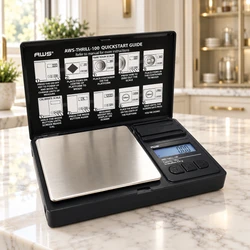
A pocket scale is a good choice when portability and compact storage matter. It can be carried in an archery toolkit, taken to a competition, or stored in a small workbench drawer.
Many AWS pocket scales include protective covers that can help shield the platform during storage. Some covers can also serve as weighing trays, depending on the model.
A pocket scale may be the better choice for:
-
Broadheads and field points
-
Inserts, collars, and nocks
-
Portable equipment checks
-
Small workspaces
-
Sorting components before assembly
The tradeoff is a smaller platform, which can make full-length arrows harder to balance.
Bench Scales
A bench scale generally offers a larger platform and greater stability for bigger objects. Models such as the AWS 2000-gram bench scale provide more capacity and working area, although their resolution may be coarser than that of a small precision scale.
A bench scale may be useful for general workshop weighing, but archers should confirm that its displayed increment is fine enough for their component-sorting goals.
Milligram Scales
Very small components may benefit from a higher-resolution instrument. AWS offers a selection of milligram scales for applications requiring finer gram measurements.
Fine-resolution scales are more sensitive to environmental effects, so they require careful setup. They are not automatically the best option for full-length arrows, particularly if their capacity or platform size is limited.
Environmental Features That Affect Scale Performance
Draft Protection
Air movement can affect light loads on sensitive scales. Fans, open windows, heating vents, and even breathing directly over the platform may cause a reading to fluctuate.
Some high-resolution scales use draft shields. If your model does not, perform measurements in a calm area and wait for the display to stabilize before recording the value.
Stable Feet and Level Placement
A scale should sit flat without rocking. Flexible tables, uneven workbenches, padded mats, and cluttered surfaces can reduce stability.
Place the scale on a rigid surface and ensure that all feet make proper contact. Do not weigh components while holding the scale in your hand.
Backlit Display
A clear, backlit display helps in garages, indoor ranges, and workshop areas where lighting may be uneven. Display size and viewing angle matter when a long arrow partially obstructs your line of sight.
Overload Indication
An overload warning helps alert the user when the applied load exceeds the scale’s capacity. Continued overloading can damage the weighing mechanism, so remove the item immediately if the warning appears.
Automatic Shutoff
Automatic shutoff conserves battery power, but a very short timeout can be inconvenient while recording and sorting multiple components. Look for a model whose shutoff behavior suits your workflow.
If a scale turns off during a long session, remove everything from the platform before restarting and verify zero before continuing.
Managing Static Electricity
Carbon shafts, plastic nocks, vanes, wraps, and synthetic work surfaces can accumulate static charge. On sensitive instruments, static may contribute to drifting or unstable readings.
To reduce potential interference:
-
Keep the platform clean and dry
-
Avoid rubbing components on synthetic cloth
-
Allow recently handled parts to rest briefly
-
Keep packaging materials away from the scale
-
Use the scale in a moderate indoor environment
-
Avoid placing it directly on highly static plastic surfaces
Humidity and temperature can also affect the measurement environment. Let the scale and components acclimate when moving them from a cold vehicle into a warm workspace.
Comparing Archery Components by Weight
Broadheads and Field Points
Broadheads and field points are sold at nominal weights, but actual pieces may vary. A precision scale lets you record each one and arrange them into close groups.
Weight is only one aspect of broadhead inspection. Also examine threads, blades, ferrules, alignment, damage, and manufacturer instructions. The Archery Trade Association provides industry information and educational resources relevant to archery businesses and participants.
Arrow Shafts
Individual shafts can be weighed before installation of inserts, nocks, and vanes. Recording shaft weights creates a baseline and makes it easier to understand where finished-arrow differences originated.
Weight matching does not replace spine testing or manufacturer selection charts. Always choose shafts with the correct specifications for your equipment.
Inserts, Outserts, and Collars
Front-end components influence total weight and weight distribution. Sorting these parts before installation may help reduce variation across a set.
Once adhesive is applied, the assembled value may differ from the sum of the dry components. Weighing before and after assembly can show how much mass the bonding process added.
Nocks and Vanes
Nocks and vanes are light, so they require a scale with suitable resolution and repeatability. Keep the platform free of adhesive residue and handle the parts consistently.
For youth and school archery programs, equipment requirements may be standardized. Refer to the National Archery in the Schools Program for current program-specific information rather than assuming that general equipment practices apply.
Completed Arrows
Completed-arrow weight is usually the most useful final measurement because it reflects every installed component, wrap, vane, and amount of adhesive.
Create an identification system for your arrows and record each finished weight. Numbered arrows make it easier to track repairs, component replacements, and changes over time.
A Practical Arrow-Matching Process
Use the same process for every item so the results are comparable.
Step 1: Prepare the Scale
Place the scale on a clean, rigid, level surface away from airflow and vibration. Confirm that the batteries are in good condition.
Step 2: Calibrate When Necessary
Follow the manufacturer’s calibration procedure using the specified calibration weight. Do not improvise with an object of unknown exact mass.
Step 3: Check Zero
The display should return to zero before each measurement. If it does not, remove all items, press tare or zero, and wait for stabilization.
Step 4: Position Components Consistently
Place small components near the center of the platform. Position completed arrows in the same orientation each time.
Step 5: Repeat Questionable Measurements
If a value appears unusual, remove the component and weigh it again. Repeated results help distinguish a genuine outlier from a temporary disturbance.
Step 6: Record the Results
Create a simple table with component identification, nominal weight, measured weight, and assembly notes. Documentation makes sorting more reliable than memory.
Step 7: Group Similar Items
Arrange components or completed arrows into groups based on your chosen tolerance. The appropriate tolerance depends on your equipment, goals, measurement system, and ability to maintain a repeatable process.
Recommended Scale Types by Task
| Archery task | Helpful scale characteristics |
|---|---|
| Sorting field points | Grain mode, fine resolution, small tray |
| Weighing broadheads | Stable platform, repeatable readings, adequate capacity |
| Sorting inserts and nocks | Fine resolution, tare function, draft-resistant setup |
| Weighing arrow shafts | Adequate capacity, arrow cradle, readable display |
| Checking finished arrows | Grain mode, suitable capacity, repeatability |
| Portable range checks | Compact design, protective cover, battery power |
| General workshop use | Larger platform, higher capacity, durable controls |
A compact option such as the AWS AC PRO-200 pocket scale may suit small-component work, but buyers should verify the current product specifications, weighing modes, capacity, and graduation before ordering.
Precision Scale Mistakes to Avoid
Common mistakes include:
-
Buying based only on the number of displayed digits
-
Ignoring maximum capacity
-
Weighing an arrow while one end touches the bench
-
Using an unstable or padded work surface
-
Assuming tare restores available capacity
-
Calibrating with a household object
-
Recording a fluctuating reading too quickly
-
Comparing results from different units without careful conversion
-
Allowing adhesive, dust, or debris to accumulate on the platform
-
Treating component weight as a substitute for structural inspection
For additional context on scale terminology and regulatory concepts, consult the current edition of NIST Handbook 44. Although hobby arrow building is different from commercial weighing, the handbook is a useful authoritative reference for understanding weighing-device concepts.
Frequently Asked Questions
What is the best precision scale for archery components?
The best choice is a scale with grain mode, useful resolution, repeatable readings, adequate capacity for completed arrows, a stable platform, tare capability, and a documented calibration procedure. The ideal model depends on whether you primarily weigh small parts, complete arrows, or both.
What resolution do I need for arrow building?
A resolution of 0.1 grain is practical for many component-sorting and finished-arrow applications. Finer resolution may help with very light parts, but only when the scale is accurate, repeatable, properly calibrated, and used in a controlled environment.
How much scale capacity do I need?
Choose a capacity greater than the heaviest completed arrow plus any tray or support. Several hundred grams is generally more than enough for ordinary arrow-building tasks, but verify the weight of your particular equipment.
Can I weigh a full arrow on a pocket scale?
Yes, provided the arrow is fully supported by the weighing platform or a tared cradle, does not touch another surface, and remains within the scale’s capacity. A poorly balanced arrow can produce inconsistent readings or fall from the platform.
Should I weigh components or only finished arrows?
Ideally, do both. Component measurements help identify variation before assembly, while completed-arrow measurements show the final result after adhesive, wraps, vanes, and other parts have been added.
Can I calibrate my scale with a coin?
A specified calibration weight is the better choice. A coin’s actual mass can vary due to manufacturing tolerance, wear, contamination, or damage.
Does matching arrow weight guarantee identical flight?
No. Total weight is only one variable. Spine, straightness, component alignment, vane condition, point design, front-of-center balance, bow tuning, and shooting technique can also affect results.
Final Thoughts
The best precision scale for archery components combines useful resolution with repeatability, suitable capacity, grain measurement, easy calibration, and a platform arrangement that supports both small parts and completed arrows.
For most arrow builders, reliable tenths-of-a-grain measurements are more valuable than unnecessary capacity or extra display digits. Choose a scale that fits your actual components, use it in a stable environment, calibrate it correctly, and follow the same weighing procedure every time.
A consistent process turns the scale into a useful quality-control tool. It helps you document components, organize closely matched sets, spot unexpected changes, and make better-informed assembly decisions—without treating weight as the only factor in arrow safety or performance.