
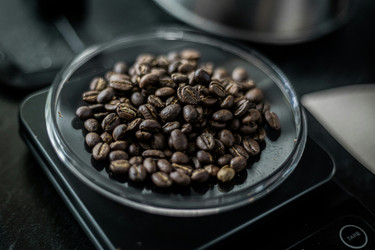
The best precision scale for coffee beans is not necessarily the scale
with the most decimal places. For everyday coffee preparation, the
features that matter most are useful readability, sufficient capacity,
fast response, tare, repeatability, platform size, calibration,
and---when brewing directly on the scale---a built-in timer and
resistance to everyday splashes.
For most espresso, pour-over, AeroPress, and general coffee preparation,
0.1g readability is an excellent target. It provides enough detail
for repeatable doses while allowing substantially more useful capacity
than many ultra-fine laboratory-style scales.
American Weigh Scales currently recommends the BARISTA-3KG as its
strongest all-around coffee option. It combines 3,000g capacity with
0.1g readability, a timer, splash-resistant construction, removable
silicone mat, and a brewing-friendly platform.
For people who only weigh beans or espresso doses, a smaller model from
the AWS pocket scales collection
can be more portable.
This guide explains the features that matter most when choosing a
precision scale for coffee beans---and which specifications are
genuinely useful rather than simply impressive on paper.
Quick Answer: The Features That Matter Most
When shopping for a precision coffee scale, prioritize:
-
0.1g readability
-
Enough capacity for the complete setup
-
Fast tare
-
Fast response
-
Good repeatability
-
Gram measurement
-
Large enough platform
-
Built-in timer for brewing
-
Splash-resistant construction
-
Clear display
-
Stable zero
-
Straightforward calibration
-
Appropriate power source
-
Compact dimensions for espresso
-
Protective or removable mat where useful
The ideal configuration depends on whether you are weighing beans alone
or brewing directly on the scale.
Precision Coffee Scale Feature Comparison
Feature Why it matters
0.1g readability Practical detail for coffee dosing
0.01g readability Useful for specialized small-dose experiments
500--750g capacity Beans, grounds and dosing containers
3,000g capacity Complete manual-brewing setups
5,000g capacity Heavy brewers and multipurpose kitchen use
Tare Removes container mass from displayed net reading
Fast response Helps track active pours and espresso yield
Timer Tracks extraction and brewing time
Large platform Supports mugs, drippers and carafes
Splash resistance Useful around brewing water and espresso
Calibration Helps maintain/check scale performance
Repeatability Supports consistent recipes
Backlit display Easier to read while brewing
1. Readability
Readability is the smallest increment shown by the scale.
Common coffee-scale specifications include:
-
1g
-
0.1g
-
0.01g
For most coffee users, 0.1g is the best balance. The Specialty Coffee
Association Sample Preparation
Standard
specifies a scale with 0.1g or higher accuracy for its standardized
coffee sample preparation.
A 0.1g scale can display:
-
15.0g
-
18.0g
-
18.5g
-
20.0g
-
36.0g
That level of detail is useful for espresso doses, filter-coffee
recipes, and systematic adjustments.
2. Why 0.1g Is Usually Better Than 1g
A whole-gram scale may be adequate for casual large-batch coffee
preparation, but it provides relatively coarse information.
Imagine targeting an 18g espresso dose.
A scale reading to 1g gives substantially less information than one
reading to 0.1g.
For espresso and smaller manual-brew recipes, tenths of a gram make dose
adjustments easier to repeat.
AWS's current Best Scale for Coffee Beans and Espresso
Dosing
guide similarly recommends 0.1g readability for most coffee preparation.
3. Do You Need 0.01g?
Usually not.
A 0.01g scale may be useful for:
-
Tiny experimental doses
-
Individual-bean experiments
-
Specialized recipe development
-
Other precision hobbies sharing the same scale
But most coffee preparation does not require hundredth-of-a-gram
readings.
A finer scale may also have:
-
Lower capacity
-
Smaller platform
-
Greater sensitivity to drafts and vibration
-
Less room for complete brewing equipment
For coffee, practical capacity and response speed often matter more than
an extra decimal place.
4. Do You Need 0.001g?
For normal coffee preparation, no.
Milligram scales are designed for much finer measurements than typical
coffee dosing requires.
They often have low capacity and small pans, and they can be more
sensitive to environmental conditions.
For coffee beans, 0.1g is usually the more useful real-world
specification.
5. Readability Is Not the Same as Accuracy
This distinction matters.
Readability is the smallest displayed increment.
Accuracy concerns closeness of a measurement to the relevant
reference within the instrument's stated performance.
Repeatability describes how consistently the same stable load is
measured under similar conditions.
A scale displaying 0.01g increments is not automatically better than a
well-designed 0.1g coffee scale.
Always evaluate the complete specification.
6. Capacity
Capacity is the maximum total load the scale can support.
For bean dosing alone, capacity requirements are modest.
For brewing directly on the scale, capacity must include:
-
Coffee
-
Cup
-
Dosing container
-
Portafilter
-
Dripper
-
Filter
-
Carafe
-
Water
That is why coffee scales can range from a few hundred grams to several
kilograms.
7. 200--600g Capacity
A compact scale in this range is useful for:
-
Coffee beans
-
Espresso grounds
-
Small dosing cups
-
Travel kits
-
Pre-portioned coffee
AWS currently lists 500g and 600g models as practical options for
portable coffee dosing.
Its Best Pocket Scales for Jewelry, Coins, Coffee and
Crafts
guide identifies the AWS-600 as a 600g x 0.1g option for coffee beans
and related uses.
8. 3,000g Capacity
For complete coffee preparation, 3kg is highly versatile.
A 3kg scale can accommodate many combinations of:
-
Mug
-
Dripper
-
Carafe
-
Coffee
-
Brewing water
-
AeroPress equipment
AWS's current BARISTA-3KG specification is 3,000g x 0.1g.
This is an excellent balance because the scale retains fine
coffee-friendly readability while offering enough capacity for many
complete brewing setups.
9. 5,000g Capacity
A 5kg scale is useful for:
-
Heavy carafes
-
Large French presses
-
Bigger bowls
-
Batch brewing
-
General kitchen use
If one scale must handle coffee, cooking, and baking, additional
capacity can be worthwhile.
The tradeoff may be larger physical dimensions.
10. Capacity Headroom
Do not select a scale that barely supports your normal setup.
Suppose your setup includes:
-
Carafe: 350g
-
Dripper: 150g
-
Coffee: 30g
-
Water: 500g
Total:
1,030g
A 1kg scale is insufficient.
A 2kg scale works numerically, while a 3kg scale provides more
comfortable headroom.
Choose capacity based on the heaviest complete setup---not just the
coffee beans.
11. Tare
Tare is essential for coffee.
To weigh beans:
-
Put the dosing cup on the scale.
-
Press tare.
-
Confirm zero.
-
Add beans.
-
Read the net coffee mass.
During brewing, tare can similarly zero a cup, carafe, or brewer before
adding water.
12. Tare Does Not Restore Capacity
If a carafe weighs 500g and you tare it, the scale is still physically
supporting 500g.
Tare changes the displayed net value; it does not remove physical load.
Always calculate gross load when selecting capacity.
13. Fast Response
Response speed matters much more in coffee than in many static weighing
applications.
During pour-over, water is continuously entering the brewer.
During espresso, beverage output increases quickly.
A slow display can lag behind the actual pour.
For brewing directly on the scale, prioritize fast, stable response
rather than simply buying the scale with the finest readability.
14. Repeatability
A precision coffee scale should produce consistent readings when the
same stable load is measured repeatedly under similar conditions.
A simple test:
-
Confirm zero.
-
Place a dosing cup or stable object on the platform.
-
Record the reading.
-
Remove it.
-
Wait for zero.
-
Repeat.
Consistent behavior helps you trust recipe comparisons.
15. Built-In Timer
A timer is one of the most useful coffee-specific features.
It helps track:
-
Espresso extraction
-
Pour-over bloom
-
Pour intervals
-
Total brew time
-
AeroPress steep time
You can use a separate timer, but an integrated timer makes the workflow
simpler.
AWS's
BARISTA-3KG
includes a built-in brewing timer alongside its 3kg capacity and 0.1g
readability.
16. Platform Size
A coffee scale must physically support what you place on it.
For bean dosing, a small platform is fine.
For brewing, check dimensions for:
-
Mug
-
Portafilter
-
Dripper
-
Carafe
-
French press
A scale can have enough numerical capacity while still having a platform
that is too small.
17. Espresso Footprint
Espresso introduces a special constraint: the scale may need to fit
beneath the group head.
A large 5kg kitchen scale might have excellent capacity but be
physically unusable beneath your espresso machine.
SCA research on defining contemporary
espresso
also illustrates why both dose and beverage output by mass are useful
variables in espresso preparation. For espresso yield, check:
-
Width
-
Depth
-
Height
-
Cup clearance
-
Display visibility
Physical fit can be more important than maximum capacity.
18. Splash Resistance
Coffee scales operate near liquid.
Potential exposure includes:
-
Brewing water
-
Espresso
-
Condensation
-
Wet cups
-
Minor spills
Splash resistance is therefore highly useful.
Do not assume splash resistance means waterproof or submersible.
Follow the manufacturer's cleaning instructions.
19. Silicone Mat
A removable silicone mat can help:
-
Protect the platform
-
Catch minor drips
-
Improve grip
-
Simplify cleanup
AWS includes a removable silicone mat with the BARISTA-3KG.
For active brewing, this is more useful than it may initially appear.
20. Display Quality
Look for:
-
Large digits
-
Clear decimal placement
-
Backlighting
-
Visible timer
-
Good viewing angle
During pour-over, you need to read the scale while pouring.
During espresso, the cup must not completely hide the display.
A technically precise scale with poor display visibility can be
frustrating.
21. Gram Measurement
Grams are the most practical unit for coffee recipes.
NIST explains that the gram is a decimal submultiple used in expressing
mass within the SI framework. citeturn0search1
For standardized unit context, the NIST Guide to SI conversion
factors
also provides mass-unit conversion factors. Using grams makes recipe
math straightforward:
-
18g coffee
-
36g espresso output
-
20g coffee
-
320g brewing water
You can compare inputs and outputs directly without relying on volume.
22. Coffee-to-Water Ratios
A precision scale makes coffee-to-water ratios repeatable.
For example:
1:16
20g coffee × 16 = 320g water
1:17
30g coffee × 17 = 510g water
The Specialty Coffee Association provides broader
professional coffee education and brewing resources. The exact ratio you
prefer can vary.
The important advantage is that the scale lets you repeat the same
recipe and adjust one variable at a time.
23. Calibration
A precision scale should have a clear calibration process.
Check:
-
Required calibration mass
-
Calibration procedure
-
Whether the weight is included
-
Recommended operating conditions
AWS provides a detailed walkthrough in How to Calibrate a Digital Scale
for Accurate
Results.
Use the calibration mass specified by the manufacturer rather than an
arbitrary household object.
24. Stable Zero
A useful coffee scale should return predictably to zero when the load is
removed.
If the display drifts, investigate:
-
Surface stability
-
Airflow
-
Battery condition
-
Calibration
-
Platform contamination
-
Water or grounds around the weighing surface
Coffee grounds can easily accumulate around a platform, so routine
cleaning matters.
25. Surface Stability
Place the scale on a hard, stable counter.
Avoid:
-
Flexible trays
-
Wobbly tables
-
Soft towels
-
Uneven surfaces
A precision scale needs stable mechanical support.
26. Drafts
Air movement is generally less problematic for a 0.1g coffee scale than
for a milligram balance, but strong drafts can still interfere with
stable readings.
Avoid placing the scale directly beside:
-
Fans
-
HVAC vents
-
Open windows
This is especially sensible when weighing small bean doses.
27. Battery Power
Battery-powered scales are convenient for:
-
Travel
-
Coffee carts
-
Office setups
-
Moving between brewing stations
AWS's BARISTA-3KG currently uses three AAA batteries.
citeturn0search3
Replace weak batteries if scale behavior becomes unusual.
28. Rechargeable Power
Rechargeable scales can be convenient for a permanent coffee station.
Advantages include:
-
No disposable batteries during routine use
-
Easy charging
-
Convenient daily operation
The best choice depends on whether you value travel flexibility or
permanent countertop use.
29. Auto-Off
Auto-off conserves power.
However, an aggressive auto-off timer can be annoying during:
-
Grinder adjustments
-
Pour-over setup
-
Longer manual brewing
-
Espresso preparation
Check whether the scale's power behavior fits your workflow.
30. Protective Cover
A protective cover is useful for pocket scales used mainly for beans.
It protects the platform during:
-
Travel
-
Storage
-
Office use
A full-size brewing scale may prioritize a removable mat instead.
31. Best Precision Scale for Espresso Beans
For beans and grounds only:
500--750g x 0.1g
is an excellent target.
Prioritize:
-
Tare
-
Fast response
-
Compact dimensions
-
Stable readings
-
Clear display
You generally do not need 3kg capacity if the portafilter and cup never
go on the scale.
32. Best Precision Scale for Espresso Yield
When measuring espresso output, prioritize:
-
0.1g readability
-
Fast response
-
Timer
-
Compact footprint
-
Tare
-
Splash resistance
The scale must physically fit beneath the espresso machine.
A high-capacity scale is useless if it does not fit.
33. Best Precision Scale for Pour-Over
Pour-over benefits from:
-
2--3kg+ capacity
-
0.1g readability
-
Timer
-
Large platform
-
Fast response
-
Tare
-
Splash resistance
This is where a dedicated coffee scale clearly outperforms a tiny pocket
scale.
34. Best Precision Scale for AeroPress
For AeroPress, a 1--3kg scale provides plenty of flexibility for many
setups.
A timer is particularly useful because immersion time is part of the
recipe.
If you only weigh beans before brewing, a pocket scale is sufficient.
35. Best Precision Scale for French Press
French presses can be relatively heavy.
Calculate:
empty press + coffee + water
before choosing capacity.
A 3--5kg scale may be more appropriate than a small dosing scale.
36. Best Precision Scale for Cold Brew
For weighing coffee beans alone, a 500--750g scale may be enough.
For placing a complete cold-brew vessel on the scale, capacity
requirements can become much larger.
A 3--5kg scale is often more practical for batch preparation.
37. Best Precision Scale for Travel
Travel coffee favors:
-
Compact size
-
Battery power
-
Protective cover
-
0.1g readability
-
200--750g capacity
A pocket scale is excellent if you only need to measure beans.
If you intend to brew on the scale, confirm the complete travel setup
remains within capacity.
38. Best Precision Scale for a Home Coffee Bar
For a permanent home coffee station, a 3kg x 0.1g scale is
exceptionally versatile.
It can handle:
-
Bean dosing
-
Espresso cups
-
Pour-over
-
AeroPress
-
Small carafes
-
General coffee preparation
A timer and splash-resistant design add significant practical value.
39. Pocket Scale vs. Dedicated Coffee Scale
Pocket Scale
Best for:
-
Beans
-
Grounds
-
Travel
-
Small dosing cups
-
Compact storage
Dedicated Coffee Scale
Best for:
-
Pour-over
-
Espresso yield
-
Complete brewers
-
Timing
-
Water measurement
-
Larger containers
The right format depends on whether you weigh ingredients or perform the
entire brew on the scale.
40. Coffee Scale vs. Kitchen Scale
A kitchen scale can be excellent for coffee if it has:
-
0.1g readability
-
Fast response
-
Tare
-
Suitable capacity
-
Suitable platform
A generic kitchen scale reading only in whole grams is less useful for
detailed espresso dosing.
A coffee-specific scale adds brewing-oriented features such as a timer
and compact platform.
41. Why More Capacity Is Not Always Better
A 10kg scale may sound more capable than a 3kg scale.
But if the 10kg model reads only to 1g, it may be less useful for
espresso dosing.
The best scale balances capacity with readability.
For most coffee stations, 3kg x 0.1g is a highly practical combination.
42. Why More Resolution Is Not Always Better
Similarly, a 0.001g scale may sound more precise.
But it may have:
-
Very low capacity
-
Tiny pan
-
Slow workflow
-
High environmental sensitivity
For coffee, usability matters.
The goal is repeatable brewing---not maximizing decimal places.
43. Cleaning and Maintenance
Coffee scales encounter:
-
Grounds
-
Water
-
Oils
-
Dust
-
Drips
Good maintenance includes:
-
Wiping after use
-
Removing grounds from platform edges
-
Drying splashes
-
Cleaning removable mats
-
Avoiding immersion
-
Keeping charging ports dry
-
Storing without heavy objects on the platform
Regular care supports reliable operation.
44. Warranty
Warranty can matter because coffee scales are used frequently and around
liquid.
AWS currently lists a 10-year manufacturer's warranty for the
BARISTA-3KG. citeturn0search3
When comparing models, check what the warranty covers and follow care
instructions.
45. Precision Scale Features by Brewing Priority
The same specification should not be weighted equally by every coffee
user.
If Your Priority Is Espresso
Prioritize response speed, compact dimensions, 0.1g readability, tare,
timer visibility, and splash resistance. Capacity only needs to cover
the cup and beverage if the scale is used beneath the machine, but the
platform must fit the drip tray.
If Your Priority Is Pour-Over
Prioritize 2--3kg or greater capacity, a stable platform, built-in
timer, 0.1g readability, fast response, and an unobstructed display.
Pour-over places more total equipment on the scale than bean dosing.
If Your Priority Is Travel
Prioritize small dimensions, battery power, a protective cover, and
enough capacity for beans and a dosing cup. A dedicated pocket scale can
be more useful than carrying a full-size brewing scale.
If Your Priority Is Recipe Development
Prioritize repeatability, calibration, stable zero, 0.1g readability,
timer functionality, and the ability to record both coffee dose and
water or beverage output consistently.
46. How to Compare Two Coffee Scales
When two scales look similar, compare them in this order:
-
Does each scale have enough total capacity?
-
Does each provide 0.1g readability?
-
Will the platform physically fit the equipment?
-
Which responds more quickly during an active pour?
-
Does one include a built-in timer?
-
Is the display visible with the brewing vessel in place?
-
Is either design better protected from everyday splashes?
-
Can both be calibrated according to clear instructions?
-
Which power system better fits the brewing station?
-
Which is easier to clean and store?
This approach prevents a flashy feature from distracting from basic
usability.
47. Why Stable Measurements Matter More Than Extra Digits
Coffee recipes are improved through controlled changes. If you change
grind size, dose, water amount, temperature, and brew time
simultaneously, it becomes difficult to identify what improved or
worsened the cup.
A dependable scale helps hold dose and water mass constant while you
adjust another variable.
That makes repeatability more valuable than displaying an extra decimal
place that your brewing process does not meaningfully use.
48. Coffee Scale Capacity Examples
Consider three realistic workflows.
Bean Dosing
Dosing cup: 60g
Coffee: 20g
Gross load: 80g
A 500g scale has abundant capacity.
Espresso Yield
Cup: 180g
Espresso: 40g
Gross load: 220g
A compact 500g scale may have enough capacity, assuming it fits beneath
the machine.
Pour-Over
Carafe: 400g
Dripper and filter: 150g
Coffee: 30g
Water: 500g
Gross load: 1,080g
A 500g pocket scale cannot support this setup. A 3kg brewing scale is
much more appropriate.
These examples show why the best coffee scale depends on the complete
workflow rather than the coffee dose alone.
49. When a Second Scale Makes Sense
Some coffee enthusiasts benefit from two scales rather than forcing one
model to satisfy incompatible requirements.
A compact 500--750g dosing scale can live beside the grinder and handle
beans quickly. A larger 3kg brewing scale can remain at the espresso
machine or pour-over station.
This setup can be especially useful when a large brewing scale does not
fit comfortably near the grinder or when a tiny dosing scale cannot
support a full carafe.
50. What Matters Less Than Marketing Suggests
Certain specifications can sound impressive without substantially
improving everyday coffee preparation.
For most users, you do not need:
-
Milligram readability
-
Extremely high maximum capacity
-
Numerous obscure weighing units
-
Laboratory-style sensitivity
-
A huge platform for bean dosing
You do need the scale to respond quickly, tare reliably, fit the
equipment, remain stable, and display enough detail for your recipes.
That is the distinction between theoretical precision and practical
precision.
Precision Coffee Scale Buying Checklist
Before purchasing, ask:
-
Will I weigh beans only or brew directly on the scale?
-
What is my typical coffee dose?
-
What is the heaviest complete brewing setup?
-
Is 500--750g enough?
-
Do I need 3kg?
-
Would 5kg provide useful extra headroom?
-
Does the scale read to 0.1g?
-
Is 0.01g genuinely necessary?
-
How quickly does the display respond?
-
Is repeatability good?
-
Does it have tare?
-
Does it measure grams?
-
Does it include a timer?
-
Is the platform large enough?
-
Will it fit under my espresso machine?
-
Can I see the display with a cup on it?
-
Is it splash resistant?
-
Does it have a removable mat?
-
Can it be calibrated?
-
What calibration mass is required?
-
Is it battery powered or rechargeable?
-
Does auto-off interfere with brewing?
-
Is it portable?
-
Is it easy to clean?
-
What warranty is provided?
Common Buying Mistakes
Buying by Decimal Places Alone
Coffee usually does not need 0.001g.
Choosing Too Little Capacity
Remember the brewer, cup, water, and container.
Choosing Huge Capacity With Coarse Readability
A high-capacity whole-gram scale may be poor for espresso.
Forgetting Platform Size
Capacity does not guarantee physical fit.
Ignoring Response Speed
Brewing is dynamic.
Skipping the Timer
For pour-over and espresso, an integrated timer is highly useful.
Ignoring Splash Resistance
Coffee preparation happens around liquid.
Assuming Tare Restores Capacity
It does not.
Ignoring Calibration
A precision scale should have a clear calibration process.
Buying a Large Scale for Espresso Without Measuring Clearance
It may not fit beneath the machine.
Frequently Asked Questions
What is the best precision scale for coffee beans?
For complete coffee preparation, a 3kg x 0.1g scale with tare, fast
response, a timer, and a brewing-friendly platform is an excellent
all-around choice.
Is 0.1g precise enough for coffee?
Yes. For most espresso, pour-over, and everyday coffee dosing, 0.1g
readability provides useful measurement detail.
Do I need 0.01g for coffee?
Usually not. It can be useful for specialized experiments, but most
brewing workflows benefit more from capacity, response speed, and
platform size.
Do I need 0.001g?
No for ordinary coffee preparation.
What capacity is best for coffee beans?
For beans alone, 500--750g is generous. For complete brewing setups,
2--3kg or more is more practical.
Is 3kg enough for pour-over?
For many home pour-over setups, yes. Always calculate the total mass of
the brewer, carafe, coffee, and water.
Is 5kg better?
It provides additional capacity for heavy equipment and multipurpose
kitchen use, but it is not automatically more precise.
Does a coffee scale need tare?
Yes. Tare is one of the most useful features for coffee preparation.
Does tare increase capacity?
No. It only changes the displayed net reading.
Do I need a timer?
A timer is highly useful for pour-over, espresso, AeroPress, and other
time-sensitive brewing methods.
Should a coffee scale measure grams?
Yes. Grams make coffee recipes and ratios easy to calculate and repeat.
Does response speed matter?
Yes, especially when monitoring an active espresso shot or pour-over.
Does platform size matter?
Yes. The brewer, cup, carafe, or portafilter must fit without contacting
another surface.
Is splash resistance important?
It is very useful because coffee scales operate around water and
espresso.
Should I calibrate a coffee scale?
Follow the manufacturer's instructions, particularly after transport or
when measurements behave unexpectedly.
Can I use a pocket scale for coffee?
Yes. Pocket scales are excellent for beans, grounds, travel, and small
dosing containers.
Can I use a kitchen scale?
Yes, provided it has suitable 0.1g readability, response speed, tare,
capacity, and platform size.
What is the best scale for espresso?
Look for 0.1g readability, fast response, compact dimensions, tare, a
timer, and splash resistance.
What is the best scale for pour-over?
A 2--3kg+ scale with 0.1g readability, timer, tare, large platform, fast
response, and splash-resistant construction is ideal.
Final Verdict: Features That Matter
For most coffee lovers, the best precision scale is built around 0.1g
readability, not extreme laboratory-style resolution.
Then choose the remaining features around your workflow:
-
500--750g x 0.1g: beans, grounds, espresso dosing, travel
-
2--3kg x 0.1g: pour-over, AeroPress, espresso yield, cups and
carafes -
5kg x 0.1g: heavier brewers and multipurpose kitchen use
-
0.01g: specialized small-dose experiments
-
0.001g: generally unnecessary for coffee
For complete coffee preparation, prioritize fast response, tare, a
timer, enough capacity, a brewing-friendly platform, stable readings,
calibration, and splash resistance.
For bean dosing alone, portability and compact dimensions become more
important.
AWS's current BARISTA-3KG combines the core features that matter for a
dedicated coffee station: 3,000g capacity, 0.1g readability, built-in
timer, splash-resistant construction, removable silicone mat, backlit
display, and coffee-specific accessories.
The best precision scale for coffee beans is therefore not the model
with the smallest displayed increment. It is the scale that lets you
weigh your actual coffee setup quickly, consistently, and repeatably
while giving you the features your brewing method needs.