
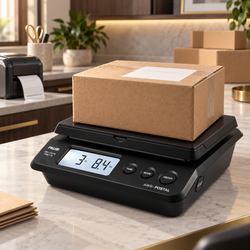
The best precision scale for postal mail should provide consistent measurements across the full range of letters, padded envelopes and packages you send. It needs adequate capacity for the heaviest completed shipment, fine enough resolution for lightweight mail and a platform that supports packages without interfering with the display.
Precision does not simply mean displaying more decimal places. A useful postal scale must combine:
-
Appropriate resolution
-
Reliable repeatability
-
Sufficient capacity
-
Stable readings
-
A practical minimum load
-
Correct calibration
-
Suitable platform dimensions
-
Convenient postal weighing units
-
Tare and hold functions
-
A dependable power source
For most small-business shipping stations, a scale with 25 to 110 pounds of capacity and approximately 0.1-ounce resolution provides a practical combination of range and sensitivity. However, businesses mailing jewelry, cards, samples or other lightweight merchandise may benefit from a smaller scale with finer gram-level measurement.
Understanding which features genuinely affect postal weighing will help you avoid paying for specifications you do not need—or buying a scale that cannot handle your actual packages.
What Makes a Postal Scale “Precise”?
A precise postal scale produces detailed, consistent and repeatable measurements when used under appropriate conditions.
Several specifications contribute to precision:
| Feature | What It Describes | Why It Matters for Mail |
|---|---|---|
| Capacity | Maximum supported load | Determines the heaviest package the scale can weigh |
| Resolution | Smallest displayed increment | Affects how clearly small weight changes appear |
| Accuracy | Closeness to an accepted reference value | Helps determine whether the reported weight is dependable |
| Repeatability | Consistency across repeated measurements | Reduces conflicting package weights |
| Linearity | Performance across the weighing range | Matters when weighing both light and heavy mail |
| Minimum practical load | Smallest load that can be weighed dependably | Important for letters and lightweight products |
| Stabilization time | Time required for the reading to settle | Affects packing-station speed |
| Calibration capability | Ability to check or adjust scale response | Supports continued measurement confidence |
These features should be considered together. A postal scale that displays 0.01 ounce but produces a different result each time is less useful than a 0.1-ounce scale with stable, repeatable performance.
Resolution: The First Feature Shoppers Notice
Resolution is the smallest weight increment displayed by the scale. It may also be called readability or graduation.
Examples include:
-
1 gram
-
0.1 gram
-
0.1 ounce
-
0.01 pound
A lower numerical increment shows smaller changes in weight.
Resolution for Letters and Documents
Letters, cards and document mailers are relatively light. Adding a few pages, an insert or a small promotional item can create a noticeable percentage change in the total weight.
For lightweight mail, look for:
-
Capacity between 500 and 2,000 grams
-
Resolution between 0.1 and 1 gram
-
Gram and ounce modes
-
A platform large enough to support an envelope
-
A stable zero reading
A compact precision scale may be more useful for letters than a high-capacity warehouse scale.
Resolution for Padded Envelopes
Padded mailers often contain:
-
Jewelry
-
Cosmetics
-
Small electronics
-
Accessories
-
Replacement parts
-
Collectibles
-
Craft supplies
-
Clothing
-
Samples
A scale displaying 0.1-ounce increments is generally practical for many of these shipments. It provides useful measurement detail without requiring the controlled environment associated with analytical or laboratory weighing.
Resolution for Boxes
Boxes weighing several pounds usually do not require 0.01-gram resolution. For ordinary parcel shipping, capacity, platform size and repeatability are more valuable than extreme sensitivity.
A medium-capacity scale that reads in 0.1-ounce increments may be a strong option for small and medium packages.
More Decimal Places Do Not Guarantee Better Results
It is easy to assume that the scale showing the most digits is automatically the most accurate. That is not necessarily true.
A scale might display:
2.35 lb
Another might display:
2.347 lb
The second reading contains more detail, but that additional digit is useful only if the scale can measure repeatably at that level.
Performance can still be affected by:
-
Calibration
-
Vibration
-
Uneven surfaces
-
Package movement
-
Weak batteries
-
Temperature
-
Platform contact
-
Electrical interference
-
Manufacturing quality
-
Load placement
Select the resolution your application requires rather than the smallest increment available.
Capacity: Precision Must Cover the Entire Shipment
Capacity is the maximum weight the scale is designed to support.
Your calculation should include the complete shipment:
-
Product
-
Inner packaging
-
Protective material
-
Shipping envelope or box
-
Inserts
-
Printed documents
-
Tape
-
Promotional items
-
Accessories
If the products weigh 20 pounds but the prepared package weighs 23 pounds, a 20-pound scale is not adequate.
Leave Capacity Above Your Typical Maximum
Suppose the heaviest package you currently send weighs 42 pounds. A 50- or 55-pound scale may handle it, but a higher-capacity model could provide more flexibility if order sizes are growing.
The right margin depends on:
-
Normal package variation
-
Seasonal orders
-
Product expansion
-
Multi-item shipments
-
Packaging changes
-
The likelihood of larger future packages
Avoid operating continuously at the scale’s maximum capacity.
Tare Does Not Create Additional Capacity
Tare subtracts a container or tray from the displayed result, but it does not remove that load from the weighing mechanism.
If you place a five-pound container on a 50-pound scale and press tare, only about 45 pounds of physical capacity remain.
This distinction is important whenever products are weighed in reusable:
-
Bins
-
Trays
-
Baskets
-
Shipping totes
-
Product containers
Finding the Right Balance Between Capacity and Resolution
Capacity and resolution often involve a tradeoff. A scale designed for extremely heavy packages may display larger increments than one designed for letters.
| Postal Application | Suggested Capacity | Useful Resolution |
|---|---|---|
| Letters and cards | 500–2,000 g | 0.1–1 g |
| Jewelry and small samples | 500–5,000 g | 0.1 g |
| Padded mailers | 5–25 lb | 0.1 oz |
| Small ecommerce boxes | 25–55 lb | 0.1 oz |
| Subscription boxes | 50–110 lb | 0.1–0.2 oz |
| Heavy commercial packages | 110 lb or more | 0.1–0.2 lb |
These ranges are general starting points. Carrier requirements, package types and shipping software should also guide the final choice.
American Weigh Scales offers dedicated shipping scales with different combinations of capacity, resolution and platform design.
Minimum Load Matters for Lightweight Mail
Maximum capacity receives most of the attention, but the minimum practical load is equally important when mailing light items.
A scale may be capable of holding 110 pounds while performing poorly with an envelope weighing only a few grams. The display might remain at zero, fluctuate or round too coarsely to provide useful information.
Ask:
-
What is the lightest complete mailpiece?
-
How much does a single insert weigh?
-
Must the scale distinguish one small product from two?
-
Does adding a label change the displayed result?
-
Can the scale detect packaging variations?
Test the scale with the actual lightweight products and mailers used in your operation.
For very light shipments, compact pocket scales may provide more useful resolution than a high-capacity package scale. Always confirm that the platform and capacity are suitable for the finished mailpiece.
Repeatability: One Package Should Produce One Consistent Result
Repeatability is the ability of a scale to provide similar readings when the same package is weighed repeatedly under the same conditions.
To test repeatability:
-
Place the scale on a stable, level surface.
-
Turn it on and confirm zero.
-
Center a representative package on the platform.
-
Wait for the reading to stabilize.
-
Record the result.
-
Remove the package.
-
Allow the scale to return to zero.
-
Repeat the test five to ten times.
-
Compare the results.
Minor variation may occur depending on the scale and displayed increment. Large or unpredictable changes indicate that something needs attention.
Possible causes include:
-
An unstable table
-
Package contact with another surface
-
Low batteries
-
Vibration
-
Air movement
-
Temperature changes
-
Platform debris
-
Improper calibration
-
Off-center loading
-
Previous overload damage
A highly repeatable scale makes fulfillment more efficient because employees do not need to weigh the same package several times to decide which number to trust.
Linearity Across the Weighing Range
Linearity describes how well the scale maintains its performance across different points in its capacity range.
A scale may appear accurate when tested with a light reference weight but show increasing error as heavier loads are applied.
For a shipping operation handling a broad variety of packages, verification should include more than one point.
For example, a 50-pound scale might be checked with suitable references near:
-
The lower working range
-
The middle working range
-
The upper working range
The test values should reflect the packages actually being shipped.
If almost every order weighs between two and eight pounds, that range deserves particular attention. If the scale is frequently used near 40 pounds, verification should include a suitable higher load.
Stability and Stabilization Time
A precision postal scale should reach a stable result quickly and hold it long enough for the operator to record the weight.
A slow or fluctuating display can reduce productivity in high-volume fulfillment.
Look for a scale that:
-
Returns to zero consistently
-
Stabilizes quickly
-
Provides a clear stable-weight indication
-
Does not jump between increments unnecessarily
-
Maintains the reading while the package is stationary
Extremely sensitive scales may take longer to stabilize because they respond to smaller environmental changes. This is another reason not to select finer resolution than the application requires.
Platform Size and Load Placement
Platform design is one of the most practical—and frequently overlooked—postal-scale features.
The platform should support your common packages without allowing them to:
-
Tip
-
Rock
-
Slide
-
Touch the table
-
Press against a wall
-
Cover the controls
-
Interfere with the display
A package can be within the scale’s weight capacity but still produce an incorrect result if part of it rests on another surface.
Overhanging Packages
A rigid box may extend beyond the platform if:
-
It remains stable
-
Its weight is centered
-
It does not touch anything else
-
It does not press on the display or buttons
Soft poly mailers and padded envelopes can be more difficult because their edges may droop onto the surrounding table.
A lightweight tray may help support flexible mailers, but remember to tare the tray and include its physical weight when calculating the remaining capacity.
Center the Load
Place packages as close to the platform’s center as possible. Repeatedly placing the same package in different positions can expose corner-load or platform-load-distribution differences.
For efficient daily use, mark a visual center point or train employees to use consistent placement.
Display Placement and Visibility
Large packages frequently cover an integrated display. A precision scale is not useful if the operator must tilt the box to read it.
Helpful display features include:
-
A remote wired display
-
A pull-out display
-
A wall-mountable display
-
Large digits
-
Backlighting
-
An angled screen
-
A long display cable
-
A stable-weight indicator
The display should be readable from the operator’s normal working position.
Why a Hold Function Matters
The hold function keeps a measurement visible after the package is removed or locks the reading after stabilization.
It is particularly useful when:
-
A box blocks the display
-
The operator needs to carry the package to another station
-
Weight is entered manually into software
-
The scale is positioned below a countertop
-
Large packages are difficult to reposition
Some scales offer automatic hold, while others use a button. An adjustable hold mode is useful in workplaces handling multiple package sizes.
Test the feature before relying on it. Confirm when the scale captures the reading, how long it remains displayed and how it is cleared.
Why a Tare Function Matters
Tare resets the displayed weight to zero while a container is on the platform.
Common postal uses include:
-
Weighing loose items in a bin
-
Using a tray for poly mailers
-
Weighing multiple products before boxing
-
Subtracting reusable packaging
-
Preparing product bundles
The typical process is:
-
Place the empty container on the scale.
-
Wait for a stable reading.
-
Press tare.
-
Confirm the display returns to zero.
-
Add the products.
-
Record the net weight.
The final sealed shipment should still be weighed separately because the shipping box, cushioning, inserts and tape contribute to postage weight.
Choose the Right Units and Display Format
A postal scale may offer:
-
Grams
-
Kilograms
-
Ounces
-
Pounds
-
Pounds and ounces
-
Decimal pounds
The selected format must match the data expected by the carrier or shipping software.
Pounds and Ounces Versus Decimal Pounds
These formats are not interchangeable.
For example:
-
2 pounds 8 ounces equals 2.5 decimal pounds.
-
It does not equal 2.8 pounds.
Confusing the formats can create incorrect shipping data.
A good postal scale should make the active unit obvious and reduce the chance that an employee records a number without noticing the measurement format.
Actual Weight and Dimensional Weight
A precision scale measures actual physical weight. It does not automatically determine dimensional weight.
Dimensional weight is based on package volume and an applicable carrier formula. Depending on the shipment, the carrier may use actual or dimensional weight for billing.
UPS provides instructions for measuring packages and calculating dimensional weight in its package dimensions and weight guide.
FedEx similarly explains how package size affects billable weight in its overview of dimensional-weight pricing.
A complete shipping station should therefore include:
-
A precision postal scale
-
Measuring tape or dimensioning equipment
-
Current carrier guidance
-
Shipping software
-
Standard packaging procedures
Accurate actual weight is essential, but it is only one part of determining the appropriate shipping charge.
Postal Verification and Weight Adjustments
Postal carriers may check package information after a shipment enters their network.
USPS explains its process for identifying differences in weight, dimensions and postage through Automated Package Verification.
Potential consequences of incorrect shipment information can include:
-
Postage adjustments
-
Additional charges
-
Delays
-
Package returns
-
Customer-service issues
-
Accounting discrepancies
A precision scale cannot prevent every shipping adjustment because dimensions, service selection and package characteristics also matter. It can, however, reduce errors caused by guessed or inconsistent actual weights.
Calibration Capability
Calibration is the process of establishing or adjusting the scale’s response using a known reference mass.
A postal scale may support:
-
External calibration
-
Internal calibration
-
Factory calibration
-
Model-specific adjustment procedures
Before buying, determine:
-
Whether the scale can be calibrated by the user
-
Which calibration mass is required
-
Whether the weight is included
-
Whether compatible weights are readily available
-
Whether calibration instructions are accessible
-
Whether your quality process requires documentation
Never assume that a random household object provides a reliable calibration reference.
AWS offers purpose-made calibration weights for compatible scales.
Calibration Versus Verification
Calibration and verification are related but different.
Calibration
Calibration establishes or adjusts how the scale converts the load into a displayed value.
Verification
Verification checks the scale with a known reference to determine whether it performs within the required tolerance.
A scale may be verified regularly without being adjusted each time. In fact, unnecessary recalibration can create problems if the wrong reference weight or procedure is used.
Before calibrating an apparently incorrect scale, check:
-
Surface stability
-
Zero setting
-
Battery condition
-
Unit selection
-
Platform cleanliness
-
Package contact
-
Temperature
-
Required calibration value
Consult the applicable model instructions. AWS provides a searchable collection of digital scale manuals for setup, operation and calibration information.
How Often Should a Postal Scale Be Verified?
There is no universal schedule for every fulfillment operation. Verification frequency should reflect:
-
Shipping volume
-
Required accuracy
-
Scale history
-
Frequency of movement
-
Exposure to overloads
-
Environmental conditions
-
Internal quality procedures
-
Customer requirements
-
Applicable regulations
Consider checking the scale:
-
When first installed
-
At the beginning of a high-volume period
-
After moving it
-
After an overload
-
After a drop or impact
-
After a major temperature change
-
When readings become inconsistent
-
At scheduled maintenance intervals
A simple verification log can record:
-
Date
-
Scale model or identification number
-
Reference weight
-
Expected value
-
Displayed value
-
Operator
-
Corrective action
Environmental Features That Protect Precision
Even a good scale can provide poor results in an unsuitable environment.
Level, Stable Surface
Place the scale on a rigid table or packing bench. Avoid flexible folding tables, carpet, soft mats and uneven countertops.
Vibration Control
Keep the scale away from:
-
Conveyors
-
Compressors
-
Vibrating machinery
-
Slamming doors
-
Unstable shelving
-
Printers that shake the work surface
Air Movement
Fans, vents and open windows can affect sensitive letter scales. This is less significant for heavy boxes but can matter when weighing very light mail.
Temperature Stability
A scale moved from a cold vehicle into a warm fulfillment room should be allowed to acclimate before precision measurements are taken.
Clean Platform
Remove:
-
Cardboard dust
-
Tape
-
Labels
-
Packing peanuts
-
Product debris
-
Adhesive residue
Debris lodged around the platform can interfere with free movement.
For more care recommendations, follow the AWS guidance for scale maintenance.
Power Supply and Precision
Stable power supports consistent operation.
Postal scales may use:
-
Disposable batteries
-
Rechargeable batteries
-
AC adapters
-
USB power
-
A combination of power sources
Battery Power
Battery operation is helpful for:
-
Portable shipping stations
-
Craft fairs
-
Shared workspaces
-
Temporary fulfillment areas
-
Backup during outages
AC or USB Power
Continuous power is useful for:
-
Daily ecommerce fulfillment
-
Warehouses
-
Mailrooms
-
Retail backrooms
-
High-volume packing stations
Look for a low-battery warning. If readings become unstable or the display dims, check the power source before assuming that the scale needs calibration.
Auto-Off Controls
Auto-off can conserve battery power, but it may interrupt shipping work if the scale shuts down while an operator is preparing a package.
A useful postal scale may allow auto-off to be:
-
Extended
-
Adjusted
-
Disabled
-
Automatically bypassed while using an adapter
The ideal setting balances energy use with workflow efficiency.
Durability and Overload Protection
Postal scales are exposed to repeated package placement, cardboard debris and occasional impacts.
Useful durability features include:
-
A strong platform
-
Stable feet
-
Overload indication
-
Protected controls
-
Reinforced display connections
-
Easy-to-clean surfaces
-
A design suited to frequent use
Overload protection may reduce the risk of damage, but it does not make it safe to exceed the stated capacity.
Place heavy packages gently instead of dropping them onto the platform. Sudden impact can apply a force much greater than the package’s resting weight.
Portable Precision Scale Versus Dedicated Shipping Scale
Portable Precision Scale
A compact scale may be best when:
-
Most mail weighs only a few ounces
-
The scale must travel
-
Storage space is limited
-
Fine gram measurements are important
-
Products are small
-
Packages fit safely on the platform
Dedicated Shipping Scale
A larger shipping scale may be best when:
-
Boxes are sent daily
-
Shipments vary widely in weight
-
High capacity is required
-
A remote display is useful
-
Continuous power is preferred
-
Employees share the station
Two-Scale System
A business sending both tiny products and heavy packages may need:
-
A small precision scale for letters and lightweight mail
-
A shipping scale for boxes and bulkier orders
This provides suitable resolution at the low end without sacrificing capacity at the high end.
For broader comparisons, see the AWS guide to the best digital scale for postage.
Software Connectivity
Some shipping operations benefit from a scale that sends weight directly to a computer or shipping system.
Potential advantages include:
-
Faster label preparation
-
Less manual data entry
-
Fewer transcription errors
-
More consistent records
-
Easier workstation integration
Before purchasing a connected scale, verify:
-
Operating-system compatibility
-
Shipping-platform compatibility
-
Required drivers
-
Cable type
-
Data format
-
Update support
-
Whether integration requires additional software
Do not assume that a USB port automatically means the scale can transfer live weight to every shipping platform. Some USB connections provide power only.
Legal-for-Trade Considerations
A scale used internally to prepare packages may be subject to different requirements from a scale used to calculate a customer’s charge directly by weight.
NIST explains commercial weighing-device considerations in its weighing and scales FAQs.
If the scale determines a price charged to a customer, check with the appropriate state or local weights-and-measures authority. Do not assume that a scale is approved for commercial transactions simply because it is accurate or marketed for shipping.
Common Precision-Scale Buying Mistakes
Buying Based Only on Resolution
A tiny display increment does not guarantee suitable accuracy, stability or repeatability.
Ignoring the Minimum Load
A high-capacity scale may not respond appropriately to very lightweight letters.
Ignoring the Platform
A box that touches the table or blocks the display can create incorrect readings and inefficient handling.
Choosing Insufficient Capacity
The scale must support the complete package, not just the products.
Assuming Tare Restores Capacity
Tared containers still apply a physical load to the weighing mechanism.
Using the Wrong Unit Format
Decimal pounds and pounds with ounces are different formats.
Ignoring Dimensional Weight
Actual scale weight alone may not determine the billable weight for a large, lightweight package.
Calibrating With an Improvised Object
Coins, canned goods and household items are not dependable substitutes for suitable calibration weights.
Placing the Scale on an Unstable Surface
Even a good scale can fluctuate on a flexible or vibrating table.
Skipping Verification
Regular checks can detect problems before they affect a large batch of shipments.
Precision Postal Scale Buying Checklist
Before selecting a scale, ask:
-
What is the lightest complete mailpiece?
-
What is the heaviest complete package?
-
What resolution does the shipping workflow require?
-
What is the scale’s minimum practical load?
-
Does it produce repeatable readings?
-
How quickly does it stabilize?
-
Will the platform support common boxes?
-
Can flexible mailers touch the table?
-
Will packages block the display?
-
Does the scale include hold?
-
Does it include tare?
-
Which units are available?
-
Does the display clearly identify the active unit?
-
Can auto-off be adjusted?
-
Does it operate on batteries and external power?
-
Can it be calibrated?
-
Are compatible calibration weights available?
-
Can the scale connect to shipping software?
-
Is the connection supported by your platform?
-
Does the intended use require a legal-for-trade device?
Frequently Asked Questions
What is the best precision scale for postal mail?
The best model is one that combines sufficient capacity, useful resolution, repeatability, a suitable minimum load, tare, hold and a platform designed for your packages.
Is 0.1-ounce resolution precise enough for postage?
It is appropriate for many padded mailers and small ecommerce parcels. Very light letters may benefit from finer gram-level resolution.
How much capacity does a postal scale need?
Choose a capacity above the weight of your heaviest completed shipment. Include the product, box, protective material, inserts and tape.
Is resolution the same as accuracy?
No. Resolution is the smallest displayed increment. Accuracy describes how closely a result corresponds to the accepted value.
Why does minimum load matter?
A high-capacity scale may not respond dependably to a very light envelope. The minimum practical load helps determine whether the scale is suitable for lightweight mail.
What does the hold button do?
Hold keeps a stabilized reading visible, which is useful when a large package covers the display.
What does tare do?
Tare subtracts the weight of a tray or container from the displayed result. It does not increase the scale’s physical capacity.
Can a precision scale calculate dimensional weight?
No. A scale measures actual weight. Dimensional weight is calculated from the package’s dimensions using the carrier’s applicable formula.
Why do I get different weights for the same package?
Possible causes include vibration, an uneven surface, weak batteries, package contact, off-center placement, temperature change, debris or calibration problems.
Can I calibrate a postal scale with coins?
Purpose-made calibration weights are the better choice. Coins can vary because of wear, contamination and manufacturing differences.
How often should I check a postal scale?
Verify it according to your operational requirements and after movement, overload, impact or unusual readings. High-volume or critical workflows may need more frequent checks.
Do I need a legal-for-trade postal scale?
Possibly, if the scale directly determines a charge to a customer. Requirements depend on the use and jurisdiction, so consult the appropriate weights-and-measures authority.
Final Thoughts
The best precision scale for postal mail is not automatically the model with the finest displayed increment. It is the scale that provides reliable performance across the full range of shipments your business actually handles.
For most small ecommerce operations, a scale offering 25 to 110 pounds of capacity, approximately 0.1-ounce resolution, tare, hold and a visible display will meet a broad range of shipping needs. Sellers of lightweight products may benefit from a smaller precision scale with gram-level resolution, while businesses sending larger boxes should prioritize platform size, capacity and display placement.
Evaluate capacity and minimum load together. Test repeatability with real packages. Confirm that the display units match your shipping software. Measure package dimensions separately, verify the scale regularly and use the correct calibration procedure.
When resolution, repeatability, capacity and workflow features are properly matched, a precision postal scale becomes more than a convenient accessory. It becomes a dependable part of an efficient shipping process.