
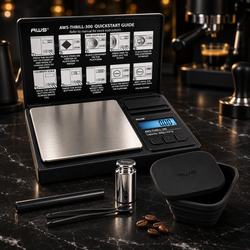
A digital jewelry scale can tell you how much an item weighs, within the capabilities of the instrument and the conditions of measurement. It cannot, by itself, tell you whether a stone is a diamond, whether gold is a particular purity, or whether jewelry matches every detail of a description.
That distinction matters when a convincing number appears on the display. A ring weighing 5.00 grams has a measured gross mass. The number does not reveal how much of that mass belongs to gold, gemstones, solder, or other components. Similarly, a loose stone weighing one carat has a measured mass, not a confirmed identity.
This guide answers a practical question: Can a digital jewelry scale identify a gemstone or determine metal purity? It explains what weighing can establish, how to interpret jewelry units, and how to collect useful measurements without drawing conclusions the evidence cannot support.
What a jewelry scale actually measures
For everyday use, a digital scale reports an indication of mass in the selected unit. Its usefulness depends on capacity, readability, repeatability, calibration, and the weighing environment. The object must also be supported correctly on the platform.
The scale does not directly analyze chemical composition, crystal structure, treatments, or manufacturing history. Different materials can produce the same reading because they can have the same mass.
Think of weighing as one recorded property of an item. It can help organize a collection, reconcile inventory, or check a stated mass. Identifying the material requires additional evidence appropriate to that particular question.
Carat weight and gold karat describe different things
In common United States jewelry terminology, carat describes gemstone mass, while karat describes gold purity. The words sound alike, but they answer different questions. GIA explicitly distinguishes them in its explanation of carat and karat.
A display mode marked “ct” normally means metric carats. Selecting that mode converts the measured mass into a gemstone weight unit. It does not activate a gold purity test.
Before interpreting an unfamiliar abbreviation, consult the AWScales product manuals for the exact model. The display legend and supported units matter more than an assumption based on the appearance of the instrument.
One carat is a mass, not a material certificate
One metric carat equals 0.2 grams. Therefore, a loose object with a mass of 0.40 grams has a mass of two carats. The conversion remains the same regardless of whether the object is a gemstone, glass, or another material.
That arithmetic cannot authenticate the object. Two visually different materials can both weigh two carats. Conversely, two genuine stones of the same species can weigh different amounts because their dimensions differ.
Record the measured result as a mass statement. “Loose green stone, 0.40 grams” is defensible when that is what you measured. A species name or treatment claim requires evidence beyond the number on the display.
A higher carat display does not add information
Changing from grams to carats can make a number look more detailed. It does not improve the underlying measurement. The instrument still uses the same weighing system, with the same practical limitations.
For example, a 0.01 gram display increment corresponds to 0.05 carat. That conversion helps explain why a scale with coarse gram increments may not suit a task requiring small differences in carat weight.
Do not infer an accuracy specification from the number of displayed digits. Choose a scale whose documented performance fits the smallest meaningful difference you need to evaluate, including the conditions under which you will use it.
Gross jewelry weight includes every supported component
A complete necklace, ring, or bracelet is an assembly. Its gross weight includes whatever rests on the platform: metal, stones, clasps, settings, decorative inserts, and attached tags if they remain in place.
The scale cannot separate those contributions electronically. A “gold” description does not cause non-gold components to disappear from the reading. Neither does switching into troy ounces.
Define the measurement before you start. “Complete bracelet without packaging” is clearer than “gold weight.” That wording prevents a legitimate gross measurement from becoming an unsupported statement about the mass of a specific material.
Why tare cannot remove an attached gemstone
Tare subtracts a measured reference load, usually a container. If you place an empty tray on the platform and tare it, the later indication represents the added load relative to that tray.
An attached gemstone is different. Unless its mass is independently known and appropriately accounted for, there is no separate reference value for the scale to subtract. Pressing tare with the complete ring present simply establishes that entire assembly as the new reference.
For general operation and common questions, use the AWScales product FAQ. Treat tare as a weighing function, rather than a way to identify or isolate hidden components.
Gold purity requires a different kind of evidence
Karat expresses a proportion of gold in an alloy. A mass measurement alone supplies no direct measurement of that proportion. A heavy item can have low gold content, and a lighter item can have higher gold content.
GIA's technical discussion of methods for determining gold content describes analytical approaches and their limitations. It illustrates why composition is a separate measurement problem from weighing.
Do not attempt chemical or abrasive tests merely because a scale reading seems unexpected. If purity is the question, seek an appropriate qualified assessment and ask what the chosen method actually establishes about the item.
Conditional calculations need clearly stated assumptions
Suppose a hypothetical, homogeneous metal sample has an independently established mass of 8.00 grams and an independently established gold fraction of 75 percent. Multiplication gives a nominal gold mass of 6.00 grams.
The calculation works because both inputs are supplied. The scale provides the sample mass; it does not establish the fraction. If the fraction is assumed, the calculated gold mass remains conditional on that assumption.
A complete ring with stones or mixed components does not automatically meet this simple example. Avoid applying a single purity fraction to gross jewelry mass unless the composition and relevant component masses justify doing so.
Troy ounces and ordinary ounces must stay distinct
A troy ounce and an ordinary avoirdupois ounce are different mass units. Their names overlap, but substituting one for the other produces a substantial conversion error.
NIST provides precious metals conversion information for checking relevant unit relationships. Use an explicit unit name in records instead of relying on the word “ounce” alone.
When comparing measurements, convert both to the same clearly identified unit, such as grams. Check the original unit before investigating calibration. A correct reading in one unit can appear inconsistent when compared with a figure expressed in another.
A matching mass supports only a limited conclusion
An item matching a stated mass is consistent with that particular statement, within the measurement's limitations. It does not confirm all other statements about the item.
Consider two objects that both weigh 10.00 grams. Their matching indications do not demonstrate matching material, construction, origin, or condition. Many combinations of volume and composition can produce the same mass.
Use careful language: “The measured mass agrees with the recorded mass under these conditions.” Avoid turning that observation into “The item is authentic.” The broader conclusion requires evidence that directly addresses identity.
A mismatching mass needs investigation, too
A discrepancy can arise from the wrong unit, different packaging, attached components, rounding, a transcription mistake, or a scale problem. It can also reflect a real difference between the objects being compared.
Begin with those measurable possibilities. Confirm whether both figures describe a loose stone, a mounted piece, or a packaged item. Check that the reference describes the exact item rather than a similar product.
A discrepancy alone does not establish its cause. Record what differs and how you measured it. That approach supports a productive follow-up without attributing the difference to material identity or someone's intentions prematurely.
Gemstone identification uses additional observations
A gemstone's identity involves properties that a standalone mass reading cannot capture. GIA explains that its colored stone identification process combines weighing and measurement with further examination.
For an owner, the practical lesson is straightforward: a useful weight record can accompany an identification process, but it cannot replace that process. A scale result should remain one field in a larger description.
Do not assume that buying a finer scale will resolve an identity question. Better mass measurement answers a mass question more effectively. Material identification still requires the relevant observations and expertise.
Mounted stones cannot be weighed individually in place
When a stone remains attached to a setting, placing the jewelry on a scale measures the assembly. The instrument has no separate access to the stone's contribution.
A specialist may estimate mounted stone weight from dimensions and other information, but an estimate is different from directly weighing the loose stone. Keep those descriptions separate in records.
Do not remove a stone yourself simply to obtain a weight. If a direct loose-stone measurement is necessary, discuss handling and removal with an appropriate professional. Avoid creating damage to answer a question that may have another suitable route.
Read reports without confusing their fields
A report can list weight, measurements, identification, and treatment information in separate fields. Those fields describe different observations and conclusions; one should not be used as a substitute for another.
GIA's guide to reading an identification report shows this separation. A recorded carat weight appears alongside, rather than in place of, identification information.
When comparing your reading with a document, first match the item description and measurement context. A loose stone's reported mass cannot be compared directly with the gross weight of a ring containing that stone.
Density needs more than a scale reading
Density relates mass to volume. A scale supplies the mass input, but it does not independently establish volume. A heavy object is not necessarily denser than a lighter object because their sizes may differ.
Improvised volume measurements can introduce additional difficulties, especially with small, hollow, porous, assembled, or mounted items. Uncertainty in either input affects the calculated density.
Even a useful density result may not uniquely identify a material. Avoid treating a household density experiment as a definitive authenticity or purity test. For sensitive jewelry, choose an assessment method compatible with the item's materials and construction.
Start with a suitable instrument
Select a scale for the actual mass range and required discrimination. A tray plus jewelry must fit within capacity, and the display increment must be appropriate for the difference you need to observe.
Explore AWScales pocket scales by their individual specifications. A portable format describes convenience; it does not guarantee suitability for every gemstone or jewelry task.
A scale that works well for complete bracelets may not resolve differences between very small loose stones adequately. Define the intended measurement first, then compare documented specifications rather than selecting solely by the number of decimal places advertised.
Prepare the platform and surrounding area
Use a firm, stable surface away from obvious vibration and airflow. Allow the instrument and item to reach suitable conditions according to the model's instructions. Avoid weighing immediately after a major temperature change.
Keep the platform clean and confirm that the cover, tray, or surrounding objects do not touch it. A chain draped onto the table can transfer part of the load away from the weighing system.
Follow the AWScales scale maintenance guidance for general care and the model manual for specific instructions. Never let cleaning liquid enter the scale or improvise a cleaning method for delicate jewelry.
Use a container without hiding the load
A small, clean weighing container can keep loose stones together and prevent rolling. It should sit fully supported on the platform without contacting the housing or nearby surfaces.
Weigh or tare the empty container as appropriate, then add the item gently. Remember that taring changes the displayed reference but does not increase the instrument's physical capacity. The combined load still matters.
Keep packaging separate unless packaged mass is the intended result. An extra bag, foam insert, or label can be a meaningful fraction of the total when the item itself is very small.
Check the scale with an appropriate reference
An unknown ring or stone is not a calibration reference merely because it has a familiar description. Use a suitable reference weight and follow the manufacturer's checking or calibration procedure.
NIST's work on calibration of mass standards explains the role of reference mass measurements. For routine users, the practical point is to distinguish an independently characterized reference from an object whose mass is only assumed.
A satisfactory reference check supports confidence in weighing performance under the checked conditions. It does not verify jewelry composition. Keep the instrument check and material assessment as separate records with separate purposes.
Repeat measurements consistently
Place the item near the platform's center, release it completely, and wait for a stable indication according to the instrument's operation. Record the unit with the reading.
Remove the item and repeat the placement a few times under the same conditions. Note the spread instead of retaining only the result closest to the number you expected.
Repeatability is useful evidence about consistency. It cannot reveal a shared error in every reading or establish material identity. If readings vary enough to affect your intended conclusion, improve the setup or obtain a more suitable measurement before proceeding.
Keep a record another person can interpret
A useful entry includes item identification, whether it was loose or mounted, components included, container treatment, unit, scale model, and observed readings. Add the date and any relevant reference check.
Photographs can connect the record to the item, especially when several pieces look similar. Keep photographs and descriptions organized so measurements are not inadvertently assigned to the wrong object.
For additional weighing explanations, consult the AWScales knowledge center. A clear measurement record is more useful than a longer string of digits with no explanation of what was actually on the platform.
Example: a ring and its center stone
Imagine a ring weighing 4.62 grams. A document separately describes a center stone as 0.80 carat. Converting the stated stone mass gives 0.16 grams.
Subtracting that figure from the ring's gross mass gives 4.46 grams mathematically. However, that remainder is not automatically pure gold or even exclusively one alloy. Other stones, solder, inserts, or components may remain.
The calculation also depends on the document matching the same stone and the measurements being fit for the comparison. Label the remainder as conditional arithmetic, rather than presenting it as a directly measured metal mass.
Example: two loose stones with the same reading
Two loose stones each display 1.00 carat on the same instrument. That observation supports equal indicated mass at the scale's displayed resolution under those conditions.
The stones may still differ in dimensions, species, treatment, or origin. Their similarity in mass does not settle any of those questions. Nor does a visible size difference necessarily mean the scale is malfunctioning.
Record the equal readings and keep identity questions open until relevant evidence is available. The scale has supplied a useful comparison, but the comparison has a narrower meaning than a complete gemstone assessment.
Avoid rounding away an important distinction
Keep original observations before converting or rounding them for a summary. If two small items appear equal after rounding, that does not mean the underlying measurements established exact equality.
Use the same recording convention throughout an inventory. Include the unit on every entry, and distinguish a directly observed reading from a converted value or a figure copied from a document.
When a difference matters, decide whether the weighing method can resolve it reliably before interpreting the result. A tiny numerical difference may be smaller than the practical variability of your setup. Reporting it confidently can make the record less informative, even when the arithmetic is correct.
When support can help
Contact scale support when you need help identifying a unit, finding the correct manual, interpreting inconsistent readings, or checking whether the instrument suits a particular weighing task.
Provide the model number, displayed unit, approximate load, container arrangement, power condition, and results from any appropriate reference check. Explain the observable behavior rather than asking support to infer it from the jewelry description.
Use AWScales customer support for instrument questions. For gemstone identity or metal composition, direct the question to a qualified specialist with the appropriate analytical capability.
Frequently asked questions
Does ct mode test whether gold is real?
No. The ct setting expresses mass in carats. It does not measure gold content or distinguish gold from other materials. Check the model manual if the unit abbreviation is unclear.
Can a scale prove that a stone is a diamond?
No. A mass reading alone cannot establish gemstone identity. It can document the mass of a loose stone, but identification requires additional evidence.
Can I weigh the gold in a ring without separating its parts?
A scale directly measures the complete supported assembly. Estimating a component requires reliable additional information and clearly stated assumptions. The gross reading does not isolate gold.
Will a more precise scale determine purity?
No. Better weighing performance may improve a mass result, but purity remains a composition question. More display digits cannot replace an appropriate analytical method.
Why does the same item show different numbers in grams and carats?
The units represent different quantities of mass per unit. One metric carat equals 0.2 grams, so the numerical carat value is five times the gram value before display rounding.
Use the measurement for the question it answers
A jewelry scale can provide valuable mass information when the instrument, setup, and record suit the task. Keep the item description, unit, included components, and observed consistency attached to every result.
Use those measurements to compare like with like, organize items, and identify discrepancies that need further investigation. Keep composition, identity, treatment, and component estimates clearly distinguished from direct weighing.
The useful next step follows the unanswered question. Improve the weighing procedure when mass is uncertain. Obtain appropriate specialist evidence when identity or purity is uncertain. A well-recorded number becomes more useful when its meaning stays precise.