
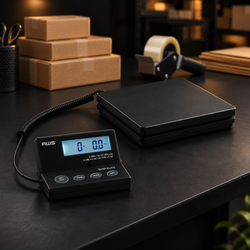
A digital scale works most simply when the load rests quietly and remains fully supported on the platform. A moving object creates a different situation. A small animal shifting position, liquid sloshing in a container, or an unstable package can produce changing indications even though the amount of material has not changed.
The practical question is: Can a digital scale weigh a moving load accurately, and should you trust its hold reading? The answer depends on whether the instrument supports the application, how its hold or averaging feature operates, and whether the load remains correctly supported throughout the measurement.
A frozen number is a recorded result, not independent proof of a good measurement. Understanding how the scale obtained that number helps you distinguish a useful dynamic result from a captured disturbance.
Why movement changes the displayed number
A scale responds to forces transmitted through its weighing system. Movement can change those forces temporarily as an object accelerates, settles, or shifts against its container.
The object does not need to gain or lose material for the indication to fluctuate. A fixed amount of liquid can create changing platform forces while it moves inside a vessel.
For a stationary mass measurement, the simplest approach is usually to allow motion to subside. When motion is unavoidable, the instrument and procedure must be appropriate for that condition. Ordinary static weighing and supported dynamic weighing should not be treated as interchangeable methods.
Decide whether the movement is temporary or unavoidable
A jar of liquid may become sufficiently still after being placed gently on the platform. A rounded object may stop rolling when supported by an appropriate container.
A live load may continue moving. In that case, waiting for a completely motionless display may not be a realistic measurement procedure, and repeatedly selecting a convenient number can introduce bias.
Identify the type of movement before choosing a solution. Remove avoidable movement through a suitable setup. For unavoidable movement, establish whether the scale has a documented function intended for that application and whether its capabilities meet the measurement requirement.
Confirm the exact model's capabilities
Look for an explicit description of hold, dynamic weighing, animal weighing, averaging, or another relevant feature in the instructions. Do not infer the function from a button label alone.
Use the AWScales product manuals to find the instructions for the exact model. Similar instruments may use different trigger conditions, display symbols, and release procedures.
A scale without a documented dynamic function should not be assumed to perform one because its display occasionally stops changing. Establish what the instrument supports before relying on the result for a moving-load workflow.
Hold can mean different things
Some hold functions retain a reading after the load is removed. Others capture a value once a stability condition is satisfied. Some instruments calculate an average and then hold that calculated result.
These behaviors answer different practical needs. Retaining a display makes a number easier to read; averaging processes multiple observations. Neither function should be interpreted without the model's definition.
The A&D GX-AE and related series manual provides a concrete example of distinct average-hold and hold-when-stable modes for supported versions. Its settings and thresholds belong to those models rather than every scale with a hold indicator.
Dynamic weighing commonly uses a defined interval
A supported dynamic function may calculate a representative result from readings collected over a specified period. Its start condition and treatment of movement are part of the method.
The Mettler Toledo PG-S operating instructions describe dynamic weighing over a preset interval, with automatic and manual start options. This illustrates a documented implementation rather than a universal rule.
Read the timing and operating requirements for your own instrument. A number produced by one dynamic mode cannot automatically be interpreted as equivalent to a snapshot from an ordinary weighing display.
Averaging cannot remove every disturbance
Averaging may reduce the influence of certain fluctuations, but it does not guarantee that all influences cancel. A persistent external force can remain throughout the entire collection period.
If a container touches the table, part of the load may bypass the platform during every reading. An average of those readings does not reconstruct the missing support force automatically.
Similarly, a hand pressing on a container creates a force the instrument may include. The first requirement is a correct mechanical arrangement. Signal processing cannot replace proper support and clearance.
Longer averaging is not automatically better
A longer collection interval includes more time, but it may also include more changes in position, contact, or sample condition. The result must still represent the intended load under the intended conditions.
There is no universal averaging duration suitable for every moving object. Use the manufacturer's supported settings and an appropriate assessment of the actual application.
Do not keep extending the interval until a preferred number appears. Define a consistent method, check whether it produces useful results, and document the settings used. A reproducible procedure makes comparisons more meaningful than an improvised interval selected separately for each measurement.
A hold result may describe an earlier moment
After a value is captured, the display may stop updating even if the load changes. Adding an object, removing part of the contents, or shifting the arrangement may leave the held number unchanged.
That behavior can be normal for the mode. It becomes a problem when the operator mistakes a retained result for a live indication.
Learn the hold symbol and release sequence. Before beginning another measurement, confirm that the instrument has returned to the required state. A visible number should always be associated with a specific measurement event and item.
Capacity includes the container and every supported item
A tared basket or vessel still contributes to the physical load. The scale must accommodate the combined mass of the container, contents, and any included accessories.
Movement can also create forces beyond those associated with a gently placed stationary object. Follow the instrument's application and loading instructions rather than planning to operate close to an unknown limit.
Select capacity with the complete arrangement in mind. A displayed zero after tare does not provide additional physical capacity. If the application requires specialized equipment, a smaller general-purpose scale is not made suitable by changing display modes.
Choose a platform that supports the whole arrangement
A suitable platform must support the container securely without contact with the housing or nearby surfaces. An oversized vessel can bridge across objects or shift into contact during movement.
Inspect clearance with the empty container and consider how its position might change when loaded. A container that barely clears the housing while empty may not provide a dependable arrangement.
When reviewing AWScales pocket scales, use individual specifications and intended applications. A portable format does not establish suitability for a moving or live load, even if the total mass appears to fit within capacity.
Use a container appropriate to the task
For nonliving objects, a stable vessel can prevent rolling or spilling and make the load easier to place consistently. It must remain fully supported and should not distort or rock during use.
For live loads, use equipment and an established handling procedure appropriate to the species and task. A weighing function alone does not establish that a general-purpose container or instrument is appropriate.
Do not improvise restraints to obtain a steadier number. If the available arrangement cannot support the task properly, change the equipment or obtain suitable assistance rather than forcing the measurement.
Tare the complete empty arrangement
Prepare the container and any fixed liner or accessory that will remain present during weighing. Establish tare according to the manual before adding the load.
If you later add or remove an accessory, the reference no longer describes the same arrangement. A liner, lid, or support item can be significant relative to a small sample.
For general operating questions, consult the AWScales product FAQ. Keep a clear distinction between gross load, container mass, and the intended net result, especially when the display holds values between measurements.
Keep hands and outside support clear
Touching a container can add force or support part of its weight. The reading may change even when the touch appears gentle.
Wait until hands and unrelated objects are clear before starting a supported measurement cycle. Do not record a value while someone is partly supporting the load.
If the task cannot be performed without outside contact, an ordinary platform measurement may not answer the intended question. The procedure needs to account for that contact through an appropriate method, rather than assuming the scale can distinguish helpful support from sample weight.
Separate load motion from a moving table
A dynamic mode intended for an unstable sample does not eliminate every installation problem. A vibrating support surface can affect both the sample and the instrument.
Shimadzu's balance installation guidance addresses factors such as airflow, temperature changes, and proper leveling. These conditions still matter when a sample has its own movement.
Start with a suitable support location. Avoid diagnosing a moving-load problem while the table itself rocks or receives repeated impacts. Improving the installation makes the remaining sample behavior easier to assess.
Let liquids settle when the task permits
For a liquid that does not need to remain in motion, place the container gently and allow visible sloshing to diminish. Keep the vessel clear of other surfaces.
A dynamic mode is not necessarily required just because a reading fluctuates briefly after placement. The appropriate procedure may simply involve a normal settling period consistent with the instrument and sample.
Do not impose an arbitrary waiting time on every liquid. Container shape, filling level, viscosity, and measurement requirements differ. Observe the actual conditions and use a method that produces an interpretable stationary result when possible.
Rolling objects need support rather than lucky timing
A rounded item may cross the platform or change contact position. Capturing the lowest, highest, or most familiar indication does not establish its mass reliably.
Use a suitable container or support that prevents uncontrolled rolling without contacting anything outside the platform. Include that support in the tare arrangement.
The aim is to create a straightforward static measurement where practical. A stable support can remove the need for dynamic processing and simplify repeatability checks. Keep the complete arrangement within the instrument's documented limits.
Start by checking a stationary reference
Before investigating a moving load, establish whether the scale performs suitably with an appropriate stationary reference. Use the manufacturer's checking procedure and a suitable characterized weight.
NIST's work on calibration of mass standards explains the role of supported reference mass information. An everyday object with an assumed mass is not equivalent to an appropriate reference.
A satisfactory stationary check supports confidence in that part of the system. It does not independently validate the moving-load method. Keep instrument performance and application performance as separate questions.
Assess the complete method under actual conditions
Once the instrument passes appropriate checks, evaluate the intended container, operating mode, start procedure, and representative load conditions. The useful question is whether that complete method meets the task's requirements.
Mettler Toledo's guidance on routine testing of balances discusses testing between calibrations to detect performance problems. Application-specific assessment adds information beyond a single reference reading.
Avoid treating a successful calibration message as approval for any dynamic application. The actual procedure can introduce influences that were absent during calibration or a simple stationary check.
Repeat measurements using the same procedure
A useful repeatability comparison keeps the method as consistent as practical. Use the same container, mode, units, start conditions, and placement procedure over a short period.
NIST's measurement terminology defines repeatability in terms of successive measurements under the same conditions. That distinction helps explain why changing the setup between attempts complicates interpretation.
For live loads, follow the established procedure and avoid unnecessary repetition for the sake of collecting more numbers. If repeated measurements are appropriate, record the spread rather than retaining only the result closest to an expectation.
Do not select only the convenient result
A fluctuating display may show several plausible values. Choosing the number that matches a previous measurement or expected trend creates a biased record.
Use a defined capture procedure instead. That may mean a supported dynamic cycle, a stationary reading after settling, or another validated method appropriate to the task.
If the procedure fails to produce an acceptable result, record the failure and investigate it. An honest indication that the method was unsuitable is more useful than a precise-looking number chosen from an uncontrolled sequence.
Example of a sloshing container
Imagine a capped vessel containing a fixed amount of water. Immediately after placement, the display changes as the water moves inside. After the motion subsides, the readings become more consistent.
The changing indications do not necessarily indicate a changing water mass or a calibration fault. The load was temporarily dynamic.
For a task requiring the vessel's stationary mass, allow it to settle and use the ordinary procedure. Keep the vessel closed where appropriate to the task and avoid introducing new changes while comparing readings.
Example of a held result after removal
Imagine an instrument displaying a held result after the load has been removed. The number remains visible long enough to copy into a record.
That retained number may be exactly what the feature is intended to provide. It should be recorded as the result of the completed cycle, rather than interpreted as a current load indication.
Before placing the next item, release or reset the mode as instructed. Confirm that the next captured value belongs to the next item. This prevents a normal convenience feature from creating an incorrect measurement record.
Example of a container touching the table
Imagine a container partly supported by the platform but also touching an adjacent object. A moving load shifts within it, changing how much force passes through each support.
The resulting fluctuations combine motion with an unintended support path. Dynamic averaging cannot be assumed to separate those effects.
Correct the container arrangement before continuing. If the container cannot fit with adequate clearance, use equipment with an appropriate platform. A larger display or a longer hold interval does not solve a mechanical support problem.
Keep comparisons between sessions meaningful
If you monitor an item over time, use a consistent procedure whenever practical. Changing the container, scale, mode, or capture interval can make a later result different for reasons unrelated to the item's mass.
Record necessary changes rather than hiding them. When a new instrument or method is introduced, establish how its results should be interpreted before combining them with the earlier series.
Avoid treating every small difference as a real change. Consider the observed variability and the capabilities of the measurement method. A trend becomes useful when the differences are meaningful relative to those limitations, rather than merely visible in the final displayed digit.
Record settings along with the result
A useful record includes the item identifier, date, unit, scale model, container, tare condition, and operating mode. Include the relevant averaging or capture setting when the instrument exposes it.
Note whether the result was a stationary indication, an automatically captured value, or a calculated dynamic result. Those distinctions help explain differences between sessions.
Additional explanations in the AWScales knowledge center can help clarify weighing terminology. Keep records detailed enough that another person can understand what the number represents without reconstructing the procedure from memory.
Clean the weighing area without changing its support
Spills and debris can interfere with platform clearance or cause containers to sit differently. Check the area before preparing the next measurement.
Follow AWScales scale maintenance guidance and the model's instructions. Use a cleaning method compatible with the instrument, container, and application.
After cleaning, confirm normal installation and an unobstructed platform. If a liner or accessory is replaced, establish the appropriate new tare reference. A clean setup should also be mechanically consistent with the procedure used for previous measurements.
Ask support about the application and the symptom
Provide the model, approximate combined load, container dimensions, mode, selected unit, and observed behavior. Explain whether a stationary reference behaves normally.
State whether the display fluctuates continuously, never completes a cycle, holds an old value, or disagrees between repeated completed cycles. Each observation suggests a different question to investigate.
Contact AWScales customer support for model-specific capabilities and troubleshooting. Ask whether the instrument is intended for the application before seeking a setting that might make an unsuitable arrangement appear to work.
Frequently asked questions
Does hold mean the scale averaged the reading?
Not necessarily. Hold can retain a snapshot, capture a stable value, or display a calculated average, depending on the model. Read the exact function description.
Can an ordinary scale weigh a moving animal?
Do not assume suitability from capacity alone. The instrument, platform, container, handling procedure, and supported weighing mode all need to fit the application.
Is the lowest reading the correct one?
No. Selecting a low value from a fluctuating sequence is not a defined measurement method. Use a suitable procedure with consistent capture conditions.
Will a longer average remove container contact errors?
No. Persistent outside support or pressure can affect the entire collection period. Correct the mechanical arrangement before assessing the processed result.
Why is the number unchanged after the load moves?
A hold mode may have stopped updating the display. Confirm whether the value is live or retained and follow the instructions for beginning a new cycle.
Match the method to the motion
Moving-load weighing requires more than a readable display. Establish what moves, whether that movement can be removed, and whether the instrument supports the remaining conditions.
Use a fully supported container, the correct tare reference, and a documented capture procedure. Check stationary performance separately, then assess whether the complete method produces results suitable for the task.
A hold or averaging feature can make certain measurements practical when used as intended. Its value comes from a correct, consistent procedure and a clear record of how the result was obtained.