
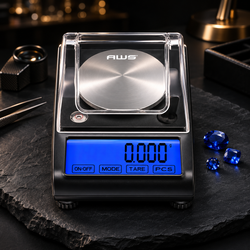
You add a silicone mat to protect the platform, use an extra tray to hold small parts, or place a lightweight liner beneath a bowl. The arrangement feels more convenient, but the displayed weight changes. Does the accessory affect accuracy, or should tare remove its influence completely?
The practical question is: Can a protective mat or extra tray affect a digital scale's accuracy?
A suitable accessory can be part of a reliable method, but its mass, fit, flexibility, cleanliness, temperature, and contact with surrounding surfaces matter. Tare can subtract an appropriate baseline indication; it does not remove physical load or correct every force introduced by an unsuitable arrangement.
Begin with the exact model's directions in the AWS product manuals. Identify which components are supplied, optional, or approved, and how they should be installed. Do not assume every mat, cover, or tray with similar dimensions is compatible.
Distinguish a platform accessory from a support mat
A mat placed on top of the weighing platform becomes part of the applied load. A mat beneath the entire instrument changes its support.
These arrangements can affect measurement differently. A platform liner can consume capacity or touch the housing, while soft support beneath the scale can compress unevenly or interfere with its feet.
Describe the location precisely before troubleshooting. “The scale has a mat” leaves the most important distinction unresolved. Follow the model's requirements for both the load arrangement and supporting surface rather than assuming one instruction covers both.
An accessory's mass remains physically present
Zeroing or taring can change the displayed baseline, but the accessory still loads the mechanism. Its mass must be included when assessing total capacity.
METTLER TOLEDO's precision balance guidance explicitly notes that protective covers or other material on the pan still count toward the physical load limit.
Do not treat a zero net display as an empty platform. Include the mat, tray, vessel, contents, and other supported components. A convenient accessory can reduce the remaining usable capacity even when its own mass is not visible in the net indication.
Tare subtracts a baseline rather than every influence
A suitable tray can be tared so the display represents contents added afterward. That operation depends on the tray and arrangement remaining adequately unchanged.
If the liner shifts, gains moisture, touches the housing, or is removed after taring, the baseline may no longer describe the current setup.
The AWS product FAQ explains common tare operation. Follow the exact model's sequence and keep net and gross quantities clear. Do not assume that pressing tare makes an accessory mechanically irrelevant.
A supplied accessory still needs correct installation
A component supplied for a particular model has an intended orientation and use. It can still be misplaced, folded, or seated incorrectly.
Check the manual and inspect clearance around the platform. Confirm whether an accessory is intended for weighing, storage, transport, or another purpose.
A protective cover may look like a convenient tray without being documented for loaded use. Do not reverse or repurpose a component solely because it fits physically. Correct installation is part of using the accessory as intended.
Similar appearance does not establish compatibility
Two trays can have similar dimensions while differing in rigidity, shape, contact points, mass, and material. Those differences can affect the arrangement.
A third-party mat may overhang or grip a raised edge differently from the intended component. A replacement cover may not preserve the same clearance.
Ask the manufacturer when compatibility is unclear. A product listing that says an accessory fits a general size does not independently establish its suitability for the model's measuring mechanism, operating limits, or required tolerance.
Contact with the housing can divert force
A mat that bridges the platform and housing can transfer part of the load outside the intended path. A tray can also rub against an edge or rest partly on the counter.
The resulting indication may change with load, position, or movement. A stable screen does not establish that the contact is harmless.
Inspect the full arrangement before and after loading. Flexible material can sag as contents are added, creating contact that was absent when empty. Correct the arrangement rather than trying to compensate through sensitivity adjustment.
Flexibility can change how the vessel sits
A soft surface can compress, tilt a narrow vessel, or allow a container to move. A rigid tray can distribute contact differently from the original platform.
These effects do not mean every flexible accessory is unsuitable. They mean its intended design and actual behavior matter.
Use a vessel that remains secure and fully supported under the approved method. Do not hold it upright while recording, because the hand adds another force. If the task requires an arrangement the accessory cannot support reliably, choose a more suitable vessel or instrument.
An enlarged tray does not enlarge every capability
An expansion tray can provide useful space where the model supports it. It does not automatically increase capacity, eliminate off-center effects, or validate every oversized object.
METTLER TOLEDO's weighing pan information illustrates that pans and loading accessories are designed around particular applications.
For your instrument, follow the actual accessory instructions. Keep the load secure and within limits. Do not use a larger surface as permission to balance a vessel that touches surrounding objects or applies unsuitable forces.
Center of load can change with the accessory
A tray may encourage placing objects farther from the platform's center. A bowl can also shift as a mat deforms or grips unevenly.
Consistent central placement helps make routine observations more comparable. If varied placement is part of the task, the method needs appropriate assessment.
Do not evaluate only the accessory's empty reading and assume every loaded position behaves equally. A suitable reference placed centrally answers a narrower question than a large vessel spread across the expanded surface.
Added surface area can interact with airflow
A broad lightweight tray or liner can present more area to moving air than a compact reference. Vents, fans, doors, and nearby activity may affect the arrangement.
A material that overhangs can also move visibly or transmit changing forces while the intended contents remain still.
Choose a suitable calm location and use approved draft protection where provided. Do not press down on the liner to stop movement while recording. The final observation should represent the intended load without a hand stabilizing the setup.
Static can be introduced by materials and handling
Plastic and other surfaces can carry electrical charge. Rubbing, wiping, or handling an accessory can change its electrical state.
Shimadzu's guidance on sample-related weighing influences discusses static and other effects on compatible balances. Its remedies depend on the instrument and application.
Do not assume that an accessory is electrostatically suitable because it is lightweight or transparent. Use compatible materials and approved methods. Avoid spraying the instrument or attaching improvised electrical connections to address an unconfirmed problem.
Temperature matters even with a protective layer
A mat does not automatically make a platform suitable for hot cookware or extreme temperatures. Heat can still affect the instrument and surrounding air.
A recently washed tray can also be warmer or colder than the weighing environment. Thermal changes can complicate comparisons before and after installation.
Follow the model's temperature and material limits. Do not infer heat resistance from a silicone label or a kitchen use elsewhere. The complete instrument, accessory, and task must be compatible, not merely the exposed surface.
Moisture can change the accessory's load
A damp liner, condensation, or trapped liquid can add mass. Evaporation then changes the baseline over time.
If the accessory was tared while wet, later drying can create a negative or shifting net indication even without a change in contents.
Prepare components in the condition required by the method and manual. Keep cleaning, drying, and taring sequences consistent. Do not treat a changing accessory as a fixed subtraction simply because it initially produced zero.
Residue can remain hidden underneath
A mat can conceal crumbs, powder, or sticky liquid near the platform. A clean top surface does not establish a clean loading arrangement.
A&D's electronic balance cleaning guidance emphasizes keeping residue and cleaning liquid out of internal gaps. Its component-removal instructions apply only to compatible designs.
Follow AWS maintenance guidance and the exact manual. Remove only user-removable parts, avoid forcing the platform, and reassemble correctly. If contamination cannot be addressed through approved access, seek manufacturer advice.
Adhesive and improvised attachment can change movement
Tape, glue, clips, or tight wrapping can bind a mat to surrounding surfaces or constrain a platform. An attachment intended to prevent slipping may introduce an unintended force path.
Do not modify the mechanism or attach material where the manufacturer has not approved it. A secure-looking arrangement is not automatically a valid weighing setup.
Use accessories according to their instructions. If the task needs a fixture or special holder, ask about a suitable solution rather than improvising an attachment that changes the instrument's intended motion or loading.
Startup should use the prescribed arrangement
An accessory present at startup may be treated according to the model's initial reference rules. Removing it later can produce a confusing indication.
Other models may require a particular component to remain installed or a different sequence for adding a vessel. Do not assume all instruments handle initial loads the same way.
Follow the exact manual and record whether the accessory was present when zero or tare was established. A changed startup baseline is different from an accuracy fault. Resolve operating interpretation before adjusting the scale.
Compare the actual arrangement with suitable evidence
If the accessory is approved, assess the task under a controlled method. Keep the instrument, location, reference, units, preparation, and intended load sequence consistent.
Changing the tray, vessel, surface, settings, and reference together makes the comparison difficult to interpret. Where practical, change one intended factor at a time.
Record what stayed the same and what changed. A clearer comparison can show whether the final arrangement meets the task without claiming that one accessory alone caused every difference observed during the investigation.
Use an adequately known reference
A suitable reference helps assess indication agreement. An arbitrary object can reveal a difference but cannot establish accuracy if its actual mass is uncertain.
The NIST mass standards program describes formal mass calibration. Reference value, condition, and uncertainty should support the intended decision.
Use the prescribed reference for adjustment. Do not adjust the scale to make an unknown object agree before and after adding a mat. A successful reference observation supports the aspect tested, while vessel fit and task behavior still need attention.
Follow a controlled accessory check
Use any required procedure first. For ordinary suitable applications, this framework organizes the relevant observations:
-
Identify the model and approved accessory.
-
Confirm the intended vessel, load range, and required tolerance.
-
Inspect the platform, accessory, and accessible clearance.
-
Prepare the instrument on suitable support.
-
Install the accessory according to its instructions.
-
Establish the prescribed baseline and confirm units and mode.
-
Apply a suitable reference centrally within capacity.
-
Record settled observations and unloaded return.
-
Assess the actual vessel arrangement through an appropriate method.
-
Preserve the sequence and evaluate the requirement.
This framework is not a universal calibration procedure or permission to use undocumented accessories. Its purpose is a clear assessment within the instrument's intended operation.
Record behavior beyond a single settled value
Useful observations include repeated readings, position changes, settling, drift, and contact appearing as the load increases.
Do not keep only the trial that matches the expected number. A short video can help show intermittent rubbing or movement if the complete arrangement remains visible.
Preserve the original values and conditions. If the method changes during the investigation, distinguish earlier and later configurations. An average across unlike setups can conceal the very difference the comparison was intended to examine.
A hypothetical example needs cautious interpretation
Suppose a suitable reference repeatedly indicates 50.00 g in a correct arrangement. With an unapproved liner overhanging the platform, readings vary between 49.94 g and 50.03 g.
That pattern warrants investigating contact, movement, static, support, and other changes. It does not establish that all liners create the same error or that the instrument is damaged.
These values are not an AWS specification. Restore the approved arrangement and follow appropriate verification. Do not calibrate around the questionable liner to force one selected observation to match.
A stable reading can still include a problem
An accessory touching the housing can settle into a consistent but unsuitable state. The resulting indication may look calm.
Do not treat stability as a complete compatibility check. It describes recent measurement behavior under the instrument's criteria, not independent correctness of the physical setup.
Inspect clearance and compare with adequate references and task requirements. A protective accessory should preserve the intended load path rather than merely reduce visible movement on the screen.
Adjustment does not remove mechanical interference
A user adjustment addresses the instrument relationship specified by the manufacturer. It cannot reliably correct a shifting liner, rubbing tray, or changing moisture.
Correct the arrangement first. If approved adjustment is required, use the prescribed reference and preparation, then verify appropriately.
Repeated adjustment with an unsuitable accessory can distort otherwise acceptable measurements. If controlled checks remain questionable after restoring normal conditions, seek guidance rather than continuing to chase a preferred number.
Judge suitability against the task
A small difference can matter greatly for a tiny net quantity and differently for a large batch. Define the permitted error and relevant conditions.
NIST's metrological traceability guidance explains that traceability alone does not establish fitness for purpose. The complete method and uncertainty must suit the intended measurement need.
Do not adopt a universal rule that any tared accessory is harmless or that any one-digit difference is acceptable. Use the actual requirements and obtain qualified assessment when needed. Convenience should not replace demonstrated suitability.
Choose equipment around the full vessel arrangement
When comparing AWS pocket scales, consider capacity, readability, platform dimensions, intended application, documented performance, and compatible accessories.
An accessory cannot automatically make a small platform appropriate for every large object. A larger or differently designed instrument may better fit the task.
Define the limitation before purchasing. More decimal places alone do not solve contact, support, heat, or spill concerns. Choose the method and equipment together so the normal arrangement remains secure and verifiable.
Keep the approved configuration clear
Document which tray, mat, vessel, and baseline sequence belong to the task. Include orientation and clearance checks where relevant.
The AWS Knowledge Center provides related weighing information. Connect that guidance with the exact working arrangement rather than allowing each operator to improvise.
Review the method when an accessory is replaced, cleaned, damaged, or changed. A visually similar replacement may not preserve the verified configuration. Clear records make later differences easier to investigate.
Ask support before adapting an accessory
Contact American Weigh Scales support when compatibility or intended use is unclear.
Provide the model, accessory dimensions and material, vessel, smallest net quantity, largest gross load, required tolerance, and observed behavior. Explain whether the concern involves contact, drift, scatter, or reference disagreement.
Ask for the approved arrangement, verification step, or equipment alternative. Do not open the housing or modify the platform to make an accessory fit. A clear application description supports a more useful recommendation.
Review replacements before returning to routine use
A worn or damaged accessory should not be replaced solely by matching its outline. Confirm the replacement part or approved specification and inspect how it sits on the platform before loading.
Keep the earlier reference observations and configuration information available. After correct installation and preparation, perform the checks relevant to the task. If the replacement changes the vessel height, contact pattern, or total load, review those details explicitly.
For shared equipment, communicate which accessory is approved and how it is left between sessions. A user who removes a mat after another person established tare can create a confusing result without realizing the baseline changed.
Do not mark the configuration acceptable merely because the display returns to zero. Confirm the intended quantity, suitable clearance, normal operation, and relevant reference performance. If a concern remains, record it rather than replacing the original observations with a favorable retest.
A short documented return-to-use decision helps preserve the method over time. It also prevents a later convenience change, such as an extra liner or larger tray, from silently expanding the scope of an earlier check that never assessed that arrangement. Review changes before relying on them for the same measurement decisions.
Frequently asked questions
Does taring a mat remove its effect completely?
It subtracts an appropriate baseline indication, but physical load, contact, moisture, static, and other influences can remain relevant.
Can I put a towel beneath the scale?
Follow the model's support requirements. Soft material can alter how the feet are supported and is different from a platform accessory.
Does an expansion tray increase capacity?
Not automatically. Use the instrument's rated load and accessory instructions rather than assuming a larger surface supports more weight.
Can a silicone mat protect against hot pans?
Do not infer the complete scale's temperature suitability from the mat alone. Follow the manufacturer's limits.
Why did removing the tray create a negative number?
A stored tare or startup reference may still include it. Check the exact operating sequence before diagnosing a fault.
Should I calibrate with the accessory installed?
Follow the model's prescribed adjustment arrangement. Do not improvise a different configuration based on convenience.
Protect the platform without changing the measurement unintentionally
A suitable mat or tray can support a practical workflow, but it remains part of the physical arrangement. Fit, mass, clearance, condition, and operating sequence matter.
Use compatible accessories, establish the correct baseline, and verify the actual task. That provides a stronger basis for reliable weighing than assuming any protective layer becomes irrelevant after tare.