
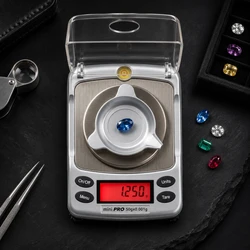
A changing scale reading can mean the instrument is unstable, but it can also mean the material is changing. An open liquid may lose mass through evaporation. A moisture-sensitive powder may gain mass while exposed to the room. A wet container may contribute a changing amount of water to the supported load.
The practical question is: Can moisture absorption or evaporation explain why a digital scale reading keeps changing? Yes, in suitable circumstances. The important next step is to distinguish a real change in the sample from effects involving the instrument, surroundings, container, or handling.
A useful measurement needs a defined sample condition and a clear recording point. This guide explains how to investigate drifting readings, control exposure, and record results without assuming that every change requires calibration.
Define what you intend to weigh
Begin with a precise description of the quantity of interest. The mass of material immediately after opening a package is not necessarily the same quantity as its mass after an hour of exposure.
Likewise, the mass of a closed bottle differs from the mass of its contents alone. A wet sample and a sample prepared under a defined drying procedure answer different questions.
Write down the condition that matters to your task. This prevents a valid measurement of one condition from being compared with a reference or earlier result describing another. Consistent definitions make a changing display easier to interpret.
Moisture can be part of the measured sample
A scale measures the supported load without identifying its chemical components. If water is present in the sample, that water contributes to the indicated mass along with the rest of the material.
When the sample exchanges moisture with its surroundings, its mass can change. The display may therefore be responding to a real change rather than creating an error.
Shimadzu's guidance on sample-related weighing influences discusses moisture absorption and evaporation among factors affecting measurements. Whether those effects matter depends on the sample, exposure, and required measurement quality.
A downward trend does not prove evaporation
Evaporation is one possible explanation for a decreasing reading, especially when an exposed sample can lose material to the surrounding air. It is not the only possibility.
Temperature differences, airflow, changing contact, instrument drift, or a shifting reference can also affect the indication. A sample can even experience several influences at once.
Record the direction and timing of the change, then investigate plausible causes. Avoid assigning an evaporation correction from the shape of the display alone. An observed trend needs context before it can support a conclusion about the material.
An upward trend does not prove moisture absorption
A material that takes up moisture can gain mass during exposure. However, an increasing indication is not sufficient to establish that mechanism.
Container contact, a changing environment, contamination, or instrument behavior can also produce an upward trend. An unnoticed addition to the container is another possibility.
Inspect the arrangement and compare its behavior with suitable controls. Use the description “the indication increased during exposure” until further evidence supports a more specific explanation. That wording preserves the observation without claiming more than the measurement establishes.
Start with the model's operating requirements
Confirm the permitted environment, startup procedure, tare operation, and calibration instructions for the exact instrument. A sample investigation is difficult when the scale itself is being used outside its intended conditions.
Use the AWScales product manuals rather than applying a procedure from a similar-looking model. Some instruments have different stabilization behavior or automatic features.
Follow the required preparation before recording a time series. Avoid restarting the scale or changing settings midway unless that change is part of a documented comparison. Otherwise, the sample and instrument histories become mixed together.
Control the installation before studying the sample
Place the scale on a firm, stable surface with proper support. Keep obvious airflow and vibration away from the weighing area.
Shimadzu's balance installation precautions address direct airflow, sunlight, temperature variation, and leveling. Those conditions can complicate a sample that is already changing over time.
Use the requirements for your instrument to establish a consistent location. A stable installation does not prevent genuine evaporation or moisture uptake, but it removes avoidable influences that can obscure the behavior you are trying to observe.
Check a suitable stable reference separately
An appropriate reference weight can help determine whether the instrument behaves normally under a controlled check. Follow the manufacturer's procedure and use a suitable, characterized reference.
NIST's work on calibration of mass standards explains the role of supported reference mass information. An open sample whose mass may be changing is not an equivalent substitute.
If a suitable reference is consistent while the exposed sample changes, that supports further investigation of the sample and its arrangement. It does not identify the mechanism conclusively, because the sample and reference may differ in temperature, shape, or handling.
Observe the empty container
A container can introduce changing mass through residual water, absorbed moisture, or material left from earlier use. It can also behave differently from the reference weight because of its shape or surface properties.
Before adding the sample, observe the prepared empty container under the intended conditions where that comparison is appropriate. Record any trend rather than assuming an empty vessel is automatically stable.
If the container itself changes meaningfully, address that issue before interpreting the loaded measurement. The sample result is easier to understand when the container reference remains suitable throughout the weighing procedure.
Tare does not freeze the container's mass
Tare establishes a reference from the load present at that moment. If that load changes later, the original reference does not continuously update to separate container changes from sample changes.
For example, a damp dish may lose water after it is tared. The later net indication can include both the sample and the change in the dish.
For common operation questions, consult the AWScales product FAQ. Keep the physical condition of the tared arrangement consistent, and do not assume that pressing tare permanently removes all future contributions associated with the container.
Use a cover when the method permits
A suitable cover can reduce exposure between a sample and its surroundings. It may help preserve a defined condition, but it must fit the task and the container.
If a lid is included during the loaded measurement, account for it consistently in the tare or gross-mass procedure. Adding a lid after taring an uncovered vessel changes the supported load.
A cover also does not establish that exchange has stopped completely. Use the intended closure and handling procedure, and avoid describing a loosely covered container as sealed without evidence that the closure provides the required condition.
Keep the outside of the vessel consistent
The scale cannot distinguish liquid inside a vessel from droplets on its exterior. Both contribute to the supported mass.
External moisture can also reach the platform or create an unsuitable contact arrangement. A cold vessel may develop a changing surface condition after it enters a different environment.
Prepare and handle the vessel according to the established method. Record visible changes that could matter. Do not repeatedly wipe the outside during a measurement series and then interpret the readings as changes in the contents alone.
Temperature differences require attention
A warm or cold sample can create a different weighing environment from a sample near the surrounding temperature. The indication may change while conditions evolve.
This does not mean every sample must be altered to room temperature. The correct preparation depends on what you intend to measure and the procedure used.
Avoid placing hot cookware or an unusually cold vessel on an instrument without confirming suitability. Establish a method that addresses both the instrument's operating requirements and the desired sample condition. Otherwise, a convenient waiting period may change the sample before you obtain the intended measurement.
Timing belongs in the measurement record
For an exposed sample, the interval between opening, transferring, placing, and recording can matter. Two operators may obtain different values because they measure at different points in that sequence.
Choose a clear time reference appropriate to the task, such as the start of exposure or completion of transfer. Record the relevant elapsed time with each observation.
There is no universal waiting period that makes every sample correct. A consistent recording point should be justified by the procedure and measurement requirement, rather than selected because it produces the most familiar value.
Do not wait indefinitely for a preferred number
A genuinely changing sample may never produce the stationary plateau expected from a stable reference. Waiting longer can change the quantity you intended to measure.
Use the defined method to decide when to record. If that method cannot produce a suitable result, revise the procedure or obtain more appropriate equipment instead of chasing a desired display.
A stability indicator describes the instrument's response criteria. It is not a chemical test showing that moisture exchange has ended. Keep the sample condition and the display behavior as separate observations.
Compare exposure conditions carefully
A controlled comparison may involve a covered and uncovered arrangement, provided the sample and method allow it. Keep other relevant conditions as consistent as practical.
Changing the vessel, quantity, location, temperature, and timing together prevents a clear interpretation. An improved result may be useful operationally but does not isolate its cause.
Plan the comparison around one question. Record what changed, what remained comparable, and which limitations affect the conclusion. The objective is to narrow the explanation rather than to demonstrate a preferred mechanism.
Reweighing the same sample is not always repeatability
If the sample changes between observations, repeated readings do not describe an unchanged quantity under unchanged conditions. They can contain both measurement variation and genuine sample evolution.
NIST's measurement terminology describes repeatability in terms of successive measurements under the same conditions. A changing sample complicates that interpretation.
Use a suitable stable reference to assess instrument consistency separately. For the sample, record the sequence as observations over time when that description is more accurate. Do not summarize a changing series as random noise without examining its pattern and context.
Separate real loss from incomplete transfer
Material can remain in a source container or on a utensil during transfer. A lower amount in the destination does not automatically indicate evaporation.
Define whether you are measuring the amount initially prepared, the amount leaving the source, or the amount reaching the destination. Those quantities may differ when residue or spills occur.
Inspect the transfer arrangement and keep handling consistent. A carefully measured starting amount is not proof that the entire amount entered another vessel. Avoid combining transfer loss and exposure effects into one unexplained correction.
A lid removal changes the load immediately
If a closed vessel is weighed and its lid is then removed, the resulting difference includes the lid's mass. It may also include material or moisture associated with that lid.
This is a different comparison from observing evaporation from an unchanged open vessel. The physical arrangement changed.
Keep lids and accessories consistent during a time series unless their removal is explicitly part of the procedure. If a configuration change is necessary, record it clearly so the resulting step in the indication is not mistaken for a gradual sample process.
Do not infer moisture percentage from ordinary drift
A decrease in mass during casual exposure does not independently establish the original moisture content. Other volatile material may be lost, the sample may not reach a defined endpoint, and the measurement may include unrelated influences.
Moisture determination requires an appropriate method with specified preparation, conditions, and interpretation. A general-purpose scale provides mass information, not an automatic analysis of which component changed.
If composition or moisture percentage is the actual objective, choose a procedure designed to answer it. Keep ordinary observations of mass change separate from analytical claims that require additional evidence.
Calculated differences carry measurement limitations
Subtracting a later reading from an earlier reading produces an indicated difference. Its usefulness depends on both observations and the conditions connecting them.
NIST's guidance on combined standard uncertainty explains how calculated results depend on their inputs and relationships. A subtraction does not remove uncertainty automatically.
If the apparent change is small relative to the method's variability, the evidence may not resolve it reliably. Avoid treating every last-digit movement as a confirmed physical change. Select equipment and a procedure capable of distinguishing the difference that matters.
Example of an open liquid sample
Imagine an open vessel whose indication gradually decreases while the same vessel with an appropriate closure behaves more consistently under comparable conditions.
That pattern is consistent with an exposure-related effect and can guide further investigation. It does not, by itself, quantify which substance escaped or eliminate every temperature and handling influence.
For a routine task requiring the retained contents' mass, a suitable covered procedure may improve consistency. Verify that the closure and tare arrangement fit the measurement objective instead of simply adopting the arrangement that produces the flattest display.
Example of a damp weighing dish
Imagine a dish tared shortly after washing. A sample is added, and the indicated net amount slowly decreases. A similar trend appears when the damp empty dish is observed separately.
That comparison points toward the container as a contributor. It does not establish the exact contribution without an appropriate assessment.
Prepare the dish consistently under the intended procedure before beginning again. Do not recalibrate the scale against the changing loaded reading. Correcting sample preparation is a different action from changing the instrument's response.
Example of a moisture-sensitive material
Imagine comparable portions prepared with different exposure times. Their measured masses differ, while suitable reference checks remain consistent.
Exposure history is a relevant variable to investigate, especially if the material can exchange moisture. However, portion differences and handling also need consideration.
A useful next step is a controlled preparation and timing procedure. Label results by their actual condition rather than comparing them as though they were measurements of identical, unchanged quantities. The sample history is part of the result's meaning.
Routine checks support the investigation
A record of suitable reference checks helps identify whether a new sample issue coincides with a broader instrument problem. It also provides context after movement, maintenance, or another significant event.
Mettler Toledo's guidance on routine testing of balances discusses checks between calibrations to identify performance problems.
Keep those checks distinct from the sample experiment. A satisfactory instrument check does not prove that the sample remained unchanged, while a changing sample does not by itself prove the instrument failed. Both questions need evidence appropriate to their scope.
Keep the platform dry and unobstructed
Spills and residue can interfere with clearance, contaminate later samples, or create a changing load outside the intended container. Inspect the weighing area before another measurement.
Follow AWScales scale maintenance guidance and the model instructions. A kitchen or laboratory vessel may tolerate cleaning methods that the instrument itself does not.
After cleaning, confirm that the platform is ready and the scale operates normally. Do not place a reference or sample on a wet surface and then expect the resulting behavior to describe only the intended load.
Choose an instrument for the required difference
The useful instrument must accommodate the container and sample while resolving the change relevant to the task. Capacity and readability are separate considerations.
Review AWScales pocket scales by individual specifications and intended use. A finer display may help observe a smaller change, but it can also make environmental and sample influences more visible.
Define the expected range and acceptable measurement limitations before selecting equipment. More digits cannot identify the cause of a changing mass or replace a suitable sample procedure. The method and instrument must work together.
Record the sample condition with the number
Include sample identification, container, closure, unit, scale model, preparation, and the timing reference. Record observed trends and relevant changes in conditions.
The AWScales knowledge center offers additional explanations of weighing concepts. Clear records make it easier to compare sessions without losing the meaning of each result.
For model-specific questions, contact AWScales customer support. Provide reference-check behavior, sample arrangement, approximate load, and the sequence of readings. Explain what was observed before assigning a cause.
Preserve the original sequence
Keep the individual observations and their times rather than recording only the first and last values. Intermediate readings can reveal interruptions, configuration changes, or an unexpected step that a single difference would conceal.
If you repeat the procedure, start a separate record. Combining observations from different preparations can hide the exposure history that the investigation is meant to understand.
Frequently asked questions
Does a decreasing reading mean the scale needs calibration?
Not necessarily. The sample, container, environment, or instrument may be contributing. Investigate the arrangement and check performance with a suitable reference before making an adjustment.
Will tare prevent evaporation from affecting the reading?
No. Tare establishes a reference at one moment. A later change in the supported mass can still affect the indication.
Can a cover make the measurement more consistent?
A suitable cover can reduce exposure when the method permits it. Account for its mass consistently and do not assume every closure eliminates exchange completely.
Does the stability symbol prove the sample stopped changing?
No. It reflects the instrument's criteria. It does not establish that moisture absorption, evaporation, or another sample process has ended.
Can I calculate moisture content from the mass lost on the platform?
An ordinary drift observation is not a complete moisture-analysis method. Use a suitable defined procedure when moisture percentage is the intended result.
Measure a defined condition rather than an unexplained trend
A changing sample requires a clear weighing objective. Define its preparation, exposure, container, and recording point before interpreting small differences.
Check the instrument separately, control avoidable influences, and record what actually changed. Keep moisture uptake, evaporation, transfer loss, and temperature effects as hypotheses until the evidence supports a specific explanation.
A useful result combines a mass indication with the conditions that give it meaning. Consistent sample handling often resolves more uncertainty than repeatedly adjusting a scale in response to a changing load.