
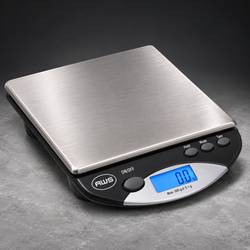
A lightweight container sits still, the draft shield is closed, and the scale’s reading continues to move. Another container behaves normally. You may also notice small particles clinging to a scoop or vessel. Static electricity is one possible influence worth investigating.
The practical question in Guide 374 is: Can static electricity affect digital scale accuracy?
Yes. Electrostatic forces can influence sensitive weighing. However, a drifting display does not prove a static problem, and an apparent improvement after changing containers does not identify the cause by itself.
Airflow, temperature, vibration, external contact, sample changes, power, and instrument condition can produce overlapping symptoms. Start with a controlled comparison rather than a homemade static remedy.
This guide explains what static can do, how to assess the clues, and when approved equipment or specialist advice is appropriate. Begin with the American Weigh Scales product manuals for your model’s operating conditions, accessories, restrictions, and verification requirements.
The practical answer
Static electricity can add forces that influence the displayed result, particularly in sensitive small-load work. It can also complicate material handling when particles adhere to surfaces.
Check the basic weighing setup first. Use stable support, suitable environmental conditions, clear platform movement, and an appropriate reference.
Compare the sample and container with a stable reference under controlled conditions. Record whether the symptom is general or specific to one arrangement.
Use only static-control methods appropriate to the instrument, sample, and work area. Do not spray household products onto the pan or improvise electrical connections.
After any approved corrective action, verify the measurement rather than judging success only by a calmer display.
How electrostatic forces can influence weighing
A charged object can interact with nearby objects and surfaces. Those interactions can introduce forces beyond the intended contribution from the load’s mass.
The instrument can respond to the resulting force arrangement, which may differ from the measurement you intended.
METTLER TOLEDO’s explanation of electrostatic charges during weighing identifies unstable readings and drift as possible effects.
Do not assume static always makes the reading higher or lower. The direction and size depend on the circumstances.
There is no universal correction amount for a plastic cup or dry room. Control and verification are more appropriate than adding or subtracting a guessed number.
The effect depends on the measurement requirement
A force that matters to a tiny sample may be insignificant for a different task with a much larger permitted difference.
Fine readability can make small changes visible, but the display increment alone does not establish accuracy or susceptibility to a particular disturbance.
Define the smallest net quantity and required performance before deciding whether the observed behavior is acceptable.
A general kitchen portioning task and an analytical measurement should not be assigned identical static-control requirements.
Use the instrument and procedure suitable for the task. A sensitive display does not transform an uncontrolled setup into a dependable measurement system.
Common clues are useful but not conclusive
Particles clinging to a container, readings that change after handling, or unusual behavior with certain materials can justify investigating static.
These signs do not independently prove that electrostatic forces explain the indicated mass. Several influences may coexist.
A different container can also change temperature, geometry, clearance, or airflow exposure. Record those differences rather than treating the material alone as the explanation.
Observe ordinary operation without deliberately creating charge through rubbing or other demonstrations.
The purpose is to identify a useful next check, not to produce a dramatic display effect that may be unrelated to the original task.
Materials and handling can affect the situation
Certain samples and containers can retain charge, and handling can contribute to the conditions. Friction, packaging, and environmental factors may matter.
Adam Equipment’s ionizer information discusses charge buildup with materials and low-humidity conditions.
Do not assume every plastic object is unsuitable or every metal object solves the problem. Compatibility, geometry, handling, and the complete arrangement still matter.
Choose containers permitted by the task and instrument. A material substitution must not contaminate the sample or invalidate the procedure.
Record the container identity and handling sequence so a comparison can be repeated meaningfully.
Static can affect transfer as well as the reading
Material may cling to a scoop, weigh boat, bag, or vessel instead of transferring as intended. That changes what actually reaches the container.
The scale cannot account for sample left on a tool outside the weighing arrangement. A plausible displayed number does not prove the intended transfer occurred.
Inspect the procedure for residue, spills, and adhering particles. Avoid brushing material around merely to produce an expected result.
For controlled applications, use an appropriate sample-handling method and equipment.
Keep transfer loss and electrostatic influence on the indicated force as separate questions. Both can matter, but they require clear observations and a suitable response.
A closed draft shield does not rule out static
A shield is intended to control certain environmental disturbances. It does not automatically eliminate electrostatic interactions involving the sample, container, enclosure, or operator.
Do not conclude that an unsettled enclosed reading must be an internal instrument fault.
Sartorius discusses static effects on analytical weighing as a distinct consideration in sensitive measurements.
Also check whether the container or tools touch the shield. Physical contact can create a different problem.
Use the intended shield correctly and keep its condition consistent. Do not rub or spray it with an improvised product to make the display settle.
Rule out basic setup problems first
Confirm firm support, secure feet, correct mode, selected unit, and normal startup. Resolve warnings before assessing ordinary measurement behavior.
Check airflow, nearby vibration, temperature changes, and platform clearance. A wide bowl touching the housing can produce misleading readings with no static diagnosis needed.
The AWScales product FAQ provides general operating and troubleshooting guidance.
Keep hands and utensils away while recording a result. Do not steady the container manually.
A controlled baseline makes a static investigation more informative. Otherwise, a change may simply remove one of several unrelated disturbances.
Compare an appropriate reference with the sample
Use a stable suitable reference under the instrument’s required conditions. Record whether it settles and repeats according to the selected procedure.
Then examine the actual sample arrangement without changing unnecessary factors. Differences can direct attention toward the container, material, or handling process.
A reference that behaves normally does not prove that the sample’s issue is static. It narrows the investigation.
Temperature, moisture exchange, movement, and external contact can also be sample-specific.
If both reference and sample are inconsistent, investigate the broader setup and instrument rather than focusing exclusively on one material.
Choose reference quality for the question
An accuracy check requires an adequately known value, not just a familiar object. Coins and packaged goods may provide only limited observations.
NIST’s overview of mass standard calibration explains how a reference weight’s value and uncertainty are established.
Select a reference appropriate to the required performance and the method. Handle and prepare it according to its instructions.
Do not create charge on the reference to demonstrate a theory. Preserve its suitability for the comparison.
A good reference helps assess measurement behavior, but a single matching reading still does not establish all aspects of performance across the range.
Test container alternatives carefully
Where the task permits, compare a suitable alternative container while keeping the reference, placement, surface, and observation method controlled.
Confirm both vessels fit securely and clear the housing. Account for their different gross loads and tare requirements.
Do not assume a calmer result identifies static uniquely. The replacement may also have a more stable base or different exposure to airflow.
Record the complete arrangement and repeat enough to establish a useful pattern under the procedure.
If material compatibility or contamination matters, obtain appropriate guidance before substituting a vessel. Measurement convenience should not compromise the sample.
Humidity is not a universal control knob
Dry conditions can be relevant to charge retention, but changing room humidity is not a simple universal remedy for weighing problems.
The instrument, sample, reference, and work area may have their own environmental requirements. Moisture changes can introduce additional effects.
Do not mist the pan, wet a container, or place a humidifier beside the balance as an improvised fix.
If environmental control is part of the approved method, follow its limits and verify the complete process.
A change that reduces visible static clues may still alter the sample or measurement. Evaluate the result through the required procedure rather than appearance alone.
Use approved ionization only where appropriate
Ionizers can be part of a suitable static-control arrangement for weighing. Selection, placement, operation, maintenance, and compatibility matter.
METTLER TOLEDO’s antistatic weighing solutions illustrate purpose-designed equipment for samples and containers.
Do not substitute an unrelated consumer device because it uses the word “ion.” Its output and operating conditions may not suit the task.
Follow the accessory and instrument instructions, including any required timing and clearance. Avoid creating new airflow or contact problems.
A successful treatment step does not replace verification. Check that the actual measurement meets the relevant requirement afterward.
Do not improvise grounding or electrical modifications
A weighing instrument is not a suitable place for guessed wiring, conductive spacers, or connections to nearby metal objects.
Do not open the housing or alter protective arrangements to pursue a suspected static problem.
Grounding, where appropriate, should follow the equipment and work-area instructions. A metal container is not automatically controlled merely because it looks conductive.
METTLER TOLEDO’s ionizer module instructions demonstrate that static-control accessories have defined installation and operating procedures.
For specialized environments, obtain qualified advice about compatible controls rather than assembling a homemade electrical workaround.
Avoid household sprays and surface treatments
Antistatic laundry products, cleaning chemicals, oils, or water can introduce residue, moisture, contamination, material incompatibility, or electrical problems.
Do not apply them to the pan, shield, sample, or housing unless the manufacturer and task procedure explicitly permit the treatment.
A calmer display after wetting or coating a surface does not establish a valid measurement. The treatment may have changed the load or surrounding forces.
Use approved cleaning and static-control methods appropriate to the complete task.
When instructions are unclear, pause the proposed treatment and ask for model-specific guidance. Do not trade an unexplained symptom for a new uncontrolled variable.
A controlled investigation sequence
Follow any required formal procedure. For an introductory investigation, preserve the original observations and avoid deliberately charging objects.
-
Identify the model, task, smallest net quantity, and requirement.
-
Complete normal preparation and resolve warnings.
-
Establish stable support and clear platform movement.
-
Record suitable reference behavior.
-
Record the actual sample and container behavior.
-
Check handling, temperature, motion, moisture, and contact.
-
Compare a permitted container alternative where useful.
-
Use an approved static-control method only if appropriate.
-
Repeat the relevant verification under controlled conditions.
-
Document what changed and what remains uncertain.
A screening comparison organizes evidence. It does not independently validate a specialized analytical method or identify an internal fault.
Interpret a hypothetical container comparison
Imagine a suitable reference with an accepted mass of 10.000 grams. These values are illustrative, not expected results or a universal test.
|
Arrangement |
Trial 1 |
Trial 2 |
Trial 3 |
|---|---|---|---|
|
Reference directly on intended platform |
10.001 g |
10.001 g |
10.002 g |
|
Reference in original container |
10.018 g |
10.009 g |
10.014 g |
|
Permitted arrangement after approved control |
10.001 g |
10.002 g |
10.001 g |
The pattern supports investigating the original arrangement and the effect of the control used.
It does not establish that static alone caused the difference. Assess the complete conditions, reference information, procedure, and relevant acceptance criteria.
Preserve the original readings rather than reporting only the favorable final series.
Distinguish a calmer reading from verified accuracy
Static-control action may improve stability without establishing every measurement characteristic. A consistent indicated difference can still remain.
Check agreement with a suitable reference and repeatability under the defined conditions. Assess the actual container-based task where required.
Do not choose the most favorable instant from a drifting display. Use the readiness criterion and recording method specified by the procedure.
Averaging is not a universal cure for uncontrolled forces or a changing sample.
The useful outcome is a result suitable for the task, supported by evidence. A quiet screen is one observation within that assessment.
Tare and calibration do not remove every external force
Tare changes the displayed reference. It does not eliminate charge, airflow, temperature differences, or physical contact.
Adjustment changes the response covered by its procedure. It should not be used to compensate blindly for a changing external influence.
Establish suitable conditions before attempting adjustment. Use the specified reference and preserve the original observations.
After any appropriate intervention, verify performance through the required method.
If repeated adjustment is needed to obtain one plausible reading, investigate the process and seek advice rather than treating the routine as normal operation.
Inspect maintenance and accessory condition
Residue, debris, damaged accessories, and incorrect assembly can complicate operation. Inspect accessible areas with the instrument switched off.
Remove only user-removable components and follow the permitted cleaning method. Do not pry up the pan or force shield parts.
Use the AWScales maintenance guidance alongside the model manual.
Allow any required drying and reassemble correctly. Repeat the same controlled check before changing settings.
If approved static-control equipment is used, maintain it according to its own instructions. A device’s presence does not establish that it remains effective or correctly configured.
Match the symptom to the next check
|
Observation |
Useful next check |
|---|---|
|
Reference stable, sample arrangement drifts |
Container, material handling, temperature, moisture, possible static |
|
Empty platform and reference both fluctuate |
General setup, power, support, airflow, instrument condition |
|
Particles cling during transfer |
Handling method and sample loss |
|
Alternative vessel behaves differently |
Fit, material, gross load, geometry, procedure |
|
Approved control improves results |
Repeat verification and document conditions |
|
Warning or restart appears |
Resolve the indicated operating problem first |
Use these as directions for investigation, not definitive diagnoses.
A clear sequence prevents a suspected static effect from becoming an explanation for every unrelated symptom.
Build a consistent handling routine
Use defined containers, tools, placement, and preparation where practical. Keep sample transfer and reference handling consistent.
Avoid unnecessary rubbing, packaging changes, or improvised surface treatments. Use approved accessories as instructed.
The AWScales Knowledge Center provides additional setup and operating resources.
Review the method when the material, vessel, smallest quantity, or environment changes. A previous result may not cover a new arrangement.
Comparable records help distinguish a recurring issue from a one-time disturbance and make later support more productive.
Choose equipment for sensitive material work
Consider capacity, smallest net quantity, readability, repeatability, platform fit, environmental needs, and verification requirements.
For portable tasks, compare the AWScales pocket scale range against the actual application rather than assuming a finer display solves static-related concerns.
If the task involves specialized materials or controlled environments, obtain appropriate equipment and method advice.
A suitable solution may require an intended accessory, different container, improved procedure, workstation, or instrument.
Select the complete measurement arrangement, not only the screen resolution. The required performance must be achievable under the actual working conditions.
Reassess when the required quantity changes
A method used for a larger sample may not remain suitable when the net amount becomes much smaller. Review the required performance, reference quality, environmental control, and handling procedure before applying earlier conclusions to the new task.
Keep an evidence-based record
Record the model, unit, reference, sample, container, handling tools, preparation, conditions, and readings. Include warnings and the observation sequence.
Identify each change separately. If several factors changed together, do not claim one was definitively responsible.
Record the approved control used and the verification afterward. Preserve unsuccessful trials and explain invalid observations through the procedure.
Do not label a process “static-free” solely because particles stopped clinging or the last digit became steady.
A practical record connects the action with the observed result while keeping the conclusion within what the evidence supports.
When to contact American Weigh Scales
Seek help if suitable references remain inconsistent, warnings persist, or you cannot identify an appropriate operating arrangement.
Provide the model, smallest net quantity, required performance, reference details, sample and container information, conditions, and comparison results.
Use the American Weigh Scales contact page for model-specific guidance.
Mention impact, overload, moisture, accessory damage, or recent setup changes. Keep the main housing closed while the issue is assessed.
For formal sensitive weighing, confirm the method, controls, and documentation needed with an appropriate qualified provider.
Frequently asked questions
Can static make a scale reading wrong?
Electrostatic forces can influence sensitive weighing. Confirm the setup and assess evidence rather than assuming static explains every unusual value.
Does static always make the reading higher?
No universal direction or correction amount should be assumed. The interactions and arrangement matter.
Will a draft shield eliminate static?
Not automatically. A shield addresses certain disturbances but does not establish control of every electrostatic interaction.
Can I spray antistatic cleaner onto the scale?
Use only treatments explicitly permitted for the instrument and task. Household products can introduce contamination and other problems.
Does a metal container guarantee the problem is solved?
No. Container suitability depends on the complete arrangement, compatibility, handling, and any approved control procedure.
What is the practical answer to Guide 374?
Static can matter. Rule out basic problems, use suitable references and approved controls, and verify the actual measurement afterward.
Control the process before correcting the number
A suspected static effect is a reason to investigate the complete weighing arrangement. It is not a basis for a guessed numerical correction.
Use suitable conditions, consistent handling, and appropriate accessories. Preserve the observations and verify performance so the final result is supported by the process rather than the appearance of the display.