
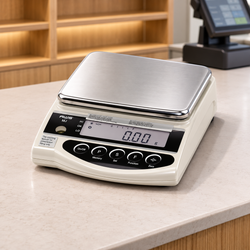
You bring a scale indoors from a warm vehicle, place a cool container on its platform, and notice that the reading takes longer to settle. Later, the same instrument seems to behave normally. Temperature is a reasonable factor to investigate, but it is important to distinguish the instrument, the sample, and the surrounding air.
The practical question in Guide 367 is: Can temperature changes affect digital scale accuracy?
Yes. Temperature can influence the instrument’s operating conditions and the physical environment of the measurement. A sample or container at a different temperature can also create complications in sensitive weighing.
The size and importance of the effect depend on the model, conditions, load, and required performance. There is no universal temperature correction or waiting period that applies to every digital scale.
This guide explains what to check, how to prepare a recently moved instrument, and how to compare performance without assuming every changing reading is a temperature fault. Start with the American Weigh Scales product manuals for your exact model’s operating range, preparation, and adjustment instructions.
The practical answer
Use the scale within its specified operating conditions, away from direct sunlight, heaters, and rapidly changing ventilation. Follow the documented acclimatization and warmup requirements.
For sensitive measurements, consider whether the reference, container, and sample are at suitable conditions relative to the instrument. Follow the sample procedure rather than changing material merely to obtain a calmer display.
Compare operation with an appropriate stable reference. Record empty-platform behavior, repeated readings, and preparation before making adjustments.
Do not calculate an improvised temperature correction from a few observations. If a correction or controlled environment is required, use an appropriate documented procedure.
A suitable location, adequate preparation, and verification provide a more dependable response than repeatedly pressing zero while conditions keep changing.
Temperature can affect more than one part of the task
A temperature-related problem can involve the scale, the reference, the container, the sample, or air movement around them. These are related possibilities, not interchangeable explanations.
The instrument may still be adjusting after transport. A warm vessel can create local air movement. A sample may lose moisture or change during handling.
The surface beneath the scale may also warm in sunlight or beside equipment. A room temperature reading taken elsewhere may not describe the immediate weighing location.
Record which part of the setup changed before deciding on a cause. A controlled reference check helps separate sample behavior from a broader instrument or environment issue.
Do not assume that an unchanged room thermostat means every component is at the same temperature.
Operating range is a limit, not a complete preparation procedure
A scale’s specified operating temperature range tells you about permitted use under the stated conditions. It does not necessarily mean that measurements are ready immediately after a large temperature change.
Warmup, acclimatization, humidity restrictions, and other requirements may appear separately in the manual. Read them together.
Do not confuse storage conditions with operating conditions. Equipment that can be stored in a particular environment may require different conditions before use.
Also avoid interpreting a broad operating range as permission to weigh hot objects directly. Platform temperature limits and sample requirements may be separate.
If the documentation is unclear, ask support for the exact model requirements instead of applying a limit from a similar-looking product.
Acclimatization and powered warmup are different
Acclimatization concerns adjustment to the surrounding environment after a move or condition change. Powered warmup concerns preparation after connecting power or switching on, as specified by the manufacturer.
An instrument may require both. Leaving a scale unpowered in a room is not automatically equivalent to completing its powered preparation.
Likewise, switching on does not instantly remove a large temperature difference between the instrument and its surroundings.
METTLER TOLEDO’s precision balance guidance discusses powered preparation and temperature differences in sensitive weighing.
Use the time and procedure stated for your product. Requirements for a laboratory balance should not be copied into a pocket-scale workflow without a valid model-specific basis.
Why there is no universal waiting time
Instrument construction, previous conditions, temperature difference, performance requirements, and the environment can all affect preparation.
A brief trip between similar rooms is not the same situation as storage in a hot vehicle. A coarse portioning task is not equivalent to sensitive analytical weighing.
Adam Equipment’s support guidance for covered equipment illustrates that some balances can require substantial acclimatization. That does not establish the same interval for every scale.
Avoid publishing or following an arbitrary rule such as “all scales are ready after five minutes.” Use the manual and verification appropriate to the task.
If preparation requirements are missing, request guidance. A reference check can provide useful observations, but it does not replace a required procedure.
Direct sunlight creates a changing local environment
A sunny countertop can warm the housing, platform, container, and support unevenly over time. The location may behave differently during morning and afternoon sessions.
Move to a suitable location protected from direct sunlight rather than trying to correct each reading with zero or tare.
Keep the support firm and stable, and check that the new position is also free from drafts and vibration. A location change can alter several conditions at once.
Record the change accurately. If performance improves after moving, you have evidence about the overall installation, not necessarily proof that sunlight alone caused every discrepancy.
Choose a consistent location where practical so the conditions remain easier to understand.
Heaters, appliances, and vents deserve attention
A nearby oven, hotplate, radiator, lamp, or operating appliance can change conditions around the scale. Ventilation can combine temperature changes with airflow.
Check the immediate location rather than relying only on the room’s general comfort. Sensitive measurements may respond to conditions that are not obvious during ordinary work.
Avoid placing the scale against warm equipment or in the path of a heating or cooling outlet. Follow clearance and environmental instructions.
Where safe and appropriate, compare operation without the suspected disturbance. Do not interrupt essential equipment simply to perform a weighing test.
Keep other variables controlled and use a suitable reference. Changing the sample and location together makes interpretation more difficult.
A warm sample can create local air movement
An object at a different temperature from its surroundings can influence the nearby air. This matters particularly in sensitive weighing.
Adam Equipment’s discussion of heat and updraft explains that temperature differences between the balance and sample can create convection currents, even with a draft shield.
Do not assume a shield eliminates every thermal influence. Its intended purpose and proper use still depend on the model.
Compare a suitable reference under appropriate ambient conditions before concluding that the scale itself is faulty.
Avoid putting a hot vessel directly on the platform unless the instrument permits it. Use the handling procedure appropriate to both the scale and the sample.
Cold samples can introduce additional changes
A chilled container brought into a warmer environment may experience changing conditions during the measurement. Moisture on the exterior can also alter the physical load.
Inspect for visible condensation, dripping, or wet surfaces. Follow the sample procedure rather than wiping or warming an item in a way that invalidates the task.
A cold container and a dry room-temperature reference are not equivalent test objects. Their different behavior can provide a clue without establishing a complete diagnosis.
Record timing and handling so the sequence remains interpretable. An object can change between the first and second weighing.
If the application requires weighing at a controlled temperature, use suitable equipment and a documented method rather than a general household workaround.
Sample mass can change while the scale works normally
Evaporation, moisture exchange, spilling, and residue transfer can create a trend in the displayed value. The instrument may be responding correctly to a changing load.
A warm liquid is an obvious case to consider, but other materials can also gain or lose moisture under changing conditions.
METTLER TOLEDO’s guide to weighing the right way discusses sample characteristics that can be mistaken for external instrument influences.
Compare with a stable reference to investigate general scale behavior. Do not repeatedly tare to conceal a trend.
If the sample must remain in a particular state, follow the task’s handling requirements. Making it easier to weigh is not a valid reason to compromise the intended measurement.
The reference weight needs appropriate preparation too
A reference carried from a different environment is not automatically ready for a sensitive comparison. Its condition and handling matter.
Use suitable storage and preparation according to the reference and measurement procedure. Avoid unnecessary hand contact where handling tools are specified.
A contaminated, wet, or damaged reference can undermine your attempt to assess the instrument. Do not assign every difference to the scale.
NIST’s mass laboratory technical criteria discuss environmental conditions, equilibration, and thermal effects in precision mass work.
Those laboratory criteria illustrate the importance of control; they are not a universal home-scale waiting schedule. Apply requirements appropriate to your actual task.
A zero display does not remove thermal influences
Zero establishes a displayed reference. Tare accounts for an existing load. Neither command makes the instrument, sample, or surroundings thermally stable.
If the conditions continue changing, the reading can move away from zero afterward. Repeated resets may hide that pattern without resolving it.
Record the empty display and loaded response before pressing controls again. Note whether the trend appears with a stable reference or only a particular sample.
The AWScales product FAQ provides general setup and troubleshooting information. Follow the model instructions for actual zero and tare operations.
Do not interpret a brief zero indication as complete evidence of readiness or accuracy.
Distinguish drift from a consistent difference
Drift is a changing reading over time under an apparently unchanged load. A consistent reference difference is a separate observation.
Temperature may be relevant to either pattern, but the observation alone does not prove the cause. Airflow, support, sample changes, power, and instrument condition also need consideration.
Record repeated placements and the time sequence. A reference that gradually trends during a session suggests a different investigation from one that repeatedly settles at the same offset.
Do not average an uncontrolled trend and report the result as though conditions were stable.
Once suitable conditions are established, compare with the accepted reference and relevant criteria. Preserve original observations before any adjustment.
Control the rest of the setup during a temperature check
A useful comparison needs dependable power, stable support, correct units, normal weighing mode, and clear platform movement.
Keep the same reference and placement method. Ensure the container touches only the intended weighing surface and that the gross load is permitted.
Take hands away from the table and stop nearby activity while recording readings. Vibration can complicate a test aimed at temperature.
Do not deliberately expose the scale to extreme heat or cold to recreate a problem. Use normal operating observations and safe preparation.
If several conditions changed, state that limitation in the record. A careful description is more useful than an unsupported single-cause diagnosis.
A practical preparation and verification sequence
Use the model’s required preparation and any formal procedure appropriate to the application.
-
Identify the scale’s operating and preparation requirements.
-
Choose a stable location away from direct thermal disturbances.
-
Let the instrument meet its documented acclimatization conditions.
-
Complete the required powered warmup.
-
Prepare a suitable stable reference as instructed.
-
Start with the intended empty-platform reference.
-
Place the reference gently near the center.
-
Record the settled value and any warning.
-
Remove it and observe the return toward zero.
-
Repeat under unchanged conditions and assess the results.
Do not decide readiness from an arbitrary elapsed time alone if the required procedure also includes checks or indicators.
Choose a reference suitable for the requirement
A household object can reveal a change in response, but an unknown mass cannot establish precise accuracy.
Use an appropriate test weight and its accepted value. Consider uncertainty and documentation where the procedure requires them.
NIST’s overview of mass standard calibration explains how a weight’s mass value and associated uncertainty are established.
Do not use a nominal stamp as a substitute for all necessary reference information in demanding work.
Keep the reference unchanged across comparisons. Moisture, contamination, or lost material creates another variable independent of the instrument’s preparation.
Interpret a hypothetical preparation comparison
Imagine a suitable reference with an accepted mass of 100.00 grams. These values illustrate observations rather than universal warmup behavior.
|
Condition |
Trial 1 |
Trial 2 |
Trial 3 |
|---|---|---|---|
|
Before required preparation is complete |
100.10 g |
100.06 g |
100.03 g |
|
After suitable preparation and stable conditions |
100.01 g |
100.02 g |
100.01 g |
The first series trends in this example, while the second is more consistent and closer to the stated reference.
That supports further attention to preparation and conditions. It does not prove a specific temperature coefficient or establish a pass tolerance.
Assess real results using the relevant procedure, reference information, instrument specifications, and task requirements.
Calibration should follow suitable conditions
Do not attempt adjustment while the setup is still changing unless the manufacturer’s procedure specifically directs it.
First establish the required operating conditions. Then follow any model-specific instruction for calibration or adjustment after a move or temperature change.
Use the exact reference and sequence. A weight that merely looks suitable is not enough for a precise adjustment.
Preserve observations before intervention and verify afterward. A success message does not independently establish measurement performance.
If appropriate preparation and the documented procedure do not resolve the issue, request support rather than repeating adjustments indefinitely.
Avoid improvised temperature corrections
A few readings at different times do not establish a valid correction relationship. Multiple conditions may have changed alongside temperature.
Do not add or subtract a guessed amount based on whether the room feels warmer. That can create a new error and conceal unstable performance.
Where a correction is appropriate, it needs a valid basis, defined conditions, and consideration of uncertainty. The instrument or application procedure should govern its use.
Also avoid changing service settings intended for technicians. A menu value is not a general remedy for a changing environment.
For most routine troubleshooting, suitable placement, preparation, and verification are more appropriate than an invented correction table.
Inspect maintenance and handling history
A problem that follows transport could involve impact, overload, moisture, or debris as well as temperature. Check the history rather than assuming acclimatization explains everything.
With the instrument switched off, inspect accessible areas according to the manual. Remove only user-removable accessories.
Use the AWScales maintenance guidance alongside model-specific cleaning instructions. Do not open the housing or pry up the platform.
Check the support and container clearance before restarting. A trapped object can produce a new symptom after a move.
If damage is suspected, seek assessment instead of using repeated warmup sessions as a substitute for support.
Make routine conditions more consistent
Use a regular suitable location and protect the instrument from direct sunlight, heaters, and changing ventilation.
Build the required preparation into the workflow, especially after transport or storage. Keep the reference and container handling consistent.
Record unusual environmental events and any significant change in performance. Comparable observations over time are more useful than unrelated readings.
The AWScales Knowledge Center provides additional setup and operating resources.
Consistency does not eliminate every fault. It reduces uncontrolled variation so a new change becomes easier to recognize and investigate.
Match equipment to the environment
A scale used in a controlled indoor workspace faces a different task from one regularly moved between locations. Select equipment for the actual conditions and measurement needs.
Check the operating specifications, capacity, readability, platform fit, and preparation requirements. Do not assume more display digits compensate for an unsuitable environment.
For portable applications, compare the AWScales pocket scale range with the complete load and required performance.
If the process requires weighing materials at controlled temperatures, obtain suitable method and equipment advice.
The aim is a usable measurement system, including the sample and surroundings, rather than a product chosen from a single specification.
When to contact American Weigh Scales
Seek help if a suitable reference remains inconsistent after required preparation, warnings persist, or the documented adjustment procedure fails.
Prepare the model, power source, unit, load, location, recent transport history, preparation steps, and repeated readings.
Use the American Weigh Scales contact page for model-specific guidance. Mention any impact, overload, moisture, or visible damage.
Keep the housing closed while the issue is assessed. Describe observed trends rather than assigning an internal temperature fault.
Clear records help distinguish an operating requirement from a condition that needs service or a different instrument.
Frequently asked questions
Can a warm room make a scale inaccurate?
Temperature can influence performance, but a warm room alone does not establish a fault. Check the permitted conditions, preparation, local disturbances, and reference results.
How long should I let a scale warm up?
Follow the exact model instructions. There is no universal interval for every pocket, kitchen, floor, and laboratory scale.
Can I weigh a hot container directly?
Only if the instrument and task permit it. Temperature limits and sample-handling requirements must be considered separately from capacity.
Will tare correct temperature drift?
No. It changes the displayed reference without making changing conditions stable.
Why does a reference settle while my sample keeps changing?
Investigate sample temperature, motion, evaporation, moisture exchange, and container contact. Different behavior points toward a sample or procedure check.
What is the practical answer to Guide 367?
Temperature can matter. Use the specified conditions and preparation, control the sample arrangement, and verify performance with a suitable reference.
Prepare the complete measurement
Temperature-related weighing is about more than the room thermostat. The instrument, support, air, reference, container, and sample all contribute to the conditions.
Follow the model’s preparation requirements and use controlled checks before changing settings. A dependable result comes from suitable conditions and evidence of performance together.