
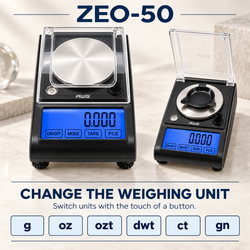
Buying a scale for diamonds becomes much easier when you focus on three fundamentals:
accuracy-related performance, capacity and calibration.
A diamond scale needs to:
-
Display sufficiently fine weight increments
-
Hold the complete load safely
-
Produce repeatable readings
-
Support appropriate calibration
-
Work in carats or grams
-
Remain stable in the environment where it is used
For small loose diamonds, a useful starting point is often:
20–50 g capacity × 0.001 g readability.
For finished jewelry and mixed diamond/jewelry use:
500 g × 0.01 g
can be significantly more practical.
The reason is simple:
individual diamonds are very light, but rings, trays and finished jewelry can require much more capacity.
American Weigh Scales offers several precision pocket scales covering both general 0.01 g and finer 0.001 g weighing applications.
The right scale depends on:
what you weigh + how much it weighs + how fine a measurement you need.
Diamonds Scale Buying Guide: Quick Recommendations
| Application | Practical Capacity | Suggested Readability |
|---|---|---|
| Tiny loose diamonds | 20–50 g | 0.001 g |
| General loose diamonds | 20–50 g | 0.001 g |
| Larger loose diamonds | 20–50 g | 0.001–0.01 g |
| Diamond parcels | 50 g+ | 0.001 g |
| Diamond rings | 100–500 g | 0.01 g |
| Finished diamond jewelry | 200–500 g | 0.01 g |
| Mixed jewelry use | Around 500 g | 0.01 g |
| Fine diamond sorting | 20–50 g | 0.001 g |
| Dealer two-scale setup | 20–50 g + 500 g | 0.001 g + 0.01 g |
These are practical starting points rather than universal requirements.
Your ideal scale depends on:
smallest meaningful weight difference + heaviest total load + intended use.
Start With the Diamond Application
Before comparing scale specifications, decide exactly what will be placed on the platform.
You may be weighing:
-
Individual loose diamonds
-
Small melee diamonds
-
Diamond parcels
-
Mounted stones
-
Rings
-
Earrings
-
Pendants
-
Bracelets
-
Finished jewelry
Each use case changes the balance between:
resolution and capacity.
Loose Diamonds Need Fine Resolution
Loose diamonds typically weigh very little.
A 1-carat diamond weighs only:
0.20 g.
A 5-carat diamond weighs:
1.00 g.
A 10-carat diamond weighs:
2.00 g.
This means very high capacity is usually unnecessary when weighing individual loose stones.
Finished Jewelry Needs More Capacity
A ring or bracelet includes:
-
Diamond
-
Precious metal
-
Setting
-
Additional stones
-
Structural components
That makes the total load significantly heavier.
For finished jewelry, a higher-capacity scale can be more useful than a low-capacity milligram scale.
What Does Accuracy Mean on a Diamond Scale?
The word “accuracy” is often used too loosely.
Several related terms should be separated.
Accuracy
How close the measurement is to the relevant true or reference value.
Readability
The smallest increment shown on the display.
Repeatability
How consistently the scale produces similar measurements when the same object is weighed repeatedly under similar conditions.
Calibration
The process used to establish or check the scale's measurement response against an appropriate reference.
A strong diamond scale should be evaluated using all four concepts.
Readability Is Not the Same as Accuracy
A scale labeled:
50 g × 0.001 g
has:
-
50 g maximum capacity
-
0.001 g displayed readability
That does not automatically mean:
every reading is guaranteed accurate to ±0.001 g.
Likewise:
500 g × 0.01 g
does not automatically guarantee ±0.01 g accuracy.
The specification describes what the display can resolve, not the complete measurement uncertainty.
Why Fine Resolution Matters for Diamonds
Diamonds are weighed in metric carats.
The Gemological Institute of America defines:
1 metric carat = 0.20 gram.
That means:
1 gram = 5 carats.
A carat is divided into:
100 points.
This makes small weight differences important.
Diamond Carat-to-Gram Conversion
| Carats | Grams |
|---|---|
| 0.05 ct | 0.01 g |
| 0.10 ct | 0.02 g |
| 0.25 ct | 0.05 g |
| 0.50 ct | 0.10 g |
| 1.00 ct | 0.20 g |
| 1.50 ct | 0.30 g |
| 2.00 ct | 0.40 g |
| 5.00 ct | 1.00 g |
| 10.00 ct | 2.00 g |
This is why ordinary kitchen scales are too coarse for individual diamond weighing.
0.01 g Readability for Diamonds
A 0.01 g scale displays hundredths of a gram.
For example:
0.18 g
0.19 g
0.20 g
0.21 g
Because:
0.01 g = 0.05 ct
each displayed step corresponds to:
five carat points.
This can be useful for:
-
Finished jewelry
-
General inventory
-
Larger items
-
Mixed jewelry use
But it may be too coarse for very fine loose-diamond work.
0.001 g Readability for Diamonds
A 0.001 g scale displays thousandths of a gram.
For example:
0.198 g
0.199 g
0.200 g
0.201 g
Because:
0.001 g = 0.005 ct
each displayed step corresponds to:
half of one carat point.
This is why 0.001 g readability is more relevant for:
-
Small loose diamonds
-
Diamond parcels
-
Fine sorting
-
Lightweight stones
0.01 g vs. 0.001 g Diamond Scales
| Specification | 0.01 g | 0.001 g |
|---|---|---|
| Display increment | 0.01 g | 0.001 g |
| Carat equivalent | 0.05 ct | 0.005 ct |
| General jewelry | Excellent | Often capacity-limited |
| Small loose diamonds | Coarser | Better |
| Typical capacity | Higher | Lower |
| Draft sensitivity | Lower | Greater |
| Vibration sensitivity | Lower | Greater |
| Best use | Jewelry and mixed use | Fine loose-diamond work |
Do not choose 0.001 g simply because it looks more precise.
Choose it when your application actually requires that finer resolution.
Repeatability Matters as Much as Resolution
A scale may display three decimal places but still perform poorly if the readings are unstable.
Suppose the same diamond gives:
0.203 g
0.203 g
0.203 g
That suggests stable behavior under those conditions.
If it gives:
0.197 g
0.206 g
0.201 g
0.209 g
something may be affecting the measurement.
Possible causes include:
-
Airflow
-
Vibration
-
Static electricity
-
Calibration issues
-
Temperature changes
-
Low battery
-
Platform contamination
Fine resolution is useful only when the scale is sufficiently stable.
Capacity: How Much Do You Need?
Capacity describes the maximum total load the scale can physically support.
For diamonds, common useful ranges include:
-
20 g
-
50 g
-
100 g
-
500 g
The correct capacity depends less on the individual diamond and more on:
diamond + tray + parcel + container + jewelry.
20 g Capacity
Twenty grams equals:
100 carats.
This is already far more than the weight of most individual diamonds.
A 20 g scale can work well when:
-
Loose diamonds are the primary use
-
Milligram readability matters
-
The tray is lightweight
-
Parcels are small
50 g Capacity
Fifty grams equals:
250 carats.
This gives more flexibility for:
-
Larger parcels
-
Multiple stones
-
Heavier trays
-
Portable dealer use
while still allowing 0.001 g readability on suitable models.
500 g Capacity
Five hundred grams equals:
2,500 carats.
That is obviously far more than an individual diamond requires.
Its advantage is versatility.
A 500 g scale can also handle:
-
Rings
-
Pendants
-
Bracelets
-
Jewelry trays
-
Precious-metal pieces
-
Finished jewelry
For mixed diamond and jewelry work:
500 g × 0.01 g
can be an extremely practical general-purpose configuration.
General-Purpose Example: 500 g × 0.01 g
The SC501g Precision Digital Pocket Scale combines:
-
500 g capacity
-
0.01 g readability
-
Carat mode
-
Gram mode
-
Multiple weighing units
-
Tare
-
Stainless-steel platform
This type of scale is well suited to:
diamonds + gemstones + finished jewelry.
It serves a different purpose from a low-capacity milligram scale.
Compact Higher-Capacity Option
The SM-501-BLK ScaleMate also provides:
500 g × 0.01 g
in a compact design.
This can be useful for:
-
Jewelry sellers
-
Collectors
-
Trade shows
-
Mobile weighing
when 0.01 g readability meets the intended task.
Fine Diamond Scale: 20–50 g × 0.001 g
For fine loose-diamond work, the better configuration may be:
20–50 g × 0.001 g.
The AWS milligram scale comparison covers several scales designed around milligram readability.
These are more appropriate when:
-
Stones are small
-
Fine weight distinctions matter
-
Total loads are modest
20 g vs. 50 g for Diamonds
The Gemini-20 vs. Gemini-50 comparison illustrates a common diamond-scale tradeoff.
20 g × 0.001 g
Best for:
-
Individual loose diamonds
-
Small parcels
-
Lightweight trays
50 g × 0.001 g
Best for:
-
Larger parcels
-
Multiple stones
-
Heavier trays
-
Greater capacity headroom
Both can provide the same displayed resolution while offering different maximum loads.
Capacity Includes the Tray
This is one of the most important rules in diamond weighing.
Suppose:
Scale capacity = 20 g
Tray = 7 g
Diamond parcel = 11 g
Total physical load:
18 g.
That leaves only:
2 g of capacity.
The scale is supporting the tray whether or not you tare it.
Tare Does Not Restore Physical Capacity
Place a 7 g tray on the scale.
Press:
TARE.
Display:
0.000 g.
The scale is still physically supporting:
7 g.
Tare changes the displayed reference point.
It does not remove mass from the load cell.
Allow Capacity Headroom
Do not choose a scale whose maximum capacity barely exceeds your normal total load.
If your routine load reaches:
19 g
a 20 g scale leaves almost no flexibility.
A 50 g model may provide a much more practical working range.
Calibration: Why It Matters
Calibration is central to precision weighing.
A scale relies on an appropriate known reference to establish or check its measurement response.
For diamonds:
follow the calibration procedure specified for the exact scale model.
Do not assume all scales use the same calibration weight.
Calibration Is Model-Specific
One model might require:
20 g.
Another:
50 g.
Another:
500 g.
The calibration mass should match the manufacturer's instructions.
Never Use a Diamond as a Calibration Weight
Even if a diamond has a documented nominal weight, it should not automatically replace the appropriate calibration reference specified for the scale.
Use the proper calibration weight.
Avoid Calibrating With Coins
Coins are also poor substitutes for precision calibration standards.
Actual coin mass can vary due to:
-
Manufacturing tolerances
-
Wear
-
Dirt
-
Corrosion
-
Damage
Use the appropriate reference mass instead.
Calibration vs. Verification
These concepts are related but not identical.
Calibration
Establishes or adjusts the scale's response according to its procedure.
Verification
Checks whether the scale gives an expected reading when measuring a suitable known reference.
Periodic verification can help identify:
-
Drift
-
Damage
-
Calibration problems
-
Unexpected behavior
When Should You Check Calibration?
Follow the scale manufacturer's instructions.
Additional checks may be sensible after:
-
Moving the scale
-
Long-term storage
-
Accidental impact
-
Significant temperature changes
-
Unexpected readings
If measurements suddenly look wrong:
check the scale before assuming the diamond record is wrong.
Stable Zero Matters
Before weighing a diamond, the unloaded scale should establish a stable zero.
If the display moves continuously between:
0.000 g
0.002 g
-0.001 g
0.003 g
investigate the environment.
Possible causes include:
-
Drafts
-
Vibration
-
Static
-
Temperature changes
-
Platform contamination
Drafts Matter at 0.001 g
Milligram scales are more sensitive to air movement.
Potential sources include:
-
HVAC vents
-
Ceiling fans
-
Open windows
-
Desk fans
-
Breathing near the platform
For 0.001 g weighing:
use the scale in a calm environment.
Draft Protection Can Help
A draft shield or protective enclosure can reduce airflow around the weighing area.
This becomes more valuable as:
resolution becomes finer.
Vibration Can Affect Measurements
Place the scale on a:
-
Hard
-
Flat
-
Level
-
Stable
surface.
Avoid:
-
Wobbly tables
-
Flexible shelves
-
Moving counters
-
Workbenches near machinery
A precision scale cannot compensate for an unstable work surface.
Static Electricity Can Matter
Static can interfere with fine measurements.
Possible contributors include:
-
Plastic trays
-
Synthetic fabrics
-
Dry indoor air
-
Packaging materials
If readings are unstable after checking calibration and drafts, static may be worth investigating.
Temperature Stability Matters
Precision scales perform best under reasonably stable conditions.
Moving a scale between very different temperatures can temporarily affect behavior.
For example:
cold vehicle → warm jewelry store
may require stabilization time.
Follow manufacturer instructions.
Platform Size Matters
The diamond itself may be tiny.
The tray may not be.
The entire tray should sit correctly on the platform without touching:
-
Scale housing
-
Table
-
Nearby objects
External contact can interfere with measurement.
Lightweight Trays Are Useful
Low-capacity milligram scales benefit from lightweight trays.
For example:
20 g capacity
10 g tray
leaves only:
10 g
for the diamonds.
Reducing tray weight preserves more usable capacity.
Carat Mode Is Worth Having
A diamond scale should ideally support:
ct
as a weighing unit.
Without direct carat mode:
grams × 5 = carats.
Examples:
0.20 g = 1.00 ct
0.30 g = 1.50 ct
0.40 g = 2.00 ct
Direct carat display simplifies repeated weighing.
Carat Is Weight, Not Size
Carat measures:
mass.
It does not directly describe:
-
Diameter
-
Width
-
Depth
-
Face-up size
The GIA's diamond carat-weight explanation explains carat weight as the standardized measurement of diamond mass.
Two diamonds can have identical carat weights but different visible dimensions.
Diamond Shape Affects Appearance
A:
-
Round
-
Oval
-
Pear
-
Emerald
-
Cushion
-
Marquise
diamond may distribute its weight differently.
Cut depth and proportions also affect how large the stone appears from above.
Therefore:
visual size is not a substitute for measured carat weight.
Weight Does Not Authenticate a Diamond
A scale cannot tell whether a stone is:
-
Natural diamond
-
Laboratory-grown diamond
-
Moissanite
-
Cubic zirconia
-
Glass
-
Another simulant
Weight alone is not enough for identification.
The FTC's consumer guidance on diamonds and gemstones discusses distinctions between natural, laboratory-created and imitation stones.
A scale measures only:
mass.
Weight Does Not Determine Diamond Quality
A scale cannot evaluate:
-
Cut
-
Color
-
Clarity
-
Polish
-
Symmetry
Carat weight is only one part of diamond assessment.
Weight Does Not Determine Value Alone
Two diamonds with identical carat weights can have very different prices.
Value can depend on:
-
Cut
-
Color
-
Clarity
-
Shape
-
Certification
-
Fluorescence
-
Market demand
-
Other quality characteristics
A scale is one measurement tool—not a valuation system.
Mounted Jewelry Weight Is Not Diamond Weight
Suppose a diamond ring weighs:
6.80 g.
That does not mean the diamond weighs:
6.80 g.
The measurement includes:
-
Metal
-
Setting
-
Diamond
-
Additional stones
The scale measures the complete object placed on it.
Commercial Diamond Weight Requires Care
Diamond weight may appear in:
-
Product listings
-
Advertising
-
Certificates
-
Sales documents
The FTC's guidance for advertising diamonds, gemstones and pearls addresses decimal representations of diamond weight.
For sellers, measurement quality is especially important because the stated weight is a commercial claim.
Legal-for-Trade Considerations
A precision pocket scale should not automatically be assumed to be:
-
Legal for trade
-
Approved for every regulated transaction
-
Equivalent to professional laboratory equipment
The current NIST Handbook 44 contains technical requirements used by weights-and-measures authorities for commercial weighing and measuring devices.
If a diamond business uses measured weight directly in regulated sales:
verify the applicable requirements for the business and jurisdiction.
Best Diamond Scale by User Type
Diamond Collector
Consider:
20–50 g × 0.001 g
with:
-
Carat mode
-
Tare
-
Protective cover
-
Easy calibration
Diamond Dealer
Consider:
20–50 g × 0.001 g
for loose stones and parcels.
A second higher-capacity scale may be useful for finished jewelry.
Jeweler
Consider two complementary scales:
20–50 g × 0.001 g
for loose diamonds
plus:
500 g × 0.01 g
for finished pieces.
Jewelry Maker
If the scale must also weigh:
-
Findings
-
Chains
-
Pendants
-
Finished pieces
a:
500 g × 0.01 g
model may be the more useful primary scale.
Hobbyist
A 0.001 g pocket scale may be useful for small loose diamonds, provided the user is willing to control:
-
Airflow
-
Vibration
-
Calibration
One Scale or Two?
A single scale may not perfectly cover both:
small loose diamonds + finished jewelry.
A two-scale setup can solve that problem.
Fine Scale
20–50 g × 0.001 g
Use for:
-
Individual loose diamonds
-
Fine sorting
-
Parcels
General Scale
500 g × 0.01 g
Use for:
-
Rings
-
Pendants
-
Bracelets
-
Finished jewelry
This gives each scale a clearly defined job.
Diamond Scale Comparison
| Scale Configuration | Strength | Limitation | Best For |
|---|---|---|---|
| 20 g × 0.001 g | Fine resolution | Limited headroom | Individual loose diamonds |
| 50 g × 0.001 g | Fine resolution + more capacity | More environment-sensitive | Parcels and dealers |
| 100 g × 0.01 g | Moderate capacity | Coarser for tiny diamonds | General gem use |
| 500 g × 0.01 g | Excellent versatility | Not milligram resolution | Jewelry |
| 500 g × 0.1 g | High capacity | Too coarse for fine diamond work | Larger items |
Common Diamond Scale Buying Mistakes
Choosing by Decimal Places Alone
0.001 g does not automatically mean better overall performance.
Confusing Readability With Accuracy
Displayed increment is only one part of measurement quality.
Buying Too Much Capacity
High capacity is not useful if the resolution is too coarse.
Buying Too Little Capacity
Trays and parcels also consume capacity.
Forgetting Tray Weight
Capacity includes everything on the platform.
Assuming Tare Restores Capacity
It does not.
Ignoring Carat Mode
Direct ct display simplifies diamond work.
Ignoring Repeatability
Stable results matter as much as fine resolution.
Ignoring Calibration
Precision scales still need appropriate calibration procedures.
Calibrating With Coins
Use the proper reference weight.
Ignoring Platform Size
The tray must fit correctly.
Measuring Near an HVAC Vent
Air movement matters at milligram resolution.
Using a Wobbly Table
Vibration can destabilize readings.
Ignoring Static
Static can affect fine measurements.
Treating Ring Weight as Diamond Weight
Mounted jewelry includes metal and settings.
Assuming Carat Means Physical Size
Carat measures mass.
Assuming Weight Authenticates a Diamond
It does not.
Assuming Weight Determines Value
Diamond quality involves much more than carat.
Diamond Scale Buying Checklist
Before purchasing, check:
-
What diamonds will I weigh?
-
Are they loose or mounted?
-
What is the smallest meaningful weight difference?
-
What is the heaviest complete load?
-
Do I need 0.001 g readability?
-
Is 0.01 g sufficient?
-
Do I need direct carat mode?
-
Will I use a weighing tray?
-
What does the tray weigh?
-
Have I included the tray in capacity?
-
Is 20 g enough?
-
Would 50 g give more useful headroom?
-
Do I need 500 g for jewelry?
-
Does the scale have tare?
-
Is the platform large enough?
-
Does the tray fit correctly?
-
What calibration weight is required?
-
Is that calibration weight available?
-
Is calibration straightforward?
-
Are repeated readings stable?
-
Is zero stable?
-
Will airflow affect measurements?
-
Is draft protection available?
-
Is the work surface stable?
-
Could vibration affect readings?
-
Could static be a problem?
-
Is the temperature reasonably stable?
-
Will the scale travel?
-
Does it have a protective cover?
-
Is battery operation important?
-
Will weight be used commercially?
-
Are legal-for-trade requirements relevant?
-
Am I confusing readability with accuracy?
-
Would two scales better fit the workflow?
Frequently Asked Questions
What is the best scale for diamonds?
For small loose diamonds:
20–50 g × 0.001 g
is a strong starting range.
For finished jewelry:
500 g × 0.01 g
is generally more versatile.
What accuracy do I need for diamonds?
Do not use readability as a synonym for accuracy.
For fine loose-diamond work, 0.001 g readability can provide useful detail, but measurement quality also depends on:
-
Calibration
-
Repeatability
-
Environment
Is 0.01 g enough for diamonds?
For finished jewelry and general weighing, it can be.
For small loose diamonds, 0.001 g is generally more appropriate.
Is 0.001 g always better?
No.
It usually brings:
-
Lower capacity
-
Greater draft sensitivity
-
Greater vibration sensitivity
Choose it when fine resolution is genuinely needed.
What is 0.001 g in carats?
0.005 ct.
What is 0.01 g in carats?
0.05 ct.
How much does one carat weigh?
0.20 g.
How many carats are in one gram?
5 ct.
Is 20 g enough capacity?
For most individual loose diamonds, yes.
20 g equals:
100 carats.
Is 50 g better?
It provides more room for:
-
Parcels
-
Trays
-
Multiple stones
while maintaining milligram readability on suitable models.
Why would I need 500 g?
For:
-
Rings
-
Bracelets
-
Pendants
-
Finished jewelry
-
General mixed weighing
rather than individual loose diamonds.
Does tare increase capacity?
No.
The tray still contributes to the physical load.
Should a diamond scale have carat mode?
Yes, if possible.
It simplifies repeated weighing.
What does calibration do?
Calibration establishes or checks the scale's response against an appropriate known reference according to the manufacturer's procedure.
How often should I check calibration?
Follow manufacturer recommendations and check the scale whenever:
-
It is moved
-
It receives an impact
-
Conditions change significantly
-
Readings become questionable
Can I calibrate with coins?
Use the manufacturer's specified calibration reference instead.
Why does my 0.001 g scale fluctuate?
Possible causes include:
-
Drafts
-
Vibration
-
Static
-
Temperature
-
Calibration
-
Battery condition
Can a diamond scale identify whether a stone is genuine?
No.
It measures mass only.
Can it identify lab-grown diamonds?
No.
A scale cannot distinguish natural from laboratory-grown diamonds.
Does carat weight tell me diamond size?
No.
Carat measures mass.
Physical appearance depends on:
-
Cut
-
Shape
-
Proportions
-
Depth
Can I get the diamond's weight by weighing the ring?
No.
The ring reading includes:
-
Metal
-
Setting
-
Diamond
-
Other stones
Do jewelers need two scales?
It can be highly practical.
Use:
20–50 g × 0.001 g
for loose diamonds
and:
500 g × 0.01 g
for finished jewelry.
Final Verdict: Accuracy, Capacity and Calibration Must Work Together
A good diamonds scale buying guide should never recommend a scale based on one specification alone.
The three most important areas are:
accuracy-related performance + capacity + calibration.
Start by identifying:
the smallest meaningful diamond measurement.
That determines the resolution you need.
For small loose diamonds:
0.001 g
is often the more useful choice.
Then calculate:
diamond + tray + parcel + container.
That determines capacity.
For many loose-diamond applications:
20–50 g
is enough.
For finished jewelry:
500 g
offers significantly more flexibility.
Then evaluate:
-
Calibration
-
Repeatability
-
Stable zero
-
Carat mode
-
Tare
-
Platform size
-
Capacity headroom
-
Draft sensitivity
-
Vibration
-
Static
-
Portability
Remember:
readability is not automatically accuracy.
And:
tare does not increase physical capacity.
For a professional mixed workflow, a strong setup may be:
20–50 g × 0.001 g for loose diamonds
plus:
500 g × 0.01 g for finished jewelry.
The best selection sequence is:
define the diamond application → determine required resolution → calculate total load → choose capacity → verify carat mode → check calibration → evaluate repeatability → assess the weighing environment.
That produces a scale setup built around real diamond-measurement needs rather than simply the biggest capacity or the most decimal places.