
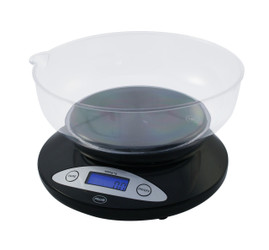
Subtracting an empty container's mass from its filled mass is a familiar way to calculate net contents. The arithmetic is simple. The measurement is reliable only when the two observations describe the same container arrangement under suitable conditions.
The practical question is: Does subtracting container weight give a reliable net weight on a digital scale? It can, provided the container value is appropriate, the gross measurement is suitable, and the method controls changes between them. Subtraction does not independently correct an inaccurate input, a missing accessory, or a changing sample.
This guide explains how to plan gross-minus-tare measurements, compare manual subtraction with the tare button, and avoid common errors involving stored container values. The aim is a net result whose meaning can be checked from the original observations.
Define gross tare and net before weighing
Gross mass is the combined mass of the contents and the included container arrangement. Tare mass is the mass assigned to that container arrangement. Net mass is the difference between them.
The word “container” needs a clear definition. It may include a lid, liner, label, divider, or another component that remains with the contents during the gross measurement.
Write down what belongs in each quantity. A calculation can be numerically correct while answering the wrong question if the gross and tare measurements include different accessories. Clear definitions prevent that mismatch before it enters the record.
Use the same physical arrangement
If you weigh a jar with its lid during the gross measurement, the matching empty-container measurement should include the lid when the intended result is the contents alone.
If the empty jar is measured without that lid, subtraction leaves the lid's mass in the calculated net result. The instrument has no way to identify that interpretation error.
Keep accessories together during preparation. If the task intentionally excludes or includes a component, state it in the method. A consistent arrangement is more important than relying on the general label “empty container.”
Follow the model's instructions
The tare button, zero function, stored tare feature, and manual subtraction procedure may behave differently across instruments. Some models do not support every option.
Use the AWScales product manuals for the exact instrument. Confirm startup, supported units, loading limits, and any relevant tare instructions before beginning.
Do not apply a button sequence from a similar-looking scale or assume that a retained display represents a new measurement. The procedure should establish which value is currently live, which is stored, and what reference the indication uses.
Manual subtraction and tare share an underlying comparison
Manual subtraction records gross and container values separately, then calculates the difference. A tare operation establishes a reference and displays subsequent load relative to that reference.
Both methods depend on suitable measurements and a consistent arrangement. Neither method automatically recognizes which supported material belongs to the sample.
For general operating questions, consult the AWScales product FAQ. Choose the method that suits the workflow and preserves the information you need. Convenience alone does not establish that either procedure meets a particular measurement requirement.
The tare button does not increase capacity
A container continues loading the instrument after the display is tared to zero. The physical capacity must accommodate the container and contents together.
A heavy bowl can leave little available capacity even though the indicated net result begins at zero. Manual subtraction has the same physical limitation during the gross measurement.
Check the full expected load before filling. Do not plan to weigh beyond capacity and subtract the vessel later. An overloaded measurement is not made suitable by correct arithmetic, and excessive loading can affect the instrument's condition.
Small net contents can be difficult inside a heavy vessel
A small net amount remains a small measurement even when supported by a large container. The gross load does not automatically improve the instrument's ability to resolve that small difference.
Consider whether the documented performance suits both the load range and the smallest meaningful net amount. Display readability is only part of that assessment.
If the vessel is much heavier than the sample, a smaller suitable container may simplify the task. Alternatively, a different instrument or method may be needed. Define the required result before deciding that a visible subtraction is sufficient.
Calculated net weight retains input limitations
If gross mass and tare mass have measurement limitations, the calculated net result depends on those limitations and their relationships. Their uncertainties do not simply vanish through subtraction.
NIST's discussion of combined standard uncertainty explains why a calculated result requires an appropriate model of its inputs, including correlations where relevant.
Avoid assigning net uncertainty solely from the last displayed digit. A difference between two readings may need a more careful assessment, particularly when the net amount is small relative to the container or close to a decision limit.
Keep the unit explicit on both inputs
Subtract only quantities expressed in compatible units. A gross value in grams and a tare value in ounces cannot be subtracted directly as ordinary numbers.
Convert correctly when necessary, retain the original unit, and check the result. A unit abbreviation copied incorrectly can create a much larger problem than the rounding difference being investigated.
Use a consistent recording unit throughout a routine process where practical. Label gross, tare, and net separately. A number without its quantity name and unit is easy to misinterpret when it is copied into another worksheet or application.
Preserve original observations before rounding
Record the displayed gross and tare values before applying reporting conventions. Perform the calculation using appropriate retained information, then round the final result suitably for the method and task.
Rounding both inputs coarsely before subtraction can hide a small difference or shift the calculated result. A calculator's extra digits do not restore information already discarded.
Keep the original values accessible so the calculation can be checked later. If a system applies automatic rounding, understand when it occurs and whether the exported result preserves the information required for the intended comparison.
A stored tare belongs to a specific container
A saved empty-container value is useful only while it remains appropriate for the actual container and arrangement. Identify the vessel and connect that identity with the stored record.
Two containers that look alike may differ in mass. A replacement lid, label, or liner can also change the relevant tare.
Do not assign a convenient stored value to whichever vessel is nearest. If the container identity is unclear, obtain an appropriate new tare measurement rather than assuming that visual similarity establishes equivalence.
Average packaging tare introduces another question
Using an average mass from several empty packages may be practical for some internal estimates. It also introduces package-to-package variation into individual net calculations.
A correct average does not establish the actual mass of each package. One package may be heavier or lighter than the assumed value, affecting its calculated contents.
If individual net amounts matter, determine whether an average tare is suitable for that purpose. This article addresses measurement interpretation; any commercial application also needs a method appropriate to its applicable requirements. Do not silently substitute an average where an actual container value is needed.
Wet or dirty containers can change the reference
A container weighed dry and later measured with external droplets no longer has the same supported mass contribution. Residue from previous contents can create a similar mismatch.
The resulting net value may include material that the method intended to exclude. A zeroed display does not identify that contamination automatically.
Prepare the container consistently and inspect it before use. If its condition changes, reassess the tare rather than applying the earlier value indefinitely. A suitable reference describes the container's actual measurement condition, not merely its identity.
The sample and vessel can change over time
Evaporation, moisture uptake, leakage, and residue transfer can affect comparisons made at different times. The longer the interval between observations, the more important the sample history may become.
Shimadzu's guidance on sample-related weighing influences discusses moisture and other effects that can complicate measurements.
Record preparation and timing where relevant. If an empty container is weighed only after its contents are removed, establish whether that later condition represents the container contribution present during the earlier gross measurement. An apparently empty vessel may retain material.
Empty before filling and empty after use can differ
An empty-before measurement describes the prepared vessel before the sample is added. An empty-after measurement may include residue, a changed label, moisture, or another alteration.
Neither sequence is automatically correct for every task. The appropriate choice depends on the intended quantity and the handling process.
Define the sequence in advance and keep it consistent. If a later empty measurement is used to estimate an earlier container contribution, state the necessary assumptions. Avoid presenting a conditional estimate as though the container had been measured independently in the same unchanged state.
Weighing by difference may describe material removed
Weighing a source vessel before and after dispensing estimates the mass that left it, subject to the method's limitations. That is different from gross-minus-empty measurement of contents remaining in a destination container.
Material spilled or retained on a transfer tool may have left the source without reaching the intended destination. The calculated decrease does not automatically establish delivered mass.
Choose the arrangement that answers the real question. Label source loss, destination gain, and retained contents distinctly. Their values may agree in a controlled transfer, but agreement should not be assumed when the handling allows loss elsewhere.
Control contact around the container
A vessel must remain fully supported by the weighing platform without unintended contact. A handle touching the housing or a bag resting on the table creates another load path.
Tare cannot remove the effects of contact that later changes. If the empty container touches something differently from the filled container, the two observations are not mechanically comparable.
Inspect the complete arrangement before recording either value. A suitably sized container with adequate clearance is easier to manage than an oversized vessel that barely fits and shifts whenever material is added.
Use a stable location for both observations
Keep the support, instrument position, and surrounding conditions consistent during the sequence. Moving the scale between gross and tare observations introduces another change to assess.
Shimadzu's balance installation precautions address support, leveling, airflow, and temperature changes. Those principles matter to both parts of a difference measurement.
Follow the exact instrument's requirements. If the setup must change, document it and establish whether the observations remain suitable for comparison. Subtraction does not compensate automatically for a different installation or an interrupted measurement state.
Separate setup consistency from scale correctness
Repeating the same sequence can show whether the procedure gives consistent results. It cannot independently establish that all readings are free of a shared error.
NIST's measurement terminology distinguishes repeatability from other measurement concepts. Use repetition to understand variation rather than treating agreement as complete proof.
When repeatability is inadequate for the task, investigate the container, placement, sample condition, and operating procedure. Keep the actual gross and tare observations so differences in net values can be traced to their inputs.
Check with an appropriate reference
Use a suitable characterized mass reference and the manufacturer's checking procedure. An unknown filled container is not an independent standard simply because its label states a nominal amount.
NIST's work on calibration of mass standards explains the role of supported reference mass information. The reference must also be suitable for the intended instrument check.
Assess the relevant range and method rather than relying on a single familiar reading. A satisfactory basic check supports confidence in the instrument under checked conditions; it does not validate every container assumption or calculation.
Validate the complete workflow
A practical assessment should include the intended container, tare method, sample range, recording process, and calculation. The result depends on the combination.
Mettler Toledo's guidance on routine testing of balances describes checks between calibrations to identify performance problems. A workflow assessment adds information about the handling and calculation steps.
Check whether records remain connected to the right container and whether units survive transcription or export. A suitable weighing result can become unsuitable through a swapped tare value or an incorrect spreadsheet formula.
Example of a missing lid in tare
Imagine a filled jar and lid with a gross reading of 185.40 grams. The empty jar alone reads 60.00 grams, while its lid contributes another 5.00 grams in this hypothetical example.
Subtracting only the jar gives 125.40 grams. Subtracting the complete matching container arrangement gives 120.40 grams for the contents.
Both calculations follow arithmetic correctly, but only the second matches the stated contents-only objective. The difference is a definition and preparation issue. Recalibrating the scale would not correct the missing lid in the tare record.
Example of two similar containers
Imagine two visually identical trays with different empty masses. A stored tare from the first tray is used with the second tray.
The calculated net result then includes the difference between their actual masses. A stable display and correct subtraction cannot identify the container swap.
Assign a clear identifier to each tray or measure the actual container according to the procedure. If a shared average is intentionally used, record that choice and establish its suitability. Do not present it as an individually measured tare.
Example of a small net difference
Imagine a gross indication of 500.03 grams and a tare indication of 500.00 grams. Their displayed difference is 0.03 grams.
That calculation alone does not establish that the instrument and method reliably measured three hundredths of a gram. Relevant performance at those loads, repeatability, reference suitability, and the relationship between the observations still matter.
When such a small net amount is important, assess the complete method or choose a more suitable arrangement. A lighter vessel can simplify handling, but the required performance still needs support rather than inference from the arithmetic.
Handle interruptions explicitly
If the instrument restarts or the sequence is interrupted, confirm its unit, reference state, and operating mode before continuing. A retained tare or stored value may behave differently depending on the model.
Record which observations remain valid and which must be repeated. Avoid reconstructing a container value from memory when several similar vessels are present.
Keep incomplete records separate from completed measurements. This simple practice prevents an uncertain input from entering a polished final calculation. A clear unresolved record is more useful than a precise-looking net value built from an assumed tare.
Keep maintenance compatible with the procedure
Residue can alter container mass or interfere with platform clearance. Clean the instrument and vessels using methods appropriate to each.
Follow AWScales scale maintenance guidance and the model instructions for the instrument. A washable vessel may tolerate treatment that the scale does not.
After preparation, establish the correct reference condition again. Do not assume the pre-cleaning tare remains valid if the container's condition changed. Consistent maintenance supports consistent measurement when the sequence accounts for what was altered.
Select equipment around the net requirement
The instrument must accommodate the gross load and suit the smallest meaningful net difference. A capacity specification does not establish both.
Review AWScales pocket scales by individual specifications and intended use. A compact instrument can be convenient, but its suitability depends on the actual container and sample.
If the desired result cannot be resolved reliably, consider a different vessel, instrument, or procedure. Choose a solution that answers the net-mass question directly rather than relying on a subtraction that merely produces the desired number of decimals.
Keep the complete calculation record
Record container identity, included accessories, gross value, tare value, unit, net calculation, scale model, and any relevant timing or condition changes.
The AWScales knowledge center provides additional weighing explanations. Clear original observations make later review much easier than a single unexplained net number.
For model-specific questions, contact AWScales customer support. Explain the gross range, smallest net amount, vessel arrangement, and whether the tare is measured, stored, or averaged. Those details help establish the right next step.
Keep corrected results connected to their originals
If a wrong tare value is discovered, retain the original gross observation and document the corrected input. State why the replacement value applies to that container and measurement condition.
Do not overwrite the history with a new net number alone. Another person should be able to follow the correction without guessing which vessel, unit, or accessory changed.
When the correct historical tare cannot be established, identify that limitation. A fresh empty-container measurement may help only if its condition still represents the earlier arrangement. Preserve that distinction instead of assuming a later measurement repairs every past record.
Frequently asked questions
Is manual subtraction less accurate than the tare button?
Neither is universally better. Suitability depends on the instrument, input measurements, reference conditions, and recording method. Assess the actual workflow.
Can I use one empty-container value for every matching package?
Matching appearance does not prove matching mass. Establish whether a shared tare value is appropriate for the intended result and record how it was obtained.
Does tare remove container changes that happen later?
No. Tare establishes a reference at a particular time. Later moisture, residue, accessory, or contact changes can affect the indication.
Can I use gross and tare values from different scales?
Only with an appropriate assessment of both measurements and their compatibility. Different instruments introduce additional factors; subtraction alone does not establish suitability.
Why is calculated net weight slightly negative?
Check units, container identity, included components, reference state, rounding, and measurement variation. Do not replace the result with zero without investigating its meaning.
Make the container reference part of the method
Reliable net weighing starts with a matching definition of gross and tare. Use the actual intended container arrangement, suitable equipment, and a consistent preparation sequence.
Preserve original observations and verify the calculation, units, and container identity. Treat a stored or average tare as an input requiring justification, rather than a permanent fact about every similar vessel.
Subtraction is useful when the measurements support it. A defensible net result shows what was included, what was removed mathematically, and why the remaining quantity answers the intended question.