
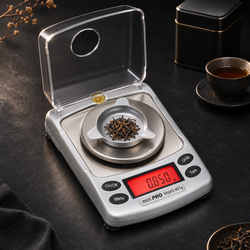
Weighing a group of small objects and dividing by their count can produce a useful average mass. It can also create a misleading impression that each object has been measured individually. Those are different conclusions, and the distinction matters when items vary.
The practical question is: Does weighing a larger sample and dividing the result improve small-item accuracy? It can make the group's average mass easier to estimate when the total is measured suitably and the count is correct. It does not prove that every item has that average mass or that a sample represents an entire batch.
For small hardware, craft components, packaging pieces, and similar objects, the best approach begins by defining the question. Decide whether you need a group total, an average for the selected items, an estimate for a larger population, or the mass of each individual piece.
Define the result you actually need
A group total describes the combined mass of the objects on the platform. Dividing that total by the number of objects gives their arithmetic mean mass.
An individual measurement describes one object. An estimated batch mean goes further by using selected objects to infer something about objects that were not measured. Each result requires different evidence.
Write the intended result before collecting data. “Average mass of these twenty washers” is a clear measurement objective. “Every washer weighs this amount” is a much stronger statement that the same group measurement cannot establish.
Start with the arithmetic
For a correctly counted group, average item mass equals net group mass divided by item count. The net group mass must exclude the container and unrelated material.
If twenty hypothetical pieces have a measured net total of 6.00 grams, their calculated average is 0.300 grams per piece. This arithmetic describes the group, subject to the quality of the total measurement and count.
The extra decimal place in the quotient does not independently establish the uncertainty of the answer. A calculator can display many digits from a limited measurement. Report the result with a precision supported by the complete method.
Why a larger load can help
An individual item may produce a reading close to the instrument's display increment. Combining items can create a larger, more readily resolved total.
If the uncertainty associated with the group total is suitable, dividing that uncertainty by an exact count gives its corresponding contribution to uncertainty in the selected group's mean. This does not mean every uncertainty source disappears.
NIST's discussion of combined standard uncertainty explains why a calculated result depends on its input quantities and their relationships. The practical lesson is to assess the inputs rather than judging the answer by its displayed digits.
A group average does not describe every member
Consider two hypothetical objects weighing 0.20 and 0.40 grams. Their average is 0.30 grams, although neither object has that mass.
The same issue remains with larger groups. Light and heavy pieces can offset one another in the total, producing an average close to a target while individual pieces differ substantially.
If the task requires every item to meet a limit, an average alone is insufficient. Use an appropriate individual assessment or a justified inspection procedure designed for that requirement. A convenient group measurement should not silently replace the original question.
Keep product variation separate from measurement variation
Two groups can have different totals because their members differ, because the weighing process varies, or because both effects are present.
Repeating the same group's measurement helps examine weighing consistency. Selecting a different group introduces item variation as another influence. These comparisons should be recorded separately.
NIST's measurement terminology describes repeatability under consistent measurement conditions. Use that distinction when planning checks so a change in sample membership is not mistaken for a change in scale performance.
Verify the item count
A division calculation is only as useful as its denominator. One missing or extra piece can change the average even when the scale measures the total correctly.
Count the sample using a consistent arrangement, such as small verified subgroups. Keep it separate from the remaining inventory until the measurement and record are complete.
Do not use an uncertain count to establish an average and then cite that average as proof of the count. That reasoning is circular. When the count is an input, establish it independently enough to support the intended calculation.
Tare the actual empty container
Place the empty container on the scale and establish tare according to the model instructions. Then add only the counted sample.
If a label, divider, liner, or lid is included during the loaded measurement, account for it consistently. An accessory added after tare becomes part of the indicated net load.
Use the AWScales product manuals for the exact procedure. Tare is a reference operation; it does not identify which part of the supported load belongs to your sample. The arrangement must supply that distinction.
Remember the full physical load
The container remains part of the load on the instrument after tare. Capacity must accommodate the container and all sample pieces together.
Increasing sample size eventually encounters practical limits: capacity, available platform space, stable containment, and handling. A larger group is useful only while the instrument can support and measure it appropriately.
Do not fill beyond the documented capacity simply to obtain a finer calculated average. A suitable sample size balances the measurement objective with the instrument and container. If those requirements conflict, consider different equipment or a revised method.
Choose equipment for the group and the question
Review capacity, readability, repeatability, platform dimensions, and documented operating requirements. The individual item's mass and the intended group total both matter.
When comparing AWScales pocket scales, use the individual product specifications. A portable instrument may fit a small-parts task, but the category name does not establish suitability for every average-mass calculation.
If you need to evaluate the spread between individual pieces, equipment suited only to the group total may leave that question unanswered. Choose the method around the required result rather than adapting the conclusion to the available display.
Control material that does not belong in the sample
Dust, oil, loose packaging, and residue can contribute to a group reading. Small unintended contributions may matter when they are comparable to the differences you intend to assess.
Define the item condition consistently. For example, distinguish components as received from components prepared by an established cleaning procedure. Do not mix these conditions within a comparison without recording the change.
Avoid cleaning or altering items merely to make readings agree. The measured condition should match the task. If a surface coating belongs to the product, removing it changes the object you are measuring.
Consider moisture and other changing conditions
Some materials absorb moisture or lose volatile components. Handling can also change temperature or static charge. A sample total can change for reasons unrelated to the number of pieces.
Shimadzu's explanation of sample-related weighing influences discusses static electricity, moisture absorption, and evaporation. Their importance depends on the sample and measurement requirements.
Use consistent preparation, timing, and containers. If a group drifts while sitting on the platform, investigate the sample and environment before dividing the changing number by its count. Arithmetic cannot make an unstable input well defined.
Check the scale with a suitable reference
A sample of parts is not a calibration standard simply because it has been weighed before. Its mass may be uncertain, and its membership or condition may have changed.
Use an appropriate reference weight and the manufacturer's checking procedure. NIST's work on calibration of mass standards describes the role of characterized mass references.
Keep the reference check separate from the sample calculation. A successful check supports confidence in weighing performance under the checked conditions. It does not establish sample representativeness or demonstrate that the pieces are uniform.
Repeat the same group before changing groups
Begin with the counted group you intend to measure. Remove and replace it using a consistent procedure, or follow another appropriate repeatability check for the method.
Record the observed spread. If repeated totals differ enough to affect the conclusion, improve the arrangement or reassess instrument suitability before interpreting differences between separate groups.
Once the same-group method is sufficiently consistent, different groups can provide information about sample variation. Keeping these stages distinct makes the results easier to interpret and prevents product differences from hiding an unresolved weighing problem.
A convenient sample may not represent the batch
Pieces taken from the top of a bin may differ from pieces elsewhere. Components can become separated by size, handling, production sequence, or other characteristics.
A sample average can describe the selected sample accurately while providing a poor estimate of the wider batch. Better measurement of the selected pieces cannot correct an unrepresentative selection.
Choose a sampling method appropriate to the decision and the batch structure. If you only measured a convenient handful, label the result accordingly. Do not present it as a validated estimate for every item in storage.
Keep different lots and item types separate
Similar-looking pieces may come from different production lots, suppliers, materials, or revisions. Combining them creates an average for the mixture rather than a clear description of either group.
Record the identifiers that matter to the task. If the goal is to compare lots, retain separate samples and totals instead of blending them before measurement.
A mixed average can conceal a practical difference. For example, two groups with different average masses may produce a combined mean that matches a target. The combined figure does not show that either source group behaves as expected.
Track spread as well as the average
A stable average can coexist with changing variation between items. If uniformity matters, information about the spread is necessary.
NIST's explanation of variables control charts emphasizes examining variability as well as the mean in process monitoring. That principle explains why an average alone can miss a change that matters.
For a simple inventory task, you may only need a group mean. For a task involving consistency of individual components, use a method that can reveal their differences. Match the recorded statistics to the decision rather than collecting an average by default.
Investigate unusual results without deleting them automatically
One unusually heavy piece may be a different part, an attached contaminant, a recording error, or a genuine member of a variable population.
NIST's guidance on detection of outliers distinguishes possible erroneous data from observations that may contain useful information. An unexpected value deserves investigation rather than automatic removal.
If an identified mistake is corrected, keep a clear record of what changed. If the item is genuine, excluding it simply because it moves the average away from a preferred number can misrepresent the group.
Do not discard a group because its total looks inconvenient
The same principle applies to entire samples. Choosing a replacement sample only when the first average seems wrong can bias the record.
Define the selection and handling procedure in advance. If a measurement fails because of a spill, count uncertainty, or contact problem, record that reason and repeat appropriately.
A result that differs from expectation is not itself evidence of failure. Separate documented procedural problems from legitimate sample variation. This makes the final average more useful and preserves evidence that may explain differences elsewhere in the workflow.
Distinguish average-mass estimation from parts counting
Average mass can be an input to estimating the count of an unknown group. That method requires the reference average to suit the group being counted and the instrument to support the required discrimination.
Variation in piece mass can affect the estimate. A reference sample containing unusually heavy parts may lead to a different count estimate from one containing lighter parts.
For operating questions, consult the AWScales product FAQ and the model's counting instructions where applicable. Do not assume an average-mass calculation automatically provides an exact inventory count.
Example of identical totals with different pieces
Imagine two groups of ten pieces, each with a net total of 5.00 grams. Each group therefore has a calculated mean of 0.50 grams per piece.
One group could contain pieces clustered closely around that mean. The other could contain a wider mixture of light and heavy pieces. The totals alone cannot distinguish those situations.
If the task only concerns the selected groups' average mass, both results answer it. If the task concerns individual uniformity, additional measurements are needed. The required conclusion determines whether the group totals are enough.
Example of a counting error
Imagine a group recorded as twenty pieces with a measured total of 8.40 grams. Dividing by twenty gives 0.420 grams per piece.
If the group actually contains twenty-one pieces, the mean is 0.400 grams. The scale reading can be correct while the calculated average is wrong because the count was entered incorrectly.
Recounting the actual measured sample can resolve this specific issue if its membership has remained intact. Once pieces have been mixed back into inventory, reconstructing the original count may be impossible. Keep the sample separate until verification is complete.
Example of pooling unequal groups
Suppose one hypothetical group contains ten pieces averaging 0.40 grams and another contains thirty pieces averaging 0.60 grams. Their totals are 4.00 and 18.00 grams.
The combined average is 22.00 grams divided by forty pieces, or 0.55 grams per piece. Averaging the two group means directly would give 0.50 grams and would ignore their unequal counts.
When combining groups, use total net mass divided by total count, with compatible measurements and item definitions. Keep the original group results when differences between sources matter, even if a pooled average is also useful.
Preserve the group until the result is checked
Keep the measured pieces together while you verify the count, unit, tare treatment, and calculation. Returning them to a larger container too early can prevent a useful recount or repeat measurement.
A simple sample identifier connects the physical group to its recorded total. If several groups are waiting for measurement, separate them clearly so totals and counts cannot be exchanged accidentally.
This handling step does not improve the scale's specifications, but it protects the relationship between the observations and the objects they describe. That relationship is essential when investigating an unexpected average later.
Report calculated digits with restraint
A calculator may show a long quotient, but the measurement does not gain unlimited information through division. The reported precision should reflect the inputs and intended use.
Retain original totals and counts so later calculations can be checked. Avoid repeatedly rounding intermediate values and then using those rounded numbers in another calculation.
If uncertainty must be quantified, use an appropriate measurement model rather than assigning a tolerance from the final decimal place. A clear result with a realistic limit is more informative than an extended number that implies unsupported certainty.
Keep a record that preserves the sample definition
Record the item type, lot or source, selection method, count, net total, unit, container treatment, scale model, and calculated average. Include repeated totals where they are relevant.
State whether the figure describes only the measured group or is being used as an estimate for a wider population. That distinction should remain visible wherever the result is copied.
The AWScales knowledge center provides additional explanations of weighing concepts. Clear sample records allow another person to assess the calculation and its scope without guessing how the pieces were selected.
Maintain a clean and consistent weighing arrangement
Debris around the platform, container contact, and inconsistent placement can introduce avoidable differences. Inspect the setup before preparing another sample.
Follow AWScales scale maintenance guidance and the model instructions. Use cleaning methods suitable for the instrument and keep liquids out of areas not designed for them.
After cleaning or changing the container, establish the correct tare and confirm normal operation. A comparison between samples is easier to interpret when the support, clearance, and handling procedure remain consistent.
Ask support about the measurement objective
Explain whether you need the average of a measured group, an estimated inventory count, or individual item measurements. Include the expected item mass, group size, total load, and acceptable variation.
Describe the container arrangement and any observed repeatability problem. A statement such as “twenty pieces produce inconsistent totals after replacement” gives more useful information than saying the average looks inaccurate.
Contact AWScales customer support for model-specific capabilities and checking procedures. For a population sampling decision, seek an appropriate sampling method as well as suitable weighing equipment.
Frequently asked questions
Does a larger sample always give a better answer?
No. The total must be measured suitably, the count must be correct, and the sample must fit the question. A larger unrepresentative sample can still misdescribe a batch.
Can I assign the calculated average to every item?
The average describes the group. It does not establish each member's mass. Individual differences require an appropriate method to observe them.
Should I round each individual reading before averaging?
Preserve original observations and avoid unnecessary intermediate rounding. Report the final result with precision supported by the method and inputs.
Can I use a previous sample average for another lot?
Only if its suitability for that use is established. Different lots may have different average masses or variation. Similar appearance is insufficient evidence.
Does a stable total prove uniform pieces?
No. Different combinations of light and heavy pieces can have the same total. Stability of the display and uniformity of the items are separate questions.
Use the average for the conclusion it supports
Weighing a counted group can make average-mass estimation practical when individual items are small. Its usefulness depends on the total measurement, count, sample condition, and purpose.
Keep weighing variation separate from differences between pieces. Preserve the original sample definition and avoid extending a selected group's mean to individual items or a larger batch without supporting evidence.
A useful average is a clearly defined result with a traceable calculation. It becomes more valuable when the record also shows whose average it is, how it was obtained, and which questions it leaves unanswered.