
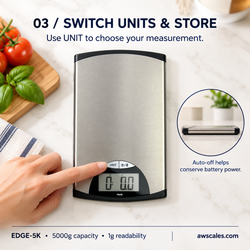
The American Weigh Scales EDGE-5K is worth considering for everyday kitchen weighing when you need substantial capacity and whole-gram display increments. Its stainless steel and black plastic construction suits a straightforward countertop setup for ingredients, food portions and larger quantities.
Its main appeal is the ability to accommodate heavier loads than many pocket scales. Buyers measuring tiny additions or needing sub-gram detail should compare finer-readability equipment.
This EDGE-5K review examines published manufacturer information rather than independent hands-on testing.
EDGE-5K Specifications at a Glance
The EDGE-5K digital kitchen scale has the following published specifications.
| Specification | Published detail |
|---|---|
| Maximum capacity | 5000g / 5kg, approximately 11lb |
| Readability in grams | 1g |
| Listed ounce readability | 0.1oz |
| Listed modes | lb, fl, g and ml |
| Listed calibration mass | 5kg, not included |
| Display | LCD |
| Construction | Stainless steel and black plastic |
| Additional listed feature | Automatic shutoff |
| Operating temperature | 50°F–86°F / 10°C–30°C |
The reviewed product page contains inconsistent dimension and power fields. Exact measurements and battery requirements are therefore excluded here; confirm them with AWS or the documentation supplied with your unit.
What Does 5000g × 1g Mean?
The specification combines two different properties.
5000g is the maximum load. The container, contents and any accessories resting on the weighing surface all contribute to that limit.
1g is the readability. In gram mode, the display changes in whole-gram increments.
For background on metric mass measurement, see NIST’s guide to mass units.
A reading of 350g shows the indicated mass at the available display resolution. It does not establish that the true value is within one gram of that result.
Readability Is Different From Minimum Sample Weight
A scale that displays whole grams should not automatically be assumed capable of reliably measuring a one-gram sample.
The smallest suitable working load depends on actual performance and your acceptable tolerance. Very small quantities can have a large relative error even when the absolute error appears modest.
How Accurate Is the EDGE-5K?
The listing establishes capacity and readability but does not provide enough independently verified performance information for this review to assign a numerical accuracy rating.
Three concepts help explain what buyers should evaluate:
| Term | Meaning |
|---|---|
| Readability | The smallest displayed increment |
| Repeatability | Agreement between repeated measurements of the same object |
| Accuracy | Agreement with an appropriate reference value |
A scale can repeat a result consistently while showing an offset from a reference. Readings may also vary between trials.
For the EDGE-5K, the practical question is whether performance meets your tolerance at the quantities you normally weigh.
A Simple Consistency Check
You can examine repeatability by weighing the same suitable object several times:
-
Set up the scale according to its instructions.
-
Place the object near the center.
-
Allow the indication to settle and record it.
-
Remove the object and check zero return.
-
Repeat under consistent conditions.
An ordinary object can reveal inconsistent readings. It cannot establish absolute accuracy unless its mass is appropriately known.
Capacity: Remember the Bowl
The maximum load includes your container.
For example:
| Container | Contents | Combined load | Capacity fit |
|---|---|---|---|
| 300g | 1000g | 1300g | Within the limit |
| 1000g | 2500g | 3500g | Within the limit |
| 1500g | 4000g | 5500g | Exceeds the limit |
These examples illustrate capacity rather than verified measurement performance.
Tare Does Not Increase Capacity
Tare subtracts a container’s indicated weight from the display. Its physical load remains on the sensor.
A 1kg bowl leaves a theoretical 4kg of contents capacity. Leave headroom while adding material instead of planning around the absolute maximum.
Make sure the container rests securely and touches no other support. Contact with the table or housing can interfere with weighing.
Features That Matter in Everyday Use
Kitchen-Oriented Capacity
The EDGE-5K can accommodate loads that exceed many pocket-scale limits. That may reduce the need to split a recipe or food quantity across separate measurements.
Capacity still needs to be considered alongside container fit and display visibility.
Stainless Steel and Black Plastic Construction
The listed materials provide a practical kitchen format.
Follow the supplied cleaning instructions and keep moisture away from electronic openings. Do not assume the scale is waterproof or dishwasher safe.
Multiple Display Modes
The available modes can support recipes and records using different conventions.
Confirm the unit before weighing and recording results. A familiar-looking number can be misleading when the scale is set to another mode.
Automatic Shutoff
Automatic shutoff can help conserve power between uses.
For longer preparation sessions, record measurements promptly and follow the supplied instructions. Do not assume a reading will remain available indefinitely.
Best Uses for the EDGE-5K
Baking and Larger Ingredient Quantities
The EDGE-5K is a candidate for flour, sugar and other substantial ingredient quantities when whole-gram readability meets the recipe’s requirements.
Its load capacity may accommodate a mixing bowl and several ingredients together. Calculate that combined load before starting.
For alternative formats and capacities, explore the AWS kitchen scale range.
Meal Prep and Food Portions
The scale may suit weighing food portions and grouped meal ingredients when its checked performance is appropriate.
Use a clean container, select the intended unit and allow the indication to settle before recording the result.
A scale measures mass. Nutritional estimates also depend on using the correct food information and preparation state.
Produce and Batch Preparation
Larger quantities of produce may fit comfortably within capacity.
Keep items contained and positioned securely. A bulky container should not obstruct the display or contact the surrounding work surface.
Bulk Craft Materials
The EDGE-5K may suit heavier craft materials when whole-gram increments are sufficient.
For mixtures, follow the supplier’s required proportions and tolerance. If a process depends on small sub-gram additions, choose more suitable equipment.
When Whole-Gram Readability Is Too Coarse
The EDGE-5K cannot display individual sub-gram differences in gram mode.
If your task requires observing a 0.2g or 0.5g addition, compare equipment with finer readability and verified performance at that load.
The LB-3000 digital bowl scale is one AWS option with tenths-of-a-gram readability and lower capacity. Its suitability still depends on your container weight and tolerance.
For very small samples, a finer display alone remains insufficient; establish an appropriate working range.
Understanding Milliliter and Fluid-Ounce Modes
The EDGE-5K lists volume modes, but a scale measures mass. A volume indication converts that measurement using an assumed density.
Do not assume those modes accurately represent every liquid. Water, oil and syrup do not all have the same density.
Follow the model’s instructions for supported liquids and settings. When necessary, use a suitable density conversion or measure volume directly.
Fluid ounces describe volume, while ounces can describe mass. The NIST SI units reference provides background on standardized units and notation. Record units alongside values.
Calibration and Performance Checks
The product listing identifies a calibration mass. Confirm the applicable procedure through the AWS scale manuals or AWS support before attempting an adjustment.
Do not substitute objects of assumed weight or borrow instructions from another kitchen scale.
NIST’s calibration overview explains how instrument indications relate to reference values. Some consumer-scale routines also adjust the instrument’s response.
Verify at Your Typical Working Loads
Completing a calibration procedure does not establish acceptable performance across every load.
Use suitable reference weights near your normal working range, repeat measurements and compare results with your tolerance.
Keeping records can help reveal changes over time. NIST’s guidance on check standards describes using reference checks to monitor measurement performance.
An AWS calibration weight kit may provide useful masses, but confirm that it contains the required weight and has suitable specifications.
A nominal weight value does not establish certified traceability. NIST’s metrological traceability guidance explains the documented calibration chain needed to relate results to a reference.
How to Get More Consistent Results
Use a firm, level surface away from vibration and drafts.
Keep the weighing surface and container clean, center the load and allow the indication to settle. Ensure all scale feet are supported and the bowl touches no other surface.
If readings fluctuate, inspect the setup and power supply before recalibrating. Calibration cannot correct an overloaded platform or a container partly supported by the table.
EDGE-5K Advantages and Limitations
| Advantages | Limitations |
|---|---|
| Useful capacity for larger kitchen quantities | Whole-gram readability is too coarse for some small additions |
| Multiple display modes | Volume modes depend on density assumptions |
| Automatic shutoff | Long sessions require attention to displayed results |
| Stainless steel and black plastic construction | Waterproofing should not be assumed |
| Kitchen-oriented working format | Exact power and dimension details need confirmation |
The strongest reason to consider the EDGE-5K is its capacity for everyday food quantities.
Commercial Weighing Considerations
Check applicable equipment requirements before selling goods by weight.
Capacity, readability and a calibration function do not establish legal-for-trade approval. NIST’s weighing and scales FAQs provide background on commercial weighing requirements.
Frequently Asked Questions
Is the EDGE-5K accurate to one gram?
Its published readability is 1g. That specification alone does not establish a guaranteed accuracy of ±1g.
Can it weigh 5kg of ingredients after taring a bowl?
The bowl and ingredients must remain within the total capacity. Tare does not remove the bowl’s physical load.
Is it suitable for jewelry or gemstones?
Its whole-gram readability is too coarse for tasks requiring small sub-gram differences to be displayed. Compare equipment designed for the required tolerance.
Can it measure any liquid in milliliters?
Do not assume that. Follow the supported settings and density assumptions described in the instructions.
Where can I find operating help?
Consult the supplied manual and AWS product FAQs for guidance relevant to your model.
Should You Buy the EDGE-5K?
The EDGE-5K is worth considering for baking, meal prep and larger ingredient quantities when whole-gram readability and checked performance meet your needs.
Calculate the full load, confirm container fit and verify the missing power or dimension details before purchasing. For small additions, select equipment with the readability and performance your task requires.