
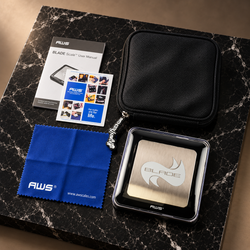
A reliable fishing tackle scale can help anglers identify mixed sinkers, compare jig heads, document lure modifications, organize hooks, and build consistent tackle kits. The right scale can reveal differences too small to judge by sight, but buying one requires more than selecting the model with the most decimal places.
The most important specifications are accuracy, capacity, readability, minimum useful load, repeatability, and calibration. Practical features such as tare, measurement units, platform size, display visibility, automatic shutoff, and a protective cover also influence how useful the scale will be.
For most anglers and lure makers, a digital scale with 0.01-gram readability and a capacity between 200 and 1,000 grams provides the best general-purpose combination. Smaller milligram scales suit extremely lightweight fly-tying components, while higher-capacity bench scales work better for bulk sinkers and complete tackle kits.
American Weigh Scales offers multiple digital pocket scales for hobbies, components, sorting, inventory, and portable precision measurement.
Quick Fishing Tackle Scale Recommendations
| Primary application | Suggested capacity | Suggested readability |
|---|---|---|
| Tiny fly-tying components | 20–100 g | 0.001 g |
| Hooks, swivels and split rings | 100–300 g | 0.01 g |
| Jig heads and small sinkers | 200–500 g | 0.01 g |
| Completed freshwater lures | 500–1,000 g | 0.01 g |
| Large lures and bulk tackle | 1,000–2,000 g | 0.1 g |
| Shipping packages | Based on parcel | Carrier-appropriate |
These ranges are general starting points. Your final choice should reflect the lightest item, heaviest load, and smallest meaningful difference in your own tackle collection.
Understanding Scale Accuracy
Accuracy describes how closely a scale’s result agrees with the item’s actual weight under specified conditions.
A scale displaying 7.09 grams is not automatically accurate to the final hundredth simply because the screen shows two decimal places. Accuracy depends on the scale’s design, calibration, repeatability, environmental conditions, and proper use.
Factors That Affect Accuracy
Fishing tackle measurements may be influenced by:
-
Incorrect calibration
-
Wind or air-conditioning
-
Table vibration
-
Boat movement
-
Rapid temperature changes
-
Static electricity
-
Weak batteries
-
An uneven surface
-
Off-center loading
-
Platform contamination
-
Overloading
-
An object touching the table
-
Magnetic equipment nearby
NIST’s Office of Weights and Measures provides broader information about measurement standards, traceability, and reliable weighing practices.
Accuracy vs. Readability
Accuracy and readability are related but different.
Readability is the smallest displayed increment. If a scale reads in 0.01-gram increments, it may display:
7.08 g, 7.09 g, 7.10 g
That does not guarantee each result is accurate within 0.01 gram.
A scale can have fine readability but poor calibration or unstable performance. Likewise, a dependable 0.1-gram scale may be more useful for heavy tackle than a sensitive milligram scale used in a windy environment.
American Weigh Scales offers precision scales with multiple capacity and readability combinations.
Understanding Repeatability
Repeatability describes how closely repeated measurements of the same item agree when conditions remain unchanged.
How to Check Repeatability
-
Place the scale on a stable, level workbench.
-
Turn it on and allow it to initialize.
-
Place a lightweight tray on the platform.
-
Press tare.
-
Add one clean, dry jig head.
-
Record the result.
-
Remove the jig head.
-
Wait for the display to return to zero.
-
Repeat five times.
If the measurements vary significantly, check for drafts, vibration, weak batteries, dirt, improper placement, or calibration issues.
Repeatability is important when comparing nearly identical hooks, swivels, or lure builds.
Understanding Capacity
Capacity is the maximum load the scale is designed to support.
Low-Capacity Scales
A scale with a capacity between 100 and 300 grams works well for:
-
Individual hooks
-
Swivels
-
Snaps
-
Split rings
-
Beads
-
Jig heads
-
Small sinkers
-
Fly-tying weights
-
Compact lures
The AC PRO-200 Digital Pocket Scale is a compact option for lightweight components within its stated capacity.
Medium-Capacity Scales
A scale holding 500 to 1,000 grams is useful for:
-
Larger sinkers
-
Saltwater jig heads
-
Completed lures
-
Small tackle kits
-
Groups of hooks
-
Hardware packages
-
Lure-making materials
This range is usually the most versatile for general fishing-tackle work.
Higher-Capacity Scales
A capacity of 2,000 grams or more may be appropriate for:
-
Bulk sinkers
-
Heavy saltwater lures
-
Multiple tackle kits
-
Inventory containers
-
Product packaging
-
Small shipping parcels
The American Weigh 2000 × 0.1-gram Bench Scale provides additional capacity where tenth-gram readability is sufficient.
Include the Container in Your Capacity Calculation
Small components should often be placed in a tray so they do not roll, fall, or catch beneath the platform.
The tray’s weight counts toward capacity even after pressing tare.
If a tray weighs 80 grams and holds 175 grams of sinkers:
80 + 175 = 255 grams total load
That combination would exceed a 200-gram scale’s maximum capacity, even though the display shows only 175 grams after tare.
Choose a scale with enough capacity for the tackle, tray, packaging, and a reasonable safety margin.
Choosing the Right Readability
One-Gram Readability
Whole-gram readability is suitable for large sinkers, heavy tackle kits, and packages. It is usually too coarse for individual hooks and terminal tackle.
One-Tenth-Gram Readability
A 0.1-gram scale works for:
-
Large jig heads
-
Medium and heavy lures
-
Completed rigs
-
Bulk hooks
-
Larger sinkers
-
Tackle kits
One-Hundredth-Gram Readability
A 0.01-gram scale is the strongest general-purpose choice for:
-
Hooks
-
Swivels
-
Snaps
-
Split rings
-
Jig heads
-
Small sinkers
-
Beads
-
Blades
-
Soft plastics
-
Completed lures
One-Thousandth-Gram Readability
A 0.001-gram scale can measure very lightweight fly-tying components, but it requires controlled conditions.
American Weigh Scales’ milligram scales are intended for applications requiring finer displayed increments.
Understanding Minimum Useful Load
Maximum capacity tells you the heaviest permissible load. The minimum useful load helps determine whether the scale can respond consistently to the lightest item.
If a single hook is too light for a stable measurement, weigh several identical hooks and calculate the average.
If 40 hooks weigh 16.80 grams:
16.80 ÷ 40 = 0.42 gram per hook on average
This calculation produces an average and does not prove every hook is exactly the same.
Choosing Measurement Units
Grams
Grams are the easiest unit for detailed tackle comparisons because they use decimals.
Ounces
Many sinkers and jig heads are marketed in fractional ounces. Common approximate conversions include:
| Nominal size | Approximate grams |
|---|---|
| 1/32 oz | 0.89 g |
| 1/16 oz | 1.77 g |
| 1/8 oz | 3.54 g |
| 1/4 oz | 7.09 g |
| 3/8 oz | 10.63 g |
| 1/2 oz | 14.17 g |
| 3/4 oz | 21.26 g |
| 1 oz | 28.35 g |
These conversions do not guarantee that a finished product matches its labeled nominal weight.
Grains
Grain mode may be useful for lightweight tackle. A grain and a gram are different units, so confirm the display before recording results.
Why Tackle May Differ From Its Labeled Weight
A jig head or lure may differ from the advertised nominal weight because of:
-
Manufacturing tolerances
-
Material composition
-
Hook weight
-
Paint
-
Clear coat
-
Eyes
-
Skirts
-
Split rings
-
Attached blades
-
Soft-plastic trailers
A 1/4-ounce jig head is nominally associated with approximately 7.09 grams, but the complete finished lure may weigh more.
Record whether your measurement includes the hook and finishing components.
Calibration Explained
Calibration compares or adjusts the scale using a known reference mass.
Calibration may be needed after:
-
Transportation
-
Battery replacement
-
Long storage
-
A significant temperature change
-
A minor impact
-
Unexplained measurement drift
-
Moving to a new workbench
American Weigh Scales offers compatible calibration weights for scale maintenance.
Never Calibrate With a Sinker
A fishing sinker is not a certified reference weight. Even if it is marked 1 ounce, the actual mass may differ from 28.35 grams.
Use only the calibration mass and procedure specified by the scale manufacturer.
General Calibration Process
The exact sequence varies by model, but a typical process may involve:
-
Placing the scale on a level surface
-
Allowing it to acclimate
-
Turning it on
-
Entering calibration mode
-
Confirming the requested mass
-
Placing the correct weight at the platform’s center
-
Waiting for confirmation
-
Removing the weight
-
Testing the scale
Always use the instructions for the specific model.
Calibration Is Not Commercial Certification
Calibrating a personal pocket scale does not automatically make it legal for commercial transactions.
If tackle is sold by weight, consult the appropriate regulatory authority about:
-
Legal-for-trade approval
-
Inspection
-
Certification
-
Required units
-
Customer-visible displays
-
Tare procedures
-
Labeling
NIST’s current Handbook 44 addresses technical requirements for commercial weighing and measuring equipment.
Platform Size and Shape
Small Platforms
Small platforms suit hooks, swivels, jig heads, and individual sinkers. They also keep a pocket scale compact.
Larger Platforms
A larger platform helps with:
-
Long hard baits
-
Spinnerbaits
-
Larger jig heads
-
Bulk hardware
-
Tackle packages
-
Weighing trays
An item can extend beyond the platform if it remains fully supported and touches nothing else.
Protective Cover and Weighing Tray
A protective cover helps prevent hooks and sinkers from pressing against the load cell during storage.
Some covers can also be used as weighing trays. Check the manufacturer’s instructions.
A good tray should be:
-
Lightweight
-
Stable
-
Dry
-
Clean
-
Nonmagnetic when necessary
-
Large enough to contain components
-
Small enough to avoid touching the table
Display and Automatic Shutoff
A backlit display improves visibility in a garage, workshop, vehicle, or fishing cabin.
Check whether a large lure or tray blocks the screen.
Automatic shutoff saves battery power but can interrupt lure assembly. Look for an adjustable delay or a setting that can be disabled during longer workbench sessions.
Weighing Jig Heads
To document a jig accurately:
-
Weigh the unfinished jig head.
-
Record the result.
-
Apply paint or coating.
-
Weigh it again.
-
Add eyes, skirt, blade, or other hardware.
-
Record the finished weight.
If an unfinished jig weighs 7.05 grams and the completed jig weighs 7.52 grams:
Added material = 7.52 − 7.05 = 0.47 gram
Weighing Hooks, Swivels and Rings
Individual terminal-tackle components may be lightweight enough to require 0.01-gram readability.
Use a tared tray and protect the scale from drafts.
If one component does not register consistently, use batch averaging rather than assuming the unstable reading is correct.
Weighing Custom Lures
A lure-building specification might include:
-
Blank: 8.25 grams
-
Internal weight: 3.00 grams
-
Hooks: 2.15 grams
-
Split rings: 0.42 gram
-
Finish: 0.30 gram
-
Completed lure: 14.12 grams
These figures are illustrative.
Record configuration details because changing hook size, rings, or finishing materials can affect the completed weight and balance.
Outdoor Use
Precision scales work best on stable indoor surfaces.
Wind
A breeze can affect lightweight components and sensitive load cells.
Boat Movement
A rocking boat prevents stable precision measurement. Weigh tackle on land or when the vessel is secured and sufficiently stable.
Water
Do not assume a pocket scale is waterproof. Keep it away from rain, spray, bait residue, and saltwater.
Temperature
Allow the scale to adjust after moving it between air conditioning, a hot vehicle, or direct sunlight.
Vibration
Keep it away from engines, pumps, speakers, and unstable tables.
Lead Tackle Precautions
Some sinkers and jig heads contain lead. The EPA provides information about lead exposure, and the CDC explains approaches to preventing lead exposure.
When handling tackle that may contain lead:
-
Keep it away from children.
-
Never place it in your mouth.
-
Wash your hands afterward.
-
Keep it away from food surfaces.
-
Avoid sanding or grinding.
-
Clean the workspace.
-
Follow product warnings.
-
Check local restrictions.
A scale used with lead, bait, oils, or dirty fishing equipment should remain dedicated to nonfood use.
Environmental Responsibility
Lost tackle and fishing line can contribute to aquatic debris and harm wildlife. NOAA discusses the effects of lost and abandoned fishing gear.
Anglers can reduce waste by:
-
Securing tackle compartments
-
Inspecting knots and hardware
-
Retrieving tackle when safe
-
Recycling fishing line
-
Disposing of damaged equipment properly
-
Following local tackle-material restrictions
The U.S. Fish and Wildlife Service provides general fishing information, but current rules should be confirmed with the authority responsible for the particular fishing location.
Fishing Tackle Scale Buying Checklist
Before purchasing, confirm:
-
The maximum capacity
-
The displayed resolution
-
The minimum useful load
-
The platform dimensions
-
The tray weight
-
Available measurement units
-
Tare functionality
-
Calibration procedure
-
Required calibration weight
-
Display visibility
-
Automatic-shutoff options
-
Battery type
-
Protective cover
-
Water-resistance rating, if any
-
Warranty and support
Common Buying Mistakes
Selecting Only by Decimal Places
More digits do not guarantee better real-world measurements.
Selecting Only by Capacity
A high-capacity scale may be too coarse for individual components.
Forgetting Container Weight
The tray consumes part of the available capacity.
Using a Hanging Fish Scale
A fish scale designed for pounds or kilograms is not sensitive enough for small tackle.
Assuming Waterproof Construction
Pocket-size electronics are not automatically protected from moisture.
Calibrating With Coins or Sinkers
Use the reference specified by the manufacturer.
Using One Scale for Every Task
Tiny hooks and shipping packages may require separate scales.
Frequently Asked Questions
What accuracy do I need for fishing tackle?
Most anglers benefit from 0.01-gram readability and good repeatability. Actual accuracy also depends on calibration and operating conditions.
What capacity is best?
A 200- to 1,000-gram scale handles most hooks, swivels, jig heads, sinkers, and completed lures.
Do I need a milligram scale?
Only for extremely light components and controlled workbench conditions.
How often should the scale be calibrated?
Follow the manufacturer’s instructions and recalibrate when readings become questionable or after significant movement, storage, impact, or environmental change.
Can a sinker be used as a calibration weight?
No. A nominal fishing-tackle weight is not a certified reference mass.
Why does the reading fluctuate?
Wind, vibration, temperature, static, weak batteries, contamination, or unstable placement may be responsible.
Can I weigh tackle on a boat?
Precision results are difficult on a moving vessel. Use a stable, protected location whenever possible.
Can a calibrated pocket scale be used to sell tackle by weight?
Not necessarily. Commercial use may require a legal-for-trade device and official approval.
Final Verdict
The best fishing tackle scale balances accuracy, capacity, readability, and calibration rather than maximizing a single specification.
For general tackle work, choose a scale with 0.01-gram readability and a capacity between 200 and 1,000 grams. This range works for hooks, swivels, split rings, jig heads, sinkers, soft plastics, and completed lures.
Choose a milligram scale for exceptionally light components and a higher-capacity bench scale for bulk tackle, heavy saltwater weights, and packages.
Use a lightweight tray, account for its weight, and protect the scale from wind, water, vibration, temperature changes, and overload. Calibrate only with the specified reference mass and follow the model’s instructions.
With the right scale and a consistent procedure, anglers and lure makers can organize mixed tackle, reproduce successful builds, compare components, and assemble more dependable fishing kits.