
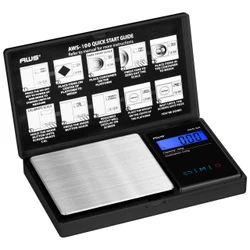
The Gemini-20 and AWS-100 offer two different approaches to portable weighing.
The Gemini-20 has a 20g capacity and 0.001g readability, making it worth considering for lightweight objects requiring finer displayed detail. The AWS-100 has a 100g capacity and 0.01g readability, offering more room for heavier objects, containers, and small batches.
The tradeoff is straightforward: the Gemini-20 displays gram increments that are 10 times finer, while the AWS-100 provides five times the rated capacity.
Neither specification alone establishes better accuracy. Choose according to your complete load, the smallest difference that matters, and the measurement performance your task requires.
This comparison uses published AWS specifications rather than independent hands-on testing.
Gemini-20 vs AWS-100: Quick Comparison
| Feature | Gemini-20 | AWS-100 |
|---|---|---|
| Maximum rated capacity | 20g | 100g |
| Gram readability | 0.001g | 0.01g |
| Equivalent display increment | 1mg | 10mg |
| Example gram reading | 1.257g | 1.26g |
| Listed platform dimensions | 1.3 x 1.3 inches | 2.5 x 3.0 inches |
| Listed overall dimensions | 3.5 x 4.0 x 0.8 inches | 5 x 3 x 0.9 inches |
| Weighing units | g, oz, ozt, dwt, ct, gn | g, oz, ct, gn |
| Calibration weight listed | 20g included | 100g, not included with standard model |
| Power | Two AAA batteries | Two AAA batteries |
| Main advantage | Finer displayed increments | Higher capacity and larger platform |
These details come from the current product listings. Confirm specifications and package contents for the selected version before purchasing.
What Does 20g x 0.001g Mean?
The Gemini-20 Precision Milligram Scale supports a maximum rated load of 20 grams and displays gram readings in increments of 0.001g.
One increment equals one milligram.
For example, the display can show:
-
2.350g
-
2.351g
-
2.352g
NIST’s guide to SI mass units explains the relationship between grams and milligrams.
The specification describes displayed detail. It does not guarantee accuracy within ±0.001g or reliable measurement of a standalone 1mg sample.
The complete supported load, including its container, must remain within 20g.
What Does 100g x 0.01g Mean?
The AWS-100 Digital Pocket Scale supports a maximum rated load of 100 grams and displays gram readings in increments of 0.01g.
One increment equals 10 milligrams.
The display can show:
-
25.00g
-
25.01g
-
25.02g
It cannot display 25.001g in gram mode.
Compared with the Gemini-20, the AWS-100 provides 80g more capacity and a larger listed platform. Its gram display is coarser, but may still provide sufficient detail for many everyday tasks.
Gemini-20: When Finer Readability Matters
The Gemini-20 is worth considering when your complete loads stay comfortably below 20g and milligram display increments are useful.
Potential Applications
It may suit:
-
Individual lightweight gemstones.
-
Small jewelry findings.
-
Miniature hardware.
-
Lightweight craft components.
-
Small noncritical samples.
-
Educational measurement activities.
Suitability depends on the required tolerance, not simply the object’s category.
Included Accessories
The current AWS listing identifies a carrying case, tweezers, weighing tray, calibration weight, and batteries. It also describes a protective shield and backlit display.
Its Main Limitation
Twenty grams is a small complete-load allowance.
A 7g container holding 15g of material creates a 22g load, exceeding capacity even after the container is tared.
Choose the Gemini-20 when finer displayed detail matters and its capacity accommodates the entire setup.
AWS-100: When Capacity and Platform Space Matter
The AWS-100 is worth considering when you need more capacity and hundredths-of-a-gram readings meet your requirements.
Potential Applications
It may suit:
-
Individual coins.
-
Rings, pendants, and other jewelry within capacity.
-
Coffee portions.
-
Groups of small components.
-
Lightweight craft materials.
-
Small ingredient quantities.
Practical Features
AWS lists a hinged protective cover, backlit display, tare controls, and calibration functionality. The platform is listed at 2.5 x 3.0 inches.
That additional platform space can make positioning objects and compatible containers easier.
Its Main Limitation
The AWS-100 does not display milligram increments in gram mode. If your target requires three decimal places, its 0.01g readability cannot show that detail.
Choose the AWS-100 when complete loads exceed 20g or a larger platform is useful, provided its performance meets your tolerance requirements.
Readability Is Different From Accuracy
The Gemini-20 has finer readability, but that does not establish that it is universally more accurate.
Readability
Readability describes the smallest displayed increment.
-
Gemini-20: 0.001g.
-
AWS-100: 0.01g.
Repeatability
Repeatability describes agreement between repeated measurements under the same conditions.
Consistent readings are useful, but they can still contain a systematic error.
Accuracy
Accuracy concerns agreement with the reference value.
NIST’s weighing and scales FAQs provide background on scale divisions and weighing terminology.
The correct claim is that the Gemini-20 provides 10 times finer displayed gram increments. Calling it “10 times more accurate” would require evidence beyond these specifications.
Capacity Includes the Container
Both scales’ limits apply to everything resting on the platform.
Use this formula:
Complete load = container + contents + other supported items
Example Load Comparisons
| Container | Contents | Complete load | Gemini-20 | AWS-100 |
|---|---|---|---|---|
| 2g | 5g | 7g | Within capacity | Within capacity |
| 5g | 10g | 15g | Within capacity | Within capacity |
| 8g | 20g | 28g | Exceeds capacity | Within capacity |
| 15g | 60g | 75g | Exceeds capacity | Within capacity |
| 25g | 80g | 105g | Exceeds capacity | Exceeds capacity |
These examples assess capacity only. They do not establish measurement performance.
Tare Does Not Increase Capacity
Tare subtracts container weight from the displayed reading. The container’s physical load remains.
An 8g container leaves:
-
12g of rated capacity on the Gemini-20.
-
92g of rated capacity on the AWS-100.
This difference can matter more than readability when containers are part of your routine.
Which Scale Is Better for Jewelry and Gemstones?
The Gemini-20 may be the more relevant starting point for lightweight stones and findings when finer displayed increments matter.
The AWS-100 may be more practical for heavier jewelry, grouped pieces, or containers that push the complete load above 20g.
Both list carat mode. The Gemini-20 additionally lists troy ounces and pennyweights, while the standard AWS-100 listing specifies grams, ounces, carats, and grains.
For broader selection guidance, read the AWS digital jewelry scale buying guide.
Neither model’s unit options establish approval for transactions based on weight. Confirm the specific device’s certification and applicable requirements for commercial use.
Which Scale Is Better for Coins?
The AWS-100’s greater capacity and larger platform may make it more practical for heavier individual coins or groups of coins.
The Gemini-20 may provide useful displayed detail for lightweight specimens that fit within capacity.
However, weight alone cannot establish a coin’s authenticity. Scale performance, wear, contamination, and other characteristics must be considered alongside the measurement.
Which Scale Is Better for Coffee?
For ordinary coffee portions, the AWS-100 may be more practical because a container and coffee can easily exceed 20g.
For example:
12g cup + 18g coffee = 30g complete load
That exceeds the Gemini-20’s capacity but fits within the AWS-100’s maximum.
Neither model should be assumed suitable for supporting a complete brewing vessel. Calculate the total load and consider whether a coffee-specific scale offers more appropriate features.
Which Scale Is Better for Components and Crafts?
Choose the Gemini-20 when lightweight samples require finer displayed detail and fit within capacity.
Choose the AWS-100 when you weigh larger groups, broader objects, or heavier containers and 0.01g readability is sufficient.
If estimating component counts is important, check for a dedicated counting function. Do not assume either model provides it solely because it can weigh small parts.
AWS-100 vs AWS-100-CAL: Check the Package
The standard AWS-100 listing identifies a required 100g calibration weight that is not included.
The AWS-100-CAL package is listed with a 100g calibration weight included. Both listings specify 100g capacity and 0.01g readability.
This distinction matters when comparing total purchasing cost and included equipment.
Calibration and Routine Checks
Calibration establishes the relationship between instrument readings and reference values. Some user procedures also adjust the instrument’s response.
NIST’s introduction to calibration explains calibration in relation to reference standards.
Follow Model-Specific Instructions
The current listings identify different calibration loads:
-
Gemini-20: 20g weight included.
-
AWS-100: 100g weight required.
-
AWS-100-CAL: 100g weight included.
Follow the instructions supplied with your exact version. Consult the American Weigh Scales manuals for documentation.
Check Your Working Loads
A successful check at one load does not prove performance across the entire range.
Where required, use suitable references at representative quantities and compare repeated results.
NIST’s guidance on check standards explains their role in monitoring bias and variability.
Match Measurement Quality to the Task
Traceability alone does not guarantee that uncertainty is adequate for your application.
NIST’s metrological traceability guidance explains this distinction.
Choose according to your measurement tolerance rather than decimal places alone.
How to Get More Consistent Results
For either model:
-
Use a firm, stable surface.
-
Avoid drafts and vibration.
-
Allow adjustment after temperature changes.
-
Follow the supplied stabilization instructions.
-
Keep the platform and container clean.
-
Center the load.
-
Tare when appropriate.
-
Wait for a stable reading.
-
Repeat important measurements.
-
Stay within the complete-load capacity.
Portable scales still need a suitable weighing environment. Holding a scale in your hand or placing it on fabric can undermine consistency.
Which AWS Scale Should You Choose?
| Your requirement | Model to consider |
|---|---|
| 0.001g displayed increments | Gemini-20 |
| Complete loads between 20g and 100g | AWS-100 |
| Larger platform | AWS-100 |
| Troy-ounce or pennyweight display modes | Gemini-20 |
| General weighing with 0.01g readability | AWS-100 |
| AWS-100 with an included calibration weight | AWS-100-CAL |
| Loads above 100g | A higher-capacity model |
| Proven application-specific accuracy | Compare quantified performance and verification results |
Frequently Asked Questions
What is the main difference between the Gemini-20 and AWS-100?
The Gemini-20 offers 20g capacity with 0.001g readability. The AWS-100 offers 100g capacity with 0.01g readability.
Is the Gemini-20 more accurate?
That cannot be concluded from readability alone. It displays finer increments, but accuracy requires separate performance information.
Does the AWS-100 include a calibration weight?
The standard listing says it does not. The AWS-100-CAL package includes a 100g calibration weight.
Can the AWS-100 display 0.001g changes?
It cannot display 0.001g increments in gram mode with 0.01g readability.
Does tare restore full capacity?
No. The container remains part of the physical load.
Which is better for heavier jewelry?
The AWS-100 offers more capacity and a larger platform. Confirm that its measurement performance meets the task’s requirements.
Which is smaller?
The Gemini-20 has smaller listed overall dimensions.
Choose Finer Readability or Greater Capacity Around Your Task
Choose the Gemini-20 when three-decimal-place gram readings are useful and your complete loads stay comfortably below 20g.
Choose the AWS-100 when you need more capacity or platform space and hundredths-of-a-gram readings meet your requirements.
Explore the American Weigh Scales milligram scale collection if you need finer readability with additional capacity.
The right choice accommodates your complete load and delivers suitable measurement performance at the quantities you weigh most often.