
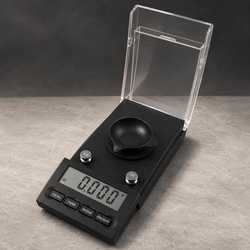
Two objects look identical, carry the same product description, and come from the same package. You place them on a digital scale and obtain different readings. The difference may be real, measurement-related, or a combination of both. Appearance alone cannot tell you which explanation is correct.
The practical question for this guide is: How can you distinguish variation between similar objects from variation in the weighing method? Repeatedly measure identified objects under controlled conditions, evaluate the scale with suitable references, and preserve the sequence so that item differences are not confused with handling or environmental changes.
For American Weigh Scales users, this approach is useful for comparing components, craft supplies, packaged portions, and other apparently matching items. This guide explains what the comparison can establish, how to organize a practical check, and when the method cannot support a confident conclusion.
Define what identical is supposed to mean
Objects can share a name, size, shape, or intended function without having exactly equal masses. A product description may not specify mass equality at all.
Clarify the requirement before judging the readings. Are you comparing complete assembled items, contents without packaging, or one component of each item? A label, closure, liner, or protective film may be part of one observation but absent from another.
Identify any stated acceptance criteria relevant to the task. Do not invent an exact mass requirement from visual similarity or assume that a rounded nominal value applies to every individual object.
Use cautious language. “These items look similar but produced different indications” is an observation. “The manufacturer made defective items” or “the scale is inaccurate” requires evidence beyond that initial comparison.
Recognize that item and measurement variation can coexist
The observed differences can contain both genuine item-to-item variation and variation introduced by the weighing process. You do not have to choose only one possibility.
NIST’s discussion of process variability identifies variation as a feature of manufacturing and measurement processes. An apparent spread in results therefore needs an appropriate basis for interpretation.
If two items differ slightly while the method also varies noticeably, the observed ranking may be unreliable. If each item repeats closely and their indications remain separated, the evidence for an item difference becomes stronger under the checked conditions.
Neither pattern automatically establishes a complete uncertainty evaluation or a production acceptance decision. Keep the conclusion connected to the measurements, conditions, and criteria actually used.
Give every item a clear identity
Assign an identifier to each object before collecting readings. Use a method that does not change the measured quantity or make the items difficult to handle consistently.
Do not add different labels directly to the objects if their mass matters and the labels are not part of the intended system. A separate tray position, photograph, or written map may be more appropriate.
Keep lids, inserts, packaging, and accessories matched to the correct item where those components are included. Swapping a closure midway can create a genuine difference while obscuring its origin.
Record the identifier with every observation. A list of numbers without item identity cannot distinguish repeated measurements of one object from measurements of different objects. That distinction is central to the investigation.
Confirm the scale suits the comparison
Identify the model, capacity, display increment, operating conditions, and normal preparation. Use the AWScales product manuals to find the exact instructions.
Write the smallest difference that matters to your decision. A scale can accommodate every item while remaining unsuitable for distinguishing the particular small difference you care about.
Do not assume a displayed decimal place establishes a matching accuracy limit. Readability, repeatability, agreement with references, support conditions, and the complete method all matter.
Include containers and accessories in the physical load. If the comparison uses a tared tray, that tray still consumes capacity. A zero net display does not remove its mass or improve the smallest useful distinction automatically.
Prepare one consistent weighing arrangement
Use a stable support and appropriate power. Keep the platform clear and the instrument prepared according to its manual. Confirm the unit and operating mode before beginning.
Choose a repeatable placement. Center each item consistently and make sure no portion touches the housing, bench, cable, lid, or another object. Similar items may sit differently if their shapes or contents vary.
Withdraw hands and tools before reading unless the documented method intentionally includes them. Apply a consistent waiting and recording procedure rather than reacting differently to each number.
Use the AWScales product FAQ for general operating questions, then rely on the exact model instructions. A consistent arrangement reduces the number of uncontrolled influences that could masquerade as item variation.
Repeat measurements of the same item
Measure an identified stable item through separate placements using a predetermined procedure. Remove it fully between placements and record the individual results.
This exercise provides evidence about the method’s short-term consistency for that item and arrangement. It does not automatically describe every load, material, day, or operator.
NIST’s explanation of measurement variability distinguishes short-term behavior from changes associated with time and conditions. A brief check should not be expanded into a universal instrument specification.
Do not count several glances at one continuously loaded display as separate placements. Label continuous observations separately if they are relevant to drift or sample stability. The record should show exactly which behavior you examined.
Compare more than one identified item
Repeat the controlled procedure for the other selected objects. Keep the same unit, placement, container, waiting method, and preparation.
For a simple exploratory comparison, a small planned set of repeated observations can reveal obvious patterns. It does not create a universal sample-size rule or prove that every unmeasured item behaves the same way.
Retain all observations. Do not choose the lowest reading for one item and the highest for another to emphasize a difference, or select matching values to make the items appear equal.
Look at within-item behavior and between-item differences separately. If one item varies substantially on repeated placement, investigate that method before interpreting a fine difference between its average and another item’s average.
Preserve time order and watch for drift
If every observation of the first item occurs early and every observation of the second occurs later, time and item identity change together. A changing environment can then look like an item difference.
Where appropriate, return to an earlier item later in the sequence. Keep the method controlled and record the observation order. A repeated change in the same item points toward time-dependent influences needing review.
Do not assume one alternating sequence eliminates every timing effect. The useful principle is to avoid silently confounding item identity with changing conditions.
Record interruptions, operator changes, relocation, cleaning, and power events. These observations can explain a pattern that would otherwise be attributed to manufacturing variation or an instrument fault.
Check agreement using suitable references
Consistency alone does not establish accuracy. A scale can repeat closely while disagreeing with an adequate expected value.
The NIST mass standards calibration program describes establishing reference mass values with associated uncertainty. Use references appropriate to the instrument, working load, and decision.
Do not treat one of the similar objects as an exact reference merely because its reading matches an expected nominal value. That would make the comparison depend on an unsupported assumption.
Inspect reference identity, condition, and handling. A poor reference basis can make an adequate instrument appear unsuitable or conceal a genuine performance concern. Record the reference check separately from the item comparison.
Understand the different checks a scale may need
Sensitivity, repeatability, and load-position behavior address different performance questions. A single favorable observation cannot answer all of them.
Mettler Toledo’s routine testing procedures distinguish these checks. Use the concepts to plan an appropriate evaluation rather than applying another manufacturer’s model-specific controls.
If an item is awkwardly shaped or its contents shift, the ordinary center reference may not reveal the full handling problem. Evaluate the actual arrangement as well as the instrument.
Stay within capacity and use a suitable documented procedure. Avoid aggressive corner loading, unstable stacking, or improvised tests that create damage risk without addressing the comparison.
Control packaging and tare differences
Two complete packages can differ because of packaging rather than contents. Labels, lids, seals, liners, and bag construction may contribute to gross mass.
If net contents matter, choose a tare method adequate for the decision. One empty container is not automatically representative of every package, especially when the expected content difference is small.
Record what each reading includes. Gross-to-gross, net-to-net, and component-only comparisons should not be mixed without accounting for the definitions.
Keep the tare and container conditions comparable. A damp container, missing lid, or added identification label changes the measured system. A correct subtraction does not resolve inconsistent inputs or establish which component caused the difference.
Investigate sample condition before blaming the scale
Objects can gain or lose moisture, retain residue, change temperature, or shed material during handling. Apparently identical items may also have different exposure histories.
Shimadzu’s sample measurement precautions identify absorption, evaporation, and other sample-related influences relevant to weighing. These can create real changes as well as disturbances.
Record whether items were open, covered, recently cleaned, cold, warm, or handled differently. Keep preparation suitable for the material and consistent across the comparison.
Do not wipe, dry, heat, or modify an object simply to make its indication agree with another. Define the intended sample state and follow a suitable preparation method. Otherwise, the intervention may change the quantity being compared.
Keep residue and external contact out of the comparison
A small spill on a tray, debris around the platform, or a tool resting against an item can produce an apparent difference. These influences may change between placements.
Follow the AWScales maintenance guidance for accessible cleaning and care. Avoid opening the housing or forcing components to investigate an ordinary comparison.
Inspect the support path for every relevant arrangement, especially when items differ slightly in shape. An object can be within capacity yet touch a surrounding surface in one orientation.
Document an identified disturbance rather than silently removing the observation. If a repeat measurement is justified, retain the original and explain why the method was repeated. This preserves the evidence needed to evaluate the comparison honestly.
Avoid interpreting a mean without its underlying values
Averages can summarize repeated observations, but they can conceal scatter, a trend, or an unusual placement. Keep the original values and item identities available.
Do not average different items and then assign that value to each one. The group mean describes the selected group, not the individually measured mass of every member.
Extra decimal places produced by arithmetic do not establish extra instrument capability. Report the result at a level supported by the method and its evidence.
If two calculated means are close, evaluate whether the complete method can support the claimed distinction. A spreadsheet can subtract any two numbers, but it cannot determine whether the resulting difference is physically meaningful without appropriate measurement information.
Consider uncertainty when differences are small
The observed separation between items needs to be interpreted alongside the limitations of the method. Repeatability is important, but it may not be the only relevant contribution.
NIST guidance on combined standard uncertainty describes combining relevant contributions through a measurement model. A demanding comparison may need an appropriate evaluation of references, resolution, conditions, and relationships among observations.
Do not assume a universal number of display increments establishes a real difference. Do not attach a guessed plus-or-minus value to make the record appear complete.
When evidence is insufficient, report the comparison as unresolved at the required level. That conclusion is useful because it identifies the need for improved conditions, more suitable equipment, or a better-designed evaluation.
Use a comparison record that separates the questions
Keep instrument checks, item observations, calculated summaries, and acceptance decisions in clearly labeled fields.
|
Record area |
What to preserve |
|---|---|
|
Item identity |
Which object and included components |
|
Method |
Unit, placement, container, waiting sequence |
|
Individual results |
Every observation in time order |
|
Reference checks |
Identity, expected value, conditions, findings |
|
Interventions |
Cleaning, relocation, setting or operator changes |
|
Calculations |
Means or differences with original inputs retained |
|
Decision |
Criteria, conclusion, limitations, next action |
Use the AWScales knowledge center for supporting weighing information. Keep the application’s actual requirements alongside the observations rather than inventing a tolerance after seeing the spread.
A clear record supports both possibilities: the items may differ, and the measurement method may need improvement.
Example: similar components repeat at different values
Imagine two visually similar components. Each gives closely grouped observations under the same controlled method, and their indications remain separated when the sequence is repeated appropriately.
This supports investigating a genuine item difference under the checked conditions. It does not independently establish the cause, such as internal construction, residue, or material composition.
Suitable reference checks and task-specific criteria help determine whether the difference can support the intended decision. Visual similarity alone does not establish an exact mass specification.
The appropriate record describes the observed pattern and its limitations. It avoids jumping from a measured difference to a claim that either the supplier or instrument is necessarily defective.
Example: one item varies with every placement
Consider an irregular item that rocks on the platform. Its readings differ as the contact arrangement changes, while a compact reference and another stable item behave more consistently.
The method is not providing a clear basis for a fine item-to-item comparison. A suitable support arrangement may improve repeatability, provided it remains within capacity and clear of surrounding surfaces.
Retest the revised method and preserve the original observations. Do not select one convenient placement and label it the unquestionable true value.
When choosing portable equipment, compare the AWScales pocket scale options with the actual load, platform needs, and required discrimination. The right arrangement matters alongside the number of displayed digits.
Decide what to do with an unresolved comparison
An unresolved result does not prove equality, difference, or instrument failure. It means the available method and evidence do not support the required conclusion.
Identify the main limitation before collecting more data. More repetitions may help one question while leaving a reference, sample-state, or support problem unchanged.
For persistent unexplained instrument behavior, use AWScales customer support with the model, reference information, item arrangement, individual readings, and sequence.
If the decision concerns product conformance, use the applicable specification and an appropriate evaluation. Do not turn a general troubleshooting exercise into an unsupported acceptance or rejection of a complete batch.
Keep selection and coverage explicit
If the objects come from a larger group, record how they were selected. Choosing two unusual-looking pieces addresses a different question from examining a planned selection across the group.
A comparison of selected items does not automatically characterize every item in the package or every production lot. The result may reveal a concern worth investigating while remaining insufficient for a broad claim.
Preserve relevant batch or package identifiers where available. If items come from different sources or storage conditions, do not silently treat them as though their histories were identical.
Choose any broader sampling procedure according to the actual decision and requirements. Avoid inventing a universal count or assuming that a handful of favorable observations proves complete uniformity.
Turn the findings into a practical next step
Review the strongest established observation. If one item is unstable on the platform, improve its support method. If all items shift with time, investigate conditions and reference behavior. If identified items repeat consistently at different values, examine the item requirement and relevant physical differences.
Change one justified part of the method at a time where practical. Preserve before-and-after observations so the improvement can be assessed rather than merely assumed.
Keep the acceptance question separate from troubleshooting. Demonstrating a possible cause does not automatically establish whether the item meets its specification, and a satisfactory instrument check does not establish that every product is identical.
Document the next action, responsible person where relevant, and any limitation on using the comparison. This makes the result useful to someone who did not witness the measurements.
If the revised method resolves the required distinction, retain its procedure and baseline for later work. If it does not, state the remaining gap clearly instead of continuing until the data tell a preferred story. A transparent unresolved result provides a better basis for further evaluation than an unsupported exact answer.
Frequently asked questions about similar items weighing differently
Should matching products have exactly equal mass?
Not necessarily. Establish the relevant specification and measured components. Visual similarity or a shared name does not prove exact mass equality.
Does repeated agreement prove the scale is accurate?
It supports consistency under the checked conditions. Agreement with suitable references and the complete method are separate considerations.
Can I average several items to prove each one is correct?
No. The average describes the selected group. Individual items can differ while the average matches a target.
What if the same item gives different readings?
Investigate placement, support, contact, sample condition, environment, and instrument behavior through a controlled method before interpreting small item differences.
Does an unchanged display prove two items are equal?
No. The method may not resolve a smaller difference. Report what was observed without extending it beyond the available discrimination.
Match the conclusion to the comparison
Identify the items and define what is included. Use a consistent method, suitable references, and a sequence that keeps item differences distinguishable from changing conditions.
Preserve individual observations and evaluate within-item variation separately from between-item differences. Avoid selecting readings or relying on visual similarity as a mass standard.
When the required distinction remains unresolved, improve the method or obtain a suitable evaluation. Keep assumptions, estimates, and acceptance criteria visible.
A useful comparison does more than produce two numbers. It explains how those numbers were obtained and what evidence supports interpreting their difference.