
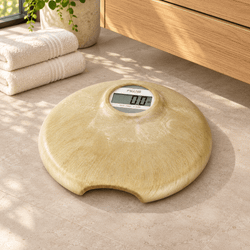
A bead, cylinder, bottle, or rounded component may fit within a scale’s capacity while refusing to stay still on the platform. Holding it with a finger makes the display steadier, but the resulting number may no longer represent the object alone. A useful solution must prevent movement without introducing an uncontrolled force.
The practical question for this guide is: How can you weigh a round or rolling object accurately? Use a suitable stable holder or container supported entirely through the platform, account for its mass appropriately, and verify the complete method under the conditions that matter to the task.
For American Weigh Scales users, the challenge is often mechanical rather than electronic. This guide explains how to choose a practical arrangement, avoid hidden support and tare errors, and distinguish a steady display from a defensible measurement.
Define the object and the required result
Start by identifying what belongs in the measurement. A rounded component with a cap, insert, label, or protective cover is a different defined load from that component alone.
Decide whether you need the object’s mass, the complete assembly’s mass, or a change between two states. Those questions require different handling and recording choices.
State the smallest difference that matters. A setup that provides an approximate shipping check may be unsuitable for comparing tiny component differences. Capacity and appearance do not establish the required discrimination.
Do not modify the object merely to make it stand still unless the task permits that modification. Adding tape, adhesive, or material to the object changes the supported system and may make the original question harder to answer.
Check the model before selecting a holder
Confirm capacity, platform dimensions, displayed increment, preparation, and operating requirements. Use the AWScales product manuals to identify the exact model instructions.
The holder, object, and any accessories all contribute to the physical load. Tare can exclude a holder from the displayed net value, but it does not remove its mass from the instrument.
Platform size matters independently of capacity. A light cylinder may be too long for a clear, stable arrangement on a compact platform. A larger suitable instrument may be a better choice than an improvised extension.
Use supported accessories where the model requires them. Do not assume that a holder designed for a laboratory balance is compatible with a consumer pocket scale. The complete arrangement needs to fit the instrument’s intended operation.
Understand why movement complicates a reading
A rolling object changes its position and contact as it moves. The instrument’s response during that motion may not represent a settled static load.
A stability indicator reflects the instrument’s criteria; it does not establish that the object is securely supported or that movement will not resume. Inspect the physical arrangement as well as the display.
Avoid waiting for a favorable instant while the object rocks or rolls. That approach selects a moment from a disturbed sequence rather than establishing a repeatable method.
Do not chase the object with a hand during reading. If it cannot remain safely and stably in the intended position, stop and improve the support arrangement before continuing. The solution should make the ordinary measurement reproducible, not require exceptional timing.
Keep hands and tools from becoming supports
A finger holding an object can support part of its weight or apply an additional force. A tool, thread, clamp, or guide attached outside the platform can do the same.
The effect does not need to be large or visually obvious. Light contact can matter when the required distinction is small. A steady indication during contact is not proof that the external force is negligible.
Release the object completely before reading unless the documented method intentionally includes a properly characterized arrangement. Ordinary hand support is not an established correction method.
Check sleeves, cables, container handles, and neighboring objects too. The complete load path must be understood. A holder that keeps the object still while leaning against the scale housing introduces a different problem rather than resolving the original one.
Choose a stable holder or container
A suitable shallow container, cradle, or other supported holder can prevent rolling while keeping the object entirely within the weighing arrangement. Its suitability depends on the object, task, and instrument instructions.
The holder should sit securely on the platform and remain clear of surrounding surfaces. It must not rock, slide, or deform into contact when loaded.
Choose a material and shape compatible with the object and preparation requirements. Avoid arrangements that can contaminate, damage, or alter the sample. Do not assume a soft material is stable simply because it stops movement.
Use the AWScales product FAQ for general operating questions and the exact model instructions for supported procedures. The holder’s purpose is clear support, not an undocumented way to change the scale’s performance.
Check the complete load path
Place the empty holder and inspect beneath and around it. Then load the object and repeat the inspection. A holder can clear the housing when empty but sag or shift into contact afterward.
Look at long ends, overhanging edges, stops, and any connected component. Ensure no part rests on the bench, wall, lid, or a separate support.
Do not assume that all contact points on a holder are problematic. Internal support within an assembly entirely carried through the platform is different from external support that bypasses it.
The practical question is where the load ultimately goes. A properly supported container can carry the object through several internal contacts while still delivering the full load through the platform. An outside finger or bench contact can divert part of that load.
Account for holder mass using a clear tare method
If the required result excludes the holder, prepare it and tare according to the manual before adding the object. Confirm the starting state and keep the same holder and included accessories throughout the observation.
NIST’s weighing and scales FAQ distinguishes tare operation from calculating a difference between separate gross weighings. These are related approaches, but the measurement sequence and evidence differ.
Do not mix an assumed stored tare with a different holder. Residue, liners, labels, inserts, and clips can change its contribution.
If you determine holder mass separately, preserve both readings and the calculation. Use consistent units and comparable conditions. A subtraction cannot correct unknown changes in the holder or an externally supported loaded arrangement.
Avoid adhesive and tape as unexamined fixes
Tape or adhesive may stop an object rolling, but it becomes part of the supported system. Its location, mass, condition, and interaction with the platform need consideration.
If the method permits such material, establish exactly what is included in the tare and what remains with the object. Do not assume a small added piece is negligible for every task.
Adhesive can also leave residue, affect sample condition, or contact the housing. Removing and replacing it between observations may make the setup less repeatable than a suitable rigid holder.
Do not stick material directly to a platform unless the instrument instructions support that use. A convenient restraint should not damage the instrument or create a poorly defined measurement state.
Center the load consistently
A holder can make an object stable while moving its mass away from the intended platform region. Center the loaded assembly appropriately and keep placement consistent.
A long object’s visual midpoint may not correspond to its mass distribution. Internal components, contents, or asymmetric ends can change where the heavier portion sits.
Mettler Toledo’s routine testing guidance distinguishes eccentric loading from sensitivity and repeatability. That distinction explains why placement deserves attention alongside reference agreement.
Do not perform aggressive edge-loading experiments with an unstable or heavy object. Use an appropriate documented check when position sensitivity needs evaluation. The normal procedure should avoid unnecessary changes in load arrangement.
Treat orientation as a method variable
Changing orientation does not ordinarily change an unchanged object’s mass, but it can change support, placement, contact, and interactions with the surroundings. Those changes can affect the indication.
Record whether a cylinder lies horizontally, stands in a supported vessel, or uses a defined cradle. Do not combine results from different arrangements without examining their comparability.
If one orientation behaves differently, investigate the arrangement before claiming that the object somehow weighs more in that direction. Look for external contact, shifted contents, static, magnetic influence, or temperature differences.
Use orientation changes diagnostically only when appropriate for the object and task. Avoid allowing the sample to roll off the platform or applying pressure to hold an awkward position.
Consider magnetic and electrostatic influences
A restraint should not introduce a new interaction that affects the weighing system. Magnetic components and charged containers can matter in some sensitive arrangements.
Shimadzu’s sample measurement precautions discuss sample-related influences including magnetism and static. Their significance depends on the instrument, sample, arrangement, and required discrimination.
Do not use a magnet as a default anti-roll solution. A magnetic restraint changes the system and may create additional forces. Likewise, a plastic holder is not automatically free from electrostatic concerns.
Use appropriate documented controls and materials. Do not improvise electrical connections or spray liquids near the instrument. A more stable mechanical arrangement still needs to be suitable for the complete measurement.
Keep the environment stable
A stable holder cannot remove airflow, vibration, temperature changes, or unstable bench support. These can disturb lightweight assemblies or complicate a demanding comparison.
Shimadzu’s installation guidance identifies environmental considerations relevant to weighing. Apply the principles alongside your exact model requirements rather than transferring another product’s numerical limits.
Place the instrument where ordinary loading and reading do not require leaning on the bench. Keep nearby tools and recording devices accessible without reaching over the sample.
Follow preparation instructions after relocation or meaningful environmental change. An unloaded zero does not establish that every condition is suitable. Preserve observations when the result changes after a known event.
Verify the scale with suitable references
A rolling work object is not a reference merely because its mass is familiar or printed on a package. Use an adequate expected value when checking agreement.
The NIST mass standards calibration program describes establishing reference values with associated uncertainty. Choose references whose condition, information, and handling suit the required decision.
Check instrument behavior independently where practical, then evaluate the holder arrangement. A compact reference directly on the platform may behave well while the actual holder touches the housing.
Do not adjust the instrument against an assumed work-object mass. If a reference check remains unsuitable under controlled conditions, follow the documented model procedure or obtain appropriate assistance.
Test the holder as part of the method
Repeat the intended loading sequence using a planned procedure. Remove and replace the object or assembly as relevant to normal use, and preserve individual readings.
Inspect whether the holder returns to the same position and whether the object settles consistently. A method that depends on one unusually careful placement may be too fragile for routine work.
Distinguish repeatability from accuracy. Closely grouped values support a consistency observation, but reference agreement and other limitations still matter.
Keep the evaluation relevant. If routine work involves swapping objects in one fixed holder, test that sequence. If the complete assembly is removed each time, include that removal and replacement. The procedure should represent the work it is intended to support.
Clean without altering the measurement state
Residue, loose material, or damaged surfaces can make a holder unstable or change its tare. Inspect accessible components before and after use as appropriate.
Follow the AWScales maintenance guidance for instrument care. Do not open the housing, force the platform, or use an improvised cleaning process.
Prepare the holder according to its material and application requirements. A freshly washed holder may need appropriate drying or conditioning before a demanding comparison.
If you change a liner, add a label, or replace a stop, re-establish the relevant reference state. The holder remains part of the measurement system even when the display excludes its mass.
Use a practical holder checklist
A short checklist helps operators distinguish a stable arrangement from a merely quiet display.
|
Check |
What to confirm |
|---|---|
|
Measurement definition |
Object or assembly and included components |
|
Model suitability |
Capacity, platform size, increment, preparation |
|
Holder |
Stable, compatible, and appropriately supported |
|
Clearance |
No external contact when empty or loaded |
|
Tare |
Correct holder and accessories accounted for |
|
Placement |
Consistent loaded position and orientation |
|
Handling |
Hands and tools withdrawn during reading |
|
Verification |
Suitable references and repeat observations |
Use the AWScales knowledge center for supporting information. Keep the task-specific arrangement documented so another person can reproduce it.
Photographs can help show the support path. Include platform edges and surrounding objects, not just the display, because hidden contact is often the key issue.
Example: a cylinder is steadied by a finger
Imagine a cylinder that rolls slightly whenever it is placed on the platform. The operator holds it lightly and records the stable-looking number.
That contact introduces an uncontrolled force. The indication may be repeatable for one person’s grip without representing a defensible object-only measurement.
A suitable holder removes the need for hand support. Its mass is accounted for, its clearance is checked, and the revised loading method is evaluated with relevant observations.
The improvement is not that the screen looks calmer. It is that the support arrangement becomes defined and reproducible, allowing the result to be interpreted within the method’s demonstrated scope.
Example: a cradle touches the housing
A cradle prevents a rounded object from moving, but one edge rests on the scale housing. The object is secure, and the indication looks steady.
Part of the support can bypass the intended platform path. Moving the cradle slightly changes the result, creating an apparent orientation or instrument problem.
Inspecting the complete loaded assembly reveals the contact. A properly fitting arrangement or different instrument may solve it without adjustment.
For portable work, compare the AWScales pocket scale options with object dimensions, complete load, platform needs, and required discrimination. A small increment does not compensate for a holder that does not fit.
Interpret small differences with appropriate evidence
Two holder arrangements may produce slightly different readings. The difference could reflect placement, contact, tare, environment, or other method limitations.
NIST guidance on combined standard uncertainty explains combining relevant input contributions through a measurement model. A small computed difference is not automatically proof that one arrangement is correct.
Do not average unsuitable arrangements together or select the value closest to expectation. Identify the support and reference basis, then evaluate the method against the task.
For persistent unexplained behavior, use AWScales customer support with the model, object, holder, complete load, photographs, references, and reading sequence. Describe what changes between arrangements so the investigation can focus on the relevant conditions.
Choose an acceptance decision before collecting results
Define what the measurement needs to support before judging the holder. A rough comparison and a small-difference decision require different evidence, even if the same object is involved.
Do not invent a universal tolerance based on one displayed increment. Use the actual requirements and an appropriate evaluation of the instrument, reference, holder, and handling method.
Decide how many observations to collect and what to do if one is unusual. Preserve the complete sequence and note identifiable disturbances. Repeating placements until one value matches an expected number does not establish suitability.
If the method remains too variable, state that limitation. A holder can be physically stable while still unsuitable for the required discrimination because of tare, placement, environmental, or other contributions.
Keep the arrangement reproducible for later use
Identify the holder and record the normal orientation, included accessories, tare sequence, and placement. A simple photograph and concise written procedure can help other operators reproduce the method.
Avoid quietly substituting another container or adding a liner without reviewing the effect. Similar-looking holders can differ in mass, stability, and clearance. The original check does not automatically cover every alternative.
Review the arrangement after damage, cleaning, relocation, or an unexplained change in results. Re-establish the relevant reference state and perform appropriate checks before relying on the revised setup.
The objective is a method that works through ordinary handling, not only one successful demonstration. Keep the record connected to the task and retain limitations so a later user does not mistake a checked arrangement for a universal solution for every rounded item.
Frequently asked questions about rolling objects
Can I hold the object lightly while weighing?
Ordinary hand contact can add force or support part of the load. Use a suitable arrangement that allows hands to be withdrawn during the reading.
Does tare remove the holder from capacity?
No. Its physical mass remains supported by the instrument. Account for the complete load even when the net display is zero.
Will changing orientation change the object’s mass?
An unchanged object’s mass does not ordinarily depend on orientation, but the weighing arrangement can change. Investigate contact, placement, contents, and other influences.
Is a stable display enough to validate a holder?
No. Check full support, clearance, tare, placement, relevant references, and the method’s consistency.
Should I use a magnet to stop rolling?
Do not assume that is suitable. Magnetic interaction can introduce additional forces. Follow appropriate equipment and application guidance.
Make stability part of a defined method
Choose a holder that fits the object, platform, and task. Keep the complete load supported through the platform, account for the holder appropriately, and withdraw hands and tools.
Inspect clearance under both empty and loaded conditions. Use consistent placement and orientation, verify the instrument, and evaluate the actual loading sequence.
When results remain unsuitable, improve the arrangement or obtain appropriate assistance. Avoid adjusting against an assumed object mass or treating a quiet screen as proof of accuracy.
A round object does not need an improvised balancing act. It needs a clear, reproducible support method that lets the scale measure the intended load under suitable conditions.