
Small ingredient quantities can expose a limitation that stays hidden during ordinary weighing. A scale may handle a bowl of flour consistently yet struggle to distinguish a fraction of a gram added to that bowl. The larger load looking correct does not establish that every small addition is measured adequately.
The practical question is: How can you weigh small ingredient quantities reliably on a digital scale? Start by matching the instrument to the smallest ingredient amount and the acceptable variation. Then control the container, surroundings, transfer method, and recording procedure.
For ordinary culinary ingredients, this approach helps explain inconsistent batches and confusing readings. It also identifies when a different scale or a larger recipe batch would be more appropriate. The goal is a repeatable measurement you can interpret, with a clear distinction between what the display shows and what the process actually delivers.
Define the ingredient amount before choosing the scale
Begin with the smallest mass you expect to weigh. A recipe requiring 250 grams of flour and 0.25 grams of another ingredient places two very different demands on the instrument.
Also identify how much variation the recipe can reasonably tolerate. A target alone does not describe the required weighing performance. A small deviation might be unimportant for one culinary ingredient and materially change the result for another.
Avoid selecting a scale solely because it can hold the full batch. Capacity answers how much load the instrument can accommodate. Small-quantity suitability depends on additional performance characteristics and the conditions of use.
Readability is only one part of the answer
Readability is the increment between displayed values. A scale showing whole grams cannot directly display a quarter gram. A scale displaying hundredths of a gram offers finer indications, but those digits do not independently prove equivalent measurement performance.
Repeatability, indication error, environmental effects, and the weighing method also matter. NIST's discussion of measurement terminology distinguishes accuracy from repeatability and related concepts.
Treat the display increment as an initial screening criterion. Follow it with the manufacturer's specifications and appropriate checks. More digits can help resolve a difference, but they do not remove the need to establish whether the result suits the task.
There is no universal minimum ingredient weight
A useful minimum quantity depends on the instrument's performance and the allowable relative variation. It cannot be established for every digital scale by a single rule such as “always weigh at least one gram.”
If the same absolute uncertainty applies to two measurements, its percentage contribution is larger for the smaller quantity. This is why a scale can be satisfactory for a large amount while being unsuitable for a much smaller one.
Use a documented minimum weight only within its stated conditions. If the information is unavailable, describe your task to the manufacturer or a qualified weighing specialist rather than inventing a minimum from the final decimal place.
Decide whether the task needs one scale or two
A larger kitchen scale can suit mixing bowls and substantial ingredient amounts. A smaller, finer-reading instrument may be more appropriate for small culinary additions. Each instrument should be selected for its own part of the process.
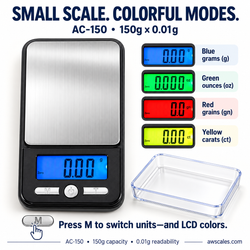
When reviewing AWScales pocket scales, compare individual capacity, readability, platform dimensions, and intended use. The word “pocket” describes a format, rather than a complete performance specification.
A two-scale workflow can be practical when a heavy bowl and a small ingredient cannot be accommodated well by the same instrument. Keep units and records consistent so changing instruments does not introduce a new mistake.
Check the manual before changing your technique
Find the exact model instructions for startup, leveling where applicable, tare, calibration, automatic shutoff, and permitted operating conditions. Similar-looking scales can behave differently.
The AWScales product manuals provide a starting point for model-specific information. Avoid borrowing button sequences or hidden settings from another instrument simply because its display looks familiar.
A weighing technique should work with the documented operation of the scale. If the instrument is unsuitable for a slow addition or a small net load, changing undocumented settings is not a substitute for selecting an appropriate method.
Prepare a stable weighing location
Place the scale on a firm surface that does not rock or flex under normal use. Keep it away from the edge of a busy counter, appliance vibration, and places where people repeatedly bump the work surface.
Airflow and temperature changes can also affect sensitive measurements. Shimadzu's balance installation precautions address conditions including direct airflow, sunlight, temperature variation, and leveling.
Use those principles to evaluate the location while following your own instrument's requirements. Do not introduce arbitrary warmup periods or room conditions that the manufacturer has not specified. A suitable, consistent location is more useful than repeated attempts on an unstable surface.
Keep the sample conditions consistent
Ingredients can change during handling. Moisture uptake, evaporation, and temperature differences may alter the mass or influence the indication. A warm container can create a different weighing situation from a room-temperature one.
Shimadzu's guidance on sample-related weighing influences discusses effects such as moisture and static electricity. Their significance depends on the sample and required measurement quality.
For routine cooking, keep the procedure practical: use a clean, dry container, avoid weighing beside steam, and work consistently. If the reading drifts, investigate whether the sample or surroundings are changing before assuming the calibration needs adjustment.
Choose a small container that sits correctly
A lightweight weighing dish can make a tiny ingredient easier to handle. It should rest fully on the platform, remain clear of the housing, and provide enough space to avoid spilling.
An oversized bowl can hide the display or touch nearby objects. A flexible container may rock or change its contact arrangement during filling. Either situation can make a small addition harder to interpret.
Choose a container suitable for food contact and the ingredient involved. Its role is to contain the sample and transfer the load cleanly to the platform. It should not create a second source of uncertainty through contact, movement, or loss.
Tare changes the reference rather than the capacity
Place the empty container on the scale and tare it according to the manual. The resulting zero represents a reference that includes that container.
The physical load still includes the container. A heavy vessel can consume much of the instrument's capacity even though the display reads zero. Adding ingredients must keep the combined load within the documented limit.
For common operation questions, consult the AWScales product FAQ. Do not interpret a tared display as a renewed capacity allowance. A smaller vessel may be the simplest way to make the intended ingredient measurement possible.
A heavy bowl does not make a tiny addition easier
Adding 0.20 grams to a large bowl does not turn that ingredient into a large measurement. The quantity of interest remains the small change in load.
A heavier background load may also involve different operating conditions from weighing the ingredient alone. Whether performance remains suitable should be established for that method rather than assumed.
If the small addition matters, consider weighing it separately on an appropriate instrument. This also allows you to inspect the amount before it enters the main mixture, where an overshoot may be difficult to correct without changing the whole recipe.
Add material in controlled portions
Approach the target with deliberate additions. Stop adding, withdraw the utensil, and allow the indication to settle before deciding on the next step. Continuous pouring can lead to overshoot because the displayed response may lag the physical addition.
Near the target, use smaller portions that the scale and handling method can distinguish usefully. Do not rely on the display to stop a flowing stream instantly.
Some instruments process gradual changes differently depending on their operating features. If very slow additions do not register as expected, consult the manual or support. Do not assume the missing change proves that the ingredient has no mass.
Keep utensils and hands clear during the reading
A spoon resting on a dish changes the supported load. A hand touching the container can add or remove force. A packet leaning against the housing can create an unintended load path.
Release the container and withdraw the utensil before recording the reading. Keep the ingredient entirely supported by the weighing arrangement rather than bridging between the dish and another surface.
This small pause makes the observation easier to interpret. You want the displayed result to correspond to the ingredient and its defined container reference, not a temporary combination of ingredient, utensil pressure, and surrounding contact.
Separate weighing from ingredient transfer
An ingredient can be weighed correctly and still fail to reach the mixing bowl completely. Fine powder can remain on a dish, and sticky material can cling to a spoon or container.
Define whether the task concerns mass prepared in the dish or mass actually delivered to the batch. Those are related but different quantities. The appropriate transfer procedure depends on which one matters.
Inspect the dish after transfer and use a consistent handling method. Avoid assuming that every displayed gram entered the mixture. For very small quantities, a residue that looks minor may represent a meaningful fraction of the intended addition.
Weighing by difference answers a different question
One option is to weigh a source container before and after dispensing. Subtracting the later mass from the earlier mass estimates how much left that source container.
That result does not automatically establish how much reached the destination. Material spilled on the counter or retained on a transfer utensil also left the source. Both measurements must be suitable for the small difference being calculated.
Use this method only when its assumptions fit the task. It can be helpful for certain handling situations, but subtracting two large readings does not automatically make a tiny delivered amount easier to establish.
Check performance with an appropriate reference
A familiar spoon, coin, or packet is not automatically a reliable mass reference. Use an appropriate reference weight with known information and follow the manufacturer's checking instructions.
NIST's work on calibration of mass standards explains the role of characterized reference masses. The practical distinction is between a reference with supported mass information and an everyday object whose mass is assumed.
Choose checks relevant to your intended use. A satisfactory reading for one larger reference load does not establish every aspect of small-quantity performance, especially when the actual workflow uses a different container or background load.
Repeatability checks reveal inconsistency
Repeatedly weigh a suitable stable reference under the same conditions and observe the spread. Keep placement, unit, container, and handling consistent so the comparison is meaningful.
Mettler Toledo's guidance on routine testing of balances explains how checks between scheduled calibrations can reveal performance problems.
Consistency is useful, but it is not complete proof of correctness. Every reading can share an error. Combine repeatability observations with appropriate reference checks and specifications rather than treating identical numbers as a guarantee for every ingredient amount.
Establish a sensible checking schedule
How often a scale needs checking depends on use, handling, conditions, and the consequences of an unsuitable result. A scale moved frequently may need different attention from one kept in a stable location.
NIST's guidance on recommended calibration intervals explains why a universal interval is not appropriate. Performance history and measurement requirements help inform the decision.
For an ordinary culinary workflow, begin with the model's instructions and keep a simple record of problems or changes. Recheck when an event gives a reason, such as a drop, unexplained discrepancy, or major change in the weighing arrangement.
Scaling a recipe can increase measurable amounts
If a tiny ingredient quantity falls below what your method can handle reliably, a larger batch may move the amount into a more suitable range. The recipe and available equipment must support that change.
For example, a hypothetical recipe calling for 0.25 grams would call for 1.00 gram at four times the batch size. That arithmetic does not independently establish that either measurement meets the required tolerance.
Consider mixing capacity, ingredient behavior, and the ability to divide the finished batch appropriately. Larger quantities can simplify weighing, but batch scaling should preserve the intended recipe rather than merely produce a more convenient display value.
Mixing first does not guarantee equal portions
Preparing a larger mixture and dividing it can be practical for some recipes. However, a measured fraction of total mixture contains the intended ingredient proportion only if the mixture is sufficiently uniform.
Particles can differ in size and density, and handling can separate components. A correct total mass does not by itself establish that each smaller portion has the same composition.
Use a tested culinary procedure when uniformity matters. Avoid presenting dilution or premixing as a universal solution for any concentrated ingredient. The weighing problem and the mixing problem require separate attention.
Example of a display that is too coarse
Suppose a hypothetical scale displays in one-gram increments, while an ingredient target is 0.30 grams. That target cannot be represented directly on its display.
Adding material until the first one-gram indication appears does not establish that 0.30 grams was delivered. Nor does switching to ounces create finer underlying weighing performance.
The sensible response is to use an instrument and method suited to the target, or revise the batch size where the recipe permits. Repeatedly guessing around a coarse display does not create a reliable measurement procedure.
Example of a transfer loss
Imagine a dish indicating 2.00 grams of an ingredient before transfer. After the ingredient is tipped into a bowl, visible residue remains in the dish.
The initial indication describes the amount in the dish at that moment. It does not prove that the entire 2.00 grams entered the bowl. If delivered mass is important, the method needs to address that residue.
Keep the explanation tied to observed quantities. Do not apply an invented correction percentage. A consistent, suitable transfer procedure is preferable to adjusting the recipe based on an unmeasured guess about what remained behind.
Plan for an interrupted weighing session
Automatic shutoff or an unexpected restart can interrupt sequential additions. A previous tare reference may not be available afterward, depending on the model. Do not reconstruct an ingredient amount from memory when the display no longer represents the same reference.
Record each completed addition before moving to the next one. If an interruption occurs, stop and establish what remains known about the contents and their measurements. A clear record allows you to decide whether the batch can continue using a defensible procedure.
Record the process alongside the result
For troubleshooting a repeated recipe, record the ingredient target, displayed amount, unit, scale model, container, and whether the ingredient was weighed separately or added to the main bowl.
Include anything that changed, such as a different location, warm container, interrupted session, or unusual drift. These observations make it easier to distinguish a weighing issue from a mixing or transfer issue.
The AWScales knowledge center offers additional explanations of weighing concepts. A short, consistent record can reveal a recurring handling problem more effectively than relying on memory after several batches have differed.
Keep residue away from the weighing mechanism
Powder around the platform can interfere with clearance or make later handling less consistent. Clean spills using the method permitted for the instrument, with the scale protected from liquid intrusion and excessive force.
Follow AWScales scale maintenance guidance along with the model instructions. Cleaning a weighing surface is different from washing an ordinary kitchen bowl.
Use removable, suitable containers to keep ingredients controlled. After cleaning, confirm that the platform moves freely as designed and that the empty scale behaves normally before beginning another small-quantity measurement.
Ask support a question the evidence can answer
If the scale behaves unexpectedly, report the model, selected unit, approximate total load, ingredient target, container arrangement, and the observable problem. Include results from appropriate reference checks where available.
For example, “a small addition does not register until more material is added” is more useful than “the scale is inaccurate.” Explain whether the problem occurs with a separate dish or only with the main bowl.
Contact AWScales customer support for instrument guidance. Clear observations help determine whether the next step is a setup change, a different technique, a performance check, or a more suitable instrument.
Frequently asked questions
Does a zero reading mean no ingredient was added?
No. A quantity may be too small for the instrument or method to distinguish, or the indication may be influenced by its operating features. Visible material and a zero display require investigation.
Can I improve the measurement by switching units?
Changing units changes how mass is expressed. It does not improve the underlying weighing system. Choose a convenient unit, then assess whether the documented performance suits the target.
Is a stable number always a correct number?
No. Stability describes the displayed behavior. A stable reading can still be affected by an unsuitable setup, an indication error, or a mismatch between the scale's capabilities and the quantity.
Should I tare between every ingredient?
Tare can make sequential additions convenient when used within the manual's instructions. Record each amount before taring, remember the combined physical load, and weigh tiny ingredients separately when that method is more suitable.
Can repeated readings make an unsuitable scale suitable?
Repetition helps reveal variation. It cannot recover information that the instrument and method do not resolve adequately. Select equipment that fits the smallest meaningful ingredient quantity.
Build the method around the smallest meaningful amount
Reliable small-ingredient weighing begins before the first addition. Define the target and acceptable variation, choose suitable equipment, and establish a container and location that allow the scale to work properly.
Then control the addition and transfer process. Record what was measured, wait for an interpretable indication, and investigate inconsistency rather than chasing a preferred number. Keep the delivered amount distinct from the amount initially prepared.
When the method cannot distinguish the quantity well enough, change the instrument or an appropriate part of the recipe workflow. The useful result is a measurement that supports the intended culinary task with clear, practical limits.