
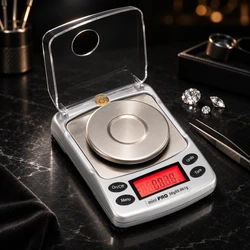
An empty weighing boat seems to register differently when a fan runs. A light bag produces restless digits, while a compact reference appears calmer. You wonder whether a draft shield would solve the problem or simply make the setup more complicated.
The practical question is: How do drafts affect light containers, and how can you check whether a draft shield helps?
Air movement can apply forces to the platform, vessel, or sample and can affect a sensitive weighing arrangement. An appropriate draft shield can reduce certain disturbances, but it does not correct every cause of unstable or biased readings. Container contact, static, temperature, sample changes, and instrument suitability still require attention.
Begin with your exact model's instructions in the AWS product manuals. Confirm whether a shield is supplied or approved and how it should be installed and used. A homemade enclosure is not automatically an equivalent accessory.
A light container can respond to moving air
A broad weighing boat, bag, or thin vessel presents surfaces on which moving air can act. The force can affect the indication even though the intended mass has not changed.
The resulting behavior depends on shape, orientation, air movement, instrument capability, and the rest of the arrangement. There is no universal error for every container or fan speed.
Observe the actual pattern rather than assuming the vessel is unsuitable merely because it is light. A suitable controlled comparison can reveal whether the working location needs improvement and whether an approved shield addresses the relevant disturbance.
Compact references and broad vessels behave differently
A small solid reference does not interact with airflow in exactly the same way as a wide shallow container. Agreement with that reference therefore does not reproduce every sample-handling condition.
The instrument may perform acceptably in the narrow reference check while the vessel arrangement remains vulnerable. That is an application question as well as an instrument question.
Use the reference to assess the aspect it supports, then evaluate the actual vessel and task through an appropriate method. Do not treat one calm reference reading as proof that all airborne influences are absent.
Air movement comes from more than obvious fans
Vents, open windows, door movement, passing people, and the operator's hands can disturb air near the weighing area.
A draft does not need to feel strong to deserve consideration in a sensitive setup. Its significance depends on the instrument and required tolerance.
METTLER TOLEDO's discussion of practical draft protection describes disturbances from surrounding activity and ventilation. Its examples concern compatible laboratory applications, not a universal prediction of error for every consumer scale.
A draft shield reduces particular disturbances
A suitable shield creates a more protected weighing area and can reduce the effect of external air movement. Its installation and operation remain part of the measurement method.
METTLER TOLEDO's draft shield information describes purpose-designed accessories for compatible instruments.
Do not interpret a shield as a guarantee of accuracy or a substitute for suitable location. It cannot identify every sample change, correct a wrong baseline, or repair a damaged mechanism. Evaluate whether it helps the actual task under the required conditions.
The working location still matters
A shield is not permission to place the instrument directly beneath a strong vent or on a vibrating appliance. Some influences can remain or enter through the arrangement.
Choose suitable firm, level support and keep direct heat, strong airflow, and unnecessary movement away. Confirm all intended feet are seated.
Shimadzu's balance installation precautions identify airflow, temperature stability, and leveling as relevant. Apply the exact model's requirements rather than copying laboratory preparation times or assuming every accessory compensates for an unsuitable room.
Shield operation can introduce new movement
Opening and closing doors or moving a cover changes the air near the platform. Rapid movement can disturb the very area the shield is intended to protect.
Use the accessory according to its instructions and allow the model's normal settling process before recording. Keep the operating sequence consistent across trials.
Do not slam doors or repeatedly lift a cover while watching for a favorable number. The aim is a controlled method, not a screen that briefly looks calm after several different disturbances.
Hands and tools should leave the weighing area
A hand inside the enclosure can disturb air, transfer heat, or make unintended contact. A spoon resting against the vessel adds another force.
Complete the permitted transfer, remove unintended contact, and follow the documented closure and settling sequence. Do not record while supporting the bowl or pressing the housing.
If continuous addition requires an opening, assess that actual method rather than assuming a fully closed reference check validates it. The operating arrangement during the real task is the one that needs suitable performance.
An enclosure must not touch the load
A shield or improvised cover that touches the vessel, platform, or sample can transfer force outside the intended measuring path.
Check clearance at the beginning and end of loading. A bag can sag or a vessel can shift as material is added, creating contact that was absent initially.
Use an approved accessory and a vessel that fits securely. A calmer display caused by the enclosure supporting part of the load is not improved accuracy. Correct physical clearance before interpreting apparent stability.
Static is a separate possible influence
Plastic, glass, and other surfaces can carry electrical charge. A container or enclosure can therefore introduce electrostatic forces in a sufficiently sensitive arrangement.
Shimadzu's guidance on sample-related influences discusses static, moisture, magnetism, and other considerations. Its remedies depend on compatible equipment and the application.
Do not assume a plastic box is harmless because it blocks air. Use appropriate approved accessories and methods. Avoid spraying the instrument or attaching improvised wiring to address an unconfirmed static problem.
Temperature can create air movement inside the shield
A warm sample or cold vessel can disturb local air even when outside drafts are reduced. Handling and nearby heat can also change conditions within the protected area.
A shield does not automatically establish thermal equilibrium. Follow the model's preparation and sample-handling requirements.
Do not place hot cookware on a platform unless the manufacturer expressly permits it. For sensitive materials, use the appropriate timing and temperature procedure rather than waiting indefinitely for a steady reading inside an enclosure.
A cover can change evaporation and moisture conditions
An exposed liquid can lose mass, while a moisture-sensitive material can gain or lose water. An enclosure may change the surrounding exposure without making the sample constant.
A later reading can therefore describe a different sample state rather than a more accurate observation of the original quantity.
Define the intended state and timing. A sample cover, when suitable, must be handled consistently and included properly in the load. Follow material requirements rather than sealing an unsuitable substance solely to calm the display.
Draft protection is not a washdown feature
An enclosure that reduces air movement should not be assumed to protect the instrument from spills, cleaning spray, or immersion.
Use the exact model's cleaning and exposure limits. A vessel can still spill inside a shield, and liquid can enter openings or affect clearance.
Follow AWS maintenance guidance and the manual. Remove only user-removable components and avoid forcing the mechanism. If liquid entry or damage is suspected, obtain manufacturer guidance before continuing ordinary checks.
Tare should match the final arrangement
If the vessel is tared with a lid, liner, or accessory present, removing that component changes the load relative to the stored baseline.
Likewise, a cover that rests on the platform is different from an external shield that remains mechanically separate. Identify which parts are included in the weighing arrangement.
The AWS product FAQ explains common tare concepts. Follow the exact sequence and keep the meaning of net and gross values clear. A zero display after tare does not establish that the arrangement is free from external forces.
Stable digits do not independently prove accuracy
A shield can make readings look calmer while a consistent error remains. Contact, a wrong baseline, or an unsuitable reference can produce a steady indication.
Do not equate improved appearance with a complete performance assessment. Evaluate agreement, consistency, and task suitability through appropriate evidence.
A stability indicator reflects the model's criteria for recent behavior. It does not inspect the vessel arrangement or certify the sample's mass. Use it as directed, alongside the rest of the method rather than as a replacement for verification.
Use a suitable reference for the instrument check
A reference with adequately known value, condition, and uncertainty can help assess weighing performance. An unknown household object cannot settle accuracy merely because it repeats.
The NIST mass standards program describes formal mass calibration and the role of known references.
Use the prescribed reference for adjustment and appropriate references for verification. A reference check inside a shield still has limited scope. It does not independently establish every vessel, sample, or transfer method used afterward.
Compare the actual task under controlled conditions
If the manufacturer supports the shield and application, compare relevant observations while preserving the same sample, vessel, unit, baseline, and preparation.
Change one intended influence at a time where practical. Moving the scale, replacing the vessel, changing settings, and adding a shield together makes the result difficult to interpret.
Record what changed and what stayed constant. A useful comparison can show whether the complete arrangement improved without claiming that the shield alone caused every difference. Keep conclusions tied to the conditions actually assessed.
Follow a documented comparison sequence
Use any required procedure first. For ordinary suitable applications, this framework organizes the main observations:
-
Confirm the exact model and approved shield arrangement.
-
Define the task, vessel, quantity range, and required tolerance.
-
Prepare the instrument in a suitable fixed location.
-
Check support, clearance, power, normal mode, and units.
-
Establish the prescribed baseline.
-
Apply a suitable stable reference using the approved method.
-
Record settled observations and relevant conditions.
-
Assess the actual vessel arrangement through an appropriate procedure.
-
Record results under the approved shield configuration.
-
Preserve the sequence and evaluate the task requirement.
This framework is not a formal calibration or permission to improvise an enclosure. Its purpose is comparable evidence within the instrument's intended use.
Do not deliberately create strong drafts as a test
Pointing a fan directly at the platform can produce a dramatic response without establishing useful normal-use performance.
It can also move light objects, spill material, or change the sample. Such a demonstration does not quantify the ordinary working environment.
Investigate existing conditions through suitable observation and approved methods. If formal airflow characterization or environmental control is required, obtain the appropriate expertise. The goal is a reliable task, not the largest possible display fluctuation.
Record the pattern instead of selecting a preferred value
Useful observations include settling time, repeated settled values, unloaded return, and any relation to door or vent activity.
Do not keep only the calmest moment. A short video can help document intermittent behavior if the full platform arrangement and actions are visible.
Preserve the original values with units and timing where relevant. If the method changes during the investigation, keep the before-and-after records distinguishable. Combining unlike conditions into one average can hide the information the comparison was intended to reveal.
A hypothetical example needs cautious interpretation
Suppose repeated settled readings with a suitable reference range from 20.00 g to 20.05 g in one arrangement and from 20.01 g to 20.02 g in an approved protected arrangement.
The reduced spread suggests the second setup may provide more consistent observations in that trial. It does not prove that every result is accurate or identify airflow as the only influence.
These numbers are not an AWS specification or acceptance limit. Reference quality, sequence, conditions, and the task's required tolerance still determine what conclusion is supported.
Repetition and range coverage are different
Repeated observations at one load assess consistency under that sequence. They do not establish agreement at every working load or position.
A method using a broad vessel or tiny additions can require evidence beyond a compact reference check. Keep those questions separate.
Do not infer universal performance because a shield helped one trial. Select checks around the actual workflow and applicable requirements. The most useful assessment is the one that answers the task's question with adequate evidence, rather than the one with the most favorable-looking screen.
Do not adjust sensitivity to compensate for drafts
A sensitivity adjustment uses a prescribed reference to address the instrument relationship defined by the manufacturer. It does not remove changing air forces or container contact.
Prepare suitable conditions first. If adjustment is required by the manual, perform it under those conditions and verify appropriately afterward.
Repeated adjustment in an unstable environment can make later readings worse or harder to interpret. If approved checks remain questionable, seek manufacturer guidance instead of chasing a preferred indication through settings changes.
Judge improvement against the required tolerance
A smaller spread or faster settling can be useful, but it must support the actual measurement need. The smallest net quantity and permitted error matter.
NIST's metrological traceability guidance explains that traceability alone does not establish fitness for purpose. The complete result and uncertainty must suit the intended use.
Avoid a universal rule that any shielded reading is acceptable. A demanding task can still require more capable equipment or better conditions. A convenient accessory does not replace an adequate measurement method.
Consider fit before buying an accessory
A shield must be compatible with the instrument, platform, vessel, and operating method. Similar dimensions or appearance do not establish approved compatibility.
Check installation requirements, opening clearance, and any associated pan or component changes. Do not assume accessories are interchangeable across product families.
If the model lacks an approved shield, ask about suitable alternatives. Improving the working location or choosing different equipment may be more appropriate than adapting an enclosure that introduces unknown contact, heat, or static effects.
Choose equipment for the available conditions
When reviewing AWS pocket scales, consider the intended task, quantity range, platform fit, readability, documented performance, and available accessories.
A scale suitable for compact objects in a calm location may not meet the tolerance for a broad lightweight vessel near persistent ventilation.
Define the requirement before replacing equipment. More decimal places alone do not establish better environmental performance. Select a method and instrument that can work together under conditions the task can actually provide.
Keep the approved arrangement clear for shared users
Document the vessel, shield, normal unit, baseline sequence, opening and closing method, preparation, and recording point.
The AWS Knowledge Center offers related weighing information. Connect that guidance with the exact working setup rather than expecting each user to improvise.
Review the method when the vessel, sample, location, accessory, or required tolerance changes. Earlier verification may not cover the revised arrangement. Clear instructions make repeated observations easier to compare and reduce accidental contact or inconsistent timing.
Ask support about the actual setup
Contact American Weigh Scales support when shield compatibility or performance remains unclear.
Provide the model, vessel dimensions, sample type, smallest quantity, gross load, required tolerance, location, and ordered observations. Describe whether the problem is scatter, slow settling, drift, or disagreement with a reference.
Ask which approved accessory, verification method, or equipment is appropriate. Do not open the housing or modify the platform to fit a homemade enclosure. A clear application description supports a more useful recommendation.
Make the return-to-use decision explicit
After an approved comparison, document which arrangement will be used and what evidence supports it. Identify the tasks, load range, vessel, shield configuration, and relevant conditions rather than writing only that the accessory worked.
Keep any unresolved observations visible. If the setup became calmer but still did not meet the required tolerance, the next step may involve a better location, different vessel, more suitable equipment, or qualified assessment. Do not treat a partial improvement as a complete pass.
Preserve the earlier results separately from the final configuration. This makes a later investigation more useful because users can see which change occurred and which measurements were collected afterward.
Assign responsibility for checking that the arrangement remains as intended. A shield door left open, a replacement vessel that touches the enclosure, or a moved workstation can change the method without an obvious equipment failure. Review such changes before extending the earlier conclusion. A clear operating decision turns the comparison into a repeatable practice while keeping its limits understandable to the next person who uses the scale.
Frequently asked questions
Does every digital scale need a draft shield?
No. Suitability depends on the instrument, task, environment, and required tolerance. Follow the model's instructions.
Can I use a plastic storage box?
Do not assume it is equivalent to an approved shield. Contact, static, heat, access, and compatibility need consideration.
Does a shield eliminate vibration?
Do not rely on draft protection as a substitute for suitable stable support. Evaluate vibration separately.
Why does the number move when I close the door?
Door movement can disturb air or the setup. Use the accessory as instructed and allow normal settling before recording.
Will a shield stop evaporation?
Not necessarily. Sample behavior and timing still need an appropriate method, and a draft shield is not automatically a sealed sample container.
Does a calmer display mean the result is correct?
No. Assess agreement, consistency, and task suitability with appropriate evidence.
Protect the weighing area without losing the method
Draft control can improve a suitable weighing arrangement, but the accessory is only one part of the process. Vessel fit, clearance, sample condition, environment, and verification remain important.
Use approved equipment and comparable observations to assess the actual task. That provides a stronger basis for reliable results than assuming any enclosure or steady display guarantees accuracy.