
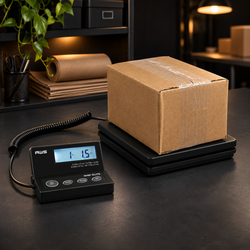
A parcel is wider than your scale's platform. You set it down, but one corner touches the counter and the box blocks the display. The number looks stable, yet moving the package slightly changes the reading. How can you weigh it without creating an unreliable arrangement?
The practical question is: How do you weigh an oversized package without letting it touch nearby surfaces?
Use equipment and an arrangement that carry the complete intended load through the platform, remain stable, preserve clearance, and stay within capacity. Overhang alone is not the same as external support, but a large box can introduce contact, position, handling, and display-access problems. An improvised workaround needs more scrutiny than a steady number.
Begin with your exact model's directions in the AWS product manuals. Confirm its intended parcel use, platform limits, accessories, display features, and verification requirements before adapting the setup.
Define oversized relative to the instrument
A box can be large in dimensions while remaining light, or compact while being heavy. Platform fit and load capacity are different questions.
Identify the parcel's complete packed configuration, approximate size, and expected gross load. Include packaging, labels, inserts, and other material that belongs to the final shipment.
Do not infer suitability from the capacity rating alone. The parcel must also fit securely enough for the intended arrangement. A scale capable of the mass can still be inappropriate if the package cannot remain stable and clear of surrounding surfaces.
The complete load needs an intended support path
A platform scale should experience the parcel's load through its designed receiving surface and measuring arrangement. Another surface carrying part of the parcel changes that relationship.
A box corner on the counter, a bag leaning against a wall, or a hand supporting an edge can reduce or alter the load seen by the instrument.
Inspect the full arrangement rather than only the visible center. A stable display does not establish that all weight reaches the platform. Correct support comes before any conclusion about accuracy.
Overhang and outside contact are different
A rigid package may extend beyond a platform while still being fully supported through it, where the instrument's instructions permit that arrangement. Overhang itself does not automatically mean another surface carries weight.
However, overhang can make balance, clearance, loading position, and handling more difficult. A flexible parcel may sag and create contact later.
Do not generalize permission from one model to another. Follow the manufacturer's intended use and limits. If the arrangement is insecure or unclear, select a larger suitable platform rather than forcing the parcel onto an unsuitable instrument.
Check underneath and around every edge
The parcel can touch a counter beneath an overhang, a wall behind the scale, a cable, or nearby packing materials. Such contact can be easy to miss from the operator's normal viewpoint.
Check clearance before recording and again if contents shift or the box settles. Loose tape, handles, or straps can also create unintended contact.
Keep the work area clear. Do not wedge the package between objects to stop movement while expecting an ordinary weight result. The arrangement should remain secure without another object supporting the load.
Flexible packaging needs particular attention
A padded mailer, bag, or soft parcel can drape around the platform. It may begin clear and later sag onto the work surface.
Use a suitable approved tray or other documented arrangement when needed. Confirm that the tray itself remains clear and within the load limit.
Do not assume that centering a soft package once guarantees continued clearance. Observe the full supported shape. If the parcel cannot remain in an appropriate arrangement, choose equipment with a more suitable receiving surface instead of holding parts of it by hand.
A blocked display can encourage bad technique
Leaning against the parcel, lifting one side, or sliding it while trying to read the screen changes the measurement arrangement.
A remote or separate display, where the model provides one, can help with visibility. A documented hold function can also have a role, but its behavior must be understood.
METTLER TOLEDO's postal and shipping scale information illustrates purpose-designed parcel-weighing equipment. Choose features around the actual workflow rather than inventing a viewing method that disturbs the load.
Hold readings need the correct sequence
A hold feature may retain a value after the parcel is removed. That value is not necessarily a current live observation of the empty platform.
Read the model's instructions for capture, indicators, clearing, and a new measurement. Do not assume every scale with a hold label behaves the same way.
An incorrectly supported parcel can still produce a held number. The function improves access to a result, not the physical validity of the setup. Establish clearance and stable support before relying on the retained indication.
Do not lift an edge to reveal the screen
Lifting or supporting part of the box changes the force passing through the platform. The resulting number can be lower or otherwise unrepresentative of the complete parcel.
Lowering it again may introduce motion and a new loading position. A quick glance during that transition is not a controlled observation.
Use the intended display method or more suitable equipment. The correct solution should preserve the complete load while making the result readable, rather than requiring the operator to alter the parcel's support.
An added riser or tray is another load
A platform accessory, vessel, or approved support arrangement contributes physical mass even when its indication is tared.
The AWS product FAQ explains common tare behavior. Follow the exact model's directions and include every supported component when checking capacity.
An accessory can also change height, stability, center of load, and clearance. Do not stack boxes or household objects beneath a parcel merely because tare can subtract a number. A calculated subtraction does not validate the mechanics of an improvised arrangement.
Tare must match the intended shipment quantity
For a finished parcel, the relevant scale observation commonly concerns the complete packed item. A tare left from a tray or earlier task can complicate that result.
Identify which accessories belong to the measurement setup and which belong to the actual parcel. Establish the appropriate baseline before loading.
Do not subtract packaging merely because it is not part of the sold product when the intended quantity is the complete shipment. The method should measure the defined parcel state, not a different net-contents quantity.
Capacity includes the parcel and every accessory
The total physical load must remain within the instrument's permitted range. A light-looking large box can still contain dense contents.
Do not determine suitability by adding the parcel until an overload warning appears. Use the documented rating and an appropriate estimate or alternative method when needed.
Impact, sideways pressure, or dropping a package onto the platform can impose unsuitable forces even when its steady mass is below capacity. Place loads through the intended normal method and seek guidance if the handling cannot be controlled.
A large parcel can shift the center of load
Contents distributed unevenly can make the center of load different from the geometric center of the box. Position matters independently of exterior dimensions.
Keep the parcel stable and use placement consistent with the model's instructions. Do not repeatedly move it until a preferred reading appears.
METTLER TOLEDO's routine testing guidance identifies eccentricity, repeatability, and sensitivity as distinct considerations. A compact central reference does not recreate every large-package loading condition.
The supporting table matters too
A scale on a soft mat, uneven counter, or flexible packing table may not have suitable support. Nearby boxes or leaning operators can change the surface.
Confirm that all intended feet are seated on a firm, level support as required. Keep cables and debris clear of the base.
Do not press the housing down while weighing. Correct the support first and prepare the instrument again. A larger package can make a weak workstation problem more visible without being the only cause.
Parcel contents can move after placement
Loose items, liquid containers, or shifting packing materials can keep the load in motion. The display may settle and change again if the parcel moves internally.
Use an appropriate packing and observation method for the actual contents. Do not shake the parcel on the scale to force a stable result.
Wait according to the model and task procedure rather than selecting a transient number. A stability indicator helps with the intended sequence but does not independently establish that the package is fully supported or unchanged.
Confirm units before comparing records
Pounds, ounces, kilograms, and grams are different expressions. A unit left from another task can produce an apparent discrepancy.
Record the original displayed value with its unit. If conversion is needed, preserve the source observation and avoid unnecessary intermediate rounding.
A shipping system may require particular entry and rounding conventions. Follow the applicable current instructions rather than assuming the raw scale display is the final billable quantity. Measurement and data entry are connected steps with different rules.
Physical mass and dimensional weight are different
A large light parcel can have a shipping calculation based partly on its dimensions. That does not mean the scale measured its physical load incorrectly.
UPS's shipping system guidance distinguishes weight, dimensions, and service details as inputs affecting shipping cost.
This article does not establish a carrier's current price, limit, or rounding policy. Use the applicable current service requirements. Keep the scale observation distinct from a calculated billing quantity so a rate difference is not misdiagnosed as an accuracy fault.
A comparison scale has its own limitations
Another instrument can disagree because of its setup, units, reference state, readability, or performance. Its larger size alone does not establish correctness.
Use a comparison arrangement suitable for the parcel, with the complete load supported as intended. Avoid transferring the same contact problem to a second scale.
NIST's discussion of combining evaluations of the same measurand addresses results with associated uncertainty and compatibility. Do not average two instruments automatically or choose the lower number. An independent suitable reference provides stronger evidence about indication agreement than a disagreement between two unverified methods.
Use adequate references for instrument checks
A reference with known value, suitable condition, and appropriate uncertainty can help assess the weighing component. An unknown parcel does not establish which scale is accurate.
The NIST mass standards program describes formal mass calibration. Select verification references and methods around the instrument and requirement.
Do not use improvised heavy combinations that cannot be handled or placed securely. If adequate reference equipment is unavailable, document the limitation and obtain an appropriate assessment rather than declaring the full range verified.
Check the actual parcel arrangement separately
A suitable reference can assess aspects of instrument performance, while a large-package trial evaluates the practical setup. Those are complementary but different questions.
Inspect clearance, display access, placement, support, and repeatability through the approved method. Preserve any change made during the investigation.
Do not assume a passing reference test authorizes every overhanging shape. The physical arrangement still needs to fit the instrument's intended use and the task's required tolerance. A stable compact weight cannot validate an unstable parcel by association.
Use a controlled weighing sequence
Follow the exact model and any applicable workplace procedure first. For ordinary suitable use, this framework organizes the key steps:
-
Define the complete parcel configuration and intended quantity.
-
Confirm the scale's capacity and physical suitability.
-
Prepare suitable support and clear the surrounding area.
-
Check units, mode, power, and the prescribed baseline.
-
Install only permitted accessories through the documented method.
-
Place the parcel securely without impact.
-
Confirm complete support through the platform and external clearance.
-
Allow the normal settling or capture sequence.
-
Record the result without touching the parcel or housing.
-
Preserve relevant observations and remove the parcel normally.
This framework does not validate an improvised riser or replace professional assessment when the arrangement exceeds the instrument's intended use.
Record useful troubleshooting observations
Note whether the value changes when the parcel shifts, whether an edge contacts the counter, and whether repeated settled results remain consistent.
A short photograph or video can show clearance and display access more clearly than a description of the box's size alone. Keep the full setup visible.
Do not document only the favorable final number. Preserve the original concern, corrected arrangement, and subsequent check. That history can help distinguish an operating improvement from an unresolved instrument problem.
A hypothetical example separates cause from appearance
Suppose a package reads 4.8 kg while one edge rests on the counter. After restoring the approved clear arrangement, it reads 5.1 kg.
The change suggests the earlier external support mattered, but the example does not establish that the final value is accurate or define an AWS tolerance.
Reference verification and the complete method still determine confidence in the result. Do not convert this example into a universal correction for overhanging parcels. The force transferred through contact depends on the actual arrangement.
Do not calibrate around a supported box
A parcel touching another surface is not an appropriate adjustment reference. Its indication depends on an unintended force path.
Correct the physical arrangement before any approved verification or adjustment. Use the reference and sequence specified by the manufacturer.
Changing sensitivity to make one box match an expected value can distort other measurements while leaving contact unresolved. If the setup cannot carry the complete parcel appropriately, choose suitable equipment rather than adjusting the instrument around the problem.
Judge performance against the actual requirement
The significance of a difference depends on the task, quantity range, permitted error, and relevant uncertainty. A display increment alone does not define acceptance.
NIST's metrological traceability guidance explains that traceability alone does not establish fitness for purpose. The method and uncertainty must suit the intended measurement need.
For decisions near an applicable boundary, use the relevant procedure and current requirements. Do not invent an unofficial allowance or assume every other operator will obtain or accept the same displayed result.
Maintain the platform and workstation
Packing residue, tape, debris, moisture, or a misplaced component can interfere with normal movement. A cluttered station can also create external contact.
Follow AWS maintenance guidance and the exact manual. Remove only user-removable parts and avoid forcing the mechanism or allowing liquid into openings.
Record unusual impact, overload, or spills. Persistent rubbing, warnings, or questionable reference results need manufacturer advice. A clean-looking surface and stable zero do not independently establish all loaded performance.
Select equipment for package dimensions and workflow
Review AWS shipping scales with the actual parcel sizes, gross loads, display access, required tolerance, and handling conditions in mind.
A larger suitable platform or intended remote display can address problems that a compact scale cannot solve conveniently. Confirm the actual model's features rather than assuming them from a category description.
Choose around the complete workflow. More capacity alone does not establish physical fit, and more decimal places do not correct external support. The best arrangement is one that can be used consistently without improvised contact.
Keep the approved setup clear for shared users
Document normal units, baseline, permitted accessories, placement, clearance checks, and the recording method.
The AWS Knowledge Center provides related weighing information. Connect that guidance to the exact workstation so users do not create different arrangements unknowingly.
Review the procedure when parcel shapes, equipment, accessories, or required tolerance changes. Earlier checks may not cover a revised setup. A clear operating method prevents convenience changes from silently undermining the measurement.
Ask support before building a workaround
Contact American Weigh Scales support when a parcel does not fit appropriately or accessory compatibility is unclear.
Provide the model, parcel dimensions, expected load, proposed arrangement, required tolerance, and observed behavior. Explain display access and any external contact.
Ask for an approved method or equipment alternative. Do not modify the platform, open the housing, or stack unsupported fixtures to create clearance. A specific application description supports a more useful recommendation.
Document the final working arrangement
After resolving a fit problem, record which parcel types and accessories the arrangement supports. Keep the conclusion tied to the observed conditions and relevant requirements.
If the scale, workstation, tray, or display method changes later, review the setup before extending the earlier conclusion. A larger box can introduce contact that a smaller verified package never created.
Keep the original concern and correction distinguishable in the record. This helps later users understand why a clearance check matters rather than treating it as an optional habit. Assign responsibility for maintaining the working area and reporting unsuitable parcels so a convenient workaround does not become an undocumented routine used beyond its assessed scope.
Frequently asked questions
Can a box extend beyond the platform?
Only where the instrument and arrangement permit it while remaining secure, within capacity, and fully supported through the intended path. Overhang is different from outside contact.
Can I hold one side while reading?
That changes the supported load. Use the intended display method or more suitable equipment.
Does a stable number prove the box is clear?
No. External support can produce a steady but unsuitable indication. Inspect the arrangement directly.
Will a tray increase capacity?
Not automatically. Include its physical load and follow the model's accessory limits.
Why does shipping software show another weight?
It may involve units, rounding, dimensions, or another calculation. Confirm the actual inputs and current applicable requirements before blaming the scale.
What if the parcel cannot fit securely?
Use a more suitable scale or approved method rather than forcing an unstable arrangement.
Preserve the load path before trusting the number
An oversized package needs suitable support, clearance, capacity, and display access. A convenient arrangement is useful only when it preserves the intended measurement.
Use approved equipment, inspect the complete setup, and verify performance with appropriate evidence. That provides a stronger basis for parcel weighing than a steady display obtained while another surface carries part of the load.