
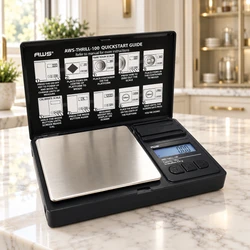
Choosing a scale for archery components requires more than finding a model that displays weight. Arrow builders may need to measure lightweight nocks and vanes, sort points and inserts, compare bare shafts, or weigh fully assembled arrows. Each task places different demands on a scale.
The right scale should provide enough resolution to reveal useful differences, enough capacity to handle your heaviest completed arrow, and enough consistency to produce repeatable results. Grain measurement, calibration, platform design, tare, portability, and operating environment also deserve consideration.
This guide explains how to choose a scale for archery components without paying for features you do not need or sacrificing the measurement performance your arrow-building process requires.
Start With What You Plan to Weigh
Begin by listing the items you expect to measure. This establishes the resolution, capacity, and platform size you need.
Common archery-related items include:
-
Field points
-
Broadheads
-
Inserts and outserts
-
Collars and bushings
-
Nocks
-
Vanes and wraps
-
Bare arrow shafts
-
Adhesive used during assembly
-
Completed hunting arrows
-
Completed target arrows
-
Small replacement hardware
A scale intended primarily for broadheads and inserts can be compact. A model intended for full-length arrows needs a platform or support arrangement that keeps the arrow balanced without allowing it to touch the workbench.
If you want one scale for both purposes, look for a precision model with a suitable capacity and plan to use a lightweight, tared arrow cradle when weighing finished arrows.
Understand Resolution Before Comparing Scales
Resolution is the smallest increment displayed by the scale. For example, a scale that changes from 100.0 grains to 100.1 grains has a resolution of 0.1 grain.
Common scale resolutions include:
-
1 gram
-
0.1 gram
-
0.01 gram
-
0.001 gram
-
1 grain
-
0.1 grain
Finer resolution makes smaller changes visible. That can be useful when comparing vanes, nocks, inserts, or closely matched finished arrows.
However, resolution is not the same as accuracy. A scale can display several decimal places without every displayed digit representing the true weight. Accuracy specifications describe how close a reading may be to the actual value under stated conditions, while repeatability describes how consistently the scale measures the same object.
When reviewing AWS precision scales, compare the capacity, readability, supported units, calibration procedure, and intended use rather than choosing solely by the number of decimal places.
Is 0.1-Grain Resolution Enough?
For many home arrow-building applications, 0.1-grain resolution provides a practical balance between detail and usability. It can reveal small differences among points, inserts, shafts, and finished arrows without requiring an extremely sensitive laboratory-style setup.
A finer resolution may be useful when comparing very light parts. However, increasingly sensitive scales can also respond more noticeably to air movement, static electricity, vibration, temperature changes, and inconsistent placement.
Choose the finest resolution that provides meaningful information for your process—not simply the smallest number advertised.
Select an Appropriate Capacity
Capacity is the maximum load the scale can safely measure. Your required capacity depends on whether you will weigh individual parts or completed arrows.
Small components usually weigh far less than a scale’s maximum capacity. Completed arrows also remain within the range of many compact scales, but you must account for any tray, fixture, or cradle placed on the platform.
For example, if an arrow weighs 500 grains and its support weighs 30 grams, the scale must physically carry both. Pressing tare hides the support’s weight on the display but does not remove that weight from the weighing mechanism.
Choose a scale with enough capacity for:
-
Your heaviest expected arrow
-
The tray or support used to hold it
-
A reasonable margin above the normal working load
Avoid buying excessive capacity if doing so forces you to accept resolution that is too coarse for small components.
Look for a Grain Measurement Mode
Archery equipment is frequently specified in grains. Field points may be labeled as 100 or 125 grains, shafts may list grains per inch, and completed-arrow weight is commonly recorded in grains.
A scale with a grain mode simplifies measurement and recordkeeping. It removes the need to convert each result from grams and reduces the risk of calculation or transcription mistakes.
The standard conversion is:
1 gram = approximately 15.432 grains
If a scale does not include grain mode, gram readings can still be converted. Nevertheless, a native grain display is more convenient when most of your records and component specifications use grains.
Confirm the scale’s supported units before purchasing. A product described as a “precision scale” does not automatically include every measurement unit.
Evaluate Repeatability
Repeatability is one of the most important qualities in an archery component scale. If the same broadhead produces noticeably different readings each time it is placed on the platform, the scale cannot reliably distinguish small component differences.
A basic repeatability test can be performed as follows:
-
Set the scale on a rigid, level surface.
-
Turn it on and allow it to stabilize.
-
Confirm that the display reads zero.
-
Place one component in the center.
-
Wait for a stable reading and record it.
-
Remove the component.
-
Wait for the display to return to zero.
-
Repeat the process several times.
Closely grouped readings indicate better repeatability. Variations may result from the scale itself, but they can also be caused by airflow, vibration, weak batteries, static electricity, dirt on the platform, or changing component placement.
Repeatability is especially important when your sorting tolerance is close to the scale’s displayed increment.
Check the Accuracy Specification
Accuracy describes how closely the scale’s result agrees with the actual value under specified conditions. Manufacturers may express accuracy as a fixed tolerance, a percentage, a number of scale divisions, or a combination of factors.
Read the complete specification rather than assuming resolution and accuracy are identical. If a scale displays 0.01 gram, that does not necessarily mean every result is accurate to exactly 0.01 gram under all conditions.
The NIST Office of Weights and Measures provides educational information concerning measurement systems, standards, and weights and measures. While home arrow building is not a commercial weighing application, basic measurement principles still help buyers evaluate scale terminology.
Choose a Scale That Can Be Calibrated
A precision scale should have a documented calibration procedure. Calibration helps establish the relationship between the load placed on the platform and the value shown on the display.
Before purchasing, determine:
-
Whether the scale supports user calibration
-
Which calibration weight is required
-
Whether the weight is included
-
Whether compatible weights are readily available
-
How the calibration process is initiated
-
Whether calibration data remains stored after power-off
Use the weight specified by the manufacturer. Coins, broadheads, field points, and household objects should not be treated as exact calibration references because their actual mass may vary.
American Weigh Scales offers calibration weights for compatible models. Always confirm the required denomination before ordering.
The current NIST Handbook 44 contains technical definitions and requirements used for commercial weighing and measuring devices. Although those rules do not turn a hobby scale into a laboratory instrument, the resource provides helpful background on concepts such as scale divisions, tolerances, and device performance.
Consider Platform Size and Shape
Platform size matters when weighing more than individual components.
A small platform can easily accommodate:
-
Nocks
-
Inserts
-
Collars
-
Field points
-
Broadheads
-
Vanes
-
Small hardware
A completed arrow is more difficult because its length causes it to extend well beyond the platform. If either end touches the bench, wall, storage bin, or your hand, part of the arrow’s weight is supported elsewhere and the reading may be incorrect.
A lightweight cradle can keep an arrow centered and elevated. Place the empty cradle on the scale, press tare, and then add the arrow. The arrow should remain stable without touching anything outside the support.
When comparing AWS pocket scales, consider whether the platform and protective cover can accommodate your components. A removable cover may also function as a useful weighing tray on certain models.
Decide Between a Pocket Scale and a Bench Scale
Choose a Pocket Scale When:
-
You primarily weigh small components
-
You need to carry the scale to a range or event
-
Storage space is limited
-
A protective cover is important
-
Battery operation is convenient
-
You want a compact scale for an arrow-building kit
A portable model such as the AWS AC PRO-200 digital pocket scale may suit component sorting and general precision work. Confirm its current specifications and measurement units to make sure they match your intended archery application.
Choose a Bench Scale When:
-
You want a larger weighing platform
-
The scale will remain in one workshop location
-
You need more capacity
-
You regularly weigh larger objects
-
Stability is more important than portability
A higher-capacity model such as the AWS 2000-gram bench scale provides more room and range, but its resolution may be coarser than that of a small precision scale.
A bench model can be suitable for completed arrows and general workshop use, while a finer pocket or milligram model may be better for extremely light components.
Determine Whether You Need a Milligram Scale
Milligram scales display very small changes in mass. They can be useful for light vanes, nocks, adhesive samples, and other small parts.
The selection of AWS milligram scales includes models designed for finer-resolution measurements. These scales generally require more careful operating conditions than coarser models.
A milligram scale may not be the right choice when:
-
Its capacity is too low for completed arrows
-
Its platform is too small for your support system
-
Your workspace has constant vibration or airflow
-
You do not need to compare extremely small differences
-
A 0.1-grain scale already provides sufficient detail
Do not assume that maximum sensitivity automatically produces the most useful arrow-building tool. The scale must still suit the object, environment, and process.
Prioritize a Tare Function
Tare allows you to place a container, tray, or arrow support on the platform and reset the display to zero. The scale then shows the net weight of the item added.
This feature is helpful for:
-
Preventing small parts from rolling
-
Holding several matching components
-
Weighing loose vanes
-
Supporting a full-length arrow
-
Measuring adhesive by difference
-
Comparing assembled and unassembled parts
Tare does not increase capacity. If a 40-gram cradle is tared, the mechanism is still carrying those 40 grams. Include the support when determining the total load.
Consider Display and Control Features
A scale used for archery components should be easy to read and operate while your attention is divided between the scale and a long arrow.
Helpful features include:
-
A backlit display
-
Large, clear digits
-
A stable-weight indicator
-
Clearly labeled buttons
-
Easy switching between grams and grains
-
Low-battery notification
-
Overload warning
-
Adjustable or appropriately timed automatic shutoff
A scale that powers off too quickly can interrupt component-sorting sessions. Conversely, automatic shutoff preserves battery life when the scale is kept in a portable toolkit.
Avoid scales with controls that can be accidentally pressed by an arrow cradle or overhanging shaft.
Account for Your Working Environment
Precision weighing requires stable conditions. Before choosing a very sensitive scale, consider where it will be used.
Air Movement
Fans, air-conditioning vents, open windows, and breathing over the platform can cause lightweight readings to fluctuate. A draft shield or calm workspace can improve stability.
Vibration
Do not place the scale on a flexible folding table, an active workbench, or the same surface as vibrating tools. A rigid table or countertop is preferable.
Temperature
Allow the scale and components to reach room conditions after bringing them in from a cold vehicle or hot garage. Rapid temperature changes may affect the readings.
Static Electricity
Carbon shafts, plastic nocks, synthetic vanes, packaging, and dry air may contribute to static. Keep unnecessary plastic away from the scale and avoid rubbing components with synthetic cloth immediately before weighing.
Cleanliness
Adhesive, dust, shaft debris, or metal particles can alter measurements and interfere with platform movement. Clean the scale according to its instructions without allowing liquid to enter the housing.
Use the Scale as Part of a Larger Inspection Process
A scale measures weight; it does not evaluate every aspect of arrow safety or performance.
When inspecting archery components, also consider:
-
Correct shaft spine
-
Shaft straightness and damage
-
Insert and outsert alignment
-
Broadhead condition
-
Point and broadhead thread engagement
-
Nock fit and condition
-
Vane adhesion
-
Manufacturer compatibility
-
Bow and arrow matching
-
Applicable competition rules
Current equipment requirements should be confirmed through organizations such as USA Archery and the World Archery rulebook.
Manufacturers’ instructions should take priority when determining whether a shaft, point, insert, or other component is suitable for your particular setup.
Match the Scale to Your Archery Application
Hunting Arrow Assembly
A scale for hunting arrows should accommodate broadheads, inserts, collars, and heavy completed arrows. Grain mode, adequate capacity, repeatability, and a secure arrow support are important.
Target Arrow Assembly
Target-arrow builders may prioritize fine resolution and close grouping across a larger set of arrows. A consistent recording process becomes especially valuable when several nearly identical shafts and components are being compared.
Youth and School Programs
Standardized programs may restrict equipment or require particular configurations. Consult the National Archery in the Schools Program for program-specific information.
A scale may assist with inventory and consistency checks, but it should not be used to justify modifications that conflict with program requirements.
Archery Shop Use
An archery shop may prefer a durable scale with a larger platform, clear display, readily available calibration weights, and enough capacity for multiple tasks.
Industry participants can find educational and business resources through the Archery Trade Association.
Create a Consistent Weighing Procedure
The scale you choose will produce more useful information when every item is measured the same way.
Use this process:
-
Place the scale on a stable, level surface.
-
Allow it to acclimate to the room.
-
Calibrate it when required.
-
Confirm zero before each measurement.
-
Center the component on the platform.
-
Keep hands and other objects away.
-
Wait for the reading to stabilize.
-
Record the result immediately.
-
Remove the component.
-
Confirm that the display returns to zero.
-
Repeat unusual measurements.
-
Use the same measurement unit throughout the project.
Assign a number to each arrow or shaft. Record its bare-shaft weight, component combination, finished weight, and any repairs. This creates a practical history that can help identify changes later.
Scale Selection Checklist
Before buying a scale for archery components, confirm the following:
-
The scale offers grain mode or convenient unit conversion
-
The resolution is fine enough for your components
-
The stated accuracy supports your intended measurements
-
The capacity covers arrows, trays, and supports
-
Readings are designed to be repeatable
-
User calibration is available
-
The required calibration weight is accessible
-
The platform works with your smallest components
-
A cradle can support completed arrows
-
The tare function is easy to use
-
The display remains visible during arrow weighing
-
The scale fits your workspace or range kit
-
Battery life and automatic shutoff meet your needs
-
The manufacturer provides clear instructions
-
The scale includes overload and low-battery indicators
Frequently Asked Questions
What type of scale is best for archery components?
A compact precision scale with grain mode, approximately 0.1-grain resolution, adequate capacity, tare, and user calibration works well for many arrow builders. The best choice depends on whether you weigh small components, completed arrows, or both.
Do I need a special archery scale?
Not necessarily. A general precision scale can be suitable if it offers the required capacity, resolution, units, repeatability, and calibration features. An arrow support may be necessary for completed shafts.
Is a kitchen scale accurate enough for arrows?
Many kitchen scales display in 1-gram increments, equivalent to roughly 15.4 grains. That may be too coarse for component sorting and close arrow matching. Some high-resolution kitchen models may work, but their actual specifications must be checked.
Can I use the scale’s cover as a tray?
Some pocket-scale covers can serve as trays, but verify the manufacturer’s instructions. Place the tray on the platform and press tare before adding components.
How often should I calibrate an archery scale?
Follow the manufacturer’s instructions. Calibration may also be appropriate after transport, a substantial temperature change, an impact, long storage, or when repeatability checks suggest a problem.
Can a scale tell me whether an arrow is safe?
No. A scale only measures weight. Arrow safety also depends on spine, structural condition, component compatibility, assembly, bow specifications, and proper inspection.
Final Thoughts
To choose a scale for archery components, begin with your actual weighing tasks. Small points and nocks require useful resolution, while completed arrows require adequate capacity and proper physical support. Grain mode, repeatability, calibration, tare, and a clear display make everyday use easier.
For many arrow builders, the best choice is a portable precision scale capable of reading tenths of a grain, paired with the correct calibration weight and a lightweight arrow cradle. More sensitive or higher-capacity scales may be appropriate for specialized needs, but neither feature should be selected without considering the tradeoffs.
Whatever scale you choose, use it on a stable surface, control environmental interference, measure every component consistently, and record your results. A disciplined process is what turns a digital scale into a useful arrow-building tool.