
Choosing a scale for watch parts starts with understanding exactly:
what you intend to weigh.
Watchmaking involves an unusually wide range of component weights.
A watchmaker may work with:
-
Tiny screws
-
Springs
-
Pins
-
Washers
-
Jewels
-
Watch hands
-
Gears
-
Crowns
-
Stems
-
Movement components
-
Complete movements
-
Cases
-
Case backs
-
Buckles
-
Clasps
-
Bracelets
-
Complete watches
-
Batches of replacement components
The scale that works well for a complete watch may not provide enough displayed detail for an extremely lightweight movement component.
Likewise, a scale designed to measure tiny screws to:
0.001g
may not have enough capacity to weigh:
a case, bracelet or complete watch.
That means you should not choose a watch-parts scale according to:
decimal places alone.
Instead, use this process:
identify the smallest component → identify the heaviest complete load → determine required readability → choose capacity → check platform size → account for trays → evaluate tare → review calibration → consider repeatability and environment → decide whether one or two scales are needed.
Quick Answer: How Do You Choose a Scale for Watch Parts?
Follow these steps:
-
List the watch parts you actually weigh.
-
Identify your lightest meaningful component.
-
Identify your heaviest complete load.
-
Decide whether you need 0.001g or 0.01g readability.
-
Choose enough maximum capacity.
-
Include tray or container weight.
-
Leave capacity headroom.
-
Check minimum usable load where specified.
-
Evaluate platform dimensions.
-
Make sure the scale has tare.
-
Review calibration requirements.
-
Check whether the calibration weight is included.
-
Consider repeatability.
-
Consider vibration, airflow and static.
-
Decide whether piece counting is useful.
-
Choose appropriate power options.
-
Decide whether portability matters.
-
Consider a two-scale setup if your weight range is unusually broad.
For many general watchmaking applications:
500g × 0.01g
is an excellent starting specification.
For tiny individual components requiring finer displayed increments:
0.001g
may be more appropriate.
American Weigh Scales provides several compact options in its Pocket Scales collection.
Step 1: List Everything You Need to Weigh
Do not begin by shopping for:
“the most precise scale.”
Begin by making:
a watch-parts list.
For example:
Tiny screw
Spring
Pin
Watch hand
Gear
Crown
Stem
Movement
Case
Bracelet
Complete watch
Your required scale specifications become much clearer once:
the working range is defined.
Step 2: Identify the Lightest Meaningful Component
Ask:
What is the lightest object whose weight I actually need to distinguish?
This is important because:
not every watchmaker needs milligram readability.
Suppose your smallest relevant component weighs approximately:
2g.
A 0.001g scale may provide:
far more displayed detail than your workflow requires.
But suppose you routinely compare:
extremely lightweight screws, springs or movement components.
Then:
0.001g readability
may be useful.
Step 3: Identify the Heaviest Complete Load
Next ask:
What is the heaviest thing that will actually sit on the scale?
This might be:
-
Complete movement
-
Case
-
Bracelet
-
Complete watch
-
Batch of parts
-
Watch plus weighing tray
Do not calculate capacity according to:
the watch part alone.
Calculate:
watch part + tray + container = complete physical load.
Step 4: Understand Readability
Readability describes:
the smallest displayed increment.
Common specifications include:
0.1g
One-tenth of a gram.
0.01g
One-hundredth of a gram.
0.001g
One-thousandth of a gram.
AWS explains these specifications further in its guide to what 500g × 0.01g means on a digital scale.
Step 5: Decide Whether You Need 0.001g
A 0.001g scale displays:
one-milligram increments.
This may be useful for:
-
Tiny screws
-
Lightweight springs
-
Small pins
-
Watch hands
-
Tiny gears
-
Jewels
-
Very small movement components
AWS's Best Milligram Scales guide compares multiple scales with 0.001g readability for fine measurement work.
Step 6: Do Not Choose 0.001g Just Because It Has More Digits
This is a common mistake.
Suppose:
Scale A = 50g × 0.001g
Scale B = 500g × 0.01g
Scale A displays:
one additional decimal place.
But suppose your complete watch weighs:
175g.
Scale A cannot weigh it.
The additional decimal place provides:
no benefit.
Step 7: Understand 0.01g Readability
A 0.01g scale displays:
hundredths of a gram.
Examples:
12.35g
37.84g
158.26g
For general watchmaking:
this is an extremely practical level of readability.
Step 8: When 0.01g Is a Strong Choice
Consider 0.01g for:
-
Crowns
-
Stems
-
Larger movement components
-
Complete movements
-
Cases
-
Case backs
-
Buckles
-
Bracelets
-
Complete watches
-
Batches of parts
For a user who wants:
one general-purpose watch scale,
500g × 0.01g can be a particularly useful combination.
Step 9: Do Not Confuse Readability With Accuracy
Suppose a scale displays:
25.347g.
That means it has:
0.001g readability.
It does not automatically mean:
the true mass is guaranteed within ±0.001g.
Measurement performance can also involve:
-
Accuracy
-
Repeatability
-
Minimum usable load
-
Calibration
-
Linearity
-
Stability
-
Environmental conditions
More decimal places do not automatically mean:
more accurate measurements.
Step 10: Choose Maximum Capacity
Once you know your readability requirement:
determine capacity.
Common precision-scale capacities include:
20g
50g
100g
500g
and higher.
The correct capacity should comfortably exceed:
your largest normal physical load.
Step 11: Include the Weighing Tray
Suppose:
Watch movement = 38g
Tray = 17g
Total physical load:
38 + 17 =
55g.
A:
50g scale
does not have enough capacity.
Even though:
the movement itself weighs only 38g.
Step 12: Understand Tare Correctly
Tare lets you:
remove the displayed weight of a container.
Example:
Place tray on scale.
Display:
15.27g
Press:
TARE.
Display:
0.00g
Add movement.
Display:
31.82g
This makes the measurement easier to read.
But:
the tray is still physically sitting on the scale.
Step 13: Tare Does Not Increase Maximum Capacity
Suppose:
Scale capacity = 50g
Tray = 15g
After taring:
the display reads zero.
But you still have only approximately:
35g
of physical capacity available.
This is particularly important when choosing:
low-capacity milligram scales.
Step 14: Leave Capacity Headroom
Avoid choosing a scale that will routinely operate:
right at maximum capacity.
Suppose your heaviest complete load is:
490g.
A:
500g scale
provides very little headroom.
A higher-capacity model may be more appropriate.
Step 15: Consider Minimum Usable Load
Maximum capacity tells you:
the upper limit.
But for tiny watch components:
the lower end matters too.
Do not assume:
0.001g readability
means every 0.001g object is necessarily an appropriate measurement load.
Review available manufacturer specifications for:
-
Minimum load
-
Accuracy
-
Repeatability
where provided.
Step 16: Check Repeatability
Repeatability matters when comparing:
tiny watch components.
Suppose the same screw produces:
0.084g
0.084g
0.084g
0.084g
across repeated measurements.
That demonstrates:
consistent displayed results under those conditions.
If measurements fluctuate considerably:
additional decimal places become less useful.
Step 17: Test Repeatability Properly
A simple test:
-
Place component on scale.
-
Allow reading to stabilize.
-
Record weight.
-
Remove component.
-
Allow scale to return to zero.
-
Replace component.
-
Record again.
-
Repeat several times.
Do not simply:
leave the object on the platform
and read the same display repeatedly.
Step 18: Choose the Right Platform Size
Capacity is not enough.
The object needs to:
fit securely.
A small platform can be excellent for:
tiny screws.
It may be awkward for:
a complete watch or bracelet.
Step 19: Platform Size for Tiny Components
For:
-
Screws
-
Springs
-
Pins
-
Gears
-
Jewels
a compact platform combined with:
a small weighing tray
can work well.
Step 20: Platform Size for Complete Movements
A movement needs enough room to:
sit securely
without contacting:
the surrounding workbench.
A larger platform is generally easier to use.
Step 21: Platform Size for Bracelets
Bracelets can:
extend beyond the weighing platform.
This is not necessarily a problem if:
the complete bracelet remains supported by the scale
and does not touch:
the surrounding table.
If part of the bracelet rests on the workbench:
the measurement will not represent the full load.
Step 22: Platform Size for Complete Watches
A complete watch should:
sit securely on the scale.
Avoid setups where:
the watch partially touches another surface.
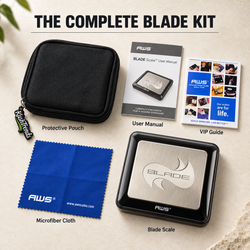
Step 23: Consider the AWS SC501g for General Watch Parts
The AWS SC501g Precision Digital Pocket Scale provides:
-
500g maximum capacity
-
0.01g readability
-
3.9 × 3.7-inch platform
-
Stainless-steel weighing surface
-
Tare
-
Two expansion trays
-
Multiple weighing units
-
Battery operation
AWS specifies:
a 500g calibration weight
for calibration,
which is not included.
For general watchmaking:
500g × 0.01g provides enough flexibility for many:
-
Movements
-
Cases
-
Bracelets
-
Complete watches
-
Component batches
while retaining:
fine hundredth-gram readability.
Step 24: Consider a Milligram Scale for Tiny Watch Parts
If your primary work involves:
very small components,
consider:
0.001g readability.
Possible capacity ranges include:
20g
50g
100g.
Step 25: 20g × 0.001g
This configuration can work for:
extremely lightweight parts.
But remember:
20g is a low maximum capacity.
If your tray weighs:
8g,
your remaining physical capacity is approximately:
12g.
Step 26: 50g × 0.001g
This provides:
more flexibility.
It can handle:
a larger tray
or:
heavier groups of tiny components
while retaining:
milligram readability.
Step 27: 100g × 0.001g
For users who need:
milligram readability
but find:
20–50g too restrictive,
100g capacity can be useful.
The tradeoff is usually:
a larger or more specialized scale format.
Step 28: GEMINI-50 for Watch Parts
AWS's GEMINI-50 provides:
50g × 0.001g.
It is designed for:
fine measurement work.
The model includes:
-
20g calibration weight
-
Tweezers
-
Weighing pan
-
Multiple units
For tiny watch components:
this configuration provides significantly finer displayed increments than:
500g × 0.01g.
Step 29: Choose Between GEMINI-20 and GEMINI-50
Both provide:
0.001g readability.
The primary difference is:
capacity.
GEMINI-20:
20g.
GEMINI-50:
50g.
For many watch-parts users:
50g offers greater flexibility.
Step 30: Consider Calibration Requirements
Before purchasing:
check exactly how the scale is calibrated.
Ask:
-
What calibration mass is required?
-
Is it included?
-
What procedure is used?
-
How easy is recalibration?
Calibration requirements differ:
by model.
Step 31: Use the Correct Calibration Mass
Do not use:
-
Coins
-
Watch batteries
-
Screws
-
Cases
-
Bracelets
-
Jewelry
-
Household objects
as substitutes for:
appropriate calibration masses.
Use:
the reference mass specified by the manufacturer.
Step 32: Do Not Confuse Calibration With Tare
Calibration:
relates scale response to a known reference mass.
Tare:
subtracts a container from the displayed measurement.
Zero:
establishes the zero reference.
These are:
different functions.
Step 33: Consider the Working Environment
A scale that performs well on:
a stable bench
may behave differently on:
an unstable surface beside a fan.
Precision measurement depends partly on:
the environment.
Step 34: Choose a Stable Workbench
Place the scale on:
a rigid, level surface.
Avoid:
-
Flexible tables
-
Soft furniture
-
Moving benches
-
Uneven counters
Step 35: Keep the Scale Off Soft Watch Mats
A watchmaker may use:
soft mats
to protect watches.
But the scale itself should ideally sit on:
a stable, rigid surface.
Do not allow the scale to:
rock or flex.
Step 36: Avoid Vibration
Possible vibration sources include:
-
Polishing equipment
-
Speakers
-
Machinery
-
Heavy footsteps
-
Unstable tables
This becomes increasingly important with:
0.001g measurements.
Step 37: Avoid Airflow
Direct airflow from:
-
Fans
-
HVAC vents
-
Open windows
can influence:
extremely lightweight measurements.
For milligram work:
keep the weighing area protected from drafts.
Step 38: Consider Static
Tiny watch parts may be affected by:
static electricity.
If a very lightweight component produces:
unstable measurements,
consider environmental factors before concluding:
the scale is defective.
Step 39: Consider Temperature Stability
Precision scales generally perform best in:
stable operating environments.
Avoid dramatic temperature changes immediately before:
fine measurements.
Step 40: Consider a Draft Shield
For 0.001g work:
a draft shield can help reduce:
air movement.
This can be particularly useful for:
tiny screws, springs and lightweight movement components.
Step 41: Consider Tare Essential
For watchmaking:
tare is one of the most useful features.
Tiny parts can:
roll or become lost.
A small tray provides:
containment.
Tare allows the scale to display:
the component weight separately.
Step 42: Consider Expansion Trays
Expansion trays are useful for:
-
Screws
-
Pins
-
Crowns
-
Springs
-
Washers
-
Gears
They can also help with:
small component batches.
Step 43: Consider Tweezers
Tiny watch components can be:
difficult to handle.
Tweezers can make it easier to:
place and remove parts
without:
touching or dropping them.
Step 44: Consider Piece Counting
If you sell or inventory:
identical watch components,
piece counting may be useful.
Examples:
100 identical screws
50 identical washers
200 identical pins
The scale estimates quantity using:
average individual piece weight.
Step 45: Know the Limits of Piece Counting
Piece counting works best when:
individual components have consistent weights.
It becomes less reliable when:
parts vary significantly.
Do not mix:
different screw sizes
and expect accurate weight-based counting.
Step 46: Consider the Display
A backlit LCD can make:
recording measurements easier.
This is particularly useful on:
watchmaking benches
where detailed visual work is already demanding.
Step 47: Consider Multiple Units
For most watch work:
grams
are straightforward.
However, scales may also offer:
-
Ounces
-
Troy ounces
-
Pennyweight
-
Carats
-
Grains
This can be useful when the same workstation handles:
jewelry or precious-metal items.
Step 48: Consider Portability
A compact scale can be useful for:
-
Traveling watchmakers
-
Dealers
-
Collectors
-
Auctions
-
Trade shows
-
Mobile repair
AWS's Pocket Scales collection provides multiple compact formats.
Step 49: Consider Power Source
Battery power is useful for:
portability.
AC power can be useful for:
permanent workstations.
If the scale will remain:
on a repair bench all day,
power options may influence convenience.
Step 50: Decide Whether One Scale Is Enough
Now combine:
your smallest and largest measurements.
Example:
Tiny screw = 0.035g
Crown = 1.75g
Movement = 31.50g
Case = 62.30g
Bracelet = 97.25g
Complete watch = 181.40g
A:
500g × 0.01g
scale can handle:
all of these physically.
But it may not provide enough displayed detail for:
the 0.035g screw.
Step 51: When One Scale Works
Suppose your normal range is:
Crown = 2.5g
Movement = 30g
Case = 60g
Watch = 170g
and you do not require:
milligram-level component comparison.
Then:
500g × 0.01g
may cover the entire workflow.
Step 52: When Two Scales Are Better
Suppose you routinely weigh:
0.025g screws
and:
200g complete watches.
A two-scale setup can provide:
better specialization.
Scale 1
50–100g × 0.001g
for:
tiny components.
Scale 2
500g × 0.01g
for:
larger components and complete watches.
Watch Parts Scale Selection Table
| What You Weigh | Readability to Consider | Capacity to Consider |
|---|---|---|
| Tiny screws | 0.001g | 20–100g |
| Springs | 0.001g | 20–100g |
| Pins | 0.001g | 20–100g |
| Hands | 0.001g | 20–100g |
| Jewels | 0.001g | 20–100g |
| Small gears | 0.001g | 20–100g |
| Crowns | 0.001–0.01g | 50–500g |
| Stems | 0.001–0.01g | 50–500g |
| Movement parts | 0.001–0.01g | 50–500g |
| Complete movements | 0.01g | 100–500g |
| Cases | 0.01g | 200–500g+ |
| Bracelets | 0.01g | 200–500g+ |
| Complete watches | 0.01g | 500g |
| Component batches | 0.01g | 500g+ |
These are:
starting points,
not universal requirements.
Choosing a Scale for Watch Screws
For extremely lightweight individual screws:
consider:
0.001g.
If you are weighing:
large batches,
capacity and piece counting may become more important.
Choosing a Scale for Watch Springs
Tiny springs can benefit from:
milligram readability.
Use:
a tray
and minimize:
airflow.
Choosing a Scale for Watch Hands
Watch hands are lightweight.
For individual comparison:
0.001g may provide useful displayed detail.
Choosing a Scale for Watch Gears
Tiny gears can be:
very lightweight.
Use:
0.001g
when fine weight comparison is required.
For larger gears:
0.01g may be sufficient.
Choosing a Scale for Watch Jewels
Individual watch jewels may require:
very fine readability.
However:
weight alone cannot identify:
the material or correct application.
Choosing a Scale for Crowns
Crowns are generally heavier than:
tiny movement screws.
Depending on your purpose:
0.01g may provide sufficient detail.
Choosing a Scale for Movements
For complete movements:
0.01g is generally more practical.
Prioritize:
-
Capacity
-
Platform size
-
Stability
-
Tare
Choosing a Scale for Cases
Cases require:
more capacity.
A:
500g × 0.01g
scale can accommodate many watch cases while maintaining:
fine displayed increments.
Choosing a Scale for Bracelets
Metal bracelets can become:
relatively heavy.
Do not sacrifice:
capacity
for:
unnecessary milligram readability.
Choosing a Scale for Complete Watches
For complete watches:
500g × 0.01g
is a strong starting specification.
Ensure:
the watch sits securely
and:
nothing touches the surrounding table.
Choosing a Scale for Watch Parts Inventory
For inventory:
consider what matters most:
individual component comparison
or:
batch weighing.
For individual tiny components:
0.001g may help.
For batches:
higher capacity can be more useful.
Choosing a Scale for a Watch Repair Shop
A repair shop handles:
a broad component range.
A practical setup may be:
500g × 0.01g general-purpose scale
plus:
50–100g × 0.001g milligram scale.
Choosing a Scale for Watch Collectors
Collectors often weigh:
complete watches.
Prioritize:
-
500g capacity
-
0.01g readability
-
Suitable platform
-
Calibration
-
Portability
Choosing a Scale for Watch Parts Sellers
Parts sellers may need:
-
Fine component measurement
-
Batch weighing
-
Piece counting
-
Inventory documentation
Depending on volume:
a two-scale setup may be useful.
Do Not Use Weight Alone to Authenticate Watch Parts
A scale measures:
mass.
It cannot independently establish:
-
Manufacturer
-
Model
-
Reference
-
Authenticity
-
Material composition
A component matching an expected weight is not automatically:
genuine.
Do Not Authenticate Complete Watches by Weight Alone
Watch weight can be:
one comparison point.
But counterfeit or modified watches can:
approximate expected weights.
Authentication may require:
-
Reference-specific dimensions
-
Movement inspection
-
Serial/reference information
-
Material analysis
-
Dial and case inspection
-
Expert evaluation
Do Not Determine Material From Weight Alone
Suppose a watch case weighs:
85g.
That alone cannot prove it is:
-
Steel
-
Gold
-
Platinum
-
Titanium
-
Another alloy
Mass without:
volume and additional material information
cannot independently determine composition.
Do Not Determine Watch Value From Weight
Watch value can depend on:
-
Brand
-
Reference
-
Rarity
-
Condition
-
Provenance
-
Originality
-
Materials
-
Market demand
Weight is:
one measurement,
not:
a valuation system.
Common Mistakes When Choosing a Scale for Watch Parts
Buying Based Only on Decimal Places
More digits are not automatically:
better.
Confusing Readability With Accuracy
0.001g readability does not automatically guarantee:
±0.001g accuracy.
Ignoring Capacity
Always calculate:
complete physical load.
Forgetting the Tray
The tray counts toward:
capacity.
Assuming Tare Restores Capacity
It does not.
Buying Exactly Enough Capacity
Leave:
headroom.
Ignoring Minimum Usable Load
The lower measurement range matters.
Ignoring Repeatability
Stable measurements matter more than:
decorative decimal places.
Ignoring Platform Size
A complete watch needs:
physical room.
Allowing the Watch to Touch the Table
The full weight must be:
supported by the scale.
Using the Wrong Calibration Weight
Follow:
the manufacturer's procedure.
Calibrating With Coins
Use:
appropriate calibration masses.
Confusing Calibration With Tare
They are:
different functions.
Putting the Scale on a Soft Surface
Use:
a rigid, stable bench.
Ignoring Vibration
Precision measurements can be affected.
Ignoring Airflow
This is especially important for:
0.001g work.
Ignoring Static
Tiny components can be sensitive to:
static effects.
Buying One Scale for an Extreme Range
Two scales may provide:
a better solution.
Using Weight as Authentication
Weight alone cannot prove:
authenticity.
Watch Parts Scale Buying Checklist
Before purchasing, ask:
-
What watch parts will I weigh?
-
What is my lightest component?
-
What is my heaviest component?
-
Will I weigh complete movements?
-
Will I weigh cases?
-
Will I weigh bracelets?
-
Will I weigh complete watches?
-
Will I weigh batches?
-
Do I need 0.001g?
-
Would 0.01g be sufficient?
-
What is maximum capacity?
-
What is minimum usable load?
-
What does my tray weigh?
-
What is the heaviest complete physical load?
-
Have I left capacity headroom?
-
What is the platform size?
-
Will a complete watch fit?
-
Will a bracelet fit without touching the table?
-
Does the scale have tare?
-
Are weighing trays included?
-
Do I need tweezers?
-
What calibration weight is required?
-
Is it included?
-
What is the calibration procedure?
-
What accuracy specifications are available?
-
What repeatability specifications are available?
-
Is my workbench rigid?
-
Is vibration present?
-
Is there direct airflow?
-
Could static affect tiny parts?
-
Would a draft shield help?
-
Is the environment temperature-stable?
-
Do I need piece counting?
-
Are the components consistent enough for piece counting?
-
Do I need multiple weighing units?
-
Do I need battery power?
-
Do I need AC power?
-
Do I need portability?
-
Do I need a protective cover?
-
Will I use the scale for inventory?
-
Will I use it for documentation?
-
Would one scale cover my complete range?
-
Would two scales be more practical?
-
Am I incorrectly treating readability as accuracy?
-
Am I incorrectly using weight as authentication?
Frequently Asked Questions
What scale should I use for watch parts?
For general watch parts:
500g × 0.01g
is a strong starting specification.
For extremely lightweight individual components:
consider:
0.001g readability.
Is 0.01g good for watch parts?
Yes, for many:
-
Crowns
-
Movements
-
Cases
-
Bracelets
-
Complete watches
-
Component batches
Do I need 0.001g for watch repair?
Not for every task.
It is most useful when weighing:
extremely lightweight components
where milligram-level displayed increments matter.
Is 0.001g more accurate than 0.01g?
Not automatically.
It provides:
finer readability.
Accuracy depends on:
the scale's specifications and operating conditions.
What does 500g × 0.01g mean?
It means:
500g maximum capacity
and:
0.01g readability.
Is 500g enough for a watch scale?
For many:
complete watches, cases, bracelets and movements,
yes.
But calculate:
your actual maximum load.
Does a tray count toward capacity?
Yes.
Everything physically supported by the weighing mechanism counts toward:
the load.
Does tare remove the tray from capacity?
No.
Tare only changes:
the displayed reference.
What scale should I use for watch screws?
For extremely lightweight individual screws:
a:
0.001g milligram scale
may be appropriate.
What scale should I use for complete watches?
A:
500g × 0.01g
scale is a practical starting point.
What scale should I use for watch movements?
For complete movements:
0.01g readability with:
100–500g capacity
is often practical.
What scale should I use for bracelets?
Prioritize:
capacity and platform size.
A:
500g × 0.01g
scale can be useful for many watch bracelets.
Is the SC501g good for watch parts?
For general watchmaking:
it provides a useful combination of:
500g capacity, 0.01g readability, a 3.9 × 3.7-inch platform, tare and expansion trays.
What scale should I use for tiny movement parts?
Consider:
20–100g × 0.001g
when milligram-level readability is genuinely needed.
Is the GEMINI-50 suitable for watch parts?
For tiny components:
it provides:
50g × 0.001g
and includes accessories useful for fine weighing.
Should I buy the GEMINI-20 or GEMINI-50?
Both provide:
0.001g readability.
The:
GEMINI-50
provides more capacity.
How should I calibrate a watch scale?
Follow:
the manufacturer's procedure
using:
the specified calibration mass.
Can I calibrate a scale with a coin?
Do not substitute:
random coins or household objects
for appropriate calibration masses.
Can I weigh a watch on a tray?
Yes.
Use:
tare
to subtract the tray from the displayed result.
Remember:
the tray still contributes to physical capacity.
Can a digital scale authenticate a watch?
No.
Weight can be one reference measurement but cannot independently prove:
authenticity.
Can a scale tell me whether a watch is gold?
No.
Mass alone cannot independently establish:
material composition.
Should a watchmaker own two scales?
If the workflow ranges from:
tiny screws
to:
complete watches,
a two-scale setup can provide much better coverage.
Final Verdict: How to Choose a Scale for Watch Parts
Choosing the right scale for watch parts begins with:
your actual working range.
First determine:
the lightest component you genuinely need to measure.
Then determine:
the heaviest complete physical load.
Remember to include:
part + tray + container.
Next choose:
readability.
For tiny:
-
Screws
-
Springs
-
Hands
-
Pins
-
Gears
-
Jewels
-
Movement components
consider:
0.001g readability
when milligram-level displayed increments are genuinely useful.
For broader watchmaking involving:
-
Crowns
-
Complete movements
-
Cases
-
Bracelets
-
Complete watches
-
Component batches
0.01g readability
provides a more practical balance with higher capacity.
For many general watchmaking applications:
500g × 0.01g
is an excellent starting configuration.
The AWS SC501g provides this combination along with:
-
3.9 × 3.7-inch platform
-
Stainless-steel weighing surface
-
Tare
-
Expansion trays
-
Multiple units
-
Battery operation
For finer work:
a 50–100g × 0.001g milligram scale
can supplement the general-purpose scale.
Before purchasing, evaluate:
readability → capacity → minimum usable load → repeatability → platform size → tray weight → tare → calibration → environmental stability → accessories.
Do not choose based on:
decimal places alone.
Do not assume:
tare restores capacity.
Do not confuse:
readability with accuracy.
Do not calibrate using:
random household objects.
And do not use:
weight alone to authenticate or value a watch.
For watchmakers whose work spans extremely tiny movement components through complete watches, the most flexible solution is often:
one 0.001g milligram scale for tiny components + one 500g × 0.01g precision scale for general watchmaking.
Choose the scale—or combination of scales—that matches:
what you actually weigh.