
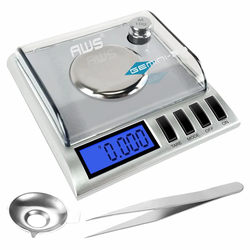
When a digital scale is labeled 500g x 0.01g, the two numbers describe its maximum capacity and readability:
-
500g is the maximum total weight the scale is designed to measure.
-
0.01g is the smallest weight increment shown on the display.
In plain language, a 500g x 0.01g scale can weigh up to 500 grams and displays results in steps of one-hundredth of a gram. A reading might appear as 24.37g, 115.08g, or 499.99g rather than only showing whole grams.
This combination is common among precision pocket scales because it balances a useful capacity with fine readability. It can be suitable for jewelry, gemstones, coins, coffee, craft materials, small components, and other lightweight objects for which a standard 1-gram kitchen scale may not provide enough detail.
However, the specification does not mean that the scale can accurately measure every quantity from exactly 0.01g through 500g, nor does it mean that every displayed digit is guaranteed to be exact in every environment. Understanding capacity, readability, minimum usable load, accuracy, and tolerance will help you choose and use the scale correctly.
Breaking Down the 500g x 0.01g Specification
Digital scale specifications often follow this format:
Maximum capacity x readability
For a 500g x 0.01g digital scale:
| Specification | Meaning |
|---|---|
| 500g | Maximum capacity of 500 grams |
| 0.01g | Display changes in increments of 0.01 gram |
| Typical display | Two digits after the decimal point in gram mode |
| Scale type | Often a precision pocket or compact tabletop scale |
| Best suited for | Small objects requiring finer detail than a standard kitchen scale |
The x does not mean ordinary multiplication. It separates the scale's capacity from its measurement increment.
What Does the 500g Capacity Mean?
The 500g capacity is the greatest total load that should be placed on the weighing platform. Five hundred grams is approximately 17.64 standard ounces or 1.10 pounds.
The capacity includes everything physically resting on the platform:
-
The item being weighed
-
A bowl, tray, cup, or other container
-
A protective sheet or weighing paper
-
Any additional objects added during measurement
The tare function can reset the visible display to zero after a container is placed on the scale, but it does not restore physical capacity.
For example, suppose you place a 125g container on a 500g scale and press tare. The display returns to 0.00g, but the load cell is still supporting 125g. Only approximately 375g of capacity remains for the contents.
If the combined load exceeds 500g, the scale may display an overload message, produce unreliable readings, or become damaged. Never press down on the platform or store heavy objects on it.
What Does 0.01g Readability Mean?
Readability, sometimes called resolution or division size in consumer descriptions, is the smallest increment displayed by the scale.
On a 0.01g scale, the reading changes in steps such as:
-
10.00g
-
10.01g
-
10.02g
-
10.03g
The scale displays hundredths of a gram. Because 0.01g equals 10 milligrams, each displayed step represents 10mg.
This is considerably finer than a typical kitchen scale that reads in 1g increments. A kitchen scale may show two objects as 10g, while a 0.01g scale might show them as 9.86g and 10.24g.
Finer readability is useful when relatively small differences matter. It also makes the scale more sensitive to drafts, vibration, temperature changes, static, and handling.
Does 0.01g Mean the Scale Is Accurate to 0.01g?
Not necessarily. Readability and accuracy are related but different.
-
Readability tells you the smallest change the display can show.
-
Accuracy describes how close the displayed result is to the true value.
-
Repeatability describes how consistently the scale shows the same result when the same item is weighed repeatedly.
-
Tolerance is the permitted measurement difference under specified conditions.
A display showing two decimal places does not, by itself, guarantee that every reading is within exactly ±0.01g of the true value. Accuracy depends on the scale's design, calibration, load range, environment, power supply, condition, and stated manufacturer specifications.
Always review the product manual or specification sheet for accuracy and tolerance information. Use a suitable calibration or check weight to verify performance.
Does a 500g x 0.01g Scale Measure as Little as 0.01g?
The 0.01g specification describes the display increment, not necessarily the minimum usable weight.
Every scale has a lower range where a tiny load may not be detected or measured with dependable repeatability. This is sometimes described as the minimum load, minimum weighing value, or recommended minimum weight. It may be greater than one displayed increment.
Therefore, a 500g x 0.01g scale should not automatically be assumed to measure a 0.01g item accurately. If you need to weigh very small quantities close to a few milligrams, a dedicated 0.001g milligram scale may be more appropriate.
Check the specific model's minimum-load and accuracy information rather than using readability alone.
How Much Is 0.01 Gram?
One-hundredth of a gram is a very small amount:
-
0.01g equals 10 milligrams.
-
0.10g equals 100 milligrams.
-
1.00g equals 1,000 milligrams.
A 0.01g scale shows 100 display divisions within a single gram. This makes it useful for comparing lightweight objects, but it also means environmental effects that are invisible on a 1g scale may appear in the final digit.
How Much Is 500 Grams?
Five hundred grams is:
-
Half of a kilogram
-
Approximately 17.64 ounces
-
Approximately 1.10 pounds
-
500,000 milligrams
This capacity is suitable for many compact items but not for heavy mixing bowls, large food batches, full shipping parcels, or objects weighing more than about one pound.
What Can You Weigh With a 500g x 0.01g Scale?
A 500g x 0.01g scale is a versatile choice for relatively small items that benefit from fine readings.
Jewelry and Gemstones
The scale can be useful for rings, chains, bracelets, loose stones, findings, and small precious-metal items. Look for carat, pennyweight, gram, or troy-ounce modes if those units are important to your work.
Weight alone cannot confirm a material's authenticity, purity, grade, or value. Professional testing may still be necessary.
Coins and Precious Metals
Collectors can use a precision scale to compare coins, rounds, small bars, and other compact objects with reference specifications. Center the item and avoid exceeding capacity.
Differences in wear, dirt, damage, and production tolerances can affect an individual coin's mass, so weight should be considered alongside other identification methods.
Coffee and Espresso
A 0.01g display provides more detail than most coffee recipes require, but it can be useful for dosing small quantities of beans or grounds. Confirm that a dosing cup or portafilter fits securely and that its weight leaves enough remaining capacity.
For pour-over brewing with a large server and water, a higher-capacity coffee or kitchen scale may be more practical.
Crafts and Hobbies
Resin additives, pigments, beads, wax, small fasteners, model-making components, and other lightweight materials can be compared precisely. Use appropriate containers and follow safety instructions for the materials involved.
Small Parts and Components
A compact precision scale can help sort, count, or verify batches of small hardware and components when used within the model's specifications. If you need automated piece counting, choose a model with a counting function and follow its sample-size requirements.
Herbs, Spices, and Recipe Ingredients
A 500g x 0.01g scale may be useful for small culinary quantities that a 1g kitchen scale rounds too heavily. Use food-safe containers and keep the scale clean and dry.
For medical dosing, medication preparation, safety-critical formulation, or regulated laboratory work, use equipment and procedures specifically approved for that application.
What Is a 500g x 0.01g Scale Not Best For?
This specification is less suitable when you need:
-
More than 500g of total capacity
-
A large platform for mixing bowls or packages
-
Reliable measurement in 0.001g increments
-
Legal-for-trade certification
-
A waterproof scale for wet environments
-
A high-capacity shipping or postal scale
-
A bathroom scale
-
Equipment approved for medical or regulated applications
The best scale is the one matched to the intended object, range, environment, and required tolerance—not simply the one with the most decimal places.
500g x 0.01g vs. Other Common Scale Specifications
500g x 0.01g vs. 500g x 0.1g
Both scales support the same maximum load, but the 0.01g model shows ten times finer increments.
-
500g x 0.01g displays 25.37g.
-
500g x 0.1g displays in tenths, such as 25.4g.
Choose 0.01g when hundredth-of-a-gram detail is genuinely useful. Choose 0.1g when slightly coarser readings are sufficient and you want a less sensitive everyday experience.
500g x 0.01g vs. 200g x 0.01g
Both display hundredths of a gram, but the 500g scale supports a heavier total load. The 200g model may be adequate for jewelry, gemstones, or very small items, while the 500g model provides more room for containers and heavier objects.
Do not assume that the higher-capacity model is more accurate. Compare the actual accuracy, minimum load, platform size, calibration requirements, and manufacturer specifications.
500g x 0.01g vs. 100g x 0.001g
The 500g scale has five times the capacity, while the 100g x 0.001g scale displays increments ten times finer.
The 0.001g model is better suited to milligram-level measurements within its usable range but is generally more sensitive to drafts, vibration, static, and temperature. The 500g x 0.01g scale is often more versatile for everyday precision tasks.
500g x 0.01g vs. 5kg x 1g
The 5kg scale has ten times the capacity but much coarser readability. It is better for kitchen bowls, food portions, and larger objects. The 500g scale is better for small objects requiring greater detail.
Many users benefit from owning both a kitchen scale and a precision pocket scale because their purposes differ.
Understanding the Capacity–Readability Tradeoff
Scale design often involves a practical tradeoff between maximum capacity and fine readability. A scale designed to measure several kilograms is not usually optimized to detect changes of one-hundredth of a gram. A scale designed to show milligrams generally supports a much smaller maximum load.
Choose based on three questions:
-
What is the lightest amount you need to measure reliably?
-
What is the heaviest combined item-and-container load?
-
How much difference between two weights actually matters for your task?
The best specification provides enough capacity with enough readability, plus a reasonable margin at both ends of the intended range.
How Many Divisions Does a 500g x 0.01g Scale Have?
Dividing capacity by readability gives the number of displayed increments across the nominal range:
500g ÷ 0.01g = 50,000 increments
That means the display can represent 50,000 steps between zero and maximum capacity in gram mode. This calculation describes resolution across the range; it does not independently establish accuracy or minimum load.
Why Does the Last Digit Keep Changing?
A 0.01g scale reveals very small changes, so the hundredth-of-a-gram digit may fluctuate if conditions are unstable.
Common causes include:
-
Airflow from fans or vents
-
Vibration from appliances or footsteps
-
An uneven or flexible surface
-
Weak batteries
-
Temperature changes
-
Static electricity
-
Material shifting inside a container
-
An off-center item
-
Dirt around the platform
-
A scale that needs calibration
Place the scale on a hard, level surface, eliminate drafts and vibration, use fresh batteries, and wait for the reading to stabilize. A small movement in the final digit does not automatically mean the scale is defective.
How to Use a 500g x 0.01g Scale Correctly
Follow these habits for more repeatable results:
-
Place the scale on a hard, flat, level surface.
-
Keep it away from fans, vents, open windows, and vibration.
-
Let it reach room temperature after transportation.
-
Turn it on with the platform completely empty.
-
Wait until the display reads 0.00g.
-
Place the item gently in the center.
-
Wait for the reading to stabilize.
-
Use tare only after the empty container stabilizes.
-
Include the container when calculating remaining capacity.
-
Never exceed 500g or press on the platform.
-
Keep the platform clean and dry.
-
Calibrate only according to the model's instructions.
For repeated comparisons, use the same location, container, item position, and procedure each time.
How Does Tare Work on a 500g Scale?
The tare function subtracts the current container weight from the displayed result.
Example:
-
Place a 75.20g bowl on the scale.
-
Press tare; the display changes to 0.00g.
-
Add 40.35g of material.
-
The display shows the net material weight of 40.35g.
The physical load is actually 115.55g, which remains well within the 500g capacity.
If the bowl weighs 460g, however, only about 40g of capacity remains even after taring. Tare does not protect the scale from overload.
How to Calibrate a 500g x 0.01g Digital Scale
Use the exact calibration weight and button sequence specified for the model. A 500g-capacity scale does not necessarily require a 500g calibration weight; it may request 100g, 200g, 500g, or another value.
General preparation includes:
-
Use a stable, level surface.
-
Eliminate drafts and vibration.
-
Install fresh batteries.
-
Let the scale reach room temperature.
-
Clean and empty the platform.
-
Enter calibration mode as directed.
-
Add the correct calibration weight only when prompted.
-
Wait for the success message before removing it.
-
Verify the result afterward with an appropriate check weight.
Do not use coins, packages, or food as precise calibration standards. Their actual mass may differ from the nominal or printed value.
How to Choose the Best 500g x 0.01g Scale
If this capacity and readability fit your needs, compare more than the headline specification.
Platform Size
Confirm that your item or container fits without touching the counter, housing, or display. An undersized platform can make an otherwise suitable capacity inconvenient.
Minimum Load and Accuracy
Review the stated minimum weight, accuracy, and tolerance. Do not infer them solely from 0.01g readability.
Weighing Units
Depending on your application, useful units may include:
-
Grams (g)
-
Ounces (oz)
-
Carats (ct)
-
Grains (gn)
-
Pennyweights (dwt)
-
Troy ounces (ozt)
Available units vary by model.
Calibration Features
Check whether user calibration is supported, which calibration weight is required, and whether a weight is included.
Display and Controls
A clear backlit display, responsive tare button, stability indicator, and easy unit conversion can improve daily use.
Protective Design
Pocket scales often include a cover that protects the load cell and platform during storage. Never use the cover in a way that touches or interferes with the platform while weighing.
Warranty and Support
Clear instructions, warranty coverage, and accessible customer support matter when you need help with calibration or troubleshooting.
American Weigh Scales offers digital pocket scales and other weighing solutions across multiple capacities and readability levels. Compare each model's full specifications to find the right balance for jewelry, coffee, crafts, coins, small components, or general precision use.
Frequently Asked Questions
Is a 500g x 0.01g scale accurate?
It can provide precise, repeatable measurements when properly designed, calibrated, and used within its specifications. The label alone does not establish exact accuracy. Review the manufacturer's stated tolerance and test the scale with an appropriate reference weight.
Can a 500g scale weigh 0.01g?
The display reads in 0.01g increments, but the minimum reliable weight may be greater than 0.01g. Check the model's minimum-load specification.
What does d = 0.01g mean?
The d generally refers to the scale division or displayed increment. d = 0.01g means the display changes in steps of 0.01 gram.
What does Max 500g mean?
It means the maximum total load is 500 grams, including any bowl, tray, or container on the platform.
Is 0.01g the same as 1mg?
No. One-hundredth of a gram equals 10 milligrams. A 0.001g increment equals 1 milligram.
Is 0.01g more precise than 0.1g?
Yes. A 0.01g display shows increments ten times smaller than a 0.1g display. Greater readability does not automatically guarantee greater accuracy.
Can I weigh more than 500g after pressing tare?
No. Tare changes the displayed value but not the physical load. The combined container and contents must stay at or below the scale's maximum capacity.
Is a 500g x 0.01g scale good for jewelry?
It can be a strong general choice for many jewelry items, provided the minimum load, accuracy, platform size, and available units fit your needs. Very small gemstones or milligram-level work may require a finer scale.
Is it good for coffee?
Yes, especially for small doses of coffee beans or grounds. Confirm that the cup or portafilter fits and that the combined load remains below 500g. Larger pour-over setups may require more capacity.
Why does the scale show 0.00g when an item is on it?
The item may be below the scale's minimum usable load, the scale may need zeroing, or the platform may not be responding correctly. Confirm the setup and use a scale designed for the required weight range.
How many decimal places does a 0.01g scale show?
In gram mode, it generally shows two digits after the decimal point, such as 12.34g.
What calibration weight does a 500g scale need?
The required weight depends on the specific model. It may not be 500g. Use the value shown during calibration or stated in the manual.
Final Answer: What 500g x 0.01g Means
A digital scale labeled 500g x 0.01g has a maximum capacity of 500 grams and displays weight in increments of 0.01 gram, or 10 milligrams.
It is often a useful precision scale for jewelry, coins, gemstones, coffee, crafts, and small components. Its capacity includes any container placed on the platform, even after tare is used. Its 0.01g readability does not automatically mean its minimum weight is 0.01g or that every reading is accurate within exactly 0.01g.
For the best choice, compare capacity, readability, minimum load, accuracy, platform size, units, and calibration requirements together. Explore American Weigh Scales to find a digital scale whose complete specifications match the objects you actually need to weigh.