
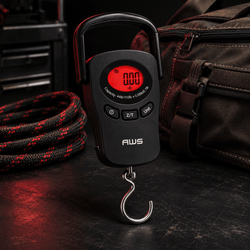
A digital scale’s maximum capacity is easy to find and compare. It tells you an important limit, but it does not answer every question about useful measurement performance. A scale that accommodates a large bowl may still be unsuitable for a tiny addition, and an unloaded zero does not establish accuracy throughout the range.
The practical question for this guide is: Is a digital scale’s maximum capacity also its useful accuracy range? No. Capacity describes the upper load limit under the instrument’s documented conditions. Suitability across a working range depends on the task, required discrimination, instrument performance, references, environment, and complete weighing method.
For American Weigh Scales users, the most useful approach is to define the smallest and largest measurements that matter, include containers and accessories, and evaluate the method where it will actually be used. This guide explains how to make that decision without inventing a universal percentage of capacity or confusing displayed digits with demonstrated capability.
Start with the measurement decision
Before comparing scales, write what the result needs to tell you. Are you checking a complete package, measuring a small ingredient, comparing a before-and-after difference, or estimating an average across several objects?
Identify the smallest quantity or difference that can change your decision. A method can produce a number while remaining unable to support the distinction required by the task.
Also define the largest physical load, including the container and supported accessories. That determines one selection boundary, while the smallest important measurement creates another question about performance.
Keep these requirements separate. Choosing solely for the heaviest load can overlook small-quantity limitations. Choosing solely for fine displayed increments can overlook capacity, platform suitability, and handling. A useful instrument and method need to address the complete task.
Understand what capacity does establish
Capacity identifies the maximum load specified for the instrument under its documented operation. Respect that limit and any additional restrictions in the model instructions.
The complete supported load counts. A bowl, tray, liner, fixture, and already added contents remain on the instrument even when tare makes the displayed value zero.
Do not exceed capacity to investigate how much extra load the scale can tolerate. An overload indication is not an invitation to continue, and normal operation afterward does not prove that an excessive load had no effect.
Find the exact requirements through the AWScales product manuals. Use the instrument’s model label and documented specifications rather than assuming a similarly named product has the same limit or tare behavior.
Separate capacity from readability
Readability is the displayed increment available in the relevant mode or range. It describes how the indication is reported, not a universal guarantee of agreement with the object’s mass.
A scale can display a small increment while having other limitations that matter to the task. Repeatability, response, placement, reference information, and environmental influences can affect the usefulness of the result.
Conversely, a display with fewer decimal places may be entirely suitable for a task whose requirements are less demanding. More digits do not automatically make a method better for every application.
Avoid multiplying capacity by a guessed percentage to derive accuracy. Likewise, do not treat one displayed increment as the correct acceptance limit for all loads. Use documented performance information and appropriate evaluation of the actual method.
Define a useful working range for the task
A useful working range is the region in which the complete method can support the intended decisions. Its limits need evidence rather than an assumption that every value below capacity is equally suitable.
Mettler Toledo’s weighing verification guidance describes evaluating a weighing range with a lower limit related to measurement performance and an upper capacity limit. The specific evaluation belongs to the instrument and application.
Do not transfer a minimum quantity from one scale to another or from one environment to another without justification. Different procedures and requirements can produce different suitability decisions.
Write the range in terms of the actual work. If your method includes a heavy container and a small addition, identify both the complete load and the net quantity being determined. A simple list of final displayed values may hide that distinction.
Understand why small quantities can be demanding
An absolute variation that is insignificant for a large quantity can be a substantial fraction of a small one. This helps explain why a scale can serve one task well while remaining unsuitable for another.
For an illustrative arithmetic example, a 0.01 g difference is one percent of 1 g but one tenth of one percent of 10 g. Those calculations do not establish the uncertainty of any scale; they show why relative requirements depend on the quantity.
A stable-looking small indication does not establish that the method resolves the intended amount reliably. Repeated placements, suitable references, and the actual conditions need attention.
If small quantities matter, evaluate them directly through an appropriate method. Do not infer capability only from a much larger reference that is convenient to place on the platform.
Do not assume a heavy tare improves small-addition accuracy
Placing a heavy bowl on the scale and pressing tare makes the next addition easier to read. It does not automatically make that small addition easier to establish accurately.
The instrument still carries the bowl, and the measurement depends on its behavior around the loaded operating point. The net quantity may be small even when the complete physical load is large.
Mettler Toledo’s precision-scale guidance distinguishes total loading from the net quantities being measured. This is useful when planning container-based work.
Use the AWScales product FAQ for general questions and the exact manual for tare operation. If the small addition is beyond the method’s demonstrated capability, repeated taring does not solve the limitation.
Check the platform and load arrangement
A load can be within capacity yet physically unsuitable for the platform. Oversized containers, flexible bags, long objects, and unstable assemblies can create contact or positioning problems.
Make sure the entire load is supported through the weighing platform. A bowl touching the countertop or a bag resting against the housing can produce an unsuitable indication even when the displayed value looks steady.
Center the relevant load consistently and keep the scale on a stable support. Do not hold the object or allow connected tools to support part of it while reading.
Capacity and platform suitability should be evaluated together. A different container or appropriate documented accessory may improve the method. An improvised platform extension can introduce new problems and should not be assumed acceptable.
Evaluate agreement using suitable references
A meaningful agreement check requires an adequate expected value. Household objects and package labels may not provide enough information to evaluate the discrepancy relevant to your task.
The NIST mass standards calibration program describes establishing mass values with associated uncertainty. Choose references that support the size of difference you need to judge.
Inspect condition and identification, follow handling instructions, and prepare references appropriately for the environment. A documented value does not eliminate contamination, damage, mix-ups, or unsuitable use.
Include relevant working loads within capacity and through an appropriate procedure. One favorable comparison establishes limited evidence at the checked condition, not universal accuracy throughout every possible load and arrangement.
Distinguish repeatability from accuracy
Repeatability concerns agreement among repeated observations under specified conditions. A scale can repeat a value closely while that value disagrees with a suitable reference.
Similarly, one reading that happens to match a reference does not establish consistent behavior. Preserve a planned sequence of observations rather than selecting the most favorable indication.
Use separate placements when evaluating placement-to-placement behavior. Watching a continuously loaded display several times answers a different question about that one loading event.
The NIST guidance on measurement terminology helps distinguish accuracy, precision, and related concepts. Keep those distinctions visible when describing the useful range rather than calling every repeated number an accuracy result.
Include the environment in the evaluation
Support, airflow, vibration, temperature changes, and sample condition can influence the method. A useful range established under one arrangement is not automatically preserved after a major change.
Prepare the instrument according to the exact manual. Keep the location stable and confirm that the platform remains clear. Record meaningful changes rather than assuming the environment stayed constant.
Follow the AWScales maintenance guidance for accessible cleaning and care. Debris or residue can affect a small-quantity method even when larger routine loads appear less troublesome.
Do not compensate for an unstable setup by inventing a narrower percentage-of-capacity rule. First improve the conditions and evaluate the method. Restricting load alone does not resolve external contact, vibration, or a changing sample.
Treat uncertainty as part of suitability
The question is whether the complete measurement can support the required decision. That requires considering limitations beyond the number of digits or a single reference comparison.
NIST’s explanation of metrological traceability distinguishes traceability from fitness for purpose. A documented reference connection does not automatically establish that uncertainty is sufficiently small for your application.
Define the relevant model, inputs, and conditions where a formal evaluation is needed. For simpler checks, be clear about the limited evidence available and avoid an unsupported quantitative claim.
Do not attach an arbitrary plus-or-minus value to make a result look complete. If the method cannot distinguish the required difference adequately, improve it, obtain suitable equipment, or seek an appropriate evaluation.
Avoid universal middle-of-range rules
Advice to use a scale only within a fixed middle portion of its capacity may sound convenient. It does not establish suitability for every model, task, and condition.
A load in the middle can still be measured poorly because of contact, incorrect references, or unsuitable preparation. A different load elsewhere may meet a particular task’s requirements when supported by evidence.
Use the manufacturer’s restrictions and an appropriate performance assessment. Do not replace them with an invented universal rule or infer undocumented capability from an informal internet recommendation.
A practical restriction can be useful when justified by the actual method and requirements. Record its basis and scope. Make clear whether it concerns total loading, net quantity, particular containers, or a specific application.
Compare total weighing with difference measurements
A task may involve determining a small change between two large readings. That is not the same as measuring one small object directly on the platform.
The difference depends on both observations and their relationship. Tare choices, container state, timing, sample changes, and instrument response can affect the interpretation.
NIST guidance on combined standard uncertainty describes combining relevant input contributions through a measurement model. Subtraction does not automatically cancel every limitation.
If your useful range is intended to cover before-and-after work, evaluate that method specifically. A favorable direct-load check does not establish the smallest difference the complete procedure can resolve.
Use a requirements worksheet before selecting equipment
A short worksheet helps connect product specifications with the actual work. Complete it before focusing on one attractive capacity or display increment.
|
Requirement |
What to record |
|---|---|
|
Heaviest physical load |
Contents, container, and all supported accessories |
|
Smallest net quantity |
Smallest addition or object requiring a decision |
|
Smallest important difference |
Change that affects the intended action |
|
Container arrangement |
Size, stability, clearance, and tare method |
|
Operating conditions |
Location, preparation, airflow, and relevant changes |
|
Required evidence |
References, checks, calibration documentation, or procedure |
|
Decision criteria |
What performance must support the task |
Keep the worksheet specific to the intended application. A scale used for several different jobs may need separate method evaluations.
Use the AWScales knowledge center to locate supporting information. Product selection should follow the requirements rather than redefining the task around a convenient specification.
Example: enough capacity but insufficient small-load evidence
Imagine a scale chosen to accommodate a large bowl and its contents. It performs suitably for a moderate ingredient quantity, so the operator assumes it can also establish a tiny final addition.
The maximum capacity answers whether the complete load is allowed. It does not independently answer whether the small net addition can be determined with the required discrimination.
A better evaluation examines the small-addition method directly, including the loaded bowl, timing, and relevant performance evidence. If that method is unsuitable, use an appropriate alternative.
Separately weighing the small ingredient may be one option when the material and task permit, but it introduces transfer considerations. Evaluate the complete delivery method rather than assuming a second instrument automatically resolves every concern.
Example: fine readability but an unsuitable container
Consider a scale selected because its display shows many decimal places. A normal work container extends beyond the platform and touches the bench during some placements.
The instrument’s readability does not resolve the external support. The indication now depends on the arrangement, making small differences difficult to interpret reliably.
A suitable container, accessory, or different platform can address the physical problem. The corrected method still needs appropriate checks against the task requirements.
For portable work, compare the AWScales pocket scale options with capacity, platform size, documented performance, and intended net quantities together. Do not select solely by the smallest number printed after the decimal point.
Record the basis of a working-range decision
Preserve the instrument identity, conditions, references, individual observations, procedure, and criteria. State what work the decision covers and what it does not establish.
Distinguish a manufacturer specification, an informal screening check, and a formal evaluation. They provide different kinds of evidence and should not be relabeled as interchangeable.
If the conclusion limits use, make that limitation clear to other operators. An unexplained note such as “use for larger amounts” is too vague when different people handle the instrument.
For unresolved model-specific questions, contact AWScales customer support with the full requirements and observed behavior. Provide total and net loads, not just a desired display increment, so the question can be assessed in its actual context.
Reassess after meaningful changes
A useful working-range decision belongs to defined conditions and a particular method. Relocation, impact, repair, container changes, and altered requirements can justify a fresh review.
A change does not automatically invalidate every earlier observation. It creates a reason to determine whether the existing evidence still supports the intended task.
Preserve before-and-after information where practical. Record what changed and repeat the relevant checks rather than performing an unrelated test that cannot be compared meaningfully.
Avoid treating a calendar date as the only trigger for attention. A new symptom or more demanding requirement may need action before the next scheduled review. Conversely, repeat evaluation should have a clear purpose rather than becoming an endless search for reassurance.
Compare specifications without mixing their meanings
When reviewing product information, keep each stated property in its own category. Capacity, displayed increment, available units, platform dimensions, and calibration instructions describe different aspects of the instrument.
Look carefully at whether a performance statement is a limit, a typical value, or information tied to specified conditions. Do not treat an unlabeled marketing phrase as a numerical guarantee. If a specification needed for the task is unavailable, identify that gap rather than filling it with an assumption.
Check whether the intended mode changes the relevant display behavior. Some equipment has features or ranges that require particular interpretation, while other models provide a simpler configuration. Use only the features actually documented for the model being evaluated.
Keep a copy of the information used for the selection decision. That helps later reviewers distinguish the product as specified from observations collected in the actual workspace.
Verify the complete workflow after selection
Selecting an apparently suitable scale is the beginning of the practical evaluation. Prepare it correctly, inspect the accessible condition, and confirm the delivered model and accessories.
Perform appropriate checks at relevant quantities, including the smallest net measurement that affects the decision. Test the real container and tare sequence, not only a compact reference placed directly on the platform.
Record the method and any unresolved limitation. If the observations do not support the intended work, revisit the setup and requirements before changing calibration. A selection error, a handling problem, and an instrument fault require different responses.
When the method is suitable, preserve the baseline and define practical checks for continued use. This turns a specification-based choice into a documented working arrangement. It also gives you a clearer way to identify meaningful changes when containers, conditions, or applications differ later.
Frequently asked questions about capacity and useful range
Can a scale weigh everything accurately below its capacity?
Capacity alone does not establish that. Suitability depends on the quantity, required decision, performance, environment, references, and method.
Does tare give me more capacity?
No. The complete supported load remains on the instrument even when the display returns to zero.
Is the smallest displayed increment the minimum useful quantity?
Not automatically. The useful lower quantity depends on demonstrated method performance and the task’s requirements, not just readability.
Should I always stay in the middle of capacity?
There is no universal percentage rule for every instrument and application. Follow documented restrictions and appropriate evidence for the actual method.
Can one scale handle both large containers and tiny additions?
Possibly, but confirm the complete requirements and performance. Maximum load capability does not by itself establish suitability for the tiny net addition.
Choose the range that the evidence supports
Define the complete physical load, smallest important quantity, and decision requirements before choosing a scale or accepting a method.
Respect capacity while evaluating readability, repeatability, agreement, container arrangement, and environmental influences separately. Use suitable references and preserve the evidence supporting the working-range decision.
When the method cannot support the task, improve the procedure, obtain appropriate equipment, or seek a suitable evaluation. Avoid filling the gap with a universal percentage rule or extra displayed digits.
A scale’s capacity is an essential limit. Its useful range for your work is a performance question that the complete measurement method must answer.