
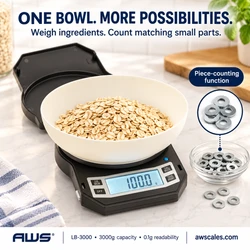
The American Weigh Scales LB-3000 is worth considering if you need more weighing capacity than a pocket scale and finer display increments than a typical whole-gram kitchen scale.
Its removable bowl, counting function and choice of battery or adapter power make it a practical candidate for a regular weighing station. It can accommodate ingredient batches and grouped components while displaying tenths of a gram.
This LB-3000 review examines published manufacturer specifications and their practical implications. It does not include independent hands-on accuracy testing.
LB-3000 Specifications at a Glance
The LB-3000 digital bowl scale has the following published specifications.
| Specification | Published detail |
|---|---|
| Maximum capacity | 3000g / 3kg |
| Readability in grams | 0.1g |
| Weighing units | g, oz, ozt and dwt |
| Specified calibration weight | 2000g, not included |
| Listed platform size | 5.3 inches |
| Body dimensions | 7.3 × 5.5 × 1.5 inches |
| Display dimensions | 0.9 × 2.4 inches |
| Power | Four AA batteries or included AC adapter |
| Accessories | Removable weighing bowl and AC adapter |
| Additional functions | Piece counting and selectable backlight |
| Protective feature | Detachable lid |
| Listed linearity | ±2d |
| Listed repeatability | ±2d |
| Operating temperature | 50°F–86°F / 10°C–30°C |
The manufacturer identifies the included bowl as dishwasher safe. Follow the care instructions supplied with your unit and keep the electronic base dry.
What Does 3000g × 0.1g Mean?
The two numbers describe different properties.
3000g is the maximum load. Everything resting on the platform contributes to that limit, including the bowl or another container.
0.1g is the readability. In gram mode, the display changes in tenths of a gram, equivalent to 100 milligrams.
For background on metric mass measurement, see NIST’s guide to mass units.
A displayed reading such as 425.7g shows the available decimal place. It does not, by itself, establish the measurement’s accuracy or uncertainty.
Include Bowl Weight in Your Capacity Planning
If a container weighs 400g, it leaves a theoretical 2600g of sample capacity.
Tare subtracts the container’s indicated weight from the display. Its physical load remains on the sensor.
Leave headroom when adding ingredients or components. If your normal combined load approaches the maximum, consider equipment with greater capacity.
How Accurate Is the LB-3000?
The listing provides more performance information than capacity and readability alone, including linearity and repeatability specifications of ±2 display divisions.
At 0.1g readability, two divisions correspond to 0.2g. These are manufacturer specifications, not measurements independently verified in this review. They should not be interpreted as a universal ±0.2g accuracy guarantee under every condition.
The following distinctions help when assessing suitability:
| Term | What it describes |
|---|---|
| Readability | The smallest displayed increment |
| Repeatability | Agreement between repeated measurements of the same object |
| Linearity | How consistently the response follows the expected relationship across the weighing range |
| Accuracy | Agreement with an appropriate reference value |
Actual results can depend on setup, load placement, environmental conditions and reference quality.
Is It Suitable for Very Small Samples?
The display increment does not establish a minimum reliable sample weight.
Do not assume a 0.1g sample can be measured with acceptable accuracy simply because the screen displays tenths of a gram. A small absolute error can represent a large percentage of a tiny sample.
For smaller quantities or tighter tolerances, evaluate equipment with appropriate readability and verified performance.
Features That Matter in Everyday Use
Removable Bowl for Loose Material
A removable bowl can simplify filling, transferring and cleaning between measurements.
It may be useful for beans, dry ingredients and groups of components that would be awkward to place directly on a flat platform.
Make sure the bowl sits securely and touches no other support. Material left inside between measurements can affect subsequent results.
Battery and Adapter Power
The choice of power source supports different workflows.
Battery operation allows weighing away from an outlet. Adapter power can be convenient at a dedicated station where the scale is used repeatedly.
Use the supplied adapter or an approved replacement specified by the manufacturer.
Selectable Display Backlight
The backlight can make readings easier to see in dim surroundings. The ability to switch it on or off offers flexibility.
Confirm both the value and selected unit before recording a result. Display visibility does not establish measurement performance.
Detachable Protective Lid
The lid helps protect the weighing surface during storage.
Avoid placing heavy objects on the scale while it is packed away. Protecting the platform from unnecessary pressure remains important.
Best Uses for the LB-3000
Baking and Ingredient Preparation
The LB-3000 is a candidate for ingredient batches when the combined container and contents fit within capacity.
Tenths-of-a-gram readability can be useful when a whole-gram display is too coarse for the intended task. Its suitability still depends on verified performance and the recipe’s tolerance.
For heavy bowls or larger batches, compare other models in the AWS kitchen scale range.
Coffee Beans and Batch Preparation
The bowl-based format may suit weighing beans for several portions or preparing larger quantities at one station.
Check the complete workflow before buying. A useful scale for weighing beans is not automatically the best choice for placing beneath brewing equipment.
Do not assume the LB-3000 includes a coffee timer or water-resistant construction unless the exact documentation confirms those features.
Small Hardware and Components
The bowl can help contain fasteners, beads and other small pieces.
The counting function may be useful for groups of similar components, provided its sampling method and performance suit the task.
Craft Materials
The capacity may accommodate modest batches of hobby materials in suitable containers.
For mixtures, follow the material supplier’s required proportions and measurement tolerance. The displayed decimal place does not establish that a very small addition has been measured reliably.
Keep containers and tools appropriate to the material being handled.
How the Piece-Counting Function Works
Counting by mass estimates quantity using the measured average mass of a sample.
The scale then uses that average to estimate how many pieces are present in the larger group. The result depends on representative sampling and consistency between pieces.
| Situation | Effect on counting suitability |
|---|---|
| Similar pieces with consistent mass | Better candidate for mass-based counting |
| Mixed components | An average piece mass may not represent the group |
| Very lightweight pieces | Measurement variability becomes more significant |
| Dirty, damaged or inconsistent pieces | Mass variation can affect the estimate |
Follow the manual’s sampling procedure. Verify estimates when exact quantities matter rather than treating a displayed count as automatically correct.
Unit Selection and Jewelry Use
The listed units include grams, ounces, troy ounces and pennyweights.
Those additional mass units may be convenient for grouped jewelry or precious-metal records. However, fine gemstone work may require different readability and performance.
For more selection criteria, consult the AWS digital scale buying guide for jewelry.
Mass alone does not establish metal purity, gemstone quality or authenticity.
Ounces and troy ounces differ. The NIST SI units reference provides background on standardized units and notation. Record the unit alongside every result.
Calibration: What You Need
The standard listing specifies a separately purchased calibration weight.
Follow the instructions for your exact model through the AWS scale manuals. The required mass should come from the procedure rather than being inferred from maximum capacity.
NIST’s calibration overview explains how instrument indications relate to reference values. Some consumer-scale procedures also adjust the instrument’s response.
Verify Performance at Typical Loads
Completing the manufacturer’s routine does not establish acceptable performance at every load.
A useful check includes:
-
Setting up the scale according to its manual.
-
Measuring suitable reference weights near your working loads.
-
Repeating measurements under consistent conditions.
-
Comparing results with your required tolerance.
-
Checking zero return after removing each load.
Keep records if consistency over time matters. NIST’s guidance on check standards describes using reference checks to monitor performance.
An AWS calibration weight kit may provide useful masses, but confirm that it includes the required weight and has specifications suitable for your checks.
A nominal weight value does not establish certified traceability. NIST’s metrological traceability guidance explains the documented calibration chain needed to relate results to a reference.
How to Get More Consistent Readings
Place the scale on a firm, level surface away from drafts and vibration.
Keep the bowl and platform clean, center the load and ensure the container touches no other support. Allow the indication to settle before recording it.
If readings fluctuate, inspect the setup and power supply before recalibrating. Calibration cannot correct an overloaded platform or a bowl partly supported by the table.
LB-3000 Advantages and Limitations
| Advantages | Limitations |
|---|---|
| Useful capacity for container-based batches | Bowl weight reduces available sample capacity |
| Finer display increments than whole-gram scales | Readability does not establish minimum reliable sample weight |
| Included removable bowl | Containers must sit securely |
| Battery and adapter operation | Larger format is less convenient for pocket carrying |
| Piece-counting function | Estimates depend on sampling and piece consistency |
| Published performance specifications | Actual performance still needs appropriate checks |
The strongest reason to consider the LB-3000 is its combination of batch capacity, bowl convenience and power flexibility.
When Another Scale Makes More Sense
Consider different equipment if you need greater capacity, a more compact carrying format or smaller display increments.
For very small samples, explore the AWS milligram scale range and compare verified performance as well as readability.
For goods sold by weight, check applicable equipment requirements. NIST’s weighing and scales FAQs provide background on commercial weighing. A calibration function and fine readability do not establish legal-for-trade approval.
Frequently Asked Questions
Is the LB-3000 accurate to 0.1g?
Its published readability is 0.1g. That increment alone does not establish a guaranteed accuracy of ±0.1g.
Does it include a bowl and adapter?
The current listing identifies both accessories. Confirm the package contents when ordering.
Can it count small parts?
It includes a counting function. Its usefulness depends on representative sampling, piece consistency and measurement performance.
Does it include a calibration weight?
The standard listing does not.
Can it weigh 3kg of ingredients after taring the bowl?
The bowl and ingredients must remain within the total capacity. Tare does not remove the bowl’s physical load.
Should You Buy the LB-3000?
The LB-3000 is worth considering for ingredient batches, grouped components and repeated container-based weighing when its readability and verified performance meet your requirements.
Calculate the full load, check container fit and define your acceptable tolerance before buying. Those requirements will show whether this bowl scale fits your work.