
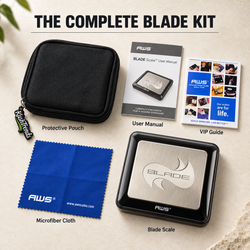
A pocket scale can be one of the most practical tools in an arrow-building kit. It can help you compare broadheads, sort inserts, check nocks and vanes, weigh bare shafts, and confirm the final weight of completed arrows. Its compact size also makes it easy to carry between a workshop, range, tournament, or hunting camp.
Choosing the right scale, however, requires balancing two specifications: capacity and resolution. A scale with excellent resolution may have limited capacity, while a high-capacity model may not display the small differences that matter when sorting lightweight components.
For many archers, the ideal pocket scale combines tenths-of-a-grain readability, sufficient capacity for a completed arrow and its support, grain measurement mode, repeatable readings, tare, and user calibration.
This guide explains what those specifications mean and how to select a pocket scale that matches your archery work.
What Can You Weigh With an Archery Pocket Scale?
A pocket scale can be used throughout the arrow-building process. Common applications include weighing:
-
Field points
-
Broadheads
-
Inserts and outserts
-
Impact collars
-
Nocks and bushings
-
Vanes and wraps
-
Bare arrow shafts
-
Cut arrow shafts
-
Small amounts of adhesive
-
Completed target arrows
-
Completed hunting arrows
-
Replacement components
The best specifications depend on which of these tasks you perform most often. A scale used only for points and broadheads does not need as much capacity as one used for fully assembled arrows. A scale used for nocks and individual vanes may benefit from finer resolution than one used only to check total arrow weight.
Before shopping, make a list of your lightest and heaviest items. This helps prevent buying a scale that offers impressive specifications but does not fit your actual workflow.
Understanding Scale Capacity
Capacity is the maximum load a scale is designed to measure. It is commonly listed in grams, ounces, grains, or another supported unit.
For archery components, capacity requirements are generally modest. Broadheads, inserts, nocks, and other individual parts weigh far less than the maximum capacity of most pocket scales. The more important question is whether the scale can handle a finished arrow plus any tray or cradle required to support it.
How Much Capacity Is Usually Enough?
A pocket scale with a capacity of approximately 100 to 500 grams can handle many arrow-building tasks. Since one gram equals approximately 15.432 grains, even a 100-gram scale has a theoretical range of more than 1,500 grains.
A typical completed arrow generally weighs much less than that. However, the scale must also support:
-
The arrow cradle or tray
-
Any adapter used to stabilize the shaft
-
The complete physical load before tare
-
A margin between normal use and maximum capacity
A scale should not be operated continuously near its stated maximum. Accidental pressure, an overloaded tray, or a dropped component can damage the weighing mechanism.
Tare Does Not Increase Capacity
Suppose a scale has a 100-gram capacity and you place a 25-gram arrow cradle on it. Pressing tare resets the display to zero, but the scale is still physically carrying 25 grams. Only 75 grams of capacity remains.
This distinction matters when using heavier homemade supports. A lightweight cradle preserves more usable range and places less stress on the scale.
When Would You Need Higher Capacity?
Consider a higher-capacity scale when:
-
You use a substantial arrow support
-
The scale will also serve general workshop purposes
-
You weigh groups of components at once
-
You need a larger platform
-
You work with equipment beyond arrows and small parts
-
You want more protection against accidental overload
A model such as the AWS 2000-gram bench scale offers more capacity and platform space than a typical pocket scale. The tradeoff is that a higher-capacity bench model may provide coarser resolution and less portability.
Understanding Scale Resolution
Resolution is the smallest change in weight that appears on the display. It may also be described as readability, graduation, or division size.
For example:
-
A scale reading to 1 grain changes in whole-grain increments.
-
A scale reading to 0.1 grain changes in one-tenth-grain increments.
-
A scale reading to 0.01 gram changes in hundredths of a gram.
-
A scale reading to 0.001 gram changes in thousandths of a gram.
Resolution determines how small a difference you can observe. It does not independently establish the scale’s accuracy.
Is 0.1-Grain Resolution Enough?
For many arrow-building tasks, 0.1-grain resolution is a practical choice. It can reveal meaningful differences among:
-
Broadheads
-
Field points
-
Inserts
-
Bare shafts
-
Component combinations
-
Completed arrows
A scale that displays whole grains may be sufficient for basic total-weight checks, but it is less useful for closely grouping components. Two parts with different actual weights can produce the same whole-grain reading because the display rounds the results.
Tenths-of-a-grain resolution provides more information without requiring the extremely controlled conditions often associated with finer laboratory-style measurements.
When Does Finer Resolution Help?
Finer resolution can be helpful when weighing:
-
Individual vanes
-
Lightweight nocks
-
Small bushings
-
Adhesive samples
-
Very light collars
-
Tiny replacement components
AWS offers milligram scales for applications requiring finer gram measurements. Before choosing one, verify that its capacity and platform size can accommodate the objects you plan to weigh.
A finer display will also respond more noticeably to airflow, static electricity, vibration, temperature changes, and handling. If your workspace cannot control those influences, the additional displayed digits may not provide more useful results.
Resolution Is Not the Same as Accuracy
This distinction is essential when comparing pocket scales.
Resolution describes the smallest displayed increment. Accuracy describes how closely a measurement agrees with the actual value. Repeatability describes how consistently the same result can be reproduced under the same conditions.
A scale might display weight to 0.01 gram while having an accuracy tolerance larger than 0.01 gram. The final digit can still be useful for comparison, but it should not automatically be interpreted as an exact statement of true weight.
The NIST Office of Weights and Measures provides educational resources concerning measurement systems and weighing principles. Home arrow building is not the same as a commercial or laboratory application, but understanding these terms makes scale comparisons more meaningful.
Choose a Scale With Grain Mode
Archery components are commonly specified in grains. A manufacturer may list a field point as 100 grains, an insert as 50 grains, or a shaft as a particular number of grains per inch.
A pocket scale with native grain mode lets you compare the displayed value directly with:
-
Component labels
-
Arrow-building records
-
Manufacturer specifications
-
Finished-arrow weight targets
-
Measurements from previous builds
If the scale only displays grams, use this conversion:
1 gram = approximately 15.432 grains
A scale reading to 0.01 gram changes in increments equivalent to approximately 0.154 grain. That may be suitable for many archery tasks, but the scale’s accuracy and repeatability still matter.
When browsing AWS pocket scales, check each product’s supported measurement units. Do not assume that every compact model includes grain mode.
Compare Capacity and Resolution Together
Capacity and resolution often involve a tradeoff. A scale designed for heavier loads may use larger divisions, while a scale designed for extremely small measurements may have a lower maximum capacity.
Use this table as a starting point:
| Primary use | Suggested capacity range | Useful resolution |
|---|---|---|
| Broadheads and field points | 100–200 g | 0.1 grain or similar |
| Inserts, collars, and nocks | 100–200 g | 0.1 grain or finer |
| Vanes and very light parts | 20–100 g | Finer than 0.1 grain may help |
| Bare arrow shafts | 100–500 g | 0.1 grain |
| Completed arrows | 100–500 g | 0.1 grain |
| General workshop weighing | 500–2,000 g | Depends on task |
These are practical ranges, not universal rules. The correct scale depends on the heaviest item, the weight of its support, and the smallest difference you need to observe.
A compact model such as the AWS AC PRO-200 digital pocket scale may suit portable component work. Buyers should verify its current capacity, graduation, units, platform dimensions, and calibration requirements before purchase.
Platform Size Matters for Completed Arrows
A pocket scale’s platform is usually large enough for points, inserts, and other small parts. A full-length arrow is more difficult because it extends beyond the platform.
The arrow must be supported entirely by the scale. If the shaft, point, or nock touches the table, wall, tool, or your hand, another surface is carrying part of the load. The displayed value may then be lower or less stable than the arrow’s actual weight.
Using an Arrow Cradle
A lightweight cradle can support the shaft above the platform:
-
Place the empty cradle on the scale.
-
Press tare.
-
Confirm that the display reads zero.
-
Position the arrow in the cradle.
-
Make sure neither end touches another object.
-
Wait for a stable reading.
-
Record the result.
-
Remove the arrow and confirm the display returns to zero.
The cradle should balance the arrow without blocking the display or pressing the scale’s buttons. It should also remain well within the scale’s capacity.
Why Repeatability Matters
When sorting components, relative consistency may be as important as the absolute value. If the same broadhead reads 100.1 grains, 100.8 grains, and 99.7 grains during three consecutive measurements, it becomes difficult to compare it with another broadhead.
Test repeatability by weighing one component several times:
-
Use the same platform location
-
Remove the component between readings
-
Let the display return to zero
-
Avoid touching the table
-
Wait for the reading to settle
-
Record every result
Closely grouped readings suggest the scale can support useful sorting. Wider variation may indicate airflow, vibration, weak batteries, dirt, static, poor placement, or a calibration problem.
A large number of displayed decimals cannot compensate for poor repeatability.
Calibration Requirements
A pocket scale used for precision comparisons should offer a documented calibration procedure. Calibration helps the scale correctly relate an applied load to the value displayed.
Use the calibration weight specified by the manufacturer. Do not substitute a coin, broadhead, or field point simply because its package lists a nominal weight. Manufacturing tolerances, wear, residue, corrosion, or damage can change the object’s actual mass.
AWS offers calibration weights for compatible scales. Confirm the required weight before ordering because different models may require different values.
The current edition of NIST Handbook 44 explains weighing-device concepts and terminology used in regulated commercial settings. Although a personal archery scale is not necessarily subject to those requirements, the resource provides useful background about device divisions, performance, and tolerances.
Calibrate your scale according to its instructions, particularly after:
-
Transportation
-
Extended storage
-
A significant temperature change
-
An impact
-
Accidental overload
-
Battery replacement when readings appear inconsistent
-
A failed repeatability check
Tare and Weighing Trays
A tare function is essential when small components require a container or a completed arrow requires a support.
Tare enables you to subtract the weight of:
-
A platform cover
-
A parts tray
-
A paper weighing boat
-
A small container
-
An arrow cradle
-
A component holder
Place the empty support on the scale and wait for the display to stabilize before pressing tare. If you remove the support afterward, the display may show a negative value. That is normal because the scale is still subtracting the stored tare amount.
Re-zero the scale before changing trays or beginning another measurement sequence.
Portability and Protective Features
A pocket scale should travel safely without placing pressure on its weighing platform.
Useful portable features include:
-
A rigid protective cover
-
Recessed buttons
-
Compact dimensions
-
Battery operation
-
Low-battery warning
-
Overload indicator
-
Locking or fitted storage case
-
Easy access to replacement batteries
-
Automatic shutoff
Do not store broadheads loose beside the scale. Sharp blades can damage the housing, platform, display, or protective cover.
Remove all items before turning the scale on. Some digital scales perform an initial zero check during startup, and weight already resting on the platform may interfere with that process.
Control Environmental Interference
Pocket scales are convenient, but their small size does not make them immune to environmental conditions.
Airflow
Fans, open windows, air vents, and breathing over the platform can affect lightweight measurements. Move the scale to a calm location and allow the display to stabilize.
Vibration
Folding tables, vehicle tailgates, active workbenches, and range benches may move more than expected. Use a rigid surface and avoid touching it while recording a reading.
Static Electricity
Plastic nocks, synthetic vanes, carbon shafts, foam cases, and packaging can generate static. Keep unnecessary synthetic material away from the scale and allow unstable readings to settle.
Temperature
Let a scale acclimate after moving it between a cold vehicle and a warm workshop. Rapid temperature changes can affect electronic measurement.
Dirt and Adhesive
Adhesive residue, dust, shaft particles, and small metal fragments can add weight or obstruct platform movement. Clean the scale carefully according to its instructions.
Weighing Different Archery Components
Broadheads and Field Points
A pocket scale can verify actual weight and help organize similar pieces into groups. Weight should not be the only inspection criterion. Examine blades, ferrules, threads, alignment, corrosion, and damage before use.
The Archery Trade Association provides broader educational and industry resources for archery businesses and participants.
Inserts and Outserts
Weigh inserts, outserts, collars, and adapters before assembly. Small variations among several front-end parts can combine into a larger difference in the completed arrow.
Shafts
Record bare-shaft weights before installing components. Shaft weight measurements do not replace spine, straightness, structural, or compatibility checks.
Nocks and Vanes
These lightweight components may benefit from finer resolution. Use a tray to prevent them from rolling or being moved by air.
Completed Arrows
Finished-arrow weight provides the most complete measurement because it includes the shaft, point system, nock, vanes, wrap, and adhesive. Assign each arrow a number and maintain a simple record for future comparison.
Scale Use and Archery Safety
A pocket scale is a measurement tool, not a complete equipment-inspection system. Two arrows with identical weight may still behave differently because of:
-
Spine variation
-
Shaft damage
-
Straightness
-
Component alignment
-
Front-of-center balance
-
Broadhead design
-
Vane condition
-
Bow tuning
-
Release consistency
Follow component and bow manufacturer instructions. Competition archers should also consult the applicable equipment rules from USA Archery and the World Archery rulebook.
Youth and school programs may have standardized equipment requirements. Refer to the National Archery in the Schools Program for its current program rules and resources.
Pocket Scale Buying Checklist
Before purchasing a pocket scale for archery components, confirm:
-
Capacity accommodates the arrow and its cradle
-
Resolution is useful for the lightest components
-
Grain mode is available
-
Accuracy specifications are clearly stated
-
Readings are designed to be repeatable
-
The scale supports user calibration
-
The required calibration weight is available
-
Tare is included
-
The platform fits points and small parts
-
A completed arrow can be safely supported
-
The display remains visible during use
-
The cover protects the platform during transport
-
Batteries are easy to replace
-
Automatic shutoff is not excessively short
-
Overload and low-battery warnings are provided
For buyers who need broader product comparisons, the complete selection of American Weigh Scales digital scales provides options across multiple capacities and resolutions.
Frequently Asked Questions
What capacity should an archery pocket scale have?
A capacity between 100 and 500 grams is sufficient for many arrow-building applications. Account for the weight of the completed arrow, tray, and arrow cradle rather than considering the arrow alone.
What resolution is best for archery components?
A resolution of 0.1 grain is practical for many points, inserts, shafts, and completed arrows. Lighter components may benefit from finer resolution when the environment and scale repeatability support it.
Can a pocket scale weigh a full-length arrow?
Yes. The arrow must be fully supported by the platform or a tared cradle without touching another surface. The combined physical load must remain within the scale’s capacity.
Is a 0.01-gram scale suitable for archery?
A 0.01-gram increment is equivalent to approximately 0.154 grain, making it suitable for many arrow-building tasks. Verify the scale’s accuracy, repeatability, capacity, and measurement modes.
Do I need grain mode?
Grain mode is strongly preferred because most archery component weights are expressed in grains. A gram-only scale can still work when measurements are converted carefully.
Can I calibrate a pocket scale with a 100-grain field point?
Use the calibration weight specified by the scale manufacturer. A field point’s nominal package weight is not a substitute for an appropriate calibration reference.
Final Thoughts
The best pocket scale for archery components balances capacity and resolution. For many archers, a model with a 100-to-500-gram capacity and 0.1-grain resolution offers a practical combination for weighing individual components and completed arrows.
Capacity must include the full physical load, including any tray or arrow cradle. Resolution should be fine enough to show differences relevant to your build without being so sensitive that normal workshop conditions make measurements difficult.
Look beyond the headline specifications. Grain mode, repeatability, calibration, tare, platform design, display visibility, and protective features all influence how well the scale performs in everyday use.
With the right scale and a consistent measurement process, you can document components, organize closely matched sets, identify unexpected changes, and add another useful layer of quality control to your arrow-building routine.