
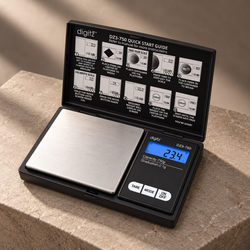
If your pocket scale gives inconsistent readings, check its setup before attempting calibration. A flexible table, moving air, poor battery contact, or a container touching the housing can affect repeated measurements.
Use a firm, level surface, control nearby disturbances, and test with an appropriate reference weight. Change one condition at a time so you can identify what helps.
Start with your model’s American Weigh Scales product manual for startup instructions, operating conditions, capacity, and performance specifications.
Quick Troubleshooting Checklist
- Confirm the selected weighing unit.
- Place the scale on a rigid, level support.
- Reduce drafts and nearby vibration.
- Check battery condition and installation.
- Remove unintended contact around the platform.
- Allow temperature differences to settle.
- Use the same loading method each time.
- Repeat measurements with a suitable reference weight.
- Consider calibration only after readings become repeatable.
1. Identify the Type of Inconsistency
Different symptoms need different checks.
| What you notice | What to investigate first |
|---|---|
| Reading moves while the load remains still | Drafts, vibration, temperature, static, or contact |
| Same object produces different settled readings | Loading method, support, or repeatability |
| Results repeat but miss a reference value | Accuracy check and possible adjustment |
| Display resets or fades | Power supply |
| Negative reading after removing a container | Stored tare |
| Tiny additions remain at zero | Small-load capability or zero tracking |
A scale can be repeatable and still read incorrectly. It can also fluctuate because of its surroundings without needing adjustment.
The AWScales product FAQ provides additional guidance for common operating symptoms.
2. Check the Surface
Place the pocket scale on a firm, level support that does not rock or flex.
Avoid weighing on:
- Upholstered furniture.
- A towel or soft cushion.
- An unstable tray.
- A folding table that moves during use.
- Your hand.
Confirm that the scale rests securely on its intended feet. If the model includes leveling adjustments, follow the manual.
NIST’s guidance on sensitive scale environments highlights sturdy support and separation from vibration and heavy foot traffic. Its Class II discussion provides useful environmental principles without implying that every pocket scale belongs to that classification. www.nist.gov
Pass condition: The support stays still while you load the scale and withdraw your hands.
3. Reduce Drafts and Vibration
Move away from open windows, ventilation outlets, fans, and running appliances.
Keep your hands and elbows off the table while waiting for the reading. If another person shares the bench, pause typing or tool use during measurements.
If your model includes a draft shield, close it as instructed. Ensure it does not touch the container or platform.
Compare results before and after changing the environment. For example, stop a nearby fan where practical, then repeat the same reference-weight measurement.
Pass condition: Readings settle without changing in response to nearby activity.
4. Check Power
Address a low-battery warning, dimming display, unexpected restart, or shutdown before further testing.
Use the specified fresh batteries and install them with the correct polarity. Replace the complete set when the model uses multiple cells.
Energizer’s battery-care guidance recommends using the manufacturer-specified battery type and avoiding mixed old and new batteries. energizer.com
For rechargeable models, follow the charging instructions. Use an external adapter only when it meets the model’s requirements.
Pass condition: The scale stays powered normally, with no battery warning or unexpected reset.
5. Check Platform Clearance and Capacity
Make sure the container and sample touch only the weighing platform.
Look for a bowl leaning against the housing, a container touching the lid, or loose material trapped around the platform.
Follow the AWScales maintenance guidance when cleaning. Do not pry beneath the weighing surface or press on it to test the mechanism.
Also check total load. The container and contents together must remain within capacity, even after taring.
Pass condition: The platform is unobstructed, and the total physical load stays within the permitted range.
6. Allow Temperature Differences to Settle
A scale moved between substantially different temperatures may need time to acclimate. Warm or cold samples can also disturb local weighing conditions.
Follow the manual’s operating range and acclimation instructions. Where appropriate for the material, allow the sample and container to approach the surrounding temperature.
NIST’s guidance on factors affecting weighing operations discusses thermal imbalance, air currents, and handling as possible error sources. www.nist.gov
Do not apply laboratory waiting periods universally to consumer scales. Use the requirements for your model.
7. Keep the Loading Method Consistent
For each measurement:
- Confirm the intended unit.
- Start from the correct zero or tare reference.
- Place the object gently in the center.
- Withdraw your hands.
- Wait for the reading to settle.
- Record the result.
Avoid comparing a settled reading with one captured immediately after placement.
Check whether the sample changes between measurements through spills, evaporation, moisture absorption, or material sticking to a container.
Shimadzu’s guide to accurate weighing emphasizes that results depend on the instrument, environment, sample, container, and procedure. shimadzu.com
8. Consider Static Electricity
Static may contribute when readings change after handling a container or behave differently with another suitable container.
These observations are clues, not confirmation. Use manufacturer-supported methods to investigate static, particularly for sensitive weighing.
METTLER TOLEDO’s guidance on electrostatic effects explains that static can cause drift or biased results, including readings that appear stable. www.mt.com
Do not spray liquids near the scale or improvise electrical connections.
9. Run a Reference-Weight Check
Use an appropriate reference weight suited to the model and load range.
| Check | Record |
|---|---|
| Empty platform | Whether the display settles at zero |
| Reference placed centrally | Settled reading |
| Reference removed | Return to zero |
| Repeated placements | Variation between results |
| Comparison with specifications | Whether performance is acceptable |
Repeat several times without changing the setup. Avoid repeatedly pressing tare to conceal a failure to return to zero.
NIST’s guide to uncertainty for balances and scales explains repeatability and other contributors to measurement performance. There is no single acceptable variation that applies to every pocket scale. nist.gov
10. Decide Whether Calibration Is Appropriate
| Result | Next action |
|---|---|
| Results repeat and meet specifications | Continue using the improved setup |
| Results repeat but consistently miss the reference | Check calibration instructions |
| Results remain scattered | Continue investigating instability |
| Scale fails to return to zero | Recheck contact and seek support |
| Only very small samples cause difficulty | Review minimum-load capability |
Follow the exact model procedure and required weight if adjustment is appropriate. The AWScales calibration guide provides general background.
Calibration does not remove drafts, stabilize a moving table, or repair damage.
Frequently Asked Questions
Does a steady display prove accuracy?
No. A steady value can still be incorrect. Compare suitable reference-weight results with the model’s specifications.
Should I average different readings?
Do not average widely scattered readings to hide an unresolved problem. Identify the cause and establish acceptable performance first.
Can tare fix inconsistency?
Tare establishes a reference. It does not remove the source of fluctuating measurements.
Does inconsistency mean I need a replacement?
Not necessarily. Check setup, power, contact, loading technique, and reference-weight performance first.
When should I contact support?
Consult the AWScales support FAQs, then contact American Weigh Scales support if the problem continues. Include the model number, reference weight, repeated readings, power source, and whether changing locations helped.